
The Cloud Kitchen Startup Dream That Attracted Thousands of Indians
Over the last few years, the idea of starting a cloud kitchen became extremely popular in India.
The business model looked attractive because people believed:
- no restaurant was needed,
- investment was low,
- food delivery apps would bring customers,
- and anyone with cooking skills could build a successful food brand.
Social media, YouTube videos, and startup influencers created a powerful narrative:
“Start a cloud kitchen startup from home and earn big money.”
Thousands of people became inspired by this idea.
Students, housewives, unemployed youth, working professionals, and families started exploring cloud kitchen businesses from their homes.
Some cloud kitchen startups became successful.
But many quietly disappeared after only a few months.
Actually once the real business challenges begin, many small cloud kitchen startups struggle to survive.
related article: How to Start Cloud Kitchen From Home in India: Legal, Practical and Step-by-Step Guide
A Real Cloud Kitchen Startup Experience
This article is also inspired by a real family experience.
A close family member decided to start a small cloud kitchen from home.
Like many first-time entrepreneurs, they were full of excitement and hope.
They:
- planned the food menu,
- bought packaging materials,
- printed labels,
- registered on Zomato with the help of a friend,
- and prepared the kitchen seriously.
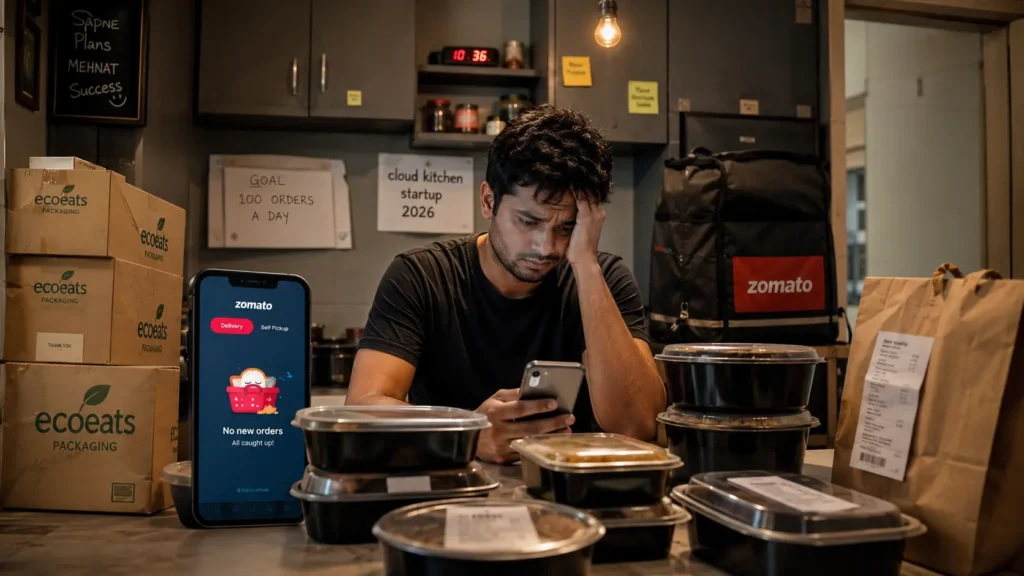
The first few food orders felt exciting.
Every notification from the delivery app created happiness.
Packing food professionally and handing it to the delivery partner felt like the beginning of a successful startup journey.
For a short time, everything looked promising.
But slowly, the situation changed.
The orders stopped coming.
Days passed with no new customers.
The kitchen remained ready, but the notifications disappeared.
Motivation slowly turned into disappointment.
Eventually, the cloud kitchen startup quietly stopped operating.
No dramatic ending.
No official announcement.
Just silence.
This is the reality many small cloud kitchen startups face in India today.
related article: How to Start a Cloud Kitchen in 2026 — A Practical, Step-by-Step Guide for New Food Entrepreneurs
Why Cloud Kitchen Business may Fail in.
1. Getting Orders Is Much More Difficult Than People Expect
One of the biggest misconceptions is:
“Once we list our cloud kitchen startup on Zomato or Swiggy, customers will automatically order.”
But the food delivery market is now overcrowded.
Customers opening delivery apps see:
- hundreds of restaurants,
- cafes,
- branded chains,
- cloud kitchens,
- and home chefs.
A new cloud kitchen startup often becomes invisible unless it:
- spends money on advertising,
- offers heavy discounts,
- gets fast customer reviews,
- or already has strong branding.
Even tasty food may fail because customers never notice the listing.
2. Competition Has Become Extremely Aggressive
The cloud kitchen industry in 2026 is very different from the early food delivery boom.
Today, the market is crowded with:
- large food brands,
- franchise chains,
- celebrity-backed kitchens,
- professionally managed dark kitchens,
- and AI-driven food startups.
Large companies dominate because they have:
- marketing teams,
- professional food photography,
- advertising budgets,
- and optimized delivery operations.
A small home-based cloud kitchen startup struggles to compete with these professionally managed businesses.
3. Zomato and Swiggy Commission Reduce Profits
Many beginners underestimate the actual business costs involved in running a cloud kitchen startup.
Food delivery platforms may deduct:
- commissions,
- GST,
- promotional costs,
- delivery charges,
- and advertising expenses.
At the same time, entrepreneurs must also manage:
- ingredients,
- packaging,
- electricity,
- cooking gas,
- and kitchen operations.
As a result, actual profits become very small.
A ₹250 order may leave surprisingly little real income after all deductions.
This becomes emotionally discouraging for many first-time entrepreneurs.
4. A Cloud Kitchen Needs Marketing Skills — Not Just Cooking Skills
One harsh reality in 2026 is:
Good food alone is no longer enough.
Modern cloud kitchen startups depend heavily on:
- digital marketing,
- branding,
- customer reviews,
- food photography,
- Instagram visibility,
- influencer marketing,
- and repeat customer strategy.
Many people know how to cook.
Very few know how to market food online.
That difference often decides which cloud kitchen startup survives.
5. Building Repeat Customers Is Extremely Difficult
A cloud kitchen startup can survive only if customers repeatedly order.
But today’s food delivery customers constantly:
- try new restaurants,
- chase discounts,
- switch between apps,
- and experiment with different cuisines.
Without customer loyalty, stable income becomes difficult.
Many cloud kitchen startups receive a few initial trial orders but fail to build a loyal customer base.
6. Rising Costs Are Hurting Small Cloud Kitchen Startups
The economic environment in 2026 has become difficult for many small businesses.
Cloud kitchen startups are now dealing with:
- rising food ingredient costs,
- expensive cooking oil,
- higher packaging prices,
- electricity bills,
- and inflation pressure.
Even basic food packaging materials cost much more than before.
Small cloud kitchen startups operating with low margins are heavily affected.
7. Emotional Burnout Is More Common Than People Realize
Running a cloud kitchen is physically and emotionally exhausting.
The entrepreneur often handles:
- cooking,
- packing,
- inventory,
- app management,
- customer complaints,
- delivery coordination,
- and business stress alone.
When hard work does not bring enough orders, frustration grows quickly.
Many entrepreneurs quietly lose confidence and stop operating.
8. Social Media Often Creates Unrealistic Expectations
Instagram and YouTube are full of:
- startup success stories,
- luxury cloud kitchens,
- viral founders,
- and “earn lakhs from home” videos.
But very few people discuss:
- failed cloud kitchens,
- financial losses,
- mental stress,
- or businesses that quietly closed.
This creates unrealistic expectations among beginners.
Is Starting a Cloud Kitchen Startup in 2026 More Difficult?
Yes — Much More Difficult Than Before
The cloud kitchen startup industry has matured rapidly.
Today, success requires:
- branding,
- customer retention,
- marketing,
- operational discipline,
- and financial patience.
Simply cooking tasty food is no longer enough.
Modern cloud kitchens are actually:
- digital businesses,
- branding businesses,
- and operational businesses.
Successful Cloud Kitchen Brands in the Last 5 Years
Despite the challenges, some cloud kitchen startups achieved major success.
1. Rebel Foods
Brands include:
- Faasos
- Behrouz Biryani
- Oven Story Pizza
Why successful:
- multiple virtual brands,
- technology-driven operations,
- strong marketing,
- and aggressive expansion.
2. Box8
Why successful:
- strong urban branding,
- efficient operations,
- and focus on repeat customers.
3. Biryani By Kilo
Why successful:
- cuisine specialization,
- premium positioning,
- and loyal customer base.
4. EatFit
Why successful:
- health-focused niche,
- subscription model,
- and urban customer targeting.
Cloud Kitchen Startup Businesses That Struggled
1. FreshMenu
FreshMenu was once considered one of India’s most promising food startups.
But reports suggested it faced:
- funding challenges,
- operational pressure,
- and intense competition.
2. Thousands of Small Independent Cloud Kitchen Startups
During the pandemic and food delivery boom, thousands of home-based kitchens launched across India.
Many later shut down because of:
- low orders,
- rising competition,
- unsustainable margins,
- and lack of visibility.
Most of these failures never became public news.
Important Lessons Before Starting a Cloud Kitchen Startup
The biggest lesson is:
A cloud kitchen startup is not an “easy business.”
Entrepreneurs should understand:
- customer acquisition is expensive,
- visibility is difficult,
- competition is intense,
- and patience is necessary.
Success usually comes slowly.
Final Thoughts
The dream of building a successful cloud kitchen startup still attracts thousands of Indian entrepreneurs.
For many families, it represents:
- independence,
- creativity,
- and hope for a better future.
But the reality in 2026 is much harsher than social media often shows.
Today’s cloud kitchen startup ecosystem is highly competitive where:
- visibility is expensive,
- customer loyalty is fragile,
- and profit margins are thin.
Many small cloud kitchen startups quietly disappear after losing motivation due to low orders and rising costs.
Still, some entrepreneurs succeed.
Usually, they succeed because they:
- stay patient,
- understand digital marketing,
- control costs carefully,
- and slowly build customer trust.
The opportunity still exists.
But the business is no longer easy.
FAQ
Why do cloud kitchen startup businesses fail?
Cloud kitchen startups often fail because of low visibility, intense competition, rising costs, weak marketing, and inconsistent customer orders.
Is cloud kitchen startup business profitable in India?
It can be profitable, but success now requires branding, digital marketing, operational management, and repeat customers.
Is it difficult to get orders on Zomato and Swiggy?
Yes. Competition is extremely high, especially for new cloud kitchen startups.
Can a home-based cloud kitchen startup succeed?
Yes, but scaling and maintaining consistent customer orders is challenging.
What is the biggest challenge for a cloud kitchen startup?
Customer acquisition and repeat customer retention are among the biggest challenges.
AI Disclaimer
This article combines practical business analysis, publicly available industry observations, and personal experience-based insights with AI-assisted research and drafting support. Business results may vary depending on location, execution, market conditions, and customer demand.
About the Author
Business Zindagi Editorial Team
Business Zindagi publishes practical and reality-based content on startups, MSMEs, entrepreneurship, finance, and business trends to help entrepreneurs understand both opportunities and risks in modern business ecosystems.
Authentic Sources & References
- Zomato Official Website
- Swiggy Official Website
- Rebel Foods Official Website
- Box8 Official Website
- Biryani By Kilo Official Website
- EatFit Official Website
- FreshMenu Official Website
- Restaurant India Cloud Kitchen Reports
- Inc42 Startup Reports
- YourStory Startup News