Every day, India generates thousands of tonnes of plastic waste.
Some of it ends up:
- in rivers,
- drains,
- landfills,
- or burnt openly in the environment.
At the same time, the world is struggling with another major challenge — the rising energy crisis.
Fuel prices continue to fluctuate globally because of:
- geopolitical tensions,
- increasing energy demand,
- fossil fuel dependency,
- and supply chain disruptions.
Now imagine if we can turn waste Plastic Into Fuel for our use.
Sounds unbelievable?
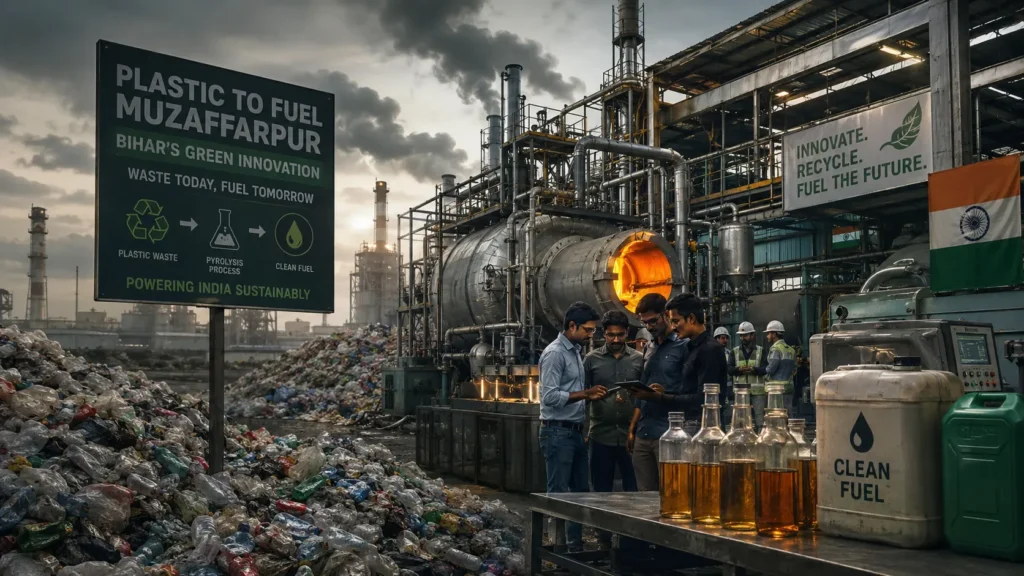
Yet this is exactly the idea attracting attention in parts of India, including a much-discussed plastic-to-fuel unit in Muzaffarpur, Bihar.
For entrepreneurs, MSMEs, recycling startups, and sustainability-focused businesses, this raises a fascinating question:
Can plastic waste become a real business opportunity in the future?
Let us understand the reality behind the growing “plastic into fuel” business trend in India.
What is Plastic Into Fuel Technology?
Plastic-to-fuel technology is a process where certain types of plastic waste are converted into usable fuel products.
The process generally uses a technology called pyrolysis.
In simple words:
- waste plastic is heated at very high temperatures,
- in the absence of oxygen,
- which breaks down the plastic molecules,
- producing fuel oil, diesel-like liquid, gas, and carbon residue.
Instead of letting plastic pollute the environment, the idea is to extract energy from it.
This is why many people see it as a possible solution to two problems at once:
- plastic waste management,
- alternative fuel generation.
Why the World is Suddenly Interested in Plastic Into Fuel business.
The global energy situation has become increasingly uncertain in recent years.
Countries across the world are facing:
- rising crude oil prices,
- fuel shortages,
- increasing electricity demand,
- and pressure to reduce environmental pollution.
At the same time, plastic waste continues to grow rapidly.
According to global environmental estimates, millions of tonnes of plastic waste enter ecosystems every year. Many governments are now exploring:
- recycling technologies,
- waste-to-energy systems,
- and alternative fuel innovations.
This is where plastic-to-fuel technologies are gaining attention.
Although still developing, the concept fits into the broader global push toward:
- circular economy,
- sustainability,
- waste reduction,
- and energy innovation.
The Bihar’s Plastic Into Fuel Startup That Sparked Attention
One of the most talked-about examples of Plastic Into Fuel in India came from Muzaffarpur, Bihar.
Reports and startup discussions highlighted a plastic-to-fuel unit developed by local innovators associated with Gravity Agro & Energy in Muzaffarpur. The project reportedly explored converting plastic waste into diesel and petrol-like fuel products using pyrolysis-based processes.
According to multiple reports:
- the plant used waste plastic as raw material,
- the technology attracted attention from local authorities,
- and discussions even reached national-level institutions.
Some reports claimed:
- around 200 kilograms of plastic waste could produce significant quantities of fuel,
- and locally sourced plastic waste was being purchased for processing.
The project generated curiosity because it connected:
- recycling,
- local entrepreneurship,
- and fuel production together.
For many MSME observers, it showed how unconventional startup ideas are emerging even from smaller Indian cities like Muzaffarpur.
Why Plastic Into Fuel Matters for India
India faces a unique combination of challenges:
- huge plastic waste generation,
- growing fuel demand,
- rising urbanization,
- and increasing environmental pressure.
This is why waste-to-energy technologies attract interest.
If such technologies become commercially viable at scale, they could potentially help:
- reduce plastic pollution,
- support local recycling ecosystems,
- create MSME opportunities,
- and generate alternative industrial fuel sources.
For a country heavily dependent on imported crude oil, even small innovations in alternative fuel systems are closely watched.
Can Plastic Into Fuel Become a Real MSME Business?
This is where the topic becomes extremely interesting for entrepreneurs.
The plastic-to-fuel sector combines:
- recycling,
- manufacturing,
- waste management,
- and energy production.
Potential business opportunities may include:
- industrial fuel supply,
- waste collection partnerships,
- municipal waste contracts,
- recycling services,
- and fuel processing operations.
As sustainability industries grow globally, many startups are exploring whether small or medium-scale plastic pyrolysis plants can become commercially viable.
For MSMEs, the attraction is obvious:
converting low-value waste into potentially higher-value fuel products.
But Here’s the Reality Most People Ignore
The business sounds exciting on social media.
But the reality is far more complex.
Plastic-to-fuel operations involve serious challenges:
- expensive machinery,
- pollution control requirements,
- safety risks,
- fuel quality testing,
- licensing issues,
- and regulatory approvals.
Many small entrepreneurs underestimate:
- technical complexity,
- operational costs,
- and environmental compliance requirements.
This is not a “simple startup” business.
Experts often warn that poorly managed plastic pyrolysis operations can create environmental and safety concerns if proper standards are not followed.
So while the concept is promising, execution matters enormously.
Is Plastic Into Fuel Actually Profitable?
Profitability depends on several factors:
- machinery cost,
- fuel recovery efficiency,
- electricity consumption,
- waste plastic availability,
- transportation costs,
- and government regulations.
Larger professionally managed plants may perform better than very small operations.
Some reports suggest that fuel recovery from plastic waste can be commercially attractive under the right conditions, but long-term sustainability still depends heavily on:
- technology quality,
- environmental compliance,
- and market economics.
In simple words:
the business has potential, but it is still considered high-risk and technology-dependent.
Why Startups and Governments Are Watching This Sector Closely
Globally, countries are trying to find alternatives to traditional fossil fuel dependency.
Because of this, waste-to-energy systems are receiving increasing attention.
Plastic-to-fuel technology fits into larger conversations around:
- clean energy transition,
- recycling innovation,
- sustainable manufacturing,
- and circular economy models.
Even if the technology does not completely replace traditional fuels, it may still become useful for:
- industrial heating,
- localized fuel generation,
- and specialized recycling ecosystems.
This is why both entrepreneurs and policymakers continue monitoring the sector closely.
Could Plastic-to-Fuel Become Bigger in India?
Possibly — but carefully.
India’s growing focus on:
- sustainability,
- recycling,
- local manufacturing,
- and MSME innovation
creates a favorable environment for experimentation.
However, long-term success will depend on:
- environmental safety,
- commercial viability,
- regulatory clarity,
- and technological improvements.
The sector remains promising, but still evolving.
Final Thoughts
The idea of converting plastic waste into fuel sounds almost futuristic.
Yet projects like the one discussed in Muzaffarpur, Bihar show that Indian innovators are actively experimenting with unconventional solutions to modern environmental and energy challenges.
For entrepreneurs, the plastic-to-fuel sector represents something bigger than just another startup idea.
It reflects a growing global reality:
future businesses may increasingly focus on solving environmental problems while creating economic opportunities.
However, this is not a shortcut business model.
The sector requires:
- technology,
- investment,
- compliance,
- and long-term operational discipline.
For serious innovators and sustainability-focused entrepreneurs, though, plastic-to-fuel may become one of the most interesting emerging industries to watch in the coming years.
Authentic Sources & References
- Navbharat Times Report on Muzaffarpur Plastic-to-Fuel Unit
- Jagran Report on Bihar Plastic-to-Fuel Innovation
- Live Hindustan Report on Muzaffarpur Startup
- Ministry of MSME, Government of India
- Central Pollution Control Board (CPCB)
About the Author
Tabrez Khan is the founder and writer behind Business Zindagi, a platform focused on MSMEs, startups, entrepreneurship, government schemes, business finance, and practical business awareness for Indian entrepreneurs.
He regularly writes about:
- startup opportunities,
- MSME trends,
- government business schemes,
- sustainability-focused businesses,
- and practical challenges faced by Indian entrepreneurs.
His writing style focuses on simplifying complex business and economic topics into practical and engaging insights for everyday readers.
AI Transparency Disclaimer
This article was created with research support and AI-assisted drafting, followed by human editing and contextual improvements for readers of Business Zindagi.