
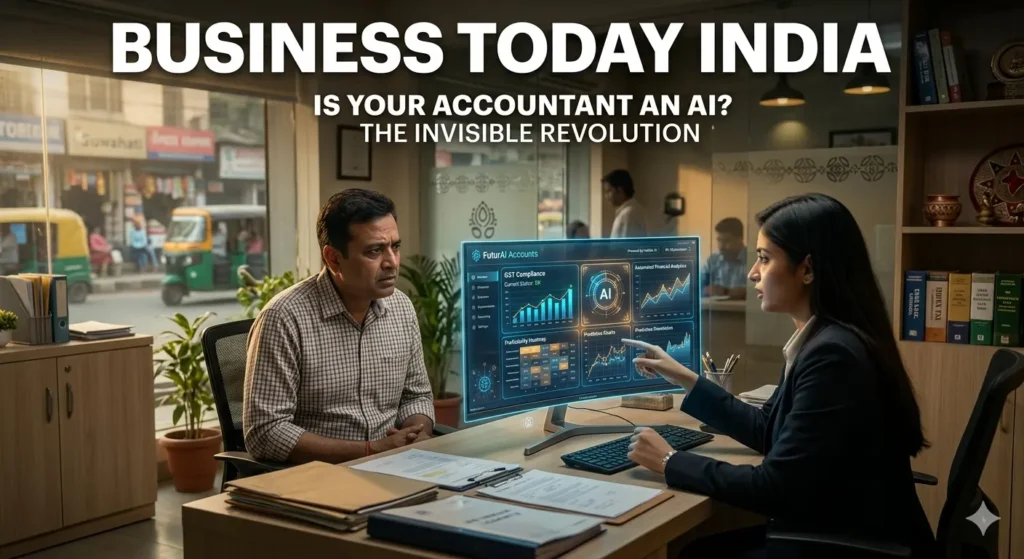
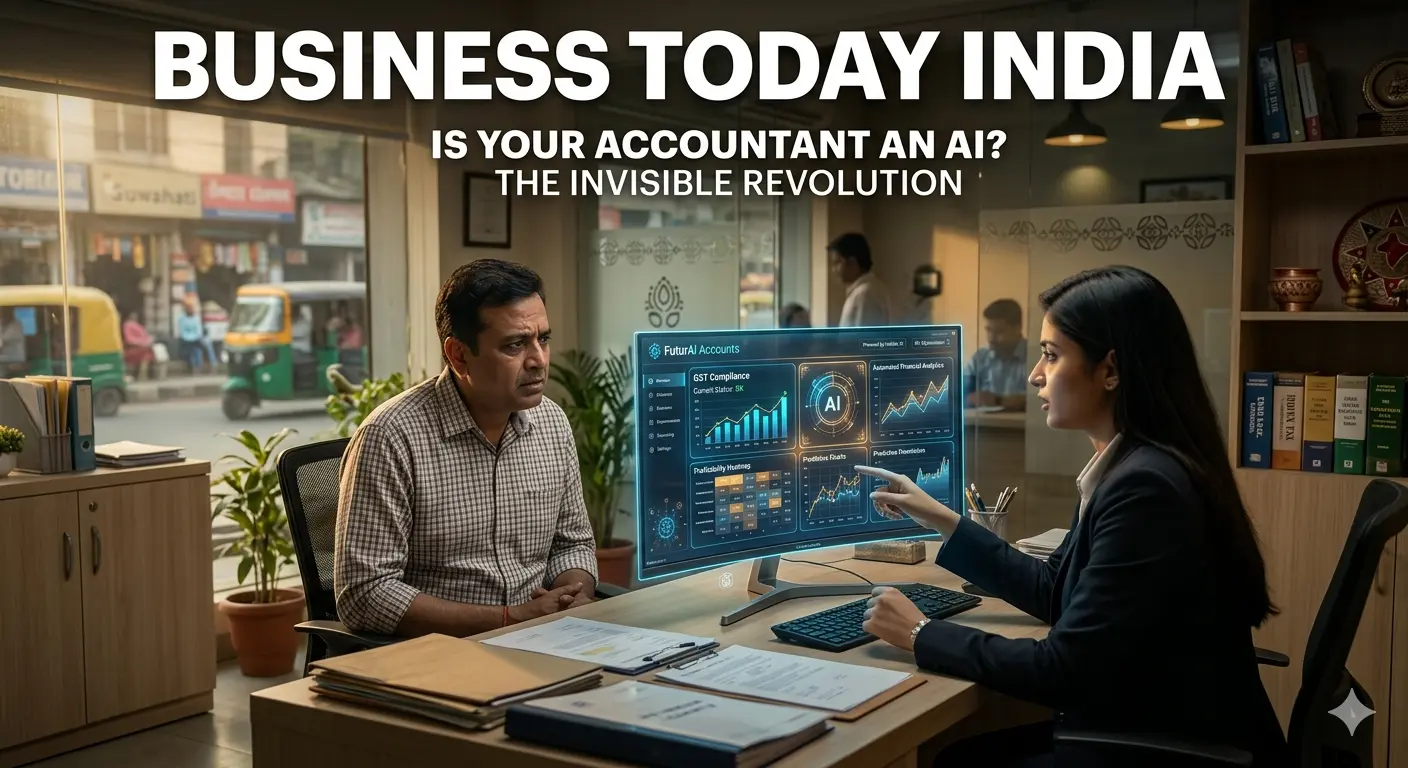
AI accountancy is quietly entering Indian businesses faster than most MSME owners realise.
A small businessman may think his accountant is still doing everything manually:
- bookkeeping
- GST filing
- invoice matching
- payroll
- reconciliation
But behind the scenes, many accountants are increasingly using:
- AI accountancy software
- automated GST systems
- smart bookkeeping tools
- AI invoice scanners
- automated payroll systems
And in many cases, the business owner has absolutely no idea.
India’s accounting industry is slowly transforming through artificial intelligence and automation. The change is not dramatic like science-fiction movies. Instead, it is happening silently inside:
- CA offices
- accounting firms
- GST software
- payroll systems
- banking integrations
For MSMEs, traders and startups, this raises important questions:
- Is AI accountancy safe?
- Can AI accounting make mistakes?
- Should accountants disclose AI usage?
- Can businessmen detect AI accounting errors?
- Is AI replacing accountants in India?
Let us understand the hidden reality of AI accountancy in Indian MSMEs.
you may also like to read: Accounting for Small Business: Best Online and Offline Accounting Solutions for MSMEs and Startups in India & Worldwide
What Is AI Accountancy?
It refers to the use of:
- artificial intelligence
- automation
- machine learning
- smart accounting software
to perform accounting-related tasks.
Instead of manual data entry, AI accountancy systems can:
- scan invoices
- categorize expenses
- reconcile bank transactions
- automate GST matching
- process payroll
- generate reports
Many businesses are already indirectly using AI accountancy without realising it.
AI Accountancy Has Already Quietly Entered Indian MSMEs
Most MSME owners still imagine accounting as:
- ledgers
- spreadsheets
- calculators
- manual bookkeeping
But modern accounting software increasingly includes AI accountancy features.
Today Artificial accountancy is quietly helping businesses manage:
- GST returns
- invoices
- payroll
- financial reports
- bank reconciliation
without many businessmen even noticing.
This is the real practical transformation happening in India.
Why Most Business Owners Do Not Know that AI Accountancy Is Being Used now?
This is the reality of Indian small businesses.
The businessman usually focuses on:
- sales
- customers
- inventory
- suppliers
- cash flow
The accountant handles:
- GST filing
- TDS
- bookkeeping
- compliance
- payroll
The client often never asks:
- which software is used
- whether AI accountancy tools are involved
- how entries are verified
- what automation exists
As long as:
- returns are filed
- notices do not arrive
- taxes are paid
many business owners remain unaware that AI accountancy systems may already be operating inside their business accounts.
How AI Accountancy Is Actually Used by Accountants
Most accountants are not using futuristic robots.
Instead, AI accountancy appears through modern software systems.
1. AI Accountancy for GST Reconciliation
One of the biggest uses of AI accountancy in India is GST reconciliation.
AI systems can:
- match invoices automatically
- detect GST mismatches
- identify missing entries
- compare supplier filings
Earlier accountants spent hours doing this manually.
Now AI accountancy software performs much of the work automatically.
2. AI Accountancy for Invoice Processing
Modern AI accountancy software uses OCR (Optical Character Recognition).
The software can scan:
- invoices
- bills
- PDFs
- photos
and automatically extract:
- GST numbers
- invoice amounts
- supplier details
- tax values
This significantly reduces manual data entry.
3. AI Accountancy for Expense Categorisation
AI accountancy systems can automatically classify:
- electricity bills
- transport costs
- office expenses
- marketing payments
- raw material purchases
without accountants manually entering each category.
4. AI Accountancy in Payroll Management
Payroll software increasingly uses AI accountancy features to automate:
- salary calculation
- PF deduction
- ESI
- attendance integration
- overtime calculation
This is becoming important after India’s labour-law reforms.
5. AI Accountancy Through Banking Integration
Some accounting systems connect directly with bank accounts.
AI accountancy tools can:
- import transactions automatically
- match payments
- identify duplicates
- detect unusual activity
This saves significant accounting time.
The Hidden Problem in AI Accountancy Nobody Talks About
AI accountancy systems are not perfect.
And this is where things become risky.
Many businessmen:
- blindly trust accountants,
while many accountants increasingly trust software.
This creates a dangerous chain of dependence.
Can AI Accountancy Make Mistakes?
Absolutely.
AI accountancy systems can make errors such as:
- incorrect GST categorisation
- duplicate accounting entries
- invoice-reading mistakes
- payroll miscalculations
- reconciliation mismatches
- wrong expense classification
Especially in India where:
- invoice formats vary
- GST complexity is high
- informal transactions still exist
- data quality is inconsistent
AI accountancy tools can misunderstand financial information.
Real Example of AI Accountancy Error
Imagine an AI accountancy system processing invoices for a manufacturing MSME.
Suppose machinery purchase is wrongly classified as:
- regular expense
instead of:
- capital asset.
This can affect:
- depreciation
- tax calculation
- profitability
- financial reporting
The businessman may never notice the error.
Even accountants may miss it if they overtrust AI accountancy automation.
Why MSME Owners May Never Detect AI Accountancy Mistakes
This is one of the biggest practical problems.
Most MSME owners:
- do not understand accounting deeply
- cannot verify reconciliation logic
- do not review ledgers carefully
- trust accountants completely
Usually they only ask:
- “GST filed?”
- “Tax kitna?”
- “Profit kitna?”
- “Any notice?”
That makes it difficult to identify AI accountancy mistakes unless major problems occur later.
Is the Accountant Required to Inform Clients About AI Accountancy?
Currently, in most practical situations:
not necessarily.
There is usually no universal rule forcing accountants to disclose every AI accountancy or automation tool being used internally.
That means AI accountancy may already be helping process:
- GST filings
- payroll
- bookkeeping
- reconciliation
without the business client fully understanding it.
The Biggest Risk in AI Accountancy Is Blind Dependence
AI accountancy itself is not automatically dangerous.
The real danger begins when:
- accountants stop verifying,
- businesses stop reviewing,
- everyone blindly trusts automation.
AI accountancy predicts patterns.
It does not truly understand business reality like humans do.
That is why human judgment remains essential.
Why Human Accountants Are Still Extremely Important Despite AI Accountancy
Despite rapid AI accountancy growth, Indian MSMEs still depend heavily on human accountants.
Because businesses still need:
- tax interpretation
- notice handling
- legal understanding
- compliance strategy
- business judgment
- relationship-based trust
AI accountancy cannot fully replace that.
Especially in India’s complex compliance environment.
The Future of AI Accountancy in India
The most likely future is not:
AI replacing accountants completely.
More likely:
accountants using AI accountancy tools to handle far more clients efficiently.
This is already happening.
AI accountancy reduces:
- repetitive data entry
- invoice processing
- reconciliation workload
- payroll calculations
while accountants focus more on:
- advisory
- review
- compliance
- financial strategy
Why MSMEs Should Pay Attention to AI Accountancy Now
Many MSMEs still believe:
“AI accountancy is only for big companies.”
That is no longer true.
Even small businesses using:
- GST software
- payroll apps
- cloud accounting
- banking integrations
may already be indirectly using AI accountancy systems.
As India becomes more digital, AI accountancy adoption will continue growing rapidly.
What Smart MSME Owners Should Do About AI Accountancy
1. Understand Which Accounting Systems Are Being Used
Business owners should know:
- what software handles their accounts
- whether automation exists
- how entries are verified
2. Review Financial Reports Regularly
Monitor:
- sales
- expenses
- GST liability
- payroll summaries
- cash flow
3. Cross-Check Important Transactions
Even random verification helps detect possible AI accountancy mistakes.
4. Do Not Blindly Depend on Automation
AI accountancy is a tool — not a replacement for business awareness.
5. Maintain Basic Financial Understanding
MSME owners should never completely surrender financial visibility to software systems alone.
India’s AI Accountancy Revolution Is Just Beginning
The transformation is happening faster inside accounting offices than many businessmen realise.
Today:
- GST systems are digital
- invoices are scanned automatically
- reconciliation is software-driven
- payroll is increasingly automated
Tomorrow AI accountancy may include:
- predictive financial reporting
- AI tax monitoring
- automated audits
- smart compliance systems
even for small businesses.
Final Thoughts on AI Accountancy in India
AI accountancy is quietly transforming Indian businesses.
Not dramatically.
Not loudly.
But steadily.
Most MSME owners may not even realise that AI accountancy systems are already influencing:
- bookkeeping
- GST filing
- payroll
- reconciliation
- financial reporting
inside their businesses.
AI accountancy can improve speed and efficiency enormously.
But blind trust in automation can also create hidden risks.
The safest future is probably:
Human accountant + AI accountancy tools + business-owner awareness.
Because technology can assist accounting —
but responsibility still remains human.
Frequently Asked Questions (FAQ)
What is AI accountancy?
AI accountancy refers to using artificial intelligence and automation in accounting tasks such as GST filing, invoice processing, payroll and bookkeeping.
Is AI accountancy already used in India?
Yes. Many GST, payroll and accounting software systems already include AI accountancy features.
Can AI accountancy make mistakes?
Yes. AI accountancy systems can create errors such as wrong categorisation, reconciliation mismatches and invoice-reading mistakes.
Can accountants use AI accountancy without informing clients?
In many practical situations, yes. Business owners may not even realise automation tools are being used internally.
Will AI accountancy replace accountants completely?
Most likely no. Human judgment, compliance understanding and advisory roles remain extremely important.
Are small MSMEs already affected by AI accountancy?
Yes. Even small businesses using digital GST or payroll software may already be indirectly using AI accountancy systems.
Sources & References
- Ministry of Corporate Affairs India
- GST Portal India
- Institute of Chartered Accountants of India (ICAI)
- Tally Solutions
- Zoho Books
- QuickBooks by Intuit
- Microsoft AI Economy Reports
About the Author
Tabrez Khan is the founder and editor of Business Zindagi. He writes about Indian MSMEs, startups, technology, AI trends, business laws and entrepreneurship in practical and easy-to-understand language for modern Indian readers.
AI Disclaimer
This article is for informational and educational purposes only and should not be considered legal, accounting or financial advice. AI accountancy tools and accounting software may vary in accuracy and implementation. Readers are advised to consult qualified accountants, Chartered Accountants or financial professionals before making business or compliance decisions.