For years, getting an MSME loan in India has often meant endless paperwork, repeated bank visits, delayed approvals, and uncertainty. While digital payments became instant through UPI, business lending largely remained slow and document-heavy.
But what if applying for an MSME loan became almost as seamless as making a UPI payment?
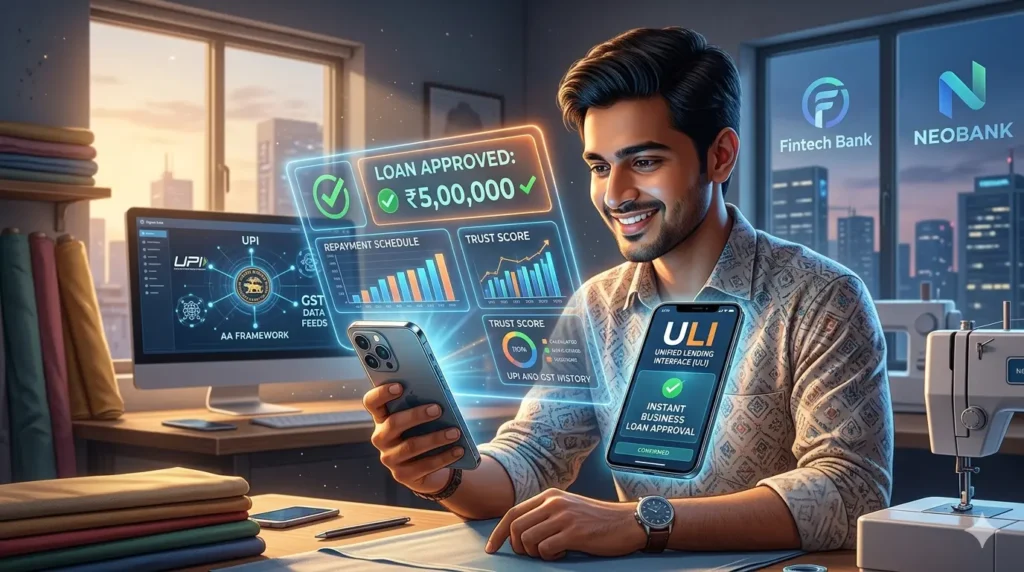
That is the larger vision behind the Unified Lending Interface (ULI) introduced by the Reserve Bank of India (RBI). Many experts believe this new digital lending infrastructure could become one of India’s biggest financial transformations after UPI itself.
For small businesses, startups, shop owners, self-employed professionals, and rural entrepreneurs, the Unified Lending Interface (ULI) may eventually change how loans are accessed in India.
What Is Unified Lending Interface (ULI)?
The Unified Lending Interface (ULI) is a digital public infrastructure initiative developed under the guidance of the RBI to simplify and accelerate the lending process in India.
In simple words, ULI aims to create a common digital platform through which banks, NBFCs, fintech companies, and other lenders can securely access verified borrower data — with the borrower’s consent.
The idea is similar to how UPI created a unified system for digital payments. ULI seeks to create a unified ecosystem for digital lending.
Instead of manually collecting multiple documents from borrowers, lenders may be able to digitally access important information such as:
- Bank transaction history
- GST records
- Land records
- Identity verification
- Income-related data
- Business information
- Credit history
This could significantly reduce loan processing time and paperwork for MSMEs and individuals.
When Did Unified Lending Interface (ULI) Start in India?
The RBI launched the pilot phase of the Unified Lending Interface (ULI) in August 2023. Later, in 2024, the central bank highlighted its larger rollout vision for India’s lending ecosystem.
The initiative is being viewed as a major part of India’s expanding digital public infrastructure model.
Why Is ULI Important for MSMEs?
India’s MSME sector contributes enormously to employment and economic growth, yet access to formal credit remains a major challenge.
Many small businesses struggle because:
- They lack collateral
- Financial documents are incomplete
- Loan approval takes too long
- Traditional assessment systems are rigid
- Rural borrowers face documentation hurdles
The Unified Lending Interface (ULI) may help solve several of these issues.
Key Potential Benefits for MSMEs
1. Faster Loan Approvals
With digitally verified records, lenders may process applications much faster than traditional methods.
2. Reduced Paperwork
Borrowers may not need to repeatedly submit physical documents across multiple institutions.
3. Improved Access to Collateral-Free Loans
Digital assessment systems may help lenders evaluate businesses beyond physical collateral.
This can complement schemes such as CGTMSE-backed MSME loans.
4. Better Credit Inclusion
Small businesses in rural and semi-urban regions with limited formal credit history may gain improved access to institutional finance.
5. Lower Operational Costs for Lenders
Automated verification and standardized APIs could reduce administrative expenses for banks and NBFCs.
Is ULI Similar to UPI?
In many ways, yes.
UPI transformed payments by:
- Making money transfers instant
- Connecting banks through a common platform
- Simplifying transactions
ULI aims to transform lending by:
- Connecting lenders and data providers
- Simplifying borrower verification
- Enabling faster loan processing
This is why many experts call ULI the “UPI moment for lending.”
However, lending is far more complex than payments because credit decisions involve risk assessment, repayment ability, fraud prevention, and regulatory compliance.
How Unified Lending Interface (ULI) May Work
A simplified process could look like this:
Step 1: Borrower Gives Consent
The applicant allows access to selected financial or business records digitally.
Step 2: Verified Data Is Retrieved
Authorized systems fetch verified records through integrated digital infrastructure.
Step 3: Lender Evaluates Eligibility
Banks or NBFCs analyze the data for loan assessment.
Step 4: Faster Decision-Making
Automated and standardized processes may reduce delays significantly.
How ULI Could Impact Collateral-Free MSME Loans
One of the biggest opportunities created by Unified Lending Interface (ULI) could be in the collateral-free lending ecosystem.
Today, many banks hesitate to provide unsecured MSME loans because:
- Risk assessment is difficult
- Financial data is fragmented
- Verification takes time
With better digital access to borrower information, lenders may gain greater confidence in evaluating repayment capacity.
This may strengthen:
- Working capital loans
- Small business loans
- Digital business lending
- Invoice financing
- CGTMSE-supported lending
For India’s small entrepreneurs, this could become a major financial inclusion milestone.
Can ULI Increase Financial Inclusion in Rural India?
Potentially yes.
Many rural borrowers face problems such as:
- Lack of traditional income proof
- Limited credit history
- Physical distance from banks
- Delayed documentation verification
If land records, transaction history, and other verified datasets become digitally accessible through ULI, rural credit delivery may improve significantly.
This may especially benefit:
- Farmers
- Rural MSMEs
- Small traders
- Self-employed individuals
The Connection Between ULI and AI Credit Scoring
Another important development is the growing role of AI-based lending models.
As digital financial data becomes more accessible, lenders and fintech platforms may increasingly use:
- AI credit scoring
- Automated risk assessment
- Alternative credit evaluation systems
This could help evaluate borrowers who previously lacked traditional credit histories.
However, it also raises important concerns regarding:
- Data privacy
- Algorithmic bias
- Incorrect financial profiling
- Cybersecurity risks
Responsible implementation will therefore remain critical.
Challenges and Concerns Around Unified Lending Interface (ULI)
Although the future potential is significant, some important concerns remain.
1. Data Privacy
Borrowers must clearly understand how their data is used and shared.
2. Cybersecurity Risks
Large-scale digital lending infrastructure must remain secure against fraud and cyber attacks.
3. Digital Divide
Not all borrowers may have equal digital access or literacy.
4. Overdependence on Algorithms
Automated credit evaluation systems may sometimes misjudge borrower capacity.
5. Integration Complexity
Connecting multiple institutions and databases nationwide is a complex task.
Could ULI Change the Future of Lending in India?
India has already shown how digital public infrastructure can transform sectors at massive scale through:
- Aadhaar
- UPI
- DigiLocker
- Account Aggregator systems
If implemented effectively, Unified Lending Interface (ULI) could become another major step in India’s financial evolution.
For MSMEs especially, the long-term impact could include:
- Faster business financing
- Easier collateral-free loans
- Improved formal credit access
- Reduced dependence on informal lenders
- More efficient digital lending ecosystems
While the system is still evolving, ULI clearly signals the RBI’s intention to modernize India’s lending infrastructure for the digital era.
Conclusion
The Unified Lending Interface (ULI) may not just be another fintech initiative. It could become the digital backbone of future lending in India.
Just as UPI simplified payments for millions, ULI has the potential to simplify credit access for MSMEs, startups, farmers, and small borrowers across the country.
For India’s growing entrepreneurial economy, faster and smarter lending infrastructure may become essential in the years ahead.
The real success of ULI, however, will depend on how securely, inclusively, and responsibly the system is implemented.
Frequently Asked Questions (FAQ)
What is Unified Lending Interface (ULI)?
Unified Lending Interface (ULI) is a digital lending infrastructure initiative supported by the RBI to simplify and accelerate the loan approval process through consent-based data sharing.
When was ULI launched in India?
The pilot phase of ULI was launched in August 2023.
How is ULI different from UPI?
UPI focuses on digital payments, while ULI focuses on simplifying digital lending and loan processing.
How can ULI help MSMEs?
ULI may help MSMEs by reducing paperwork, enabling faster approvals, improving access to collateral-free loans, and simplifying digital verification.
Can ULI improve collateral-free business loans?
Potentially yes. Better digital borrower assessment may help lenders offer unsecured MSME loans more confidently.
Is ULI fully operational across India?
ULI is still evolving and expanding through pilot and integration phases.
About Author
Tabrez Alam is a business and finance content writer focused on MSME finance, digital lending, banking trends, government schemes, and emerging fintech developments in India. Through BusinessZindagi.com, he aims to simplify complex financial topics for entrepreneurs, small business owners, and everyday readers.
AI Disclaimer
This article was created with the assistance of AI for research structuring and content drafting purposes. Final editing, interpretation, and publishing decisions were reviewed manually to maintain clarity, relevance, and reader usefulness.
Authentic Sources & References
- Reserve Bank of India (RBI) Official Website
- RBI Innovation Hub
- National Payments Corporation of India (NPCI)
- Press Information Bureau (PIB) India
- Account Aggregator Framework Information