
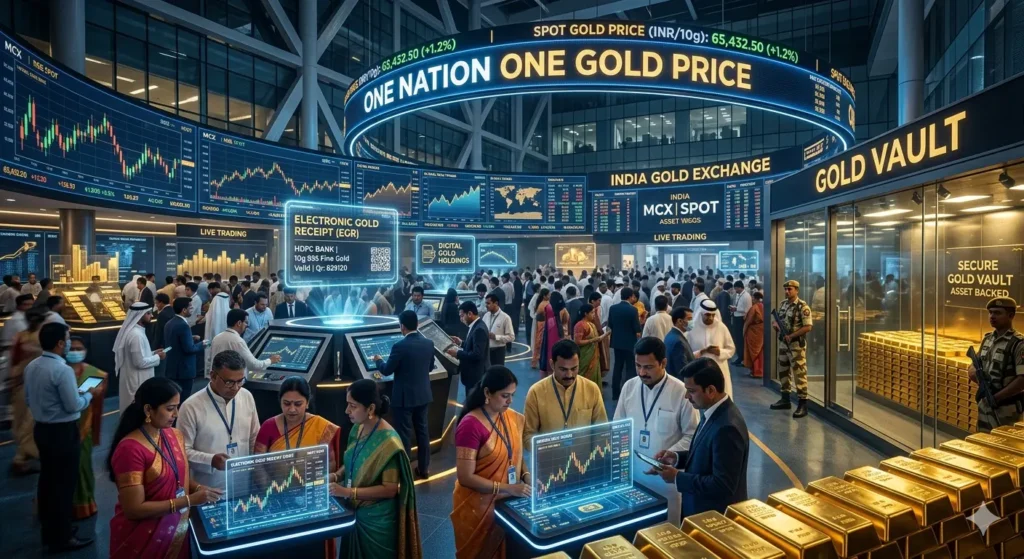
What Small Jewellers and MSMEs Must Understand Before India’s Gold Trade Changes Forever
For generations, India’s gold business has operated through trust, relationships, regional bullion markets, and traditional trading networks. From the jewellery lanes of Mumbai and Kolkata to small family-run shops in Assam, Bihar, Rajasthan, Tamil Nadu, and Uttar Pradesh, India’s gold economy has largely remained decentralized.
But now, a major structural shift may slowly be beginning in the direction of One Nation, One Gold Price” in India.
With the launch of Electronic Gold Receipts (EGRs) on the National Stock Exchange of India, policymakers and market experts are increasingly discussing a bold idea:
“One Nation, One Gold Price”
Supporters believe this could modernize India’s fragmented bullion market through:
- transparent exchange-based pricing,
- standardized gold quality,
- digital trading,
- and regulated storage systems.
But many small jewellers and MSMEs are asking a different question:
Will this transformation empower traditional gold businesses — or slowly weaken them?
That is the real debate India must now seriously analyse before moving towards One Nation, One Gold Price” in India.
related article: Electronic Gold Receipts for Jewellery Businesses: How MSMEs Can Benefit in India
Why Gold Prices Differ Across India Even Today
Most ordinary consumers assume gold prices are the same nationwide.
In reality, they are not.
Gold prices often vary between:
- Mumbai,
- Chennai,
- Delhi,
- Kolkata,
- Guwahati,
- Jaipur,
- Patna,
- and smaller regional markets.
These differences happen because of:
- transportation costs,
- regional demand,
- local premiums,
- purity variations,
- inventory shortages,
- commissions,
- and informal bullion networks.
For decades, this localized system has defined India’s gold trade.
Many small jewellers survive precisely because they understand their regional markets better than large organized players.
What Exactly Are Electronic Gold Receipts (EGRs)?
Electronic Gold Receipts are digital certificates backed by physical gold stored inside SEBI-regulated vaults.
In simple language:
- Gold is deposited in an approved vault,
- purity and weight are verified,
- and a digital receipt is issued in demat form.
That receipt can then be traded electronically through stock exchanges.
Think of it as:
“Gold becoming digitally tradable like shares.”
Supporters say this creates:
- transparency,
- standardized quality,
- easier tracking,
- and national-level price discovery.
Why the Government and Exchanges Want “One Nation, One Gold Price”
The broader vision is simple:
India should eventually move toward a more transparent and unified gold pricing ecosystem of One Nation, One Gold Price” .
Right now, India’s bullion trade remains highly fragmented.
A standardized national benchmark could potentially:
- reduce opacity,
- improve trust,
- formalize gold trading,
- and attract institutional participation.
This is similar to how:
- stock exchanges standardized equity pricing,
- and UPI standardized digital payments.
Now the same thinking is slowly entering the gold ecosystem.
How EGRs Could Benefit Small Jewellers and MSMEs
This is where the story becomes important for India’s small businesses.
If implemented carefully, EGRs could create several advantages.
1. Better Transparency in Gold Procurement
Many small jewellers depend heavily on:
- local wholesalers,
- regional bullion traders,
- or informal supply chains.
Sometimes this creates problems such as:
- hidden premiums,
- inconsistent purity,
- and lack of price transparency.
Exchange-linked EGR pricing may help MSMEs:
- compare national benchmark prices,
- negotiate better,
- and avoid overpaying suppliers.
For small businesses operating on thin margins, even small pricing improvements matter significantly.
2. Standardized Gold Quality Could Reduce Disputes
Purity disputes remain a major issue in parts of India’s gold trade.
EGR systems involve:
- standardized verification,
- approved vaulting,
- and regulated handling processes.
This may improve trust between:
- jewellers,
- wholesalers,
- refiners,
- and financiers.
For MSMEs, standardized gold can reduce operational uncertainty.
3. Easier Access to Financing May Become Possible
One of the biggest problems faced by jewellery MSMEs is financing.
Banks often hesitate because:
- gold inventory verification is difficult,
- documentation may be weak,
- and informal trading dominates parts of the sector.
Digitally recorded and standardized gold holdings may eventually improve confidence among:
- banks,
- NBFCs,
- and institutional lenders.
This could help some jewellers access:
- working capital,
- gold-backed loans,
- and inventory financing more easily.
4. Smaller Jewellers Could Benchmark Prices Nationally
Today, many small jewellers rely mainly on local price signals.
EGR-based systems may eventually allow MSMEs to:
- track national market trends,
- compare rates more transparently,
- and make smarter inventory decisions.
This could especially help businesses facing volatile gold prices.
5. Export-Oriented MSMEs Could Benefit
India’s jewellery exporters compete globally where:
- documentation,
- purity consistency,
- and transparency matter greatly.
A more formalized gold ecosystem may improve:
- international credibility,
- supply chain trust,
- and export competitiveness.
For export-focused MSMEs, this could become strategically important.
But Here Comes the Bigger Question…
Could “One Nation One Gold Price” Also Hurt Small Jewellers?
This is the part many discussions ignore.
While the concept sounds efficient and modern, there are also serious concerns that deserve equal attention.
And for small jewellers, these concerns may actually matter more than the benefits.
1. Large Organized Players May Gain Massive Advantage
This is perhaps the biggest concern.
Large jewellery chains and institutional traders already possess:
- stronger compliance systems,
- advanced technology,
- professional treasury teams,
- and easier access to exchange infrastructure.
Small jewellers often operate very differently.
If gold pricing becomes increasingly exchange-driven, bigger players may adapt much faster than traditional MSMEs.
This could gradually increase market concentration.
In simple terms:
The businesses with the best technology and capital may dominate the future gold ecosystem.
2. Traditional Bullion Markets Could Slowly Lose Power
India’s regional bullion markets are not just trading hubs — they are entire economic ecosystems.
Thousands depend on them:
- local traders,
- transporters,
- artisans,
- brokers,
- refiners,
- and wholesalers.
If centralized exchange pricing becomes dominant, many local bullion networks may weaken over time.
This could reshape traditional gold trade structures across India.
3. Digital Compliance Pressure Could Burden Small Businesses
EGR ecosystems require familiarity with:
- demat systems,
- exchanges,
- digital documentation,
- vaulting processes,
- and regulatory compliance.
For:
- rural jewellers,
- family-run shops,
- and traditional traders,
this transition may not be easy.
Without proper awareness and training, some MSMEs may struggle to survive the digital shift.
4. Speculative Trading Could Increase Gold Price Volatility
Gold has traditionally been viewed in India as:
- a store of value,
- cultural security,
- and long-term wealth.
But when gold becomes heavily exchange-traded, speculative activity can rise.
This may lead to:
- faster price swings,
- short-term volatility,
- and increased uncertainty.
For small jewellers, volatile prices can become dangerous because:
- inventory planning becomes harder,
- margins shrink unpredictably,
- and procurement risks increase.
5. Local Market Realities May Get Ignored
India is too diverse for completely uniform pricing.
Regional demand differs dramatically:
- South India’s gold consumption patterns differ from North India,
- wedding seasons vary,
- and rural demand behaves differently from urban markets.
Local pricing flexibility often reflects genuine economic realities.
A purely centralized pricing model may not fully account for:
- regional logistics,
- local shortages,
- and seasonal demand patterns.
6. Dependence on Centralized Systems Creates New Risks
Traditional bullion trading is decentralized.
But digital exchange-based ecosystems create dependence on:
- vault operators,
- exchanges,
- clearing systems,
- and digital infrastructure.
Any:
- cyberattack,
- technical disruption,
- or regulatory bottleneck
could affect trading activity on a larger scale.
This concentration risk is important and often underestimated.
Will “One Nation One Gold Price” Actually Become Reality?
Probably not completely.
Even with EGRs, several factors will continue affecting regional prices:
- transportation,
- local demand,
- taxes,
- inventory availability,
- and operational costs.
So the future may not be:
“Exactly one identical gold price everywhere.”
Instead, India may move toward:
“More transparent and nationally benchmarked gold pricing.”
That is a more realistic possibility.
The Real Challenge for Indian MSMEs
The future question is no longer:
“Will digital transformation come to gold?”
It already has.
The real question is:
“Can small jewellers adapt before the industry changes around them?”
Businesses that understand:
- digital pricing,
- compliance,
- exchange-linked systems,
- and transparent procurement
may become stronger in the coming years.
But policymakers must also ensure that modernization does not destroy the millions of traditional businesses that built India’s gold economy over generations.
Final Thoughts
Electronic Gold Receipts may eventually become one of the biggest structural reforms in India’s gold market.
They could improve:
- transparency,
- standardization,
- financing access,
- and national price discovery.
But the dream of “One Nation, One Gold Price” is not just a technology story.
It is also:
- a small business story,
- a regional economy story,
- and a survival story for traditional jewellers.
If the transition is handled carefully, EGRs may modernize India’s gold ecosystem while empowering MSMEs.
But if modernization becomes too centralized too quickly, small jewellers may face enormous competitive pressure from organized players and digital systems.
The future of India’s gold market will therefore depend not only on exchanges and technology — but on whether reform can happen without weakening the traditional businesses that have powered India’s gold trade for centuries.
FAQs
What is One Nation One Gold Price?
It is the idea of creating a more transparent and nationally benchmarked gold pricing system across India.
What are Electronic Gold Receipts (EGRs)?
EGRs are digital receipts backed by physical gold stored in SEBI-regulated vaults and traded electronically on stock exchanges.
How can EGRs help MSMEs?
EGRs may help MSMEs through:
- better price transparency,
- standardized gold quality,
- easier financing opportunities,
- and national price benchmarking.
Can EGRs hurt small jewellers?
Some experts believe increasing digitalization and exchange-based pricing may favor large organized players over smaller traditional jewellers.
Will gold prices become identical across India?
Probably not completely. Regional costs and demand differences may continue, though pricing could become more transparent.
Can speculative trading increase because of EGRs?
Yes, some analysts believe higher exchange participation could increase short-term price volatility in the future.
About the Author
Business Zindagi Editorial Team covers MSME trends, fintech innovation, startup developments, digital finance, and emerging business opportunities shaping India’s business future.
AI Disclaimer
This article was created with editorial assistance from AI tools for research structuring and language enhancement. All efforts have been made to ensure factual accuracy and balanced business analysis.