
Whenever headlines say:
“Indian rupee falls against the US dollar”
most people immediately assume it is bad news for the economy.
And in many situations, it certainly creates challenges:
- imports become expensive,
- fuel prices rise,
- inflation pressure increases,
- and many businesses struggle with higher costs.
But there is another side to this story that many small businesses fail to understand.
A falling rupee can actually increase profits for some MSMEs.
Yes, depending on the nature of the business, a weaker rupee may create:
- better export earnings,
- stronger global competitiveness,
- improved margins,
- and higher foreign income.
For India’s growing MSME sector, understanding this relationship is becoming increasingly important in a globalized economy.
And interestingly, many exporters experience this reality very personally.
related article: How Dollar–Rupee Exchange Rate Impacts Indian Exporters’ Profit
A Real Business Experience: Why Some Exporters Watch the Dollar Closely
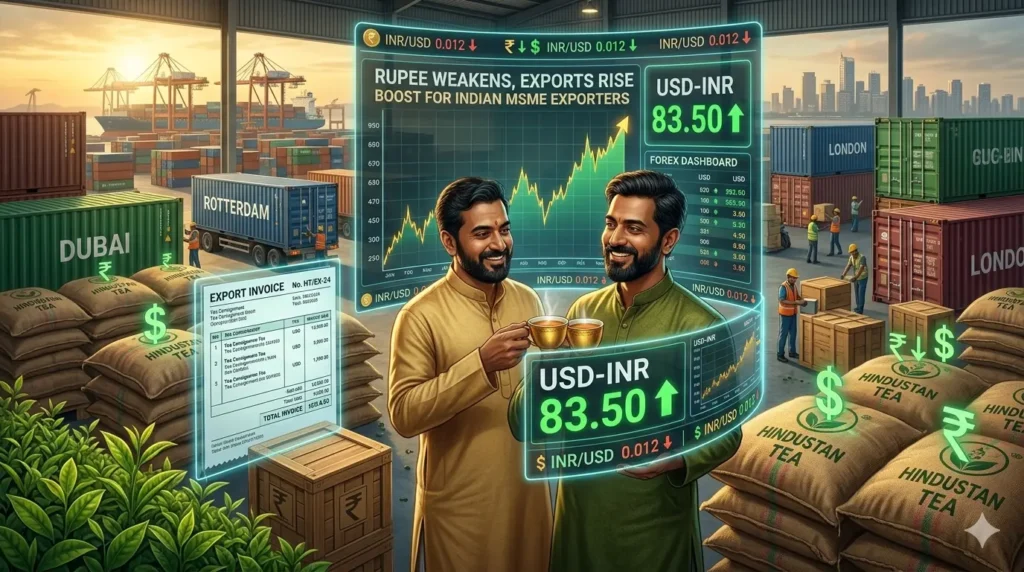
Whenever I handled tea export shipments in the past, I used to closely monitor the USD-INR exchange rate almost every day.
At first glance, many people assume exporters become worried when the rupee weakens. But in reality, during several export transactions, I actually felt happy when the rupee fell against the dollar.
Why?
Because the payment was received in US dollars.
So when the dollar strengthened, the same export payment converted into more Indian rupees — which directly increased profit margins.
For example, if a tea shipment payment was received at a stronger dollar rate, the final rupee realization became higher even though the dollar amount remained the same.
That practical experience taught me an important lesson:
Currency movements are not just economic headlines. They directly affect real business profitability.
This is especially true for export-oriented MSMEs in India.
What Does “Falling Rupee” Actually Mean?
A falling rupee means the Indian currency becomes weaker compared to another currency, especially the US dollar.
For example:
Earlier: 1 usd equals to 83 indian rupees
Now: 1 USD equals to 95.75 indian rupees
This means India now needs more rupees to buy one US dollar.
In simple terms:
- the dollar becomes stronger,
- while the rupee becomes weaker.
This affects businesses differently depending on whether they:
- import goods,
- export products,
- depend on foreign raw materials,
- or earn revenue internationally.
Why Does the Rupee Fall?
The value of the rupee changes due to multiple economic factors such as:
- rising crude oil imports,
- global uncertainty,
- strong US dollar,
- foreign investor outflows,
- inflation pressure,
- and trade imbalance.
India imports large quantities of:
- crude oil,
- electronics,
- machinery,
- chemicals,
- and industrial raw materials.
When global pressure increases, the rupee may weaken against the dollar.
Can a Falling Rupee Really Help MSMEs?
Yes — especially export-oriented MSMEs.
This is because exporters earn in foreign currency, usually dollars.
When those dollars are converted into rupees, businesses may receive more money in rupee terms.
Simple Example: How Exporters Benefit
Suppose an MSME exporter sells goods worth: 1000 USD
Earlier Exchange Rate was: 1 usd = 85 indian rupees
After Rupee Falls 1 USD = Rs 95 indian rupees
The exporter now receives:
- ₹10,000 more
for the same dollar earnings.
This is why some export-focused MSMEs may see higher profits during a falling rupee environment.
Which MSMEs Can Benefit From a Falling Rupee?
1. Tea Exporters
India’s tea exporters may benefit because global buyers usually pay in dollars.
When the rupee weakens:
- export realization increases,
- pricing becomes globally competitive,
- and margins may improve.
This can especially matter for exporters from:
- Assam,
- Darjeeling,
- and South Indian tea regions.
2. Textile & Garment MSMEs
India’s textile sector exports heavily to:
- the US,
- Europe,
- Middle East,
- and other global markets.
A weaker rupee can make Indian textile products:
- cheaper internationally,
- and more competitive globally.
This may help:
- garment manufacturers,
- and small textile units.
3. IT & Digital Service Businesses
Indian:
- software firms,
- freelancers,
- digital agencies,
- and outsourcing businesses
often earn revenue in dollars.
When converted into rupees, their earnings may rise.
4. Handicraft & Artisan Exporters
Small handicraft exporters selling internationally through:
- websites,
- marketplaces,
- and export channels
may also gain pricing advantages.
Indian handmade products become relatively cheaper for foreign buyers.
5. Agricultural Export Businesses
Exporters dealing in:
- spices,
- rice,
- tea,
- coffee,
- and processed foods
may benefit from stronger export competitiveness.
But Not All MSMEs Benefit
This is where the situation becomes complicated.
Many businesses actually suffer when the rupee falls.
Which MSMEs May Suffer From a Falling Rupee?
1. Import-Dependent Businesses
Businesses importing:
- machinery,
- electronics,
- chemicals,
- raw materials,
- or components
face rising costs.
Their profit margins may shrink significantly.
2. Fuel-Dependent Businesses
India imports large amounts of crude oil.
When the rupee weakens:
- fuel becomes costlier,
- transport expenses rise,
- logistics costs increase.
This affects almost every MSME indirectly.
3. Businesses With Thin Margins
Small businesses already operating on low margins may struggle because:
- input costs rise,
- customer demand weakens,
- and inflation affects overall consumption.
Why Exporters Sometimes Welcome a Weak Rupee
This surprises many people.
A controlled and gradual rupee depreciation can sometimes help exports because:
- Indian products become cheaper globally,
- foreign buyers get better pricing,
- exporters earn more rupees.
However, excessive currency volatility can still create uncertainty and risk.
So exporters generally prefer:
stable but slightly competitive exchange rates.
How a Falling Rupee Affects Inflation
One major concern is inflation.
As imports become expensive:
- fuel costs rise,
- transportation becomes costly,
- raw material prices increase,
- and overall business expenses rise.
This eventually affects:
- consumers,
- businesses,
- and MSME profitability.
Can Falling Rupee Affect MSME Loans?
Indirectly, yes.
If inflation rises significantly:
- interest rates may remain high,
- borrowing costs can increase,
- working capital pressure may grow.
MSMEs dependent on:
- business loans,
- collateral-free loans,
- or working capital financing
may face additional stress.
What MSMEs Should Do During Falling Rupee Periods
Instead of panicking, businesses should focus on strategy.
Improve Cash Flow Management
Monitor:
- expenses,
- receivables,
- and inventory carefully.
Reduce Unnecessary Import Dependence
Where possible:
- diversify suppliers,
- explore domestic alternatives,
- and reduce forex risk.
Focus on Export Opportunities
A weaker rupee may create new export possibilities for:
- small manufacturers,
- digital service providers,
- and product exporters.
Use Better Financial Planning
MSMEs should increasingly use:
- digital accounting,
- AI accountancy tools,
- and financial analytics
to manage rising business uncertainty.
Final Thoughts
The falling rupee is no longer just an economic headline meant for financial experts.
Today, it directly affects:
- MSMEs,
- exporters,
- traders,
- startups,
- freelancers,
- and small businesses.
While import-heavy businesses may struggle with rising costs, export-oriented MSMEs can sometimes benefit from higher rupee earnings and improved global competitiveness.
For me personally, watching the USD-INR exchange rate during tea export shipments was not just about currency charts. It was directly connected to profitability and business outcomes.
That is why understanding currency movements is becoming increasingly important for Indian entrepreneurs.
In a globally connected economy, financial awareness itself is now a business advantage
Frequently Asked Questions (FAQ)
What does a falling rupee mean?
A falling rupee means the Indian currency becomes weaker against foreign currencies like the US dollar. India then needs more rupees to buy one dollar.
Can a falling rupee benefit MSMEs?
Yes. Export-oriented MSMEs earning in dollars may receive higher rupee earnings when the dollar strengthens against the rupee.
Which MSMEs benefit most from a falling rupee?
Businesses that export products or services may benefit, including:
- tea exporters,
- textile exporters,
- IT service firms,
- handicraft exporters,
- and agricultural exporters.
Which MSMEs suffer from a falling rupee?
Import-dependent businesses may suffer because imported:
- machinery,
- electronics,
- fuel,
- chemicals,
- and raw materials
become more expensive.
Why do exporters sometimes prefer a weaker rupee?
Exporters earn in foreign currency. When converted into rupees, their earnings may increase if the rupee weakens.
Does a falling rupee increase inflation?
Yes, it can increase inflation because imported goods and fuel become more expensive, raising transportation and production costs.
Can falling rupee affect MSME loans?
Indirectly yes. Rising inflation and economic uncertainty may increase borrowing costs and working capital pressure for MSMEs.
About Author
Tabrez Khan is a entrepreneur, exporters and content writer focused on MSME finance, exports and entrepreneurship in India. Through BusinessZindagi.com, he aims to simplify complex economic and financial topics for small business owners, traders, startups, and aspiring entrepreneurs.
AI Disclaimer
This article was created with the assistance of AI for research support, content organization, and drafting purposes. Final editing, interpretation, and publishing decisions were manually reviewed to maintain accuracy, clarity, and reader usefulness.
Authentic Sources & References
- Reserve Bank of India (RBI)
- Ministry of MSME, Government of India
- Ministry of Commerce & Industry, Government of India
- Export Promotion Council for Handicrafts (EPCH)
- Tea Board India
- National Stock Exchange (NSE) Currency Market Information