
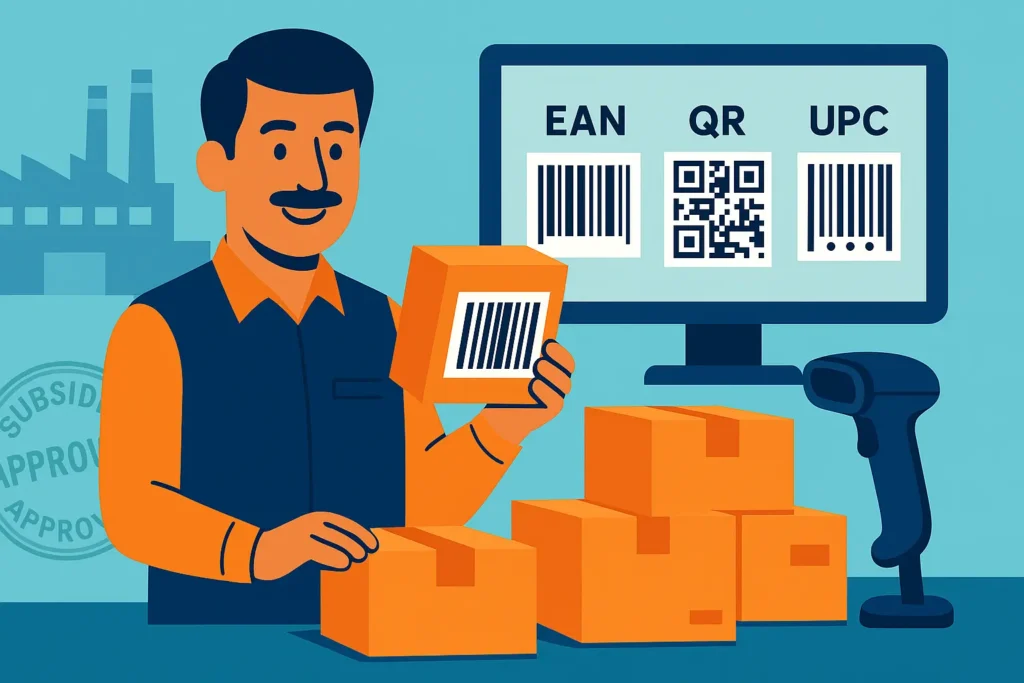
In today’s fast-paced retail and supply chain ecosystem, barcodes have become a necessity for businesses of all sizes. For Micro, Small, and Medium Enterprises (MSMEs) in India, adopting it not only streamlines operations but also opens doors to national and international markets.
Having personally implemented GS1 barcode in my own MSME product packaging, I experienced tremendous advantages—from inventory tracking to getting listed on major platforms. Even better, I received 75% reimbursement under the Government of India’s barcode subsidy scheme—a huge boost for small businesses like mine.
related post:Why Indian MSMEs Lose Money on Inventory—and How Barcodes Fix It
What is a Barcode?
It is a visual, machine-readable representation of data that can be scanned using a barcode scanner. It contains information such as product number, batch, price, and origin, helping automate identification and data collection across industries.
What Does it Look Like?
It looks like a series of black vertical lines of varying widths and spaces, printed on a white background. Beneath these lines, you’ll usually find a numeric or alphanumeric code.
Why it is Important for MSMEs?
Implementing it offfers a host of benefits, especially for growing MSMEs:
1. Professional Packaging
Using it enhances the professional look of your packaging. This boosts brand trust and meets the standards of retail chains and marketplaces like Amazon, Flipkart, BigBasket, etc.
2. Improved Inventory Management
A barcode scanner helps track inventory in real-time. You’ll know exactly how much stock is available, reducing errors and preventing overstocking or stockouts.
3. Faster Billing & Accuracy
In retail setups, barcode scanning makes billing faster, reduces human error, and improves overall customer satisfaction.
4. Better Supply Chain Management
Whether selling locally or exporting, it ensure product traceability across the supply chain.
5. Mandatory for Online Selling
Most e-commerce platforms require GS1 barcode for product listings. Without it, you may not be able to list or sell your product online.
6. Easy Product Recall
It make it simple to track faulty or expired batches, helping in quick and effective product recalls if needed—essential for food, pharma, and consumer goods industries.
7. Cost Savings Over Time
Though there’s an initial cost, it reduce labor and operational costs in the long run by minimizing manual entry and avoiding costly inventory errors.
8. Better Data & Analytics
Using it allows you to generate data for sales trends, customer preferences, and product performance. This helps MSMEs make informed decisions.
9. Export-Friendly
GS1 barcodes are globally recognized and required in many export markets. Having them on your products makes customs clearance smoother and meets international trade standards.
10. Compatibility with POS & ERP Systems
It easily integrate with modern billing systems, Point-of-Sale (POS), and ERP software, making your business digitally compliant and scalable.
related post: Smart Barcodes & AI: How Startups Are Turning Barcodes into Growth Engines (2026)
Types of Barcodes Used by MSMEs
There are various types of barcodes, each suited to different applications:
- EAN-13 / UPC-A: Widely used for retail products
- Code 128: High-density one used in logistics and warehousing
- QR Code: Stores more data and often used for URLs and payments
- Data Matrix: Small-sized one used for small products or electronics
- GS1 Barcodes: Globally recognized, essential for exports and organized retail
Tip: You can easily create barcodes using free or paid barcode generator tools available online.
Government of India Subsidy on Barcodes for MSMEs
The Indian government, through the Ministry of MSME, offers financial assistance up to 75% for the cost incurred in registration and subscription with GS1 India, the authorized body for barcode issuance in India.
Key Features of the barcode Subsidy:
- Reimbursement of 75% of the GS1 registration fee
- Applicable for Micro and Small Enterprises only
- Must be registered with Udyam (Udyog Aadhaar previously)
How I Benefited:
When I registered my products with GS1 India, I paid the full fee initially. After submitting the required documents, I received 75% of the cost reimbursed under the MSME Barcode Subsidy scheme. This encouraged me to use it across my entire packaging system, helping me get listed with larger retailers and improve stock traceability.
How to Get Started with Barcode for Your MSME
- Register with GS1 India: https://www.gs1india.org
- Choose the appropriate package based on your product count
- Use a barcode generator to create and print your barcodes
- Apply for subsidy through your local MSME-DI (Development Institute)
- Use a barcode scanner to integrate with your billing and inventory software
Conclusion
For MSMEs, adopting barcode technology is no longer optional—it’s a strategic move toward professionalism, market expansion, and efficient operations. With tools like barcode generators, easy access to barcode scanners, and a 75% government subsidy, there’s no better time than now to make your packaging barcode-enabled.
From my own experience, the return on this small investment has been multi-fold. Whether you’re a manufacturer, exporter, or local seller—adding a GS1 barcode can significantly elevate your business potential.
💡 Article FAQs
1. Why is a barcode important for MSME packaging?
Barcodes help MSMEs streamline inventory, reduce errors, enhance product traceability, and build consumer trust by ensuring authenticity and faster checkout.
2. What are the main types of barcodes used in India?
The most common barcode types are EAN-13, UPC, Code 128, and QR Codes. MSMEs selling internationally typically use EAN or UPC formats issued by GS1 India.
3. How can MSMEs apply for a barcode subsidy?
The Ministry of MSME offers reimbursement of up to 75% of registration fees through GS1 India. You can apply via the MSME Champions Portal or your District Industries Centre (DIC).
4. How does its usage help in exports?
Barcodes improve global supply chain compatibility and are mandatory for exporting products to international retail networks like Amazon, Walmart, and Carrefour.
5. Do all products need a barcode?
Not all — but for packaged goods, e-commerce listings, and retail distribution, barcodes are highly recommended for compliance and traceability.
🔗 Short, Clickable, Authentic Sources & References
- GS1 India Official Barcode Registration
- MSME Barcode Registration Subsidy – Udyam Support
- Ministry of MSME Scheme Guidelines (PDF)
- National Small Industries Corporation (NSIC) Reimbursement Info
✍️ About the Author
Tabrez Khan is the founder and editor of BusinessZindagi.com, a blog dedicated to helping Indian entrepreneurs, MSMEs, and startups grow digitally. With years of experience in trading ,exporting , he writes actionable guides on finance, marketing, and entrepreneurship.