
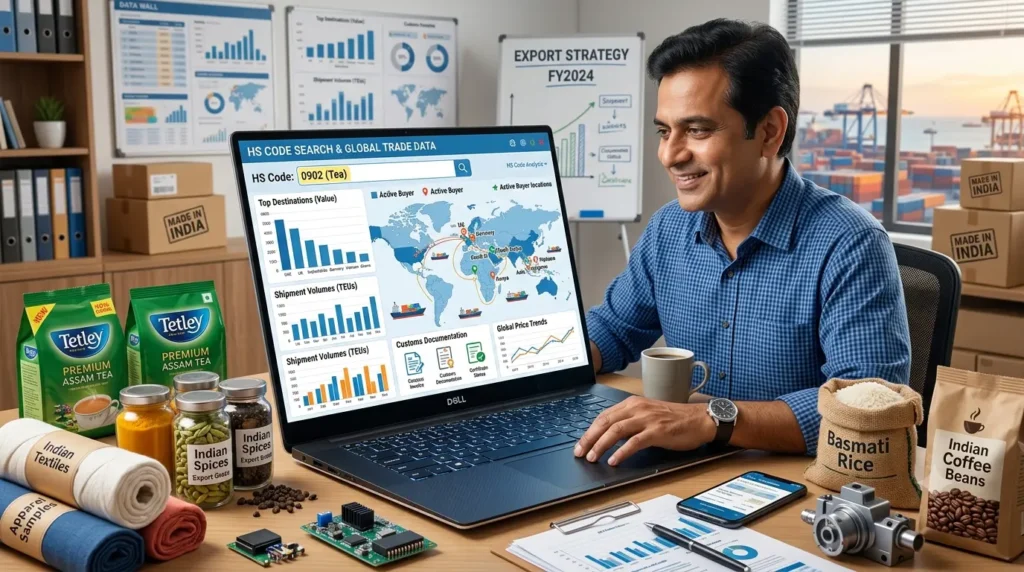
Finding international buyers is one of the biggest challenges for new exporters. Many businesses spend months searching on Google, LinkedIn, or B2B marketplaces without getting meaningful results. However, experienced exporters often use a more strategic approach—they leverage the HS Code for export to identify active buyers, analyze global trade patterns, and target the right markets.
An HS Code is more than just a customs requirement. It serves as a standardized product identifier recognized worldwide. When combined with shipment data and trade intelligence, it becomes a valuable tool for discovering companies that already import products similar to yours.
Whether you export tea, spices, textiles, engineering goods, handicrafts, or machinery, understanding how to use an HS Code for export can save time, improve your marketing efforts, and help you connect with genuine buyers.
In this guide, you’ll learn how HS Codes work, why they matter, and how exporters use them to make smarter business decisions.
What Is an HS Code for Export?
An HS Code (Harmonized System Code) is an internationally recognized numerical code used to classify products traded across borders. Developed by the World Customs Organization (WCO), the system is used by more than 200 countries for customs clearance, tariff calculation, and international trade statistics.
Every internationally traded product is assigned an HS Code based on its characteristics. The first six digits are standardized globally, while many countries add additional digits to meet their own customs and tariff requirements.
Below are the international 6-digit HS headings (common across countries). Individual countries such as India extend these to 8- or 10-digit ITC (HS) codes for tariff and statistical purposes. Always verify the final national code before filing export documents.
| Product | International HS Code | Description |
|---|---|---|
| ☕ Coffee | 0901 | Coffee, whether or not roasted or decaffeinated |
| 🍵 Tea | 0902 | Tea, whether or not flavoured |
| 🌾 Rice | 1006 | Rice |
| 🌶️ Spices | Chapter 09 | Various spices have different HS codes (0904–0910) |
| 👕 Garments | Chapters 61 & 62 | Knitted apparel (61) and woven apparel (62) |
| 💻 Electronics | Chapter 85 | Electrical machinery and electronic equipment |
Each product category has its own unique HS Code, ensuring that customs authorities worldwide classify goods consistently.
Why Is the Correct HS Code Important for Export?
Many exporters think the HS Code is only required to complete shipping documents. In reality, it plays a much bigger role in international trade.
Using the correct HS Code for export helps you:
- Complete customs documentation accurately.
- Determine applicable import duties in destination countries.
- Claim eligible export incentives and benefits.
- Avoid customs delays and product misclassification.
- Analyze global trade data.
- Identify countries importing your product.
- Research active international buyers.
For exporters looking to grow their business, the last three points are especially valuable because they transform the HS Code from a compliance requirement into a market research tool.
How the HS Code Changes Even Though It’s Still Tea
I can give you an excellent example that shows a small differences in the product can lead to different HS Codes.
Example 1: Green Tea vs Black Tea
| Product | HS Code |
|---|---|
| Green Tea (not fermented) | 0902.10 or 0902.20 |
| Black Tea (fermented) | 0902.30 or 0902.40 |
The processing method—fermented (black tea) versus not fermented (green tea)—changes the HS classification.
Example 2: Same Black Tea, Different Packaging
Suppose you manufacture the same Assam Black Tea.
| Product | HS Code |
|---|---|
| Black Tea packed up to 3 kg | 0902.30 |
| Black Tea packed above 3 kg (bulk) | 0902.40 |
The tea is the same, but the pack size changes the HS code.
Example 3: Bulk Tea vs Tea Bags
Both products contain black tea, yet they may have different national tariff classifications.
| Product | Indian ITC (HS) Example |
|---|---|
| Black Tea in bulk | 09024020 |
| Tea Bags | 09024040 |
The difference arises because customs distinguishes products by presentation and packaging, not just by the tea itself.
Example 4: Green Tea
| Product | Indian ITC (HS) Example |
|---|---|
| Green Tea in bulk | 09022020 |
| Green Tea waste | 09022040 |
Even though both are green tea, the commercial form changes the classification.
Why This Matters for Exporters
Using the wrong HS Code can lead to:
- Customs delays
- Incorrect import duty calculations
- Problems claiming export incentives
- Shipment reclassification
How Is an HS Code Structured?
Understanding the structure of an HS Code makes it easier to classify products correctly.
First Two Digits – Chapter
These digits represent a broad product category.
Example:
09 – Coffee, Tea, Mate and Spices
First Four Digits – Heading
The next two digits identify a more specific product group.
First Six Digits – Subheading
The six-digit HS Code is recognized internationally and is common across participating countries.
Additional Digits
Many countries extend the code to eight or ten digits for national tariff purposes.
For example, India uses ITC (HS) codes for import and export classification.
Why Exporters Should Care About HS Codes Beyond Customs
If you ask experienced exporters how they find buyers, many will tell you they don’t rely solely on trade fairs or online directories.
Instead, they study trade data.
Every import and export shipment is classified using an HS Code. This creates a vast database of information that reveals what products are being traded, where they’re going, and which markets have consistent demand.
When used correctly, an HS Code can help answer questions such as:
- Which countries import my product regularly?
- Which markets are growing?
- Which companies frequently import similar products?
- Where are my competitors exporting?
- Which regions offer new opportunities?
This information can help exporters make informed decisions instead of relying on guesswork.
How HS Codes Help You Find International Buyers
This is where HS Codes become particularly valuable for business development.
Imagine you’re an exporter of Assam Black Tea.
Rather than searching the internet for “tea buyers,” you can start by identifying the correct HS Code for your product. Once you have the code, you can use trade intelligence platforms and shipment databases to research businesses that have recently imported products under that classification.
This approach offers several advantages:
1. Identify Buyers Already Importing Your Product
Companies that have imported your product category in the past are more likely to purchase similar products again.
Instead of contacting random businesses, you can focus on buyers with a proven import history.
2. Save Time and Marketing Costs
Cold emailing thousands of companies often produces poor results.
Researching buyers through HS Code-based trade data allows you to concentrate on businesses that actively participate in international trade, making your outreach more targeted and efficient.
3. Discover New Export Opportunities
Trade patterns change over time.
Some countries increase imports due to rising demand, while others reduce purchases because of changing consumer preferences or local production.
HS Code-based trade analysis can help you identify markets where demand for your product is growing, allowing you to prioritize promising destinations.
4. Understand Buyer Preferences
Shipment data often includes product descriptions and import frequency, helping exporters understand what buyers are purchasing and how often they place orders.
This information can improve your sales approach by allowing you to tailor your product offerings to market demand.
Real-Life Example
Suppose you manufacture or export Assam Black Tea.
Instead of searching for “tea importers in Germany” on Google, you can:
- Identify the correct HS Code for black tea.
- Research countries importing black tea.
- Analyze shipment trends.
- Find companies that regularly import black tea.
- Study competitor export destinations.
- Prepare a targeted list of potential buyers.
This method is significantly more strategic than sending unsolicited emails to businesses without knowing whether they import your product.
How to Find the Correct HS Code for Your Product
Finding the correct HS Code for export is the first and most important step before researching international buyers. An incorrect classification can lead to customs delays, incorrect duties, shipment disputes, or difficulty finding accurate market data.
Here are practical ways to identify the right HS Code.
The more accurately you describe your product, the easier it becomes to classify it correctly.
Use Official Government Resources
The safest way to identify an HS Code is by referring to official customs and trade resources. These databases are updated periodically and should always be your primary reference for customs declarations.
If you’re unsure, consult your customs broker or freight forwarder before shipping.
Study Similar Export Products
If companies already export products similar to yours, their classifications can provide useful guidance.
However, never copy an HS Code without confirming that your product has the same specifications.
Consult Your Customs Broker
Experienced Customs House Agents (CHAs) and customs consultants deal with HS Codes daily.
For first-time exporters, professional advice can prevent expensive mistakes.
How to Perform Market Research Using HS Codes
Once you’ve identified the correct HS Code, the next step is market research.
Think of the HS Code as a search key.
Instead of searching for buyers by company name, you search using the product classification.
This allows you to analyze international trade data more effectively.
For example, you can answer questions such as:
- Which countries import this product?
- Which markets are growing?
- Who are the major exporters?
- Which companies frequently import this product?
- Is demand increasing or decreasing?
This information helps exporters make informed business decisions.
A country importing large quantities of your product may offer better opportunities than a market with limited demand.
This doesn’t mean copying competitors.
Instead, it helps you understand where opportunities already exist.
Build a Verified Buyer List
Many exporters waste time downloading outdated buyer directories.
A better approach is creating your own buyer database.
Your spreadsheet might include:
| Information | Example |
|---|---|
| Company Name | ABC Foods Ltd |
| Country | Germany |
| Product | Black Tea |
| Import Frequency | Monthly |
| Contact Person | If Available |
| Website | Company Website |
| Status | Contacted / Follow-up |
Maintaining an organized buyer database improves follow-up and sales efficiency.
Best Tools for HS Code Research
Various trade intelligence platforms use HS Codes to organize shipment information and market insights. Depending on the platform and subscription, you may be able to access:
- HS Code search
- Shipment records
- Import-export statistics
- Buyer directories
- Supplier information
- Market analysis
- Trade trends
Before subscribing, compare features, data coverage, update frequency, and pricing to ensure the platform meets your business requirements.
Find Verified International Buyers Using HS Codes
Knowing the correct HS Code is only the first step.
The real advantage comes from using that code to research global shipment data, discover active importers, identify growing export markets, and study competitor exports.
If you’re serious about growing your export business, consider using a trusted trade intelligence platform like volza ‘s free trail that lets you search by HS Code and analyze real import-export trends before approaching buyers.
Affiliate Disclosure: Some links on BusinessZindagi are affiliate links. If you purchase through these links, we may earn a commission at no additional cost to you. This helps us continue publishing free business and export guides.
Benefits of Using HS Codes for Export Growth
Using the correct HS Code offers advantages beyond customs compliance.
It can help you:
✅ Identify promising export markets
✅ Understand global demand
✅ Research competitors
✅ Build targeted buyer lists
✅ Improve marketing efficiency
✅ Reduce unnecessary outreach
✅ Make better export decisions
When combined with product quality and professional communication, HS Code research becomes a valuable part of an export growth strategy.
Common Mistakes Exporters Should Avoid
Even experienced businesses sometimes make avoidable mistakes.
Using the Wrong HS Code
Incorrect classification may affect customs procedures, tariffs, and trade data analysis.
Always verify your product classification before shipment.
Contacting Random Buyers
Not every company listed online imports your product.
Focus on businesses with relevant import activity whenever possible.
Ignoring Market Trends
Demand changes over time.
Regularly reviewing market data helps exporters adapt to changing opportunities.
Choosing Markets Only Because Competitors Export There
Competitor activity can provide useful insights, but your decision should also consider pricing, logistics, regulations, and your own capabilities.
Not Updating Buyer Information
Companies may change products, suppliers, or contact details.
Review and update your buyer database regularly.
Practical Tips for New Exporters
If you’re just starting your export journey:
- Learn your product classification thoroughly.
- Research multiple countries before selecting a target market.
- Focus on a few high-potential buyers instead of hundreds of random companies.
- Maintain detailed records of buyer communications.
- Continuously improve your product presentation and certifications.
- Stay informed about international trade regulations.
Export success usually comes from consistent research and relationship building rather than sending mass emails.
Frequently Asked Questions
What is an HS Code for export?
An HS Code for export is an internationally recognized product classification used for customs documentation, tariff determination, and international trade.
Can HS Codes help find international buyers?
Yes. When used with trade intelligence and shipment databases, HS Codes can help exporters research markets, identify active importers, and understand trade patterns.
Is one HS Code valid worldwide?
The first six digits are internationally standardized. Individual countries may extend the code with additional digits for national tariff purposes.
Can I export without an HS Code?
Export documentation generally requires accurate product classification. Using the correct HS Code helps ensure smoother customs processing.
Do HS Codes change?
Yes. The Harmonized System is updated periodically, so exporters should verify they are using the latest classification for their products.
Many businesses think an HS Code for export is just another customs formality.
In reality, it can be much more.
Used effectively, HS Codes help exporters understand international markets, research competitors, identify potential buyers, and make more informed decisions.
While an HS Code alone won’t guarantee export success, combining accurate product classification with market research, quality products, and professional communication can significantly improve your chances of building long-term international business relationships.
🚀 Continue Your Export Journey
Take your export knowledge to the next level with these practical BusinessZindagi guides:
📦 How to Start Tea Export From India (Complete Guide 2026).
🌍 Export to Russia from India – Explore opportunities, products, and export tips.
🔍 Best Free Import Export Databases – Find verified buyers and analyze global trade.
💰 Export Factoring in India: The Ultimate Fix for MSMEs Losing Buyers Due to Credit Terms.
🛡️ ECGC Insurance Explained – Learn how to protect your export payments from buyer defaults.
About BusinessZindagi
BusinessZindagi is dedicated to helping entrepreneurs, MSMEs, startups, and exporters make informed business decisions. We publish practical guides, government scheme updates, business news, export-import insights, and real-world strategies to help Indian businesses grow.
AI Transparency
This article was researched and drafted with the assistance of AI and reviewed by the BusinessZindagi editorial team for accuracy and readability. While every effort has been made to provide reliable information, readers should verify product classifications, customs regulations, and trade requirements through official government sources before making business decisions
Official Sources & References
For the latest information on HS Codes, export procedures, customs regulations, and international trade, refer to these official resources:
- World Customs Organization (WCO) – The international body responsible for maintaining and updating the Harmonized System (HS) used by customs administrations worldwide.
- Directorate General of Foreign Trade (DGFT) – Official Government of India portal for the Foreign Trade Policy, IEC registration, notifications, and ITC (HS) classifications.
- ICEGATE (Indian Customs Electronic Gateway) – Official customs portal for electronic filing, customs services, and tariff-related information.
- Central Board of Indirect Taxes and Customs (CBIC) – Official source for customs laws, notifications, circulars, and customs administration in India.
- Indian Trade Portal – Government-supported portal providing information on tariffs, export markets, trade statistics, rules of origin, and market access requirements