
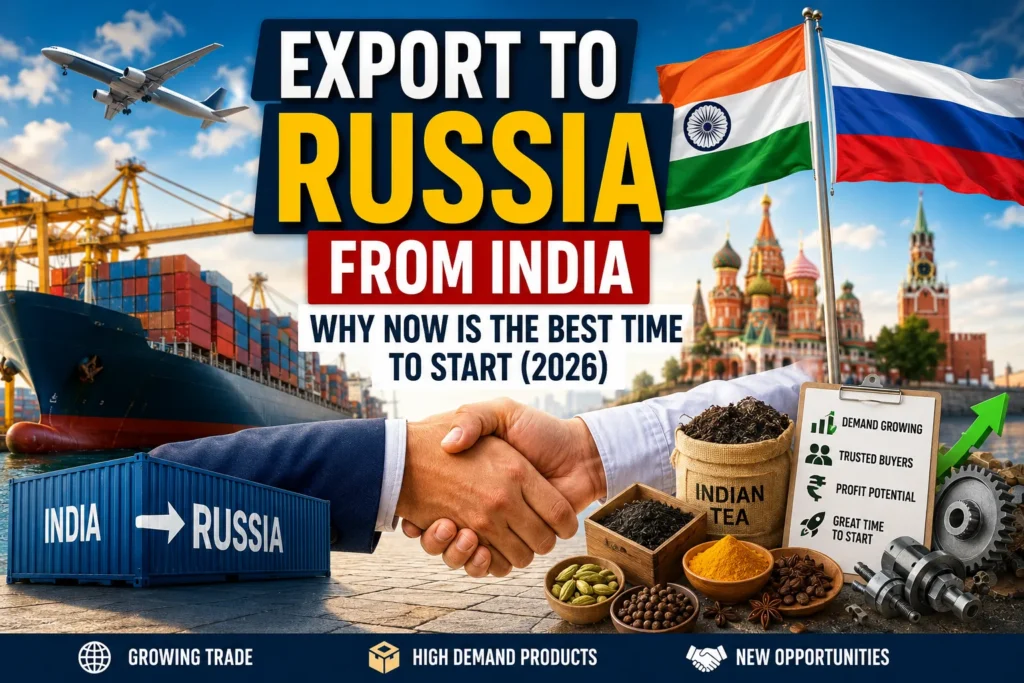
Export to Russia from India in 2026: Why the Opportunity Is Getting Bigger
If you’re an Indian manufacturer or MSME looking for a new export market in 2026, Russia deserves a closer look.
India and Russia are working toward an ambitious target of taking bilateral trade to $100 billion by 2030. Bilateral trade has already crossed $60 billion, while both countries are looking to diversify trade beyond the traditional energy-heavy relationship.
But here’s the more interesting part for Indian exporters:
India still exports far less to Russia than it imports from Russia.
India’s exports to Russia were about $4.49 billion in 2025, according to UN Comtrade data.
That gap could create opportunities for Indian businesses selling products such as:
- Machinery and engineering products
- Pharmaceuticals
- Chemicals
- Electrical equipment
- Food products
- Seafood
- Ceramics
- Plastics
- Spices and agricultural products
This guide explains how to export to Russia from India, which products are worth researching, what the emerging India-EAEU FTA could mean, and how an Indian MSME can assess whether the Russian market actually makes commercial sense.
Quick Answer: Is Russia a Good Export Market for India?
Yes — but it depends heavily on the product.
Russia is a large market with established demand for Indian pharmaceuticals, machinery, chemicals, electrical equipment, food and other products. At the same time, Indian exports remain relatively small compared with the overall value of bilateral trade.
For an MSME, the opportunity is not simply “export to Russia.”
The better strategy is:
Find the right product → identify the HS code → study Russian import demand → check tariffs and regulations → calculate landed cost → find and verify buyers.
That is the approach this guide follows.
Why Is Everyone Talking About Exporting to Russia?
If you follow international business news, you may have noticed that India–Russia trade has grown rapidly in recent years.
Most headlines focus on crude oil imports.
However, there is another important story that often receives less attention.
Russia is also looking to strengthen imports from India across a variety of sectors.
For Indian exporters, this creates opportunities that were much smaller a decade ago.
Instead of viewing Russia only as an energy supplier, many businesses now see it as a growing export destination for Indian products.
Is This Really the Best Time to Export to Russia from India?
Whenever I publish articles on BusinessZindagi, I try to avoid making exaggerated claims.
So let me be clear.
No one can guarantee success in export business.
Markets change.
Demand changes.
Trade policies change.
However…
Several developments have combined to make this one of the most interesting periods for Indian exporters.
Let’s understand why.
Is Exporting to Russia Risky?
Russia can be an attractive market, but Indian exporters should not treat it like a risk-free destination.
Before signing a contract, consider:
Payment risk
Banking channels and payment mechanisms can be more complicated than in traditional export markets.
Logistics risk
Freight routes, transit times, insurance and shipping costs can change the final landed price.
Compliance risk
International sanctions and trade restrictions can affect certain transactions, counterparties, financial institutions and products.
Currency risk
Changes in the rupee-ruble exchange rate can affect the profitability of an export contract.
Regulatory risk
Russian and EAEU product standards may differ from the requirements Indian manufacturers are familiar with.
Bottom line: Russia may offer opportunity, but exporters should conduct product-specific and transaction-specific due diligence before shipping.
1. India–Russia Trade Is Growing Faster Than Ever
Trade between India and Russia has increased significantly over the last few years.
While energy imports account for a large share of this growth, stronger trade relations also create opportunities for Indian exporters.
When trade between two countries expands, several positive developments usually follow:
- Better shipping connectivity.
- Stronger banking relationships.
- More business delegations.
- Easier commercial cooperation.
- Greater awareness of each country’s products.
All of these factors make international business easier than before.
2. Russia Wants to Buy More Products from India
This is one point many people overlook.
Trade between India and Russia is currently heavily tilted toward India’s imports.
To improve the balance, both governments and businesses have expressed interest in increasing Indian exports.
That creates opportunities in sectors where India already has strong manufacturing capabilities.
Examples include:
- Pharmaceuticals
- Tea
- Coffee
- Spices
- Textiles
- Engineering goods
- Chemicals
- Machinery
- Agricultural products
For Indian MSMEs, this represents an opportunity to explore new markets rather than depending only on domestic demand.
🔎 Don’t Know Your Product’s HS Code?
Before researching the Russian market, identify the correct HS code for your product.
Try the BusinessZindagi HS Code Finder →
Your HS code can help you research tariffs, import data, competitors and market demand more accurately.
3. Global Supply Chains Are Changing
One of the biggest lessons from the past few years is that businesses do not want to depend on a single source for all their imports.
Russian companies, like businesses in many countries, have been diversifying their supplier base.
India has emerged as an attractive sourcing destination because of:
- Competitive manufacturing costs.
- Large industrial base.
- Skilled workforce.
- Reliable production capabilities.
- Wide variety of exportable products.
This does not mean every exporter will succeed automatically.
But it does mean there are more opportunities for prepared businesses.
4. Indian Products Already Enjoy a Strong Reputation
One advantage Indian exporters often underestimate is the country’s existing reputation.
Several Indian products are already recognised internationally for quality and value.
These include:
Tea
As someone connected with Assam’s tea industry, I naturally pay close attention to this sector.
Indian tea is known worldwide.
Premium Assam Tea, Orthodox Tea, Green Tea, and specialty blends continue to attract buyers across international markets.
Pharmaceuticals
India is often referred to as the “Pharmacy of the World.”
Its pharmaceutical industry has built a reputation for manufacturing quality generic medicines at competitive prices.
Engineering Products
Indian engineering companies now supply products to markets around the globe.
Components, industrial equipment, fabrication products, pumps, valves, and machinery all have export potential.
Textiles
Indian textiles continue to enjoy strong international demand because of their quality, craftsmanship, and competitive pricing.
Spices
Indian spices remain among the country’s strongest export categories.
Products such as:
- Cardamom
- Black Pepper
- Turmeric
- Cumin
- Coriander
continue to find buyers worldwide.
5. The Biggest Advantage Today’s Exporters Have
This, in my opinion, is the most important reason why now is a good time to Export to Russia from India.
Twenty years ago…
Finding a genuine buyer was difficult.
Market research was expensive.
You often had to:
- Visit trade fairs.
- Purchase expensive market reports.
- Travel overseas.
- Depend on personal contacts.
Today…
You can learn an enormous amount before making your first phone call.
You can discover:
- Which products are being imported.
- Who the buyers are.
- Which suppliers already serve them.
- How often shipments take place.
- Which HS Codes are used.
- Which countries compete with India.
This information allows exporters to make decisions based on evidence instead of assumptions.
Information Is the New Competitive Advantage
If I were starting my export journey again today, I would spend less time searching for random buyer lists and more time understanding the market.
In my experience, successful exporters don’t simply ask:
“Who can buy my product?”
Instead, they ask:
- Is there consistent demand?
- Who is already importing?
- How competitive is the market?
- Can I offer something better?
- Which buyers import regularly?
These are far better questions.
And fortunately, today’s exporters have tools that can help answer them.
One Tool That Can Save Months of Guesswork
Before investing in production, samples, or international travel, I believe it’s worth studying actual shipment trends.
One way to do this is by using shipment intelligence platforms such as Volza, which allow you to explore import-export shipment data, identify active buyers, analyse suppliers, and understand market demand.
Rather than relying on assumptions, you can begin your export journey with real trade information.
BusinessZindagi Tip: Before approaching your first Russian buyer, spend at least an hour researching your product’s import history. Understanding who is already importing and how frequently they buy can help you focus your efforts more effectively.
Want to explore Russian import shipment data yourself?
You can check buyers, shipment trends, HS Codes, and supplier information using Volza. (click for free trail.)
The Most Important Lesson I Have Learned About Exporting
If there is one lesson I wish every new exporter understood, it is this:
Don’t choose a product first. Choose a market opportunity first.
Many beginners follow this path:
Product → Manufacture → Search for Buyers
A more effective approach is:
Market Demand → Buyer Research → Product Selection → Quotation → Shipment
This simple shift in thinking can save months of effort and help you build an export business on real demand rather than guesswork.
Export to Russia from India: Don’t Search for Buyers—Search for Demand First
One of the biggest misconceptions among new exporters is that the first step is finding buyers.
In my opinion, that isn’t the first step at all.
The first step is understanding whether there is real demand for your product.
Imagine two exporters.
Exporter A manufactures a product because someone told him it has “good export potential.” After production, he starts searching for buyers.
Exporter B spends a few hours studying the market first. He identifies products that Russian companies are already importing, understands the competition, learns the common HS Codes, and then approaches buyers who have a history of importing similar products.
Who has a better chance of success?
The answer is obvious.
At BusinessZindagi, we always encourage readers to research first and invest later.
That simple habit can save thousands of rupees and months of unnecessary effort.
My Biggest Export Lesson
When I first became interested in exports, I thought documentation would decide whether I succeeded.
I was wrong.
Preparing invoices, packing lists, shipping documents, and customs paperwork is important—but these are processes that can be learned.
Finding genuine buyers is what really determines whether your export business grows.
Over the years, I realised that many exporters spend far too much time collecting email addresses and far too little time understanding the market.
If I were starting from zero today, I wouldn’t begin by emailing hundreds of companies.
I would first try to understand the market.
The questions I’d ask include:
Is Russia importing this product regularly?
If imports are consistent throughout the year, it suggests there is ongoing demand.
Who Are the Biggest Russian Buyers?
Not all buyers are equal.
Some import once every few years.
Others import every month.
Those with regular purchasing activity may be more promising prospects.
Which Countries Supply These Buyers?
This tells you:
- Who your competitors are.
- Whether India already has a presence.
- Which countries dominate the market.
If Indian exporters are already supplying Russian buyers, that’s often a positive sign that the market is accessible.
What HS Code Is Used?
Understanding the correct HS Code helps with:
- Product classification.
- Customs documentation.
- Duty research.
- More accurate market analysis.
Are Imports Increasing or Declining?
If demand is growing, there may be more opportunities for new suppliers.
The Advantage Today’s Exporters Have
Twenty years ago, gathering this information would have been difficult and expensive.
Today, shipment intelligence platforms make much of this research accessible before you spend money on inventory or overseas travel.
One example is Volza, which allows exporters to explore import-export shipment data to better understand international markets.
Rather than relying on guesswork, you can see which products are being traded, identify active buyers, study suppliers, and analyse shipment trends.
BusinessZindagi Tip: Before you invest ₹1 lakh in manufacturing or inventory, consider investing one hour in market research. Understanding real import activity can help you avoid costly mistakes.
Planning to export to Russia from India?
You can explore Russian shipment data, identify active importers, check HS Codes, and analyse trade trends using Volza.
👉 [click for a free trail Here]Affiliate Disclosure: If you purchase through this link, BusinessZindagi may earn a commission at no extra cost to you. I recommend it because shipment research can help exporters make more informed decisions.
Case Study: If I Wanted to Export Assam Tea to Russia
Since I have experience in the tea business, let’s use Assam tea as an example.
Suppose I want to export premium Assam black tea to Russia.
I wouldn’t begin by emailing hundreds of companies.
Instead, I would first ask:
- Does Russia import Assam tea or similar black tea?
- How many shipments arrive each year?
- Which Russian companies import tea regularly?
- Which Indian exporters already supply them?
- Are buyers purchasing premium tea, CTC tea, or both?
Researching these questions gives me a much clearer picture of the market before I invest time or money.
The same approach applies whether you’re exporting spices, engineering goods, textiles, machinery, or chemicals.
Step-by-Step: How to Research Russian Buyers Using Volza
Step 1: Search for Your Product
Open Volza and search for your product—for example:
- Tea
- Turmeric
- Rice
- Textile
- Pump
- Valve
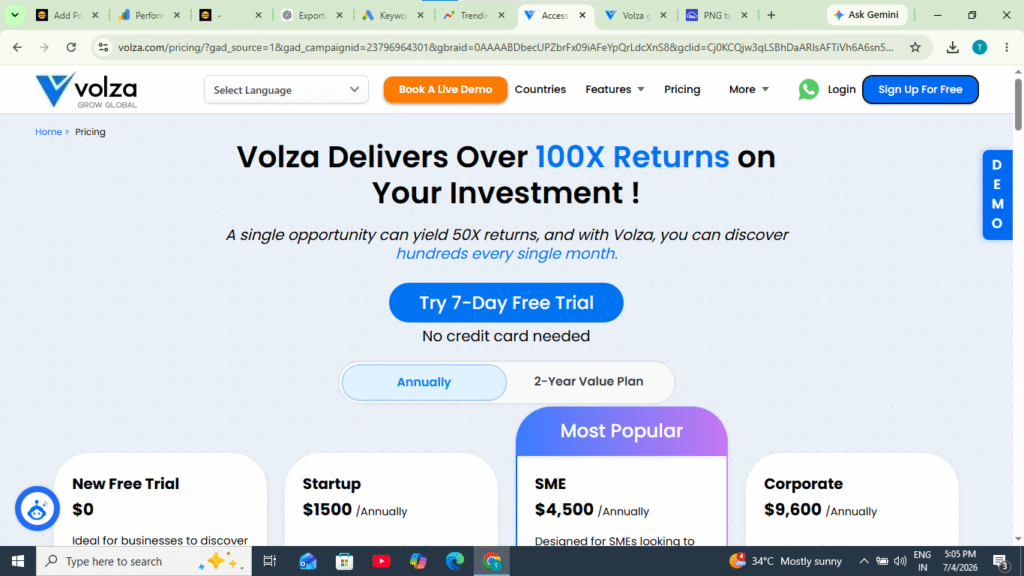
Caption: Search for the product you want to export.
Step 2: Select Russia as the Importing Country
Apply the destination filter and choose Russia.
This narrows the results to imports into the Russian market.
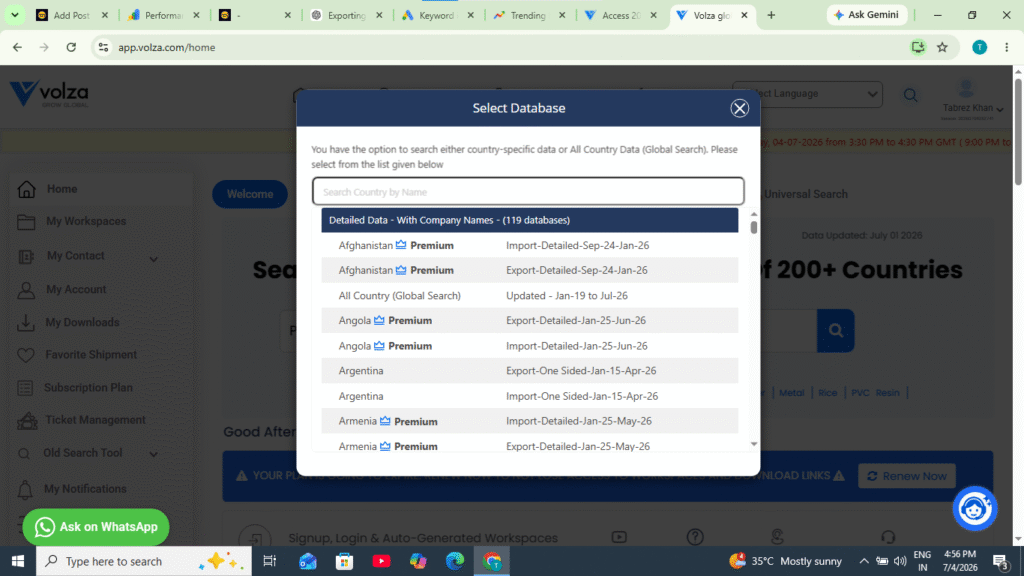
Caption: Filter results to show shipments into Russia.
Step 3: Study the Buyer List
Rather than downloading a list and emailing everyone, examine:
- Import frequency.
- Shipment history.
- Product descriptions.
- Consistency of purchases.
Buyers with regular import activity are often better prospects than companies with only one historical shipment.
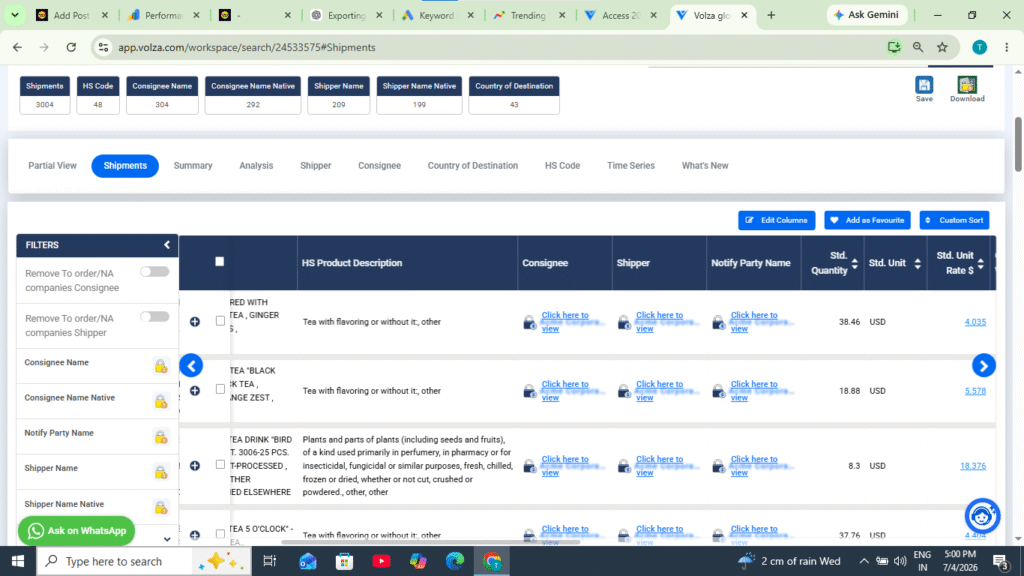
Step 4: Study Existing Suppliers
Look at which countries and companies are already supplying these buyers.
Ask yourself:
- Can my product compete?
- Can I offer better quality?
- Can I provide better packaging?
- Can I offer competitive pricing?
Market research is not just about finding buyers—it’s also about understanding the competition
Step 5: Note the HS Code
Record the HS Code used for your product.
This will help when preparing export documentation and researching customs requirements.
may offer opportunities depending on buyer demand and quality requirements
One Habit That Can Save Every Exporter Money
Whenever you’re considering a product, ask yourself one question:
“Who is already importing this?”
If you can answer that question before you manufacture, package, or market your product, you’re already ahead of many first-time exporters.
That’s why I consider market research to be the first investment every exporter should make.
“If I were starting from zero today, I wouldn’t spend huge money initially on advertisements or international travel. I would spend time understanding the market. One afternoon of studying real shipment data can prevent months of chasing the wrong buyers.”
“Whether you use Volza or another reliable shipment intelligence platform, make market research your first investment—not your last.”
📚 Suggested Articles to Read
- How to Start Tea Export From India (Complete Guide 2026)
- How to Find International Buyers Without Visiting Trade Fairs
- Best Free Import Export Databases (Beginner Guide): How to Find Genuine Export Buyers Without Paying Thousands
ECGC Export Credit Insurance Explained for Indian Exporters- How to Prepare a Proforma Invoice for Export
- Letter of Credit (LC) Explained for First-Time Exporters
About the Author
Tabrez Khan is the founder of BusinessZindagi.com and an entrepreneur from Assam. Drawing on his experience in the tea industry and export business, he shares practical, research-backed guides to help Indian entrepreneurs start and grow successful businesses.
AI & Affiliate Disclosure
AI Disclosure: This article was researched and refined with the help of AI tools. The final content has been reviewed, edited, and approved by the author.Wherever possible, information has been verified using official government websites and other reliable sources.
The goal of using AI is not to replace human expertise but to help deliver accurate, well-organized, and valuable content for our readers.
Affiliate Disclosure: Some links in this article are affiliate links. If you make a purchase through them, BusinessZindagi may earn a small commission at no extra cost to you. I only recommend tools I believe are genuinely useful.
Sources & References
- Directorate General of Foreign Trade (DGFT) – https://www.dgft.gov.in
- Ministry of Commerce & Industry – https://commerce.gov.in
- Federation of Indian Export Organisations (FIEO) – https://www.fieo.org
- Export Credit Guarantee Corporation (ECGC) – https://www.ecgc.in
- ICEGATE (Indian Customs) – https://www.icegate.gov.in
- Reserve Bank of India (RBI) – https://www.rbi.org.in
- Indian Embassy in Moscow – https://indianembassy-moscow.gov.in
- India Brand Equity Foundation (IBEF) – https://www.ibef.org