
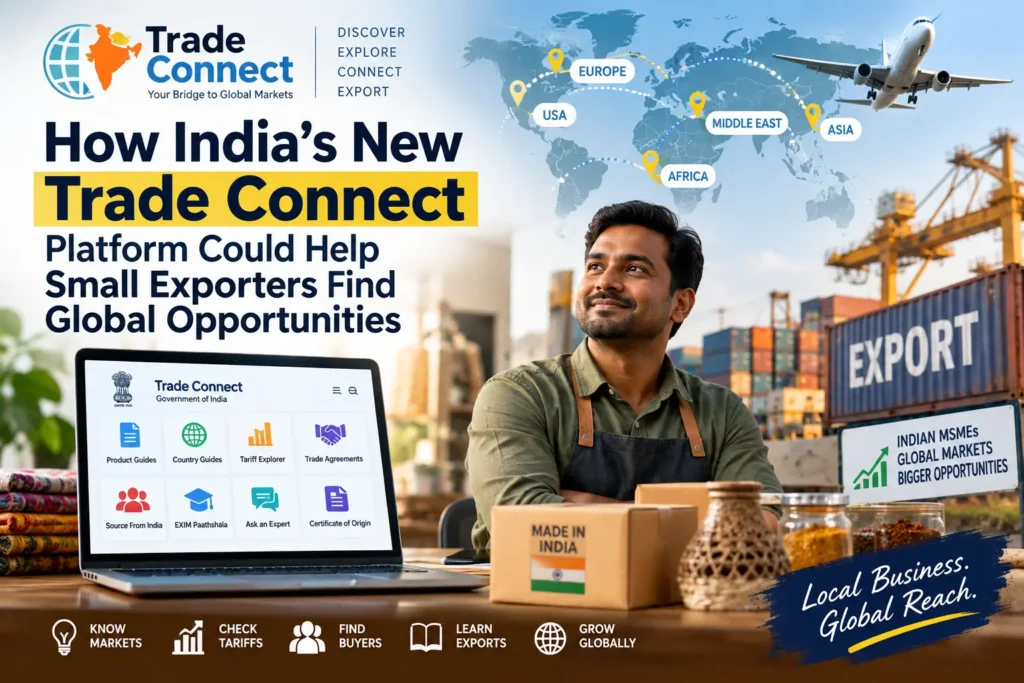
Want to export from India but don’t know which country to target, what tariff you will face or where to find overseas buyers?
Before spending money on expensive market-research reports or randomly searching Google for foreign buyers, there is a government platform worth exploring.
It is called Trade Connect ePlatform.
Developed by the Directorate General of Foreign Trade (DGFT), Trade Connect brings several export-related resources together, including market information, tariff and trade-agreement information, buyer discovery, export learning resources and access to trade-related experts.
For a small Indian exporter, the interesting question isn’t simply “What is Trade Connect?”
The better question is:
How can I actually use Trade Connect to go from my product to a foreign market and eventually to a potential buyer?
Let’s look at the practical workflow.
What Is Trade Connect ePlatform?
Trade Connect is the Government of India’s digital platform for international trade.
It is designed to bring exporters closer to trade information, government agencies, Export Promotion Councils, Indian Missions abroad and other trade-support resources through a single interface.
Some of the important features include:
- Product Guides
- Country Guides
- Trade Agreements and Tariff Explorer
- Global E-Commerce Guide
- EXIM Paathshala
- Source From India
- Ask an Expert
- Trade events information
- Certificate of Origin services
So, rather than thinking of Trade Connect as simply a buyer-finding website, think of it as an export research and support platform.
Visit the official Trade Connect ePlatform
Why Trade Connect Can Be Useful for Small Exporters
A large company may have a dedicated export research team.
A small MSME usually doesn’t.
If you are a manufacturer, trader or first-time exporter, you may have questions like:
- Which country should I target?
- Is there demand for my product?
- What is the import tariff?
- Is there an FTA with India?
- What certifications are required?
- What are the country’s import requirements?
- Where can I find overseas buyers?
- How do I understand the export process?
Trade Connect attempts to bring many of these resources together.
But there is an important point:
Trade Connect does not guarantee export orders.
It can help you research opportunities and connect with the export ecosystem. You still have to evaluate the market, verify buyers, calculate your price and manage the commercial risk yourself.
How to Use Trade Connect: A Practical Exporter’s Workflow
Imagine you are a small Indian MSME manufacturing tea, spices, handicrafts, garments, food products or engineering goods.
Instead of immediately searching Google for “buyers in USA” or “buyers in Dubai”, follow a structured process.
Product → Market → Tariff → Compliance → Buyer → Verification → Quotation
Let’s break it down.
1. Start With Your Product
Don’t begin with a country.
Begin with the product you can actually supply.
For example:
Assam tea → spices → handicrafts → rice → garments → engineering components
The first step is understanding your product classification and identifying the appropriate HS code.
Your HS code becomes extremely important because tariffs, trade agreements and import requirements are generally linked to the product classification.
Once you know your product and HS code, you can begin researching potential markets.
2. Research Potential Export Markets
This is where the Product Guide and Country Guide can become useful.
Trade Connect provides information intended to help exporters understand markets, market-access conditions, certification requirements and other country/product-related considerations.
For example, suppose you manufacture an Indian food product.
Instead of asking:
“Which country is best?”
you should ask:
“Which countries appear commercially interesting for my particular product, and what would I need to comply with before entering those markets?”
That is a much better export-research question.
BusinessZindagi Tip
Never choose an export market only because you know someone there.
Look at:
- Demand
- Import requirements
- Tariffs
- Competition
- Logistics
- Payment risk
- Product standards
- Your final landed price
3. Check Import Tariffs and FTA Opportunities
One of the most useful parts of Trade Connect is its Trade Agreements and Tariff Explorer.
The platform provides information on trade agreements and tariffs so exporters can assess potential preferential tariff benefits under applicable agreements.
This matters because your product may face different tariff treatment in different countries.
For example:
Country A → higher tariff
Country B → preferential tariff under an applicable trade agreement
That difference can directly affect your competitiveness.
But don’t stop at seeing a preferential tariff.
You also need to check:
- Correct HS classification
- Rules of origin
- Product-specific requirements
- Documentation
- Whether your shipment actually qualifies for the preference
4. Check Non-Tariff Requirements
This is one area where inexperienced exporters often make mistakes.
A country may have an attractive tariff but still have demanding import requirements.
Depending on the product, these could include:
- Product standards
- Testing
- Certification
- Labelling
- Packaging requirements
- Food-safety requirements
- Documentation
- Rules of origin
- Import restrictions
Trade Connect’s product and country information is designed to help exporters understand market-access and compliance considerations.
Remember:
Low tariff does not automatically mean easy market entry.
5. Find Potential Overseas Buyers
Now we reach the part every exporter wants to know about:
Where are the buyers?
Trade Connect includes a feature called Source From India.
It is designed to give international buyers a way to discover Indian exporters and connect with them.
In August 2026, DGFT also expanded eligibility for the Source From India service to eligible DPIIT-recognised startups, allowing qualifying startups to create profiles/microsites to increase their visibility to international buyers.
For an eligible exporter, this provides another channel through which overseas buyers can discover Indian suppliers.
But there is an important distinction.
Buyer discovery is not the same as buyer verification.
Finding a company name is easy.
Finding a company that:
- actually imports your product,
- buys regularly,
- matches your required quantity,
- operates in your target market,
- and is worth approaching
is a much more valuable exercise.
6. Go Beyond Google When Researching Export Buyers
This is where serious exporters can add another layer to their research.
Suppose Trade Connect helps you identify Country X as an interesting market for your product.
You could then research companies actually importing your product in that market using shipment-based trade intelligence.
For example, Volza provides exporter-focused buyer intelligence based on international trade/shipment data, with tools to search buyers, analyze shipment activity and identify potential decision-makers.
A smarter workflow is:
Trade Connect
→ Understand the market
→ Check tariffs and trade agreements
→ Check compliance
→ Identify potential export opportunities
Then use trade data
→ Find companies actually importing the product
→ Study their shipment activity
→ Shortlist relevant buyers
→ Research the company
→ Approach the right decision-maker
That is far more targeted than sending hundreds of generic emails to companies found through Google.
🔎 Want to Find Companies Already Importing Your Product?
If you have already identified a promising export market, the next question should be:
“Which companies are actually importing this product?”
You can use Volza’s export-import trade intelligence to research shipment-backed buyers, markets and suppliers rather than relying only on generic business directories.
Explore Volza Buyer Intelligence for Exporters
BusinessZindagi Tip: Use Trade Connect for the government-side market and trade information, and use shipment data as an additional layer when you need to investigate actual importers and buyer activity.
7. Learn the Export Process With EXIM Paathshala
If you are new to exporting, don’t use Trade Connect only for buyer research.
The platform also includes EXIM Paathshala, which provides learning resources related to international trade and export procedures.
This can be particularly useful for entrepreneurs who understand their product but are unfamiliar with:
- Export documentation
- International trade procedures
- Market entry
- Trade terminology
- Export compliance
You don’t need to become an international-trade expert overnight.
But you should understand the basic process before accepting your first overseas order.
8. Use “Ask an Expert” When You Get Stuck
Exporters often don’t know which department or institution handles a particular trade-related question.
Trade Connect also includes an Ask an Expert facility intended to help exporters get answers to trade-related queries.
This is particularly useful when you are dealing with an issue that is more complicated than a simple Google search.
9. Don’t Forget Certificate of Origin Services
Trade Connect also integrates Certificate of Origin services.
The government describes the platform as a single point for issuance and validation of preferential and non-preferential Certificates of Origin through a digital process.
This becomes relevant when your buyer or destination-country requirements call for a Certificate of Origin.
An Assam Exporter Example
Let’s make this practical.
Imagine a small tea business in Assam wants to export Assam black tea.
A common approach might be:
“I want to export tea. Let me search Google for tea buyers in Russia.”
A more structured approach would be:
Step 1
Identify the correct product classification and HS code.
Step 2
Research potential destination markets.
Step 3
Compare market-access conditions.
Step 4
Check applicable tariffs and trade agreements.
Step 5
Check certification, labelling and other import requirements.
Step 6
Explore buyer-discovery options through Trade Connect.
Step 7
Use shipment data to identify companies that are actually importing tea.
Step 8
Verify the potential buyer.
Step 9
Calculate your export price.
Step 10
Send a professional quotation and negotiate payment and shipping terms.
This approach doesn’t guarantee an order.
But it gives the exporter a much more structured starting point.
Trade Connect vs Buyer-Data Platforms
These two should not necessarily be viewed as competitors.
They solve different problems.
| What you need | Useful starting point |
|---|---|
| Country information | Trade Connect |
| Government trade information | Trade Connect |
| Tariff research | Trade Connect |
| FTA information | Trade Connect |
| Compliance information | Trade Connect |
| Export learning | Trade Connect |
| Government buyer-discovery ecosystem | Trade Connect |
| Actual importer research | Shipment/trade-data platforms |
| Buyer shipment history | Shipment/trade-data platforms |
| Buyer activity analysis | Shipment/trade-data platforms |
| Decision-maker research | Buyer-intelligence platforms |
The smarter strategy is to combine information sources rather than depend entirely on one platform.
What Trade Connect Cannot Do For You
This is important.
Trade Connect cannot:
❌ Guarantee an export order
❌ Guarantee that a buyer will respond
❌ Replace buyer due diligence
❌ Eliminate payment risk
❌ Automatically make your product competitive
❌ Replace product-specific compliance checks
❌ Tell you that every company listed or discovered is a suitable buyer
Your job as an exporter is still to verify the opportunity.
The 10-Step Trade Connect Export Strategy
If I were a first-time exporter, I would keep this simple:
1. Identify your product
↓
2. Find the correct HS code
↓
3. Research potential countries
↓
4. Check tariffs
↓
5. Check FTA opportunities
↓
6. Check compliance requirements
↓
7. Search for potential buyers
↓
8. Verify buyer activity
↓
9. Calculate your actual export price
↓
10. Approach the buyer professionally
That’s the difference between “I want to export” and actually building an export-sales process.
Final Takeaway
For a small Indian business, the biggest challenge is often not manufacturing the product.
It is finding the right market, understanding the rules and reaching the right buyer.
Trade Connect brings many pieces of that process together in one government-backed platform, including market information, tariffs, trade agreements, export learning, buyer discovery and trade-related support.
But don’t make the mistake of thinking that one platform will do everything.
Use Trade Connect to understand the market and government trade ecosystem.
Then go deeper with buyer research, shipment data, company verification, pricing and due diligence.
The goal isn’t simply to find a foreign buyer.
The goal is to find the right buyer for a product you can supply profitably, compliantly and reliably.
That is where your export journey really begins.
⚠️ Editorial Disclaimer
This article is intended for general informational and educational purposes only. Trade Connect features, export procedures, tariffs, trade agreements, eligibility conditions and government policies may change from time to time. BusinessZindagi does not guarantee export orders, buyer responses or commercial outcomes. Always verify the latest information with DGFT, the Ministry of Commerce & Industry, the relevant Export Promotion Council, Indian Mission or other competent authority before making an export or financial decision.
Where third-party tools or services are mentioned, readers should independently evaluate their suitability before using them.
🔗 Official Sources & References
- Trade Connect ePlatform — Government of India:
https://www.trade.gov.in/ - PIB — Trade Connect ePlatform:
https://www.pib.gov.in/PressReleaseIframePage.aspx?PRID=2149736&lang=2®=3 - PIB — Source From India expansion for startups:
https://www.pib.gov.in/PressReleasePage.aspx?PRID=2296253&lang=1®=3 - Directorate General of Foreign Trade (DGFT):
https://www.dgft.gov.in/ - Ministry of Commerce & Industry:
https://commerce.gov.in/
🔗 Related BusinessZindagi Resources
- DGFT Source From India: How Indian Exporters Can Find Foreign Buyers:
https://businesszindagi.com/dgft-source-from-india/amp/ - How to Find Verified International Buyers Using Global Trade Data:
https://businesszindagi.com/global-trade-data/ - Your First Export Order: Proforma Invoice, CHA, Shipping Bill & Port Choice:
https://businesszindagi.com/first-export-order-no1/ - Export Proforma Invoice Format & Template:
https