
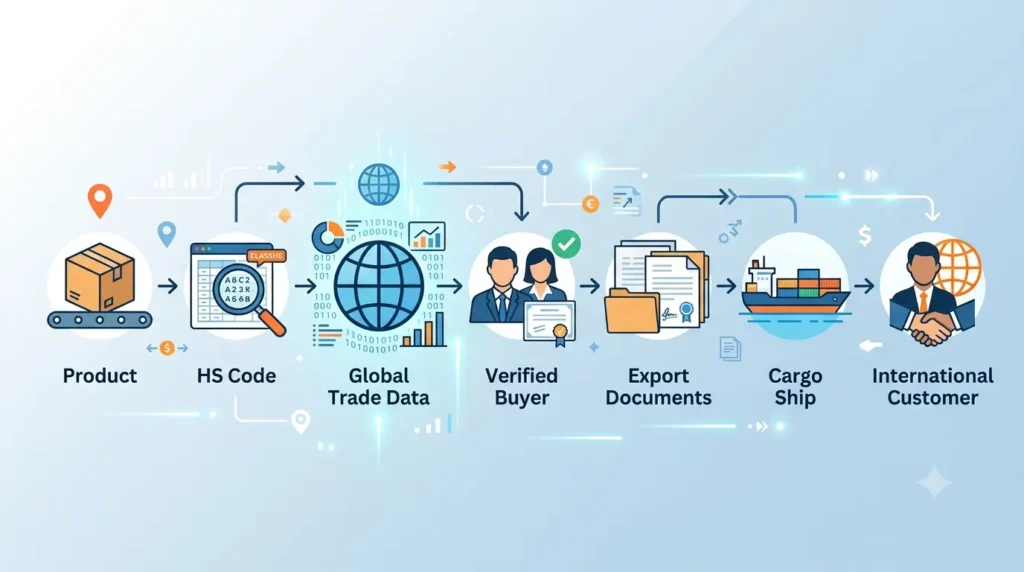
Finding genuine overseas buyers is one of the biggest challenges for every exporter. Many businesses spend months sending cold emails, attending trade fairs, or relying on expensive agents without achieving consistent results.
But what if you could identify companies that are already importing products like yours?
This is where global trade data becomes a valuable business intelligence tool.
Instead of guessing who might be interested, global trade data helps you discover companies that have already imported similar products. It also provides insights into shipment frequency, sourcing patterns, export destinations, and market trends, enabling exporters to make informed decisions.
Whether you’re a manufacturer, merchant exporter, startup founder, or MSME owner, learning how to use global trade data can significantly improve your export strategy.
In this BusinessZindagi guide, you’ll learn what global trade data is, how it works, and how to use it step by step to identify verified international buyers.
What Is Global Trade Data?
Global trade data is a collection of international import and export shipment records gathered from customs authorities, ports, government agencies, and other legally available trade sources.
These records help businesses understand how products move across international markets.
Depending on the country and data source, a trade record may include:
- Product description
- HS Code
- Importer’s name
- Exporter’s name
- Country of origin
- Destination country
- Shipment date
- Quantity
- Unit
- Port of loading
- Port of discharge
- Shipment frequency
Businesses use this information for:
- Finding active buyers
- Market research
- Competitor analysis
- Product demand analysis
- Pricing research
- Supplier identification
- Export planning
Unlike traditional buyer directories, global trade data is based on actual shipment activity rather than marketing listings.
Why Global Trade Data Matters for MSMEs
Many MSMEs assume that trade intelligence tools are only useful for large corporations.
In reality, even a small exporter can use shipment data to compete more effectively.
Instead of contacting hundreds of random companies, exporters can focus on businesses that have already demonstrated demand for their products.
For example, if you manufacture Assam tea, industrial machinery, spices, handicrafts, textiles, or engineering products, global trade data can help you identify companies that import these products regularly.
This saves time, reduces marketing costs, and improves the quality of export leads.
Global Trade Data vs Import Export Data
Although these terms are often used interchangeably, there are subtle differences.
| Global Trade Data | Import Export Data |
|---|---|
| Covers worldwide trade intelligence | Often focuses on specific countries or regions |
| Used for market research and strategic planning | Commonly used to identify buyers and suppliers |
| Includes multi-country trade trends | Usually focuses on shipment records |
| Helps identify emerging markets | Helps identify active importers and exporters |
| Useful for competitor analysis | Useful for buyer generation |
In practice, many commercial platforms combine both concepts into a single database, allowing users to search shipment records from multiple countries.
Why Traditional Buyer Search Methods Often Fail
Many first-time exporters rely on methods such as:
- Purchasing outdated email lists
- Sending mass emails
- Random Google searches
- Business directories
- Social media messages
These methods often produce poor results because there is no guarantee that the companies are currently importing your product.
Global trade data reduces this uncertainty by showing businesses with actual import activity.
Instead of asking, “Who might buy my product?”, you begin with “Who is already buying this product?”
This simple shift can make your export marketing far more targeted.
Benefits of Using Global Trade Data
1. Find Active International Buyers
One of the biggest advantages is identifying companies that are actively importing products similar to yours.
Rather than contacting random businesses, you can focus on buyers with a proven purchasing history.
2. Study Competitors
Trade data allows you to analyze:
- Which countries your competitors export to
- Who buys from them
- How frequently they ship
- Which ports they use
- Seasonal shipment patterns
This information can help you discover markets you may have overlooked.
3. Identify High-Demand Markets
Shipment records often reveal where demand is increasing.
For example, if imports of your product are rising steadily in a particular country, it may indicate a growing business opportunity.
4. Improve Export Planning
Instead of relying on assumptions, businesses can use actual trade data to:
- Select target countries
- Estimate market demand
- Plan production
- Forecast inventory
- Develop marketing strategies
5. Save Time and Marketing Costs
Finding buyers through random outreach often requires significant effort with uncertain results.
Global trade data helps exporters focus their marketing efforts on companies that are more likely to respond because they already import similar products.
Who Should Use Global Trade Data?
Global trade data is useful for:
- Manufacturers
- Merchant exporters
- Startup exporters
- MSMEs
- Buying houses
- Importers
- Export consultants
- International sourcing professionals
- Market researchers
Even businesses planning their first export shipment can use trade intelligence to understand market demand before investing significant time and money.
Is Global Trade Data Legal?
Yes—when obtained from reputable providers, global trade data is generally compiled from legally available customs records, government publications, port information, and other authorized sources, subject to each country’s laws and data availability.
However, the level of detail varies by country. Some countries publish importer and exporter names, while others release only aggregated trade statistics or restrict certain commercial information.
Businesses should always ensure they use trade data in compliance with applicable laws and platform terms of use.
What’s Next?
In the next section, we’ll cover the practical part of the guide:
- How to find verified international buyers using global trade data
- How to search by HS Code
- How to shortlist genuine buyers
- How to analyze shipment history like a professional exporter
- A practical workflow that MSMEs can follow before contacting overseas buyers
How to Find Verified International Buyers Using Global Trade Data (Step-by-Step Guide)
Now that you understand what global trade data is, the next step is learning how to use it effectively.
Many first-time exporters make the mistake of downloading a list of buyers and immediately sending emails. Unfortunately, this approach rarely works.
Successful exporters follow a structured process. They first research the market, analyze shipment history, verify buyers, and only then begin contacting potential customers.
Here’s a practical workflow you can follow.
Step 1: Identify the Correct HS Code
Everything starts with the correct HS (Harmonized System) Code.
An HS Code is an internationally standardized product classification system used by customs authorities worldwide.
Searching with the wrong HS Code may show unrelated products or cause you to miss genuine buyers.
Example
Suppose you export Assam Black Tea.
Instead of searching only for “tea,” identify the correct HS Code applicable to your product category. This helps you retrieve more relevant shipment records.
Pro Tip: If you’re unsure about your product’s HS Code, verify it using your country’s customs or trade authority before searching global trade data.
Step 2: Search Global Trade Data
After identifying the correct HS Code, search a reliable global trade database.
Instead of looking for random companies, search using:
- HS Code
- Product name
- Destination country
- Importing country
- Exporting country
- Buyer name (if known)
- Supplier name
- Port of shipment
This allows you to generate a focused list of companies already trading in your product.
Step 3: Shortlist Buyers with Recent Shipments
Not every buyer is worth contacting.
Focus on businesses with recent import activity.
For example, buyers who imported similar products within the last 6–12 months are generally more relevant than companies whose last shipment was several years ago.
Look for buyers with:
- Recent shipment dates
- Regular purchasing activity
- Consistent import volumes
- Multiple shipments from different suppliers
These are often signs of an active importer.
Step 4: Analyze Shipment Frequency
Shipment frequency tells an important story.
Compare these two buyers:
Buyer A
- Imported once in 2023
- No shipments since then
Buyer B
- Imports every month
- Purchases from multiple suppliers
- Continues importing regularly
Which buyer would you contact first?
Most exporters would prioritize Buyer B because the ongoing import activity suggests continuous demand.
Step 5: Study Import Quantity
Shipment quantity helps estimate a buyer’s purchasing capacity.
For example:
- Small shipments may indicate a distributor or startup.
- Medium shipments could represent regional wholesalers.
- Large and frequent shipments often suggest established importers.
Understanding this helps you decide whether your production capacity matches the buyer’s requirements.
Step 6: Analyze Existing Suppliers
One of the most valuable features of global trade data is supplier analysis.
Many exporters skip this step.
If a buyer has imported from three different suppliers over the past year, it may indicate that they are open to evaluating new vendors.
On the other hand, if all shipments consistently come from one supplier over several years, building a relationship may take more time and effort.
This information helps you prioritize your outreach.
Step 7: Study Seasonal Buying Patterns
Many products have seasonal demand.
Examples include:
- Tea
- Spices
- Garments
- Agricultural products
- Gifts and handicrafts
- Food ingredients
Trade data often reveals when buyers typically place large orders.
Instead of contacting buyers randomly, you can approach them a few months before their usual purchasing cycle begins.
This improves the likelihood of receiving a response.
Step 8: Identify New Export Markets
Many exporters focus only on well-known markets like the United States, the United Kingdom, Germany, or the UAE.
Global trade data often reveals emerging opportunities in countries where demand is growing but competition may be lower.
Diversifying your target markets can reduce dependence on a single economy and create new growth opportunities.
Step 9: Verify Buyer Credentials
Finding a buyer in a trade database is only the beginning.
Before sharing quotations, samples, or payment terms, verify the company’s credibility.
A simple due diligence checklist includes:
✅ Official company website
✅ Business registration details
✅ Professional email address
✅ LinkedIn company profile
✅ Physical office address
✅ Telephone number
✅ Import history
✅ Trade references (if available)
Taking these steps can help reduce the risk of fraud and improve your confidence when entering new international markets.
Step 10: Personalize Your Outreach
This is where many exporters fail.
Avoid sending generic emails like:
“Dear Sir, We are a leading exporter. Please buy our products.”
Instead, demonstrate that you understand the buyer’s business.
For example:
- Mention the product they import.
- Refer to the market they serve.
- Explain how your product meets their requirements.
- Highlight certifications, quality standards, or production capabilities relevant to their needs.
A personalized email is far more likely to receive attention than a mass message.
A Practical Workflow for MSMEs
Here’s a simple process you can follow every time you research a new market:
Identify the Correct HS Code
            ↓
Search Global Trade Data
            ↓
Filter Recent Shipments
            ↓
Analyze Shipment Frequency
            ↓
Study Existing Suppliers
            ↓
Verify Buyer Credentials
            ↓
Shortlist High-Potential Buyers
            ↓
Send Personalized Email
            ↓
Follow Up Professionally
Following this workflow helps you move from guesswork to data-driven export marketing.
BusinessZindagi Practical Example
Imagine you’re an MSME manufacturing Assam orthodox tea.
Instead of emailing hundreds of random importers, you search global trade data using the relevant HS Code.
Your search shows that a tea importer in Germany has imported Assam tea every month for the last three years from different Indian suppliers.
This information tells you several things:
- The buyer is active.
- They regularly purchase Assam tea.
- They are familiar with Indian suppliers.
- They may consider additional vendors.
Instead of making a cold approach, you’re now contacting a company with a demonstrated interest in your product. While this does not guarantee a sale, it makes your outreach far more targeted and increases the likelihood of a meaningful conversation.
AI + Global Trade Data: How Modern Exporters Find Better Buyers Faster
Global trade data can contain thousands of shipment records. Manually analyzing this information can be time-consuming, especially for MSMEs with limited resources.
Today, many exporters use AI tools to organize trade data, identify patterns, and prepare personalized buyer outreach. AI cannot replace your business judgment, but it can help you work more efficiently.
How AI Can Help Analyze Global Trade Data
Once you export shipment data into a spreadsheet, AI tools can assist with tasks such as:
- Summarizing thousands of shipment records
- Identifying the most active importers
- Grouping buyers by country
- Detecting seasonal buying patterns
- Comparing
Comparing Multiple Buyers
Suppose you have shipment records for 200 importers.
Instead of reviewing every row manually, AI can help you compare buyers based on factors such as:
- Number of shipments
- Recent import activity
- Estimated purchase volume
- Countries of origin
- Product categories
- Shipment consistency
This allows you to prioritize the most promising buyers before beginning outreach.
Remember: AI should support your decision-making—not replace proper market research or due diligence.
How AI Can Help Write Better Export Emails
Many exporters lose opportunities because they send generic emails.
After researching a buyer, AI can help you:
- Draft a professional introduction
- Customize emails for different countries
- Create product descriptions
- Rewrite emails in better business English
- Prepare follow-up messages
- Generate meeting agendas before video calls
However, always review AI-generated content to ensure it accurately reflects your products, pricing, certifications, and capabilities.
Case Study: How Global Trade Data Can Improve Buyer Research
Let’s look at a practical example.
Imagine an MSME in Assam manufactures premium black tea and wants to expand exports to Europe.
Without trade data, the company might:
- Search Google for tea importers
- Purchase a generic email database
- Send hundreds of cold emails
The response rate is likely to be low because many contacts may not currently import Assam tea.
Now consider a data-driven approach.
The exporter searches global trade data using the relevant HS Code and filters shipments to Germany.
The results show a German company that has imported Assam black tea every month for the last three years from different Indian suppliers.
Instead of approaching a random business, the exporter now has evidence that the company:
- Actively imports Assam tea
- Buys regularly
- Works with Indian exporters
- May be open to evaluating another supplier
The exporter then:
- Visits the buyer’s official website.
- Studies the company’s product portfolio.
- Identifies the purchasing contact.
- Sends a personalized email highlighting product quality, certifications, and export capabilities.
- Follows up professionally after a few days.
Important: Global trade data does not guarantee orders. It simply helps you identify buyers with a demonstrated interest in products like yours, making your marketing efforts more focused and efficient.
Common Mistakes to Avoid When Using Global Trade Data
Many exporters invest in trade intelligence tools but fail to use them effectively.
Avoid these common mistakes.
1. Contacting Outdated Buyers
Some companies listed in trade databases may no longer be actively importing.
Best Practice: Focus on buyers with recent shipment activity, ideally within the last 6–12 months.
2. Ignoring Shipment Frequency
A buyer who imported only once several years ago is usually less valuable than one who imports every month.
Consistent purchasing often indicates an ongoing business requirement.
3. Using the Wrong HS Code
Searching with an incorrect HS Code may produce irrelevant results.
Always verify your product classification before conducting research.
4. Depending on One Country Only
Many exporters concentrate on one market and overlook opportunities elsewhere.
Use global trade data to identify growing demand across multiple countries and diversify your export strategy.
5. Not Verifying Buyer Credentials
Shipment history alone does not confirm that a company is trustworthy.
Before sharing samples or agreeing to commercial terms, verify:
- Official website
- Business registration
- Company address
- Professional email
- Industry reputation
- Trade references, where available
6. Sending Generic Emails
Mass emails with the same message rarely generate positive responses.
Personalize your communication by referring to:
- The buyer’s imported products
- Their market
- Your relevant product strengths
- Certifications or quality standards
7. Ignoring Competitor Analysis
Many exporters use trade data only to find buyers.
Equally important is studying:
- Where competitors export
- Which buyers they serve
- Which markets are growing
- Which products are in demand
Competitor insights can help shape your export strategy and identify new opportunities.
Best Global Trade Data Platforms in 2026
Different platforms offer different levels of shipment data, analytics, and market intelligence. The right choice depends on your business goals and budget.
| Platform | Best For | Key Features |
|---|---|---|
| Volza | MSMEs, exporters, manufacturers | Buyer search, supplier analysis, shipment history, competitor research |
| ImportYeti | North American sourcing research | U.S. shipment records, supplier discovery |
| Trade Map (ITC) | Market research | Trade statistics, tariff information, country-level analysis |
| UN Comtrade | Researchers and policymakers | Official international trade statistics |
| Export Genius | Import-export intelligence | Shipment records, buyer and supplier insights |
Before subscribing to any platform, compare:
- Data coverage
- Countries supported
- Update frequency
- Search filters
- Export options
- Pricing
- Customer support
Choose the platform that best matches your export objectives rather than simply selecting the one with the largest database.
Is a Paid Global Trade Data Platform Worth It?
For businesses actively pursuing exports, a paid platform can save significant time by helping identify active buyers, study competitors, and evaluate market opportunities.
However, if you’re only exploring export possibilities or conducting academic research, free government trade portals and public databases may be sufficient.
Consider your export goals, budget, and expected return before investing in a subscription.
Frequently Asked Questions (FAQs)
1. What is global trade data?
Global trade data is a collection of international import and export shipment records that help businesses analyze trade flows, identify active buyers and suppliers, study competitors, and research international markets.
2. Is global trade data legal to use?
Yes. Reputable trade intelligence platforms compile data from legally available customs records, government publications, port data, and other authorized sources, subject to the laws and data-sharing policies of each country.
3. Can global trade data help me find verified international buyers?
Yes. Global trade data can help you identify companies that have previously imported products similar to yours. However, shipment history alone does not verify a buyer’s credibility. Always conduct due diligence before entering into any commercial agreement.
4. Is global trade data useful for MSMEs?
Absolutely.
Small manufacturers, merchant exporters, startups, and MSMEs can use global trade data to:
- Find active buyers
- Study competitors
- Discover new markets
- Understand demand trends
- Improve export planning
5. Is global trade data free?
Some official organizations publish free trade statistics and market reports. However, detailed shipment records, buyer information, and advanced analytics are generally available through commercial trade intelligence platforms.
6. What is the difference between global trade data and import export data?
Import export data generally focuses on shipment records, while global trade data includes broader market intelligence such as international trade trends, country-wise statistics, competitor analysis, and shipment information.
7. Can I use global trade data for competitor research?
Yes.
Many exporters use trade data to understand:
- Which countries competitors export to
- Who their customers are
- Shipment frequency
- Market trends
- Product demand
8. Which industries benefit from global trade data?
Almost every export-oriented business can benefit, including:
- Tea
- Spices
- Textiles
- Chemicals
- Engineering goods
- Agriculture
- Pharmaceuticals
- Food processing
- Handicrafts
- Industrial machinery
Final Thoughts
Finding international buyers has become more competitive than ever. Relying solely on business directories or cold emails often produces limited results.
Global trade data offers a smarter approach by helping exporters identify businesses with proven import activity, understand market demand, and make informed decisions based on actual trade patterns.
However, remember that global trade data is a business intelligence tool—not a guarantee of export orders.
Successful exporters combine trade data with:
- Product quality
- Competitive pricing
- Buyer verification
- Professional communication
- Consistent follow-up
- Long-term relationship building
For MSMEs and first-time exporters, using global trade data effectively can reduce guesswork and improve the efficiency of international marketing efforts.
Ready to Find Verified International Buyers?
If you’re serious about expanding your export business, a trade intelligence platform can help you move beyond guesswork.
By analyzing real shipment records, you can:
✅ Discover active importers
✅ Research competitors
✅ Identify growing export markets
✅ Track shipment history
✅ Build a targeted list of potential buyers
About the Author
BusinessZindagi is dedicated to helping MSMEs, startups, exporters, and entrepreneurs make better business decisions through practical guides, government scheme updates, digital business strategies, and real-world business insights. Our goal is to simplify complex business topics into actionable knowledge that helps businesses grow.
AI Disclaimer
Some parts of this article were researched and drafted with the assistance of AI. Every effort has been made to verify the information using official government websites, trusted industry sources, and practical business knowledge. Readers should always confirm the latest regulations and requirements before making business decisions.
Affiliate Disclaimer
This article may contain affiliate links. If you purchase a product or service through these links, BusinessZindagi may earn a small commission at no additional cost to you. We only recommend tools and services that we believe can provide value to entrepreneurs, MSMEs, exporters, and small business owners.
Authentic Sources & References
Official Sources
- Directorate General of Foreign Trade (DGFT)
https://www.dgft.gov.in/ - Indian Trade Portal
https://www.indiantradeportal.in/ - ICEGATE – Indian Customs Electronic Gateway
https://www.icegate.gov.in/ - Ministry of Commerce & Industry, Government of India
https://commerce.gov.in/ - International Trade Centre (Trade Map)
https://www.trademap.org/ - UN Comtrade Database
https://comtradeplus.un.org/ - World Customs Organization (HS Nomenclature)
https://www.wcoomd.org/
Related Articles on BusinessZindagi
- What Is Import Export Data? Complete Guide for Beginners
- How to Find Genuine International Buyers for Export Business
- How to Start an Export Business in India
- IEC Registration Explained for New Exporters
- HS Code Explained: A Beginner’s Guide
- How to Use Volza to Find International Buyers
- Top Export Documentation Checklist for MSMEs