
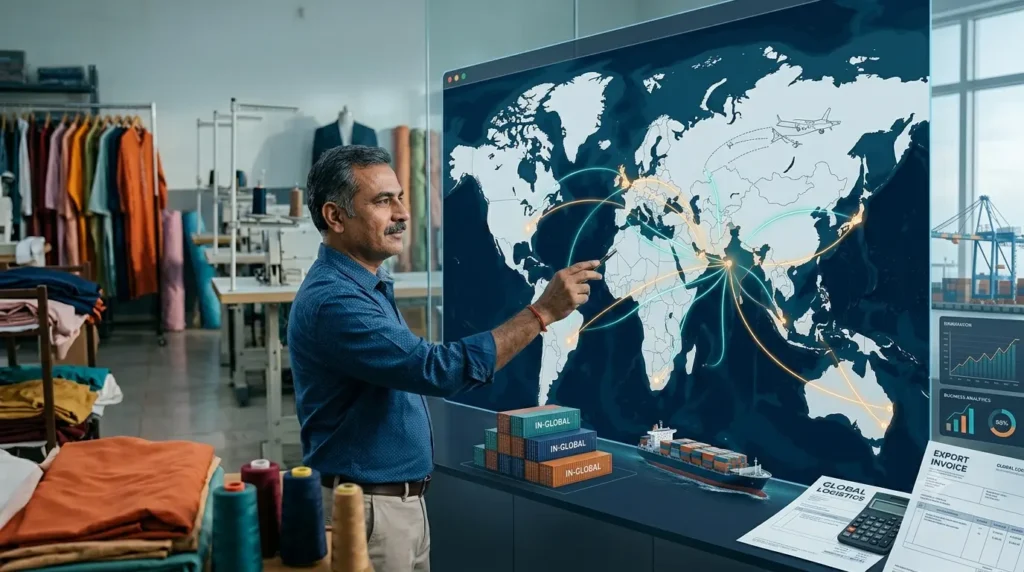
India’s exporters have a bigger world to sell to. Here are seven markets where Indian MSMEs should look closely in 2026—and the products that may offer the most realistic opportunities.
For years, the United States has been the obvious destination for Indian exporters.
And for good reason.
But an export strategy built around one major market can leave a small business exposed to tariff changes, regulatory changes, freight disruptions, currency movements and shifts in consumer demand.
The good news is that Indian exporters do not have to look very far for alternatives.
India is expanding and deepening trade relationships across Europe, the Middle East, the Indo-Pacific and other regions. Recent trade agreements are also changing the competitive equation for Indian products.
The smarter question is:
Where does India have a product advantage, improving market access and enough unmet demand for an MSME to realistically compete?
India already has a very large export footprint. The Department of Commerce’s Trade Intelligence and Analytics portal lists more than 217 trading partners and identifies the US, UAE, China, Netherlands and UK among India’s top export destinations.
The opportunity for a small exporter is therefore not necessarily to discover an unknown country.
It is to discover an under-served product niche inside an existing market.
The 7 markets Indian MSMEs should watch
| Market | Why it deserves attention | Product areas worth investigating |
|---|---|---|
| 🇬🇧 UK | Almost 99% of India’s exports to UK receive duty-free access under CETA once in force | Textiles, leather, food, jewellery, engineering, pharma |
| 🇪🇺 European Union | Huge engineering and consumer market + major new preferential access | Engineering, leather, footwear, textiles, food, marine |
| 🇴🇲 Oman | New CEPA creates near-universal duty-free access | Food, textiles, engineering, chemicals, machinery |
| 🇳🇿 New Zealand | 100% duty-free access for Indian exports under FTA | Food processing, textiles, leather, engineering, pharma |
| 🇦🇺 Australia | 100% tariff-line access for Indian exports under ECTA | Garments, chemicals, plastics, agriculture, pharma |
| 🇯🇵 Japan | High-value market with scope in food, engineering and specialised products | Basmati, processed food, machinery, chemicals, textiles |
| 🇸🇦 Saudi Arabia | Large Gulf market with strong demand for food, consumer and industrial products | Food, engineering, construction-related goods, textiles, chemicals |
The important point is that the best market depends on your product.
There is no universal “best export country”.
1. United Kingdom — a particularly interesting opportunity for MSMEs
The UK should remain high on the list of Indian exporters in 2026 because the India–UK Comprehensive Economic and Trade Agreement creates a substantially better tariff environment.
According to India’s Department of Commerce, the agreement provides duty-free access to almost 99% of India’s exports to the UK, covering nearly 100% of trade value once the agreement enters into force. Key beneficiaries include textiles, leather, marine products, gems and jewellery, toys, engineering goods, chemicals, auto components, pharmaceuticals and processed foods.
That is important for MSMEs because many of these sectors are populated by smaller manufacturers and specialist suppliers.
Where is the opportunity?
I would particularly investigate:
1. Apparel and home textiles
Indian manufacturers already have strong capabilities in cotton, garments, bed linen, towels and other textile products.
But competing purely on price is becoming difficult.
The better opportunity is to sell:
- specialised fabrics
- sustainable textiles
- private-label products
- smaller MOQ collections
- premium Indian designs
- hotel and hospitality textiles
2. Leather and footwear
India has a long-established manufacturing base, and the UK market has significant demand for footwear, bags and accessories.
An MSME does not necessarily need to create its own global consumer brand.
It can target UK distributors, private-label companies and specialist retailers.
3. Processed food
Indian-origin consumers create a natural starting point, but exporters should not stop there.
The bigger opportunity is to turn Indian food products into products suitable for the mainstream UK retail market.
Think:
- ready-to-cook foods
- spice blends
- snacks
- sauces
- premium tea
- health-oriented foods
MSME strategy
Don’t search for “UK buyers”.
Search for UK companies already importing your exact HS code or product category.
That distinction can save months of wasted outreach.
2. European Union — India’s biggest underused industrial opportunity?
The EU is not a single market in the practical sense for every exporter, but from an Indian exporter’s perspective it represents an enormous opportunity.
India’s Department of Commerce says the India-EU FTA provides preferential market access on 96.8% of tariff lines covering 99.5% of India’s exports, while 90.7% of exports by trade value are expected to become duty-free when the agreement enters into force.
The opportunity becomes especially interesting in engineering.
India’s Department of Commerce estimates that India’s exports of engineering goods to the EU were approximately US$16.6 billion, while the EU’s engineering-goods imports were nearly US$2 trillion.
That does not mean an Indian MSME can simply capture a piece of a $2 trillion market.
It does mean the addressable market is enormous compared with India’s existing penetration.
Where I see potential
Engineering components
Instead of trying to sell finished machinery, a smaller manufacturer can investigate:
- precision components
- castings
- forgings
- fasteners
- fabricated components
- auto components
- electrical components
- industrial parts
This is often a more realistic entry route.
Leather and footwear
India’s existing manufacturing ecosystem provides a base for exports, while tariff improvements can improve competitiveness.
Marine products
India already has a significant seafood export ecosystem.
But compliance is crucial.
EU food safety, residue, traceability and establishment requirements can be much more important than the tariff itself.
Processed food
The Department of Commerce specifically identifies opportunities in processed foods, tea, coffee, spices, grapes, gherkins, cucumbers, dried onion and selected fruit and vegetable products.
The lesson
Don’t target “Europe”.
Target:
Product → HS code → EU country → importer → competitor → price → compliance requirement.
That is how an MSME should convert a huge market into a practical sales plan.
3. Oman — one of the most interesting new opportunities
If I were a small Indian exporter looking for a market where trade policy has recently changed the equation, Oman would be near the top of my list.
India’s CEPA with Oman provides 100% duty-free market access for Indian exports, covering 98.08% of Oman’s tariff lines and 99.38% of India’s export value based on the agreement’s reference trade data.
More importantly, the agreement specifically opens opportunities in:
- minerals
- chemicals
- base metals
- machinery
- plastics and rubber
- auto components
- instruments
- glass
- ceramics
- marble
- paper
The agreement also identifies an Omani import market of more than US$28 billion in the relevant context.
But there is another opportunity many exporters may overlook
Oman is not only about physical products.
The CEPA includes commitments in services such as:
- IT
- professional services
- engineering
- healthcare
- education
- tourism
- environmental services
- consulting
India also secured enhanced professional mobility provisions.
Product opportunity for Indian MSMEs
I would investigate:
Food: packaged foods, processed foods, spices and selected agricultural products.
Engineering: components, machinery and industrial consumables.
Construction ecosystem: ceramics, stone-related products, fabricated products and building materials, subject to the applicable tariff and standards.
Healthcare: selected medical products and services.
Traditional wellness: Ayurveda and wellness services are another interesting niche because the agreement includes commitments around traditional medicine.
A practical warning
Don’t assume “zero duty” means “easy export”.
Oman still has:
- product standards
- customs requirements
- labelling requirements
- buyer requirements
- logistics costs
- payment risks
Tariff advantage is an opportunity—not a guarantee of sales.
4. New Zealand — small market, surprisingly interesting opportunity
New Zealand is exactly the type of market that can be overlooked because its population is much smaller than the UK, EU or Gulf markets.
But that is precisely why some MSMEs should examine it.
India and New Zealand concluded a landmark FTA in December 2025. India’s Commerce Ministry says New Zealand has granted zero-duty access on 100% of its tariff lines for Indian exports from entry into effect.
The agreement specifically identifies opportunities across:
- textiles
- pharmaceuticals
- engineering goods
- leather
- agricultural products
- processed food
- marine products
- handicrafts
- automobiles
The previous tariff environment included duties of up to 10% in some labour-intensive sectors.
What makes New Zealand interesting?
It may be a good test market for an exporter who doesn’t yet have the capacity to attack a giant market.
For example:
A textile manufacturer could test a small range with a New Zealand importer.
A food manufacturer could approach ethnic and mainstream specialty distributors.
An engineering company could identify specialist industrial importers.
One important point
New Zealand’s FTA is not a blanket invitation to export agricultural commodities.
India has retained protections for sensitive sectors, and the agreement contains exclusions and specific treatment for products such as dairy and several agricultural categories.
Always check the product-specific tariff and rules of origin before quoting a buyer.
5. Australia — a market where India already has momentum
Australia isn’t a new market for Indian exporters.
But it is a market where the numbers and trade architecture make continued expansion worth examining.
India and Australia signed the Economic Cooperation and Trade Agreement, which entered into force on 29 December 2022.
Australia has provided zero-duty access on 100% of tariff lines for Indian exports, according to India’s Commerce Ministry. Bilateral merchandise trade reached US$24.1 billion in FY2024-25.
India’s exports to Australia grew by 8% in FY2024-25, with gains reported in garments, chemicals, plastics and agricultural products.
Where could MSMEs look?
Garments
Particularly differentiated, sustainable and private-label products.
Chemicals
Specialty rather than commodity chemicals may provide better opportunities for smaller manufacturers.
Plastics
Industrial and specialised plastic products can be worth investigating.
Agriculture and food
There is potential, but Australian biosecurity and food-safety rules are strict.
An exporter should research compliance before spending money on buyer acquisition.
The bigger opportunity
India and Australia are also negotiating a deeper CECA.
That means exporters should not only look at today’s market.
They should watch where future trade rules are heading.
6. Japan — difficult market, but potentially high-value
Japan is not an easy market.
And that is exactly why it can be attractive to a well-prepared MSME.
India already has a CEPA with Japan, and India has requested its review.
India’s Commerce Minister has recently highlighted the possibility of improving market access for basmati rice and processed food products in Japan during the CEPA review.
Why Japan is different
A Japanese buyer may care deeply about:
- consistency
- specifications
- packaging
- delivery reliability
- quality control
- documentation
- traceability
- long-term supplier relationships
So the exporter who thinks:
“My product is cheaper, therefore Japan will buy it”
may struggle.
The exporter who thinks:
“How can I become the most reliable supplier for this particular specification?”
has a much better chance.
Potential areas to investigate
- premium food products
- basmati rice
- processed foods
- specialised engineering components
- chemicals
- selected textiles
- industrial products
My advice
Don’t approach Japan with 50 products.
Pick one or two products and build a very detailed buyer proposition around them.
7. Saudi Arabia — a major Gulf opportunity beyond the usual UAE strategy
Many Indian MSMEs naturally start with the UAE.
That makes sense.
But the Gulf opportunity shouldn’t stop at Dubai.
Saudi Arabia deserves separate attention because of its enormous domestic market, industrial development and infrastructure investment.
For an Indian exporter, the opportunity is particularly interesting where Indian manufacturing capabilities overlap with Saudi demand.
Product categories worth investigating
Food and processed food
India has obvious strengths in spices, rice, processed foods, snacks and other food categories.
Engineering products
Industrial components and equipment can be more attractive than trying to sell generic consumer products.
Construction-related products
The Saudi construction and infrastructure ecosystem creates potential demand for a wide range of industrial and building-related products.
Textiles
Uniforms, workwear, home textiles and selected apparel categories deserve investigation.
Chemicals and plastics
Specialty products can offer opportunities where an Indian manufacturer has a cost or technical advantage.
The right strategy
Don’t ask:
“What does Saudi Arabia import?”
That question is too broad.
Ask:
“Which Saudi companies are already importing my exact product—and who currently supplies them?”
That takes you from theory to actual prospects.
The real export opportunity is hidden inside the HS code
This is perhaps the most important lesson in this article.
Suppose you manufacture stainless-steel kitchen equipment.
You shouldn’t decide:
“I’ll export to Oman.”
Instead:
Step 1
Identify your exact HS code.
Step 2
Find countries importing that HS code.
Step 3
Compare India’s exports with the country’s total imports.
Step 4
Find the major suppliers.
Step 5
Find the companies actually buying.
Step 6
Compare their purchasing volumes and prices.
Step 7
Check tariffs and non-tariff requirements.
Step 8
Only then start contacting buyers.
This is much more powerful than relying on generic lists such as “top 10 products to export”.
Here’s how an MSME can identify a genuinely under-served market
Imagine you manufacture an Indian food product.
You find:
Country A
- imports $100 million of the product
- India supplies only $2 million
- demand is growing
- several buyers already import from India
- Indian competitors are limited
- tariff treatment is favourable
That could be an interesting opportunity.
Now compare:
Country B
- imports $500 million
- India supplies $100 million
- hundreds of Indian exporters compete there
- prices are falling
- buyer concentration is high
Country B is technically the bigger market.
But Country A may be the better market for your MSME.
This is what I mean by an “untapped” opportunity.
Don’t guess who your buyers are
One of the biggest mistakes new exporters make is searching Google for:
“importers of Indian products”
That produces directories, websites and sometimes outdated information.
A better approach is to look at actual trade activity.
For example, trade-intelligence platforms such as Volza allow exporters to investigate shipment-level import/export activity, buyers, suppliers, products, quantities and sourcing patterns across many markets. Volza says its database covers trade activity across 203 countries and provides buyer/supplier intelligence and shipment information.
🔎 Find buyers before you spend money on travel
If you are serious about entering one of these markets, use shipment data to identify companies that are already importing products like yours.
Explore Volza Buyer & Trade Intelligence
BusinessZindagi Tip: Don’t build a 1,000-company lead list.
Build a list of 20–50 highly relevant importers and research each one.
Look for:
- recent shipments
- product match
- shipment frequency
- existing suppliers
- country of origin
- approximate volumes
- price patterns
- whether they are increasing or reducing purchases
Then personalise your outreach.
Use DGFT’s Source from India as another route
India’s DGFT has also been building digital infrastructure to improve the discoverability of Indian exporters.
The Source from India initiative on Trade Connect is designed to help international buyers discover Indian suppliers. BusinessZindagi has previously covered how exporters can use it and how the eligibility framework evolved.
DGFT Source from India: How Exporters Can Find Foreign Buyers
For an MSME, I would combine:
DGFT Source from India
trade data
direct outreach
trade fairs
Indian Missions/Export Promotion Councils
rather than relying on a single platform.
Which market should YOU choose?
Here is my simplified decision framework.
| If you sell… | Markets worth investigating first |
|---|---|
| Textiles/apparel | UK, EU, Australia, New Zealand, Oman |
| Leather/footwear | UK, EU, New Zealand |
| Engineering components | EU, UK, Australia, Oman, Saudi Arabia |
| Processed food | UK, EU, Oman, New Zealand, Japan, Saudi Arabia |
| Tea/spices | UK, EU, Oman, Japan, Saudi Arabia |
| Handicrafts | UK, EU, New Zealand, Saudi Arabia |
| Pharmaceuticals | UK, Australia, New Zealand, Oman |
| Chemicals | EU, UK, Australia, Oman, Saudi Arabia |
| Auto components | UK, EU, Australia, Oman |
| IT/professional services | UK, Australia, New Zealand, Oman, Saudi Arabia |
This table is a starting point—not an export recommendation.
Product-specific tariffs, certifications, rules of origin, logistics, buyer requirements and competition must be checked before making a commercial decision.
Don’t make the FTA mistake
One of the most dangerous misconceptions is:
“India has an FTA, so my product can enter at zero duty.”
Not necessarily.
The actual benefit depends on:
- HS classification
- tariff schedule
- rules of origin
- product-specific requirements
- certificate of origin
- entry-into-force status
- exclusions
- quotas where applicable
- non-tariff regulations
The Department of Commerce itself notes that the tariff benefits vary by agreement and commodity.
So before giving a foreign buyer a quotation, check the exact HS code and applicable tariff treatment.
A practical 30-day export-market experiment for an MSME
Instead of spending ₹5 lakh attending an overseas exhibition immediately, try this first.
Days 1–5: Choose your product
Select one product, not your entire catalogue.
Determine:
- HS code
- specifications
- MOQ
- production capacity
- FOB price
- packaging
- certifications
Days 6–10: Select three countries
For example:
EU + Oman + UK
Don’t investigate seven markets simultaneously.
Days 11–15: Study the buyers
Identify 20–30 importers per market.
Study their:
- current suppliers
- product range
- shipment history
- purchasing frequency
- approximate volumes
Days 16–20: Prepare your pitch
Create:
- one-page product sheet
- professional catalogue
- company profile
- certifications
- product photographs
- indicative export price
- MOQ
- production capacity
Days 21–30: Contact buyers
Contact 5–10 highly relevant buyers every day.
Don’t send:
“Dear Sir, we are leading manufacturer and exporter. Kindly give us enquiry.”
Instead:
“We noticed that your company imports [specific product]. We manufacture [specific specification] in India and currently have capacity for [quantity]. We would like to explore whether our product could complement your existing sourcing.”
That is a completely different conversation.
What about the United States?
The answer is don’t abandon it.
The US remains one of India’s most important export markets.
The objective is diversification, not replacement.
A strong exporter could have:
Market 1 — US
Market 2 — UK
Market 3 — EU
Market 4 — Gulf
That is much safer than having 80% of export revenue dependent on one country.
My ranking for Indian MSMEs in 2026
If I were ranking these markets based on a combination of new market access, size, product opportunities and practicality for MSMEs, my shortlist would be:
🥇 European Union
Best for: Engineering, leather, footwear, textiles, marine and processed products.
🥈 United Kingdom
Best for: Labour-intensive products, food, textiles, leather, jewellery and engineering.
🥉 Oman
Best for: MSMEs looking for a smaller Gulf market with dramatically improved market access.
4️⃣ Australia
Best for: Garments, chemicals, plastics, agriculture and specialised products.
5️⃣ New Zealand
Best for: Smaller exporters wanting a developed-market test opportunity.
6️⃣ Saudi Arabia
Best for: Food, industrial products, construction-related goods and consumer products.
7️⃣ Japan
Best for: High-quality, specialised products and exporters willing to meet demanding standards.
But there is an important twist:
The ranking changes completely depending on your product.
For a textile manufacturer, UK/EU may be #1.
For an engineering component manufacturer, EU/Oman may be more attractive.
For a food processor, UK/Oman/Japan could be more interesting.
For an IT company, the list changes again.
The biggest opportunity may not be a new country
This is the conclusion I would want every Indian MSME to remember.
You don’t necessarily need to discover a country where no Indian exporter has gone before.
You need to discover a buyer who is already importing your product but hasn’t yet discovered you.
India’s trade data already shows the enormous breadth of the country’s global footprint, with exports spread across regions including Europe, WANA, Africa, ASEAN, North-East Asia and Oceania.
The next generation of Indian exporters therefore has an opportunity to move from:
“I want to export.”
to:
“I know exactly which product I want to sell, which country needs it, which companies are buying it, who supplies them today, what price they pay and why they should consider me.”
That is a much more powerful export strategy.
Before you approach a foreign buyer
Use this checklist:
- Confirm your HS code
- Check the target country’s import demand
- Check India’s existing exports of the product
- Check competitor countries
- Check the applicable FTA/CEPA tariff
- Verify rules of origin
- Check product certifications
- Calculate landed cost
- Identify genuine importers
- Study their current suppliers
- Verify the buyer
- Prepare a professional quotation
- Decide payment terms carefully
- Start with a manageable order
And never assume that a buyer is genuine simply because they have a website or a company email address.
Useful BusinessZindagi guides for exporters
If you’re serious about entering a new market, these guides can help you move from market research to actual buyer outreach:
How to use global trade data to find verified international buyers:
Global Trade Data Guide
How to find international buyers without visiting trade fairs:
International Buyer Guide
How to send product samples to foreign buyers:
Sending Samples to Foreign Buyers
DGFT Source from India:
Source from India Guide
Final takeaway
India’s export opportunity in 2026 is not simply about finding the next United States.
It is about building a portfolio of markets.
The UK and EU offer enormous scale and improving preferential access.
Oman offers a particularly interesting new trade-policy opportunity.
Australia provides an established market with strong bilateral trade momentum.
New Zealand offers a smaller but unusually open developed market.
Japan offers a demanding but potentially high-value opportunity.
Saudi Arabia gives Indian businesses another major Gulf market beyond the UAE.
For an MSME, however, the winning strategy is not to chase all seven.
Pick one product. Pick three markets. Find the actual buyers. Study their imports. Understand the tariff and compliance requirements. Then start selling.
That is how “export opportunity” turns into an actual export order.
About the Author
Tabrez — Founder, BusinessZindagi
Tabrez is an entrepreneur and exporter with more than 17 years of hands-on experience in building and growing domestic and international businesses. His experience includes exporting products such as tea and other goods to international markets.
Through BusinessZindagi, he shares practical lessons, business insights, MSME developments, export opportunities and the mistakes and experiences he has encountered along the way.
The objective is simple: help entrepreneurs and small businesses make better-informed decisions in the real world.
AI Disclosure
Parts of this article were researched, structured and assisted using artificial intelligence. BusinessZindagi independently reviews and edits the content before publication. Trade figures, government policy information and agreement-related claims should be checked against the latest official sources before making a commercial decision.
AI assistance does not replace professional export, legal, tax, customs or financial advice.
Affiliate Disclosure
Some links in this article may be affiliate or commercial links. If you purchase a product or service through such a link, BusinessZindagi may receive a commission at no additional cost to you.
Any commercial relationship does not determine the editorial conclusions or recommendations in this article.
Where Volza is mentioned, it should be understood as a commercial trade-intelligence tool rather than a government source. Its data and capabilities are provided by Volza.
Authentic Sources & References
The primary data and policy information used for this article should be cross-checked with:
- Ministry of Commerce & Industry — Trade Intelligence & Analytics
- Department of Commerce — TRADESTAT
- Department of Commerce — India FTA/CEPA information
- DGFT / Trade Connect
- PIB / Government of India
- Volza — commercial shipment intelligence
The Government of India’s Trade Intelligence & Analytics portal currently provides DGCIS-based country and commodity trade information, with data updated through June 2026.
For product-level research, exporters should use the government’s TRADESTAT database, which provides commodity-wise, country-wise and commodity-country trade data.