
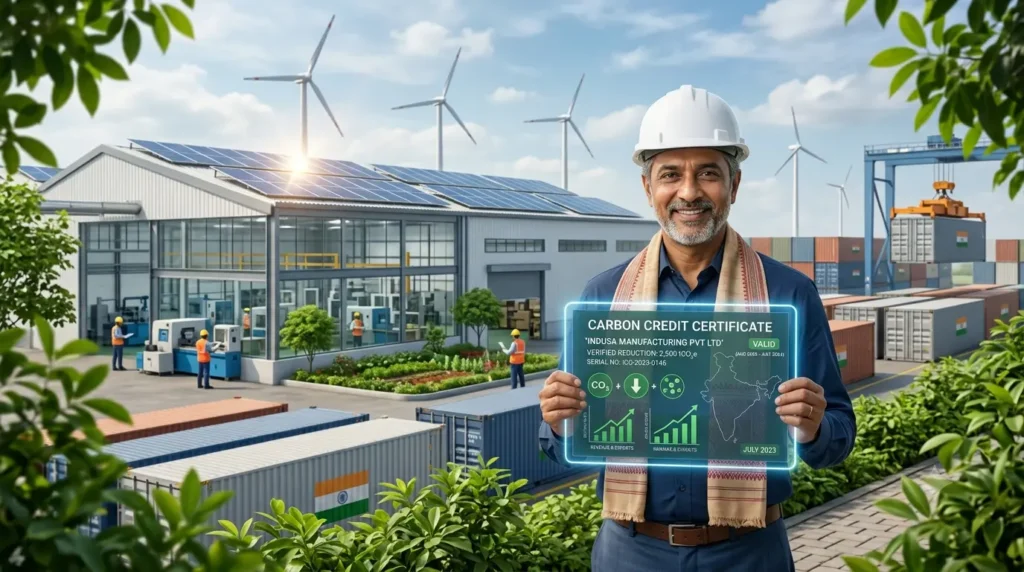
Can Going Green Increase Your Profits?
What if reducing carbon emissions could lower your electricity bill, improve your export opportunities and even create a new source of revenue?
That’s the idea behind India’s Carbon Credit Trading Scheme (CCTS).
As global buyers increasingly prefer sustainable suppliers, India is building its own carbon market to encourage industries to reduce greenhouse gas emissions. While the scheme initially focuses on large industries, MSMEs and exporters should understand it today to stay competitive tomorrow.
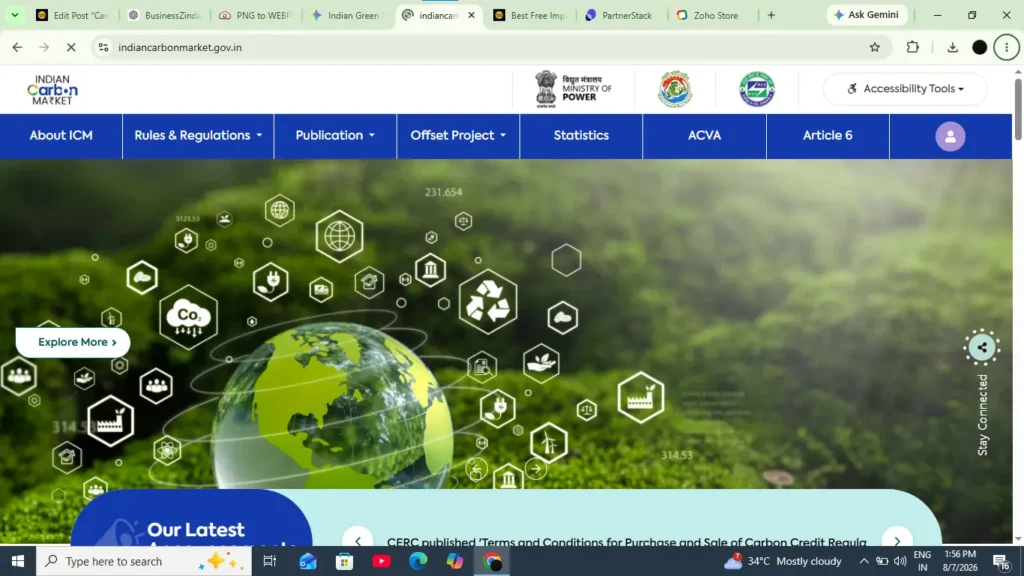
What is the Carbon Credit Trading Scheme (CCTS)?
The Carbon Credit Trading Scheme (CCTS) is India’s national framework for creating a carbon market.
Businesses that reduce greenhouse gas emissions beyond prescribed limits may earn Carbon Credit Certificates (CCCs). These certificates can be traded through the Indian Carbon Market (ICM), while businesses that exceed emission limits may need to purchase carbon credits.
Simply Put
✅ Reduce emissions → Earn Carbon Credit Certificates
✅ Emit more emissions → Purchase Carbon Credits
The scheme encourages industries to invest in cleaner technologies instead of relying only on penalties.
When Was CCTS Introduced?
India’s carbon market journey began with the Energy Conservation (Amendment) Act, 2022, which empowered the Government to establish a national carbon market.
The Carbon Credit Trading Scheme (CCTS) was officially notified by the Ministry of Power in June 2023.
Since then, the Government has developed detailed rules, identified eligible sectors and started implementing the scheme in phases.
How Has the Scheme Started Working?
The implementation is gradual.
2022
✅ Legal framework created through the Energy Conservation (Amendment) Act.
2023
✅ Carbon Credit Trading Scheme officially notified.
2024–2025
✅ Monitoring, reporting and verification systems developed.
✅ Emission intensity targets notified for selected industries.
2026
✅ Indian Carbon Market enters the operational phase.
✅ Indian Carbon Market Portal launched.
✅ Compliance begins for notified sectors.
How Does CCTS Work?
The process is simple.
- Government sets emission targets.
- Companies measure greenhouse gas emissions.
- Independent agencies verify the data.
- Eligible businesses receive Carbon Credit Certificates.
- Carbon credits are traded through the Indian Carbon Market.
Industries Covered
Initially, the scheme focuses on major energy-intensive industries such as:
- Steel
- Cement
- Aluminium
- Power
- Fertilisers
- Petroleum
- Petrochemicals
- Textiles
More sectors are expected to be added gradually.
Why Should MSMEs Care?
Although many MSMEs are not directly covered today, they are an important part of manufacturing and export supply chains.
Large companies increasingly prefer suppliers that:
- Use energy efficiently
- Reduce emissions
- Follow sustainable manufacturing practices
Preparing early can help MSMEs remain competitive.
Benefits for MSMEs
The Carbon Credit Trading Scheme can help businesses by:
- Lowering electricity costs
- Improving energy efficiency
- Increasing export competitiveness
- Building a stronger business reputation
- Preparing for future regulations
- Creating opportunities in green manufacturing
Why Exporters Should Pay Attention
Many international buyers now evaluate suppliers not only on price and quality but also on sustainability.
Improving energy efficiency today can make Indian exporters more attractive in global markets tomorrow.
🌍 Looking for Genuine Export Buyers?
If you’re planning to expand internationally, Volza helps you analyse real import-export shipment data, identify active buyers, research competitors and discover new export opportunities.
👉 BusinessZindagi Tip: Combine sustainable manufacturing with smart market research to stay ahead of the competition.
New Business Opportunities
The Carbon Credit Trading Scheme is expected to create demand for:
- Carbon Accounting
- ESG Consulting
- Energy Audits
- Solar Installation
- Renewable Energy Projects
- Carbon Verification
- Sustainability Reporting
- Climate-Tech Startups
- Environmental Compliance Software
- Green Manufacturing
How Can MSMEs Prepare?
You don’t need to wait until compliance becomes mandatory.
Start today by:
- Conducting an energy audit.
- Upgrading to energy-efficient machinery.
- Installing LED lighting.
- Exploring rooftop solar.
- Monitoring electricity and fuel consumption.
- Maintaining sustainability records.
Small improvements today can deliver long-term business benefits.
📘 Digitise Your Business with Zoho Books
As your business grows, managing GST invoices, expenses and financial reports becomes increasingly important.
Zoho Books helps MSMEs automate accounting, stay GST-compliant and make smarter financial decisions.
👉 BusinessZindagi Recommendation: A great solution for manufacturers, exporters and growing businesses.
BusinessZindagi Insight
The Carbon Credit Trading Scheme (CCTS) is not just about protecting the environment—it is about building more efficient and competitive businesses.
Companies that reduce waste, improve energy efficiency and embrace sustainability today are likely to enjoy lower operating costs, stronger customer trust and better export opportunities in the future.
Frequently Asked Questions (FAQs)
What is the Carbon Credit Trading Scheme (CCTS)?
It is India’s framework for creating a national carbon market where eligible businesses can earn and trade Carbon Credit Certificates by reducing greenhouse gas emissions.
Who will benefit from CCTS?
Manufacturers, exporters, renewable energy companies, clean-tech businesses and many MSMEs connected to industrial supply chains.
Is the Carbon Credit Trading Scheme compulsory for all MSMEs?
No. The scheme is being implemented in phases and initially covers selected sectors.
What is a Carbon Credit Certificate (CCC)?
A Carbon Credit Certificate is issued to eligible businesses that successfully reduce greenhouse gas emissions under the Carbon Credit Trading Scheme.
Can small businesses benefit?
Yes. Even if they are not directly covered, MSMEs can benefit through lower energy costs, improved sustainability and better opportunities with large buyers and exporters.
📚 Suggested Articles
- Carbon Credits for MSMEs: From Myths to Market Opportunities
- MSME Development (Amendment) Bill 2026 Explained
- Gold Standard Carbon Credits — Why They Matter in Today’s Carbon Market
- How to Find Buyers in USA Using Shipment Data
- Best Free Import Export Databases
Conclusion
The Carbon Credit Trading Scheme (CCTS) marks a significant step towards building a greener and more competitive Indian economy.
Although the scheme currently focuses on major industries, its impact will gradually extend across manufacturing, exports and MSME supply chains.
Businesses that invest in energy efficiency and sustainable practices today will be better prepared for tomorrow’s opportunities.
Disclaimer
This article is intended for educational purposes only. The Carbon Credit Trading Scheme (CCTS) is being implemented in phases, and compliance requirements may vary by sector. Readers should refer to the latest notifications issued by the Government of India before making business decisions.
🤖 AI & Affiliate Disclosure
This article was prepared with the assistance of AI and carefully reviewed by the BusinessZindagi editorial team for accuracy and readability. Some links may be affiliate links, which means we may earn a small commission at no extra cost to you if you make a purchase. This helps us keep creating free, practical business content for MSMEs, entrepreneurs and exporters.
Authentic Sources & References
- Ministry of Power, Government of India – https://powermin.gov.in
- Bureau of Energy Efficiency (BEE) – https://beeindia.gov.in
- Press Information Bureau (PIB) – https://pib.gov.in
- Ministry of Environment, Forest and Climate Change (MoEFCC) – https://moef.gov.in
- International Carbon Action Partnership (ICAP) – https://icapcarbonaction.com
- International Energy Agency (IEA) – https://www.iea.org
- Economic Times – Coverage on India’s Carbon Market and CCTS