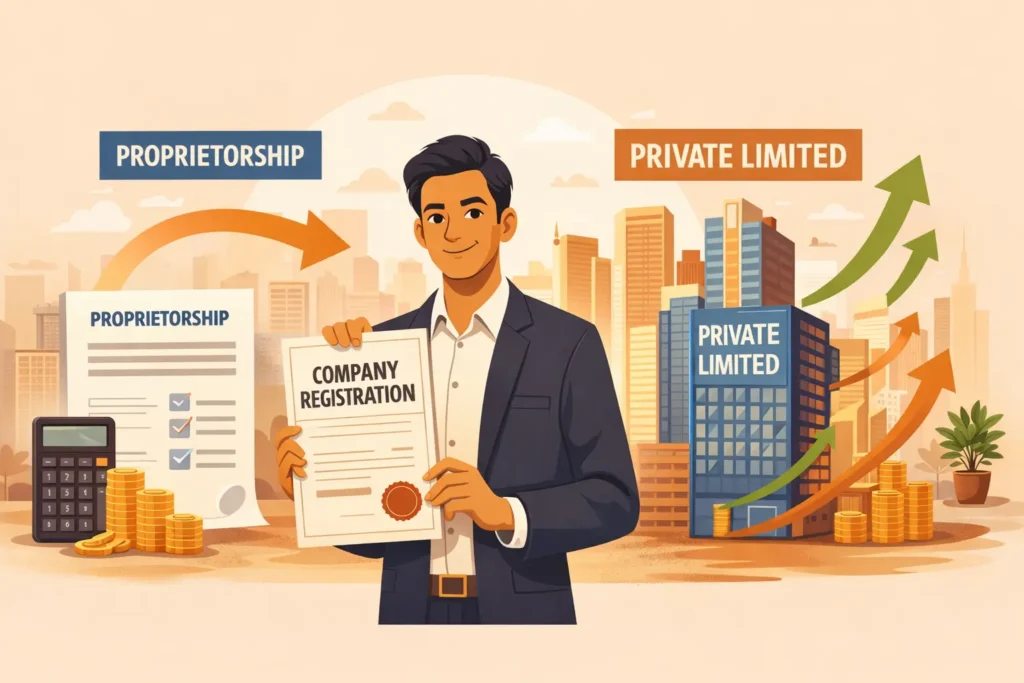
Many Indian entrepreneurs begin their journey as sole proprietors because it is simple, low-cost and easy to operate.
But as business grows, priorities change:
- larger contracts & corporate clients
- better creditworthiness
- structured governance
- lower personal risk
- long-term scalability
That is when the converting proprietorship to private limited company becomes an important strategic move — not just a legal formality.
This BusinessZindagi guide explains the advantages, business impact, and practical benefits of converting proprietorship into a private limited company from an MSME & growth perspective.
you may also like to read: LLP vs Private Limited Company: Which One Is Better for You?
What is Conversion of Proprietorship into Private Limited Company? (Focus Keyword)
The conversion of proprietorship into private limited company means:
A business owned by a single proprietor is transferred into a separate legal corporate entity registered under the Companies Act, 2013.
After conversion:
- the company becomes a distinct legal identity
- ownership is represented through shares
- the proprietor becomes a director & shareholder
- compliance and governance become structured
This transformation takes the business from informal proprietorship to formal corporate ecosystem.
Key Advantages of Converting Proprietorship to Private Limited Company
Below are the most meaningful advantages for growing MSMEs, startups, service firms and trade businesses.
1. Limited Liability — Personal Assets Are Protected
In proprietorship:
- business liabilities = personal liabilities
- loans & penalties may affect personal wealth
After the conversion of proprietorship into private limited company:
- the company is treated as a separate legal person
- liability is limited to share capital
- promoters’ personal assets are safeguarded
This significantly reduces risk exposure for business owners.
2. Stronger Business Credibility & Professional Image
A private limited company is perceived as:
- more structured
- more reliable
- more professionally governed
This improves acceptance in:
- corporate vendor onboarding
- B2B contracts & agency empanelments
- export / trade transactions
- fintech & institutional lending
The conversion of proprietorship into private limited company enhances brand trust and corporate positioning.
3. Easier Access to Loans, Credit & Banking Facilities
Banks prefer private limited companies because:
- financial reporting is transparent
- audited records create credibility
- compliance history builds confidence
Benefits include:
- higher working capital eligibility
- easier term loans
- better credit evaluation
- improved SME banking relationships
Future funding also becomes possible through equity capital — something not available in proprietorship.
4. Ability to Add Co-Founders, Partners & Shareholders
Proprietorship allows only single ownership.
After conversion:
- new shareholders can join
- co-founders can receive equity
- investor participation becomes possible
- ESOP-style rewards can be structured
This helps businesses grow from owner-centric to institution-driven.
5. Higher Scalability & Market Expansion Opportunities
Private limited companies enjoy stronger recognition in:
- corporate procurement
- franchise & distribution networks
- e-commerce marketplace onboarding
- international trade transactions
The conversion of proprietorship into private limited company enables:
✔ expansion into new markets
✔ business scaling opportunities
✔ enterprise-level partnerships
6. Separate Legal Identity & Perpetual Existence
A proprietorship ends with the proprietor.
But a private limited company enjoys:
- perpetual succession
- transferable ownership
- long-term continuity
This supports:
- succession planning
- business legacy building
- long-term sustainability
7. Better Tax Planning & Structured Financial Management
A private limited company allows:
- directors’ salary
- reimbursements (as per law)
- profit-linked payouts
This offers better financial structuring options compared to proprietorship taxation
(under professional guidance).
Conversion of Proprietorship into Private Limited Company — Who Should Consider It?
Most beneficial for:
- growing MSMEs & emerging startups
- B2B service firms & consultants
- trading & distribution businesses
- tech & e-commerce companies
- businesses planning institutional clients
If your business is scaling beyond single ownership, conversion creates long-term value.
BusinessZindagi Insight — When Is the Right Time to Convert?
Entrepreneurs usually consider conversion when:
- revenue and operations expand
- larger contracts are being executed
- liabilities & assets increase
- investors / partners may join
- organisational credibility becomes essential
Early conversion ensures:
✔ stronger compliance history
✔ better creditworthiness
✔ clean financial structure
Final Take — Why Conversion of Proprietorship into Private Limited Company Makes Sense
The conversion of proprietorship into private limited company is a strategic upgrade that helps entrepreneurs:
- protect personal assets
- build corporate credibility
- access funding & partnerships
- scale operations formally
- build a sustainable business identity
For ambitious MSMEs, it is often the next natural milestone in growth evolution.
❓ FAQs — Conversion of Proprietorship into Private Limited Company
➤ Is conversion compulsory for all proprietors?
No — but highly beneficial for expanding businesses.
➤ Do GST & licenses continue after conversion?
Yes — subject to statutory transfer procedures.
➤ Can new directors be added later?
Yes — directors & shareholders can be added.
➤ Does business identity discontinue?
No — continuity is legally maintained.
✍️ About the Author — BusinessZindagi
Tabrez | MSME, Entrepreneurship & Global Business Writer
BusinessZindagi creates practical insights on MSME growth, entrepreneurship, business structure, global expansion, trade & startup ecosystems — simplifying complex topics for Indian entrepreneurs and small business owners.
⚠️ Disclaimer
This article is intended for educational and informational purposes only. Business laws, tax rules and compliance requirements may change over time and may vary based on business activity, financial structure and individual circumstances.
Some parts of this article may have been generated or assisted using AI tools, and subsequently reviewed and refined by the BusinessZindagi editorial team. AI-assisted content may not always reflect the latest regulatory updates.
This content should not be considered legal, tax or financial advice.
Entrepreneurs should consult a qualified CA, company secretary or legal professional before making business structure or conversion decisions.
BusinessZindagi.com and the author are not liable for actions taken based on this information.
📚 Authentic Sources & Reference Links (Clickable)
• Ministry of Corporate Affairs — Companies Act, 2013
https://www.mca.gov.in
• SPICe+ Company Incorporation Framework
https://www.mca.gov.in/content/mca/global/en/mca/services/spice-plus.html
• Government of India — Ease of Doing Business Portal
https://www.startupindia.gov.in
• Income Tax Department — Business Structure Guidelines
https://www.incometax.gov.in
If you want, I can also:
👉 create a step-by-step conversion process guide
👉 add checklist, documents & compliance flow
👉 generate internal links for BusinessZindagi SEO
Just tell me — I’ll prepare the next version 👍