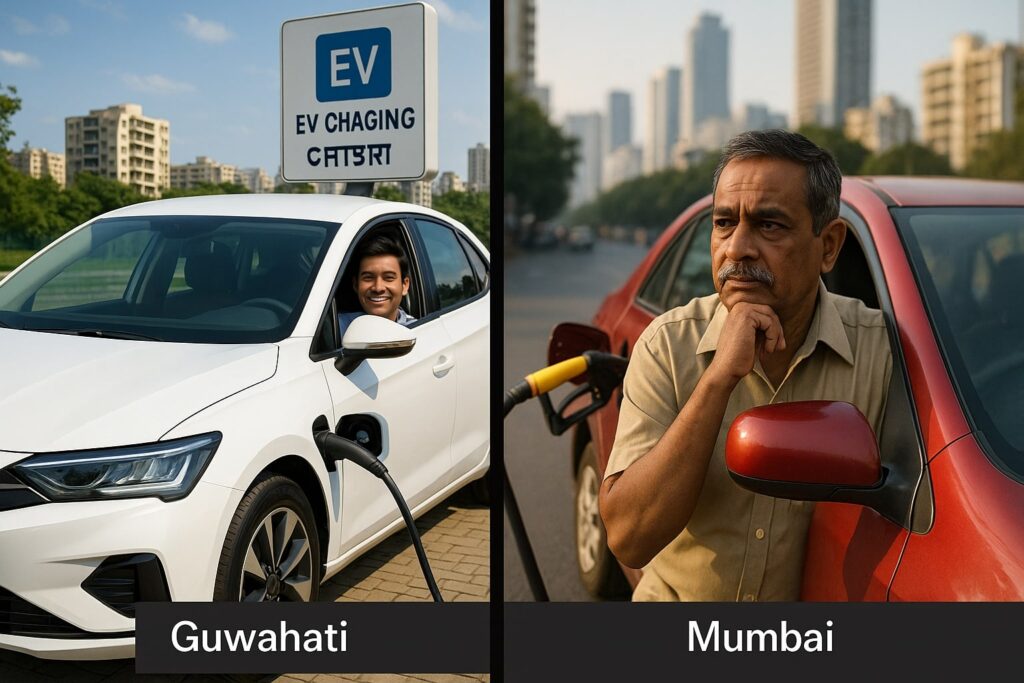
Electric car vs petrol car — buying a car today is no longer a simple choice. It’s a decision shaped by cost, convenience, technology, and most importantly, your lifestyle.
Should you go for an Electric Car (EV) for lower running costs and cleaner driving,
or stick to a Petrol Car for its unmatched convenience and long-distance capability?
This guide gives you the most complete 2025 comparison — including cost per km, case studies, pros & cons, FAQs, and final verdict — so you choose the car that truly suits you.
you may also like to read: Are India’s Electric Vehicle Charging Stations Enough? — Statewise Snapshot & What India Needs Next
Electric Car vs Petrol Car: ₹/km Cost Comparison (Realistic 2025 Figures)
Actual numbers vary by state, but the following are practical Indian averages:
Running Cost Per KM
| Car Type | Fuel Cost / Unit | Efficiency | Cost per KM |
|---|---|---|---|
| Electric Car | ₹8–10 per unit | 7–9 km / kWh | ₹1–1.3 per km |
| Petrol Car | ₹95–110 per litre | 12–15 km/litre | ₹6–7 per km |
➡ Electric cars are 4–6 times cheaper to run.
➡ A person driving 1,000 km/month saves ₹5,000–₹6,000 per month with an EV.
Electric Car vs Petrol Car: Upfront Cost Comparison
Petrol cars still cost less upfront.
| Car Type | Average On-Road Price (2025) |
|---|---|
| Petrol Hatchback | ₹6–8 lakh |
| Similar EV Hatchback | ₹9–12 lakh |
| Petrol Sedan | ₹10–15 lakh |
| EV Sedan | ₹14–20 lakh |
➡ EV cars have higher buying cost, but savings recover this in 2–4 years depending on usage.
Electric Car vs Petrol Car: Maintenance Costs: EV Cars Win Easily
Electric cars don’t need:
❌ oil changes
❌ spark plugs
❌ fuel filters
❌ complex engines
❌ gearboxes
Typical annual maintenance cost:
- EV Car: ₹3,000–₹7,000
- Petrol Car: ₹10,000–₹18,000
➡ EVs require less maintenance, fewer parts, fewer breakdowns.
Electric Car vs Petrol Car: Charging vs Refuelling Convenience
⚡ Electric Car Charging
- Home charging = extremely convenient
- Public fast chargers = improving but inconsistent
- Charging time = 45 mins to 6 hours
⛽ Petrol Car Refuelling
- Fuel stations everywhere
- Takes 5 minutes
- Ideal for long-distance driving
➡ Petrol cars still win on convenience, especially for highway and rural driving.
Case Studies: Real Indian Scenarios
Case Study A: Office Commuter (30 km/day)
- Monthly driving: 900 km
- EV running cost: ₹900
- Petrol running cost: ₹6,000
- Savings: ₹5,000/month
👉 Best choice: Electric Car
Case Study B: Sales Executive (Long Highway Travel)
- Needs quick refuelling
- Long distances daily
- Limited chargers on highways
👉 Best choice: Petrol Car
Case Study C: Low-Usage Family (200–300 km/month)
- Petrol running cost is manageable
- High EV upfront cost not recoverable
👉 Best choice: Petrol Car
Performance & Driving Feel
Electric Cars
- Instant torque
- Super-smooth acceleration
- No engine noise
- Great for city and traffic
Petrol Cars
- More traditional engine feel
- Better for enthusiastic drivers
- Great for long-distance flexibility
👉 Comfort lovers choose EVs
👉 Driving enthusiasts may prefer petrol
⭐ 7. Environment & Future Readiness
Electric cars produce zero tailpipe emissions, improving air quality.
If charged using solar or renewable energy → they become extremely eco-friendly.
Petrol cars continue to produce emissions and depend on fossil fuels.
👉 For the environment, EV Cars clearly win.
⭐ 8. EV Car vs Petrol Car — Pros & Cons Table
| Category | Electric Car | Petrol Car |
|---|---|---|
| Running Cost | ⭐ Very Low | ❌ High |
| Upfront Cost | ❌ High | ⭐ Lower |
| Maintenance | ⭐ Very Low | ❌ Higher |
| Long Distance | ❌ Needs planning | ⭐ Excellent |
| Convenience | ❌ Charging takes time | ⭐ Quick refuelling |
| Performance | ⭐ Instant acceleration | ⭐ Strong engine feel |
| Environment | ⭐ Clean | ❌ Polluting |
| Best For | Daily city users | Highway & rural users |
⭐ 9. Final Verdict — What Should YOU Buy?
Buy an Electric Car if you:
✔ Drive daily
✔ Live in a city
✔ Have home charging
✔ Want lowest running cost
✔ Prefer smooth & silent driving
✔ Care about the environment
Buy a Petrol Car if you:
✔ Travel long distances often
✔ Live in a rural/tier-3 area
✔ Want lower upfront cost
✔ Have low monthly usage
✔ Need fast refuelling flexibility
❓ FAQ — Frequently Asked Questions
Q1. Are electric cars cheaper to run?
Yes — EVs cost 4–6 times less per kilometre.
Q2. Do EV car batteries degrade?
Yes, but modern batteries last 6–10 years and most brands offer 8-year warranty.
Q3. Is long-distance travel possible in an EV car?
Yes, but only on routes with dependable fast chargers.
Q4. Which car needs less maintenance?
Electric cars — due to fewer moving parts.
Q5. Which is best for city driving?
Electric cars — smoother, cheaper, and quieter.
🔗 Authentic References & Useful Links
- NITI Aayog – Benefits of Electric Cars
https://e-amrit.niti.gov.in/benefits-of-electric-vehicles - IBEF – EV Industry Outlook India
https://www.ibef.org/industry/electric-vehicle - Livemint – EV vs Petrol Cost Insights
https://www.livemint.com/auto-news - TimesDrive – EV vs Petrol for Indian Cities
https://www.timesdrive.in - HeroFincorp – Cost Comparison of EVs and Petrol Cars
https://www.herofincorp.com/blog - Spinny – EV Maintenance vs Petrol Maintenance
https://www.spinny.com/blog
✍️ About the Author
Tabrez is a business writer, auto enthusiast, and founder of BusinessZindagi.com. He creates simple, practical guides that help Indians make better decisions in mobility, finance, and entrepreneurship. His writing blends real user behaviour, data, and everyday logic to make complex topics easy to understand.
⚠️ Disclaimer
This article is for educational and informational purposes only. Car prices, running costs, charging infrastructure availability, and government policies may change over time or vary by region. Readers should verify details directly with manufacturers, authorised dealers, and official government sources before making purchase decisions.
Neither the author nor BusinessZindagi.com is responsible for any financial decisions or outcomes arising from the information provided.