
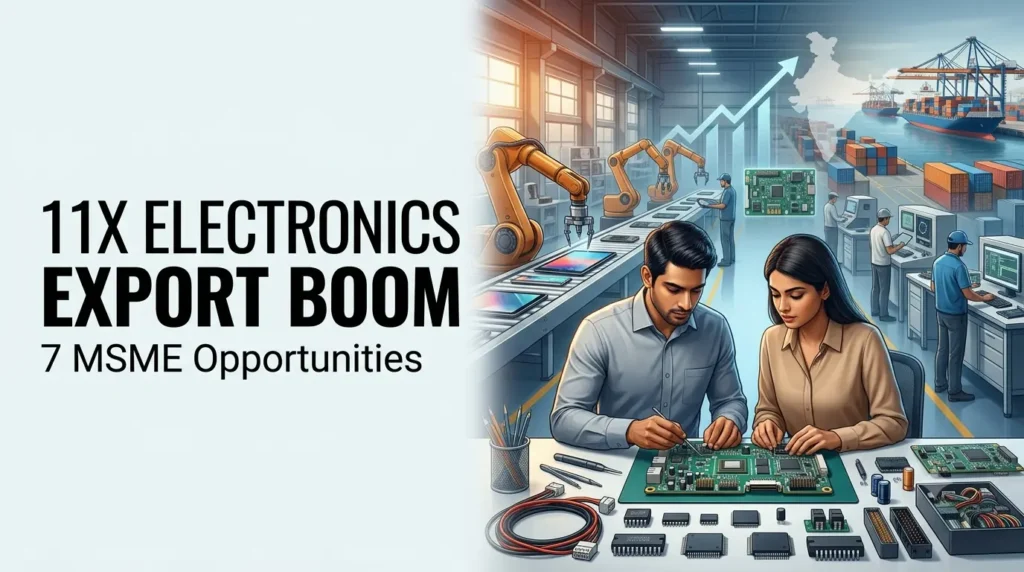
India’s electronics exports have grown 11-fold to around ₹4.24 lakh crore, but the biggest opportunity may not be limited to the companies assembling smartphones and other finished products.
📌 In This Guide you will find
ToggleAs India’s electronics ecosystem expands, a growing network of component manufacturers, sub-assembly suppliers and Tier-2, Tier-3 and Tier-4 businesses is emerging around large manufacturers.
For Indian MSMEs, this creates a potentially significant opportunity to become suppliers, service providers and specialised partners within the electronics export supply chain.
You don’t necessarily need to manufacture a smartphone, semiconductor or laptop.
You could manufacture a component, supply cables, provide specialised packaging, assemble PCBs, offer testing services, maintain factory equipment or provide logistics and export support.
In other words, India’s electronics export boom is also a supply-chain opportunity for MSMEs.
🆕 Latest Development: BRICS Is Emerging as an Important Electronics Export Market
India’s electronics exports to BRICS member countries increased 49.27% in FY2025-26, according to the Electronics and Computer Software Export Promotion Council (ESC).
BRICS accounted for approximately 19.61% of India’s total electronics exports, but the export pattern remains highly concentrated: the UAE and China together accounted for 88.5% of India’s electronics exports to the grouping, while telecom equipment represented 74.6% of the export basket.
This creates both an opportunity and a warning for Indian MSMEs. BRICS can provide new markets for electronics manufacturers and suppliers, but exporters should avoid excessive dependence on a small number of countries or product categories.
👉 Read the detailed analysis:
India’s Electronics Exports to BRICS: 5 Opportunities and 3 Risks for MSMEs
India’s Electronics Exports Have Grown 11X
India’s electronics manufacturing industry has expanded dramatically over the past decade.
According to government data, electronics exports increased from approximately ₹38,263 crore in FY2014-15 to around ₹4.24 lakh crore in FY2025-26 — an approximately 11-fold increase.
The growth reflects India’s expanding electronics manufacturing capabilities, increasing smartphone production, greater domestic value addition and deeper integration with global electronics supply chains.
But looking only at the final export number misses an important part of the story.
Every large electronics manufacturing facility needs an ecosystem of businesses around it.
That includes:
- Component suppliers
- Cable and wiring manufacturers
- PCB assemblers
- Packaging companies
- Testing and inspection providers
- Machinery and maintenance companies
- Warehouses and logistics providers
- Export-support businesses
This is where MSMEs can find opportunities.
BusinessZindagi takeaway: You don’t have to build the final electronic product. You can build one essential part of the ecosystem around it.
Why India’s Electronics Export Boom Matters to MSMEs
Think of an electronic product as a supply chain rather than a single factory.
Raw materials → Components → Sub-assemblies → Assembly → Testing → Packaging → Warehousing → Logistics → Export
Large manufacturers may handle the final assembly, but they often depend on hundreds of suppliers and service providers.
India’s growing electronics ecosystem is also creating opportunities for Tier-2, Tier-3 and Tier-4 suppliers.
This means an MSME could potentially participate without becoming a large electronics manufacturer itself.
The opportunity can be as simple as supplying one component consistently, providing specialised packaging or helping a manufacturer maintain its production equipment.
Electronics exports from india: 7 Electronics Supply-Chain Opportunities for Indian MSMEs
1. Electronics Components and Sub-Assemblies
One of the most obvious opportunities is supplying components or sub-assemblies to larger manufacturers.
Depending on your technical capabilities and investment, this could include:
- Connectors
- Cables
- Wiring harnesses
- Plastic housings
- Metal components
- Mounting parts
- Simple electronic sub-assemblies
The key is to identify products that manufacturers need repeatedly and where quality and delivery reliability matter.
The MSME opportunity
Instead of trying to sell directly to consumers, you can become a B2B supplier to an electronics manufacturer.
A small company that consistently supplies one important component can potentially build a recurring business.
2. PCB Assembly and Electronics Manufacturing Services
Printed circuit boards are at the heart of many electronic products.
An MSME with the required technical capabilities can potentially operate in areas such as:
- PCB assembly
- Component mounting
- Soldering
- Testing
- Prototyping
- Small-batch electronics manufacturing
This can be particularly useful for startups and smaller product companies that don’t want to establish their own complete manufacturing facility.
Potential customers
A PCB assembly or electronics manufacturing business could serve companies making:
- IoT devices
- Industrial equipment
- Smart devices
- Consumer electronics
- Automation products
- Automotive-related electronics
The opportunity here is not necessarily to build a consumer brand.
It can be to become the manufacturing partner behind someone else’s product.
3. Electronics Packaging
This may be one of the more accessible opportunities for existing MSMEs.
Electronic components and finished products require specialised packaging to protect them from:
- Physical damage
- Moisture
- Static electricity
- Vibration
- Dust
- Handling damage during transportation
Businesses can specialise in:
- ESD-safe packaging
- Protective inserts
- Custom boxes
- Industrial packaging
- Labels
- Component trays
- Export packaging
Why this is interesting
An existing packaging business may not need to completely transform itself into an electronics manufacturer.
Instead, it could develop a specialised electronics-packaging vertical.
This is a good example of how an MSME can enter the electronics ecosystem without taking on the investment required for full-scale electronics manufacturing.
If you are exploring packaging as an MSME opportunity, understanding barcodes, traceability and product identification is also important.
👉 Read: Why Barcodes Are Essential for MSME Product Packaging
4. Electronics Testing, Inspection and Quality Services
As electronics manufacturing grows, quality control becomes increasingly important.
Manufacturers need to ensure that components and finished products meet the required specifications.
Potential MSME opportunities include:
- Product inspection
- Component inspection
- Electrical testing
- Quality-control services
- Reliability testing
- Compliance support
Some businesses may operate as specialised service providers rather than manufacturers.
Why this matters
An electronics manufacturer cannot afford high rejection rates, product failures or inconsistent quality.
A reliable testing and inspection partner can therefore become an important part of the supply chain.
5. Industrial Maintenance and Machinery Services
Electronics factories depend heavily on machinery, automation and specialised production equipment.
That creates another less obvious opportunity for MSMEs.
Businesses with engineering and technical capabilities can provide:
- Equipment maintenance
- Electrical maintenance
- Automation support
- Machine servicing
- Calibration-related services
- Production-line maintenance
- Spare-parts support
This is a classic B2B opportunity.
You don’t need to manufacture electronics yourself.
You can instead help electronics manufacturers keep their factories running.
6. Electronics Logistics and Export Support
Electronics products can have relatively high value compared with their physical size.
That makes logistics, warehousing, packaging, documentation and secure transportation particularly important.
MSMEs can participate through:
- Warehousing
- Inventory management
- Freight forwarding
- Export documentation
- Customs coordination
- Specialised packaging
- Shipment consolidation
- Domestic transportation
For businesses already involved in export-import services, electronics can therefore become another sector to target.
A useful opportunity
Instead of being a general logistics provider, an MSME could specialise in:
“Logistics and export support for electronics manufacturers.”
Specialisation can help a small business differentiate itself from larger general-purpose providers.
7. Electronics Repair, Refurbishment and After-Sales Services
The electronics opportunity doesn’t end when the product leaves the factory.
Products eventually need:
- Repairs
- Component replacement
- Refurbishment
- Warranty servicing
- Diagnostics
- Reverse logistics
This creates opportunities for specialised service businesses.
Refurbishment can also become an important circular-economy opportunity as businesses and consumers look for ways to extend the life of electronic products.
For an entrepreneur with technical skills but limited capital, a specialised repair or refurbishment business may offer a more accessible entry point than manufacturing.
You Don’t Have to Manufacture Electronics to Enter This Industry
This is perhaps the most important point for MSMEs.
| Business Opportunity | Entry Barrier | B2B Potential |
|---|---|---|
| Electronics packaging | Low–Medium | High |
| Cables and wiring | Medium | High |
| PCB assembly | Medium–High | Very High |
| Testing and inspection | Medium–High | High |
| Factory maintenance | Medium | High |
| Electronics logistics | Medium | High |
| Repair/refurbishment | Low–Medium | High |
These are broad comparisons, not fixed investment estimates.
The actual investment, technology, machinery, certifications and skill requirements will depend heavily on the specific product or service.
The purpose of this table is simply to help entrepreneurs identify where their existing capabilities may fit into the electronics ecosystem.
7 Electronics MSME Ideas You Can Explore Without Building a Smartphone Factory
If you’re an entrepreneur looking for a business opportunity, consider:
- PCB assembly
- Cable and wiring-harness manufacturing
- Electronics-grade packaging
- Component sourcing and distribution
- Testing and inspection services
- Industrial electronics maintenance
- Electronics logistics and export support
The best opportunity for you will depend on your existing skills, machinery, capital, location and access to customers.
How Can an MSME Become a Supplier to an Electronics Manufacturer?
Getting into the electronics supply chain requires more than simply announcing that you manufacture a product.
A practical approach is:
Step 1: Choose one narrow product or service
Don’t try to serve the entire electronics industry.
Find one specific problem you can solve.
Step 2: Identify potential manufacturers
Look for electronics manufacturers, exporters, contract manufacturers and component buyers.
Step 3: Study their supplier requirements
Understand their:
- Quality requirements
- Technical specifications
- Packaging requirements
- Delivery schedules
- Certification requirements
Step 4: Develop samples
Before expecting a large order, demonstrate that you can consistently meet specifications.
Step 5: Approach procurement teams
Your target should often be the procurement or sourcing department, rather than simply sending a generic sales email.
Step 6: Start with a small order
A small successful order can be more valuable than a large promise.
Step 7: Build reliability
Electronics manufacturers value:
Quality + consistency + delivery + price
not just a low quotation.
Can Small Businesses Export Electronics From India?
Yes, but electronics exports require careful attention to the product, HS classification, destination-country requirements, standards, documentation and logistics.
A simplified export process looks like this:
Choose product → Find buyer → Verify product requirements → Calculate export cost → Check HS code → Prepare documents → Arrange logistics → Receive payment
For an MSME, the first challenge is often not manufacturing.
It is finding the right buyer and understanding what that buyer actually imports.
How Can MSMEs Find International Buyers for Electronics Products?
Traditional business directories can help, but shipment data can provide another useful perspective.
Instead of asking:
“Who sells electronics?”
you can ask:
“Which companies are actually importing this product?”
Import-export shipment databases can help exporters research:
- Potential buyers
- Importing companies
- Product descriptions
- Shipment activity
- Origin and destination markets
- Supplier relationships
👉 Explore Global Import-Export Data with Volza
Affiliate disclosure: BusinessZindagi may earn a commission if you sign up through our link, at no additional cost to you.
Government Support for India’s Electronics Manufacturing Ecosystem
India has introduced several initiatives aimed at strengthening electronics manufacturing and the wider semiconductor and component ecosystem.
One particularly relevant initiative for the supply chain is the Electronics Component Manufacturing Scheme (ECMS).
The scheme is designed to strengthen domestic component manufacturing and encourage deeper integration with global electronics value chains.
Depending on the business, entrepreneurs may also encounter initiatives relating to:
- Electronics manufacturing
- Semiconductor manufacturing
- Electronics components
- Production-linked incentives
- Technology development
- Manufacturing infrastructure
However, MSMEs should not assume that every scheme applies to every business.
Eligibility, investment requirements, incentives and application windows can differ significantly.
Before making an investment decision, always verify the latest information from the relevant government department or official scheme portal.
👉 MeitY — Electronics Component Manufacturing Scheme
What Challenges Should MSMEs Expect?
The electronics opportunity is attractive, but entering the sector is not easy.
1. Quality requirements
Electronics buyers generally expect consistent quality.
2. Technical capability
Some segments require specialised machinery and skilled workers.
3. Certifications and compliance
Depending on the product and market, multiple standards may apply.
4. Working capital
B2B customers may have payment cycles that put pressure on smaller suppliers.
5. Competition
India is competing with established electronics manufacturing ecosystems in countries such as China, Vietnam and others.
6. Delivery reliability
A component arriving late can potentially stop an entire production line.
This is why reliability can become an MSME’s competitive advantage.
A Simple Example: How a Small MSME Could Enter the Electronics Supply Chain
Imagine an MSME already operating a packaging business.
Instead of competing in general packaging, it decides to specialise in:
ESD-safe packaging for electronic components.
The business could follow this path:
Existing packaging business
↓
Develop electronics-specific packaging
↓
Approach local electronics manufacturers
↓
Supply samples
↓
Receive a small purchase order
↓
Build quality and delivery record
↓
Become a recurring supplier
↓
Target larger manufacturers and exporters
The business hasn’t manufactured a single smartphone.
But it has still become part of India’s electronics export ecosystem.
That is the MSME opportunity.
India’s Electronics Boom Is Bigger Than Smartphones
The headline number is impressive.
But the real business opportunity lies underneath it.
Every electronics manufacturing cluster needs an ecosystem of suppliers and service providers.
That means India’s electronics export growth can create opportunities for businesses involved in:
Components → Packaging → Testing → Maintenance → Warehousing → Logistics → Export → After-sales
For an MSME entrepreneur, the question should therefore not simply be:
“Can I start an electronics manufacturing company?”
A better question is:
“Which part of India’s electronics supply chain can my business serve profitably?”
That could be a much more realistic starting point.
Final Takeaway
India’s electronics exports have grown dramatically, but the opportunity isn’t limited to large manufacturers.
For MSMEs, the bigger opportunity may be to become suppliers, service providers and specialised partners within the growing electronics ecosystem.
You don’t necessarily need a huge factory.
You need to identify a specific requirement, develop the capability to meet it consistently and find manufacturers that need what you provide.
India’s electronics export boom may create its biggest MSME opportunities not at the end of the supply chain—but in the hundreds of businesses supporting it.
🔗 Useful BusinessZindagi Resources
📊 Research Export Opportunities
Before approaching international buyers, MSMEs can learn how to use import-export data to identify products, markets and potential customers.
👉 How MSMEs Can Use Import-Export Data to Find New Business Opportunities
📦 Packaging & Barcodes
👉 Why Barcodes Are Essential for MSME Product Packaging
💻 MSME Digital Tools
👉 6 New MSME Digital Platforms Every Small Business Should Know
📚 Official Sources & References
- PIB — Electronics Manufacturing Ecosystem and Export Growth
https://www.pib.gov.in/PressReleasePage.aspx?PRID=2291171&lang=1®=1 - PIB — Electronics Revolution: Mobiles Powering Exports
https://www.pib.gov.in/PressReleasePage.aspx?PRID=2284808&lang=1®=3 - MeitY — Electronics Component Manufacturing Scheme
https://www.meity.gov.in/offerings/schemes-and-services/details/electronics-component-manufacturing-scheme-UTM1IjMtQWa - MeitY — Annual Report 2025–26
https://www.meity.gov.in/static/uploads/2026/04/46face7d48c8f6a97030f713ad5fdab4.pdf - PIB — India’s Electronics Boost
https://www.pib.gov.in/FactsheetDetails.aspx?ModuleId=16&NoteId=150923&id=150923&lang=1®=6
Source note: Government figures, scheme details, eligibility conditions and policy requirements can change. Readers should verify the latest information from the relevant official government portal before making investment, manufacturing or export decisions.
✍️ About the Author
Tabrez is the founder and editor of BusinessZindagi.com, where he writes about MSMEs, exports, startups, business finance and entrepreneurship.
With hands-on experience in business and international trade, he focuses on explaining complex business and export topics in simple, practical language.
His goal is to help Indian entrepreneurs understand opportunities, avoid common mistakes and make better-informed business decisions.
BusinessZindagi combines practical business experience with research from government departments, official portals and other credible sources.
🤖 AI Disclaimer
AI tools may be used by BusinessZindagi to assist with research, drafting and editing. However, articles are reviewed and refined before publication, and factual claims are checked against available official and credible sources.
AI is used as an editorial assistance tool and does not replace human review, business experience or independent verification.
⚠️ Editorial Disclaimer
This article is for general informational and educational purposes only. Business opportunities, government schemes, eligibility requirements, technical standards and export regulations can change.
Readers should verify current requirements with the relevant government authority or qualified professional before making investment, manufacturing or export decisions.
BusinessZindagi does not guarantee the commercial success of any business idea discussed in this article.