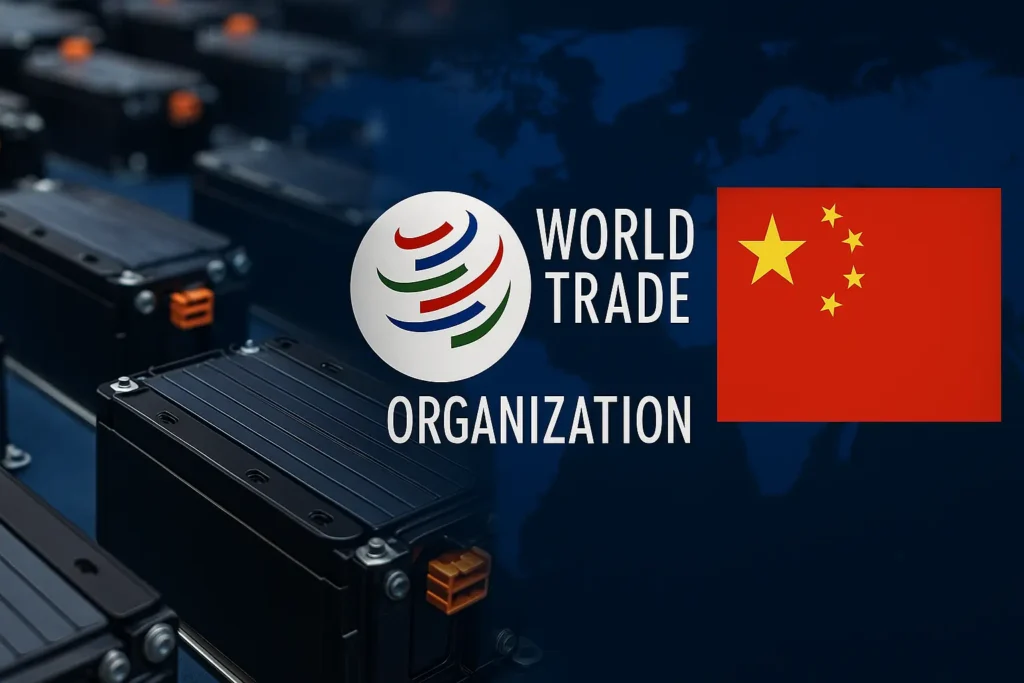
China has officially filed a complaint with the World Trade Organization (WTO) against India’s electric vehicle (EV) and battery subsidies, claiming that these policies give “unfair advantages” to domestic players.
(Reuters report)
Beijing argues that India’s Production Linked Incentive (PLI) Scheme for Advanced Chemistry Cell (ACC) batteries and FAME-II EV incentives discriminate against foreign companies—especially Chinese manufacturers—by favoring locally produced EV batteries.
At first glance, it looks like bad news for the Indian industry.
But dig a little deeper, and you’ll find that this move could actually be a blessing in disguise for EV battery manufacturers in India—especially for MSMEs trying to find a foothold in this booming sector.
you may also like to read: Why EV Charging stations Is the Next Big Business Frontier for India’s MSMEs
The Context — Why China Moved the WTO
China’s complaint essentially targets India’s localization-based subsidy framework, which links incentives to domestic value addition.
In other words, India rewards manufacturers who make more inside the country—not import and assemble.
This model helped India rapidly attract investment in gigafactories and lithium-ion cell production. Now, China sees India as a rising competitor in the global EV battery race, and the WTO move is an attempt to slow India’s momentum.
You may also like to read: Are India’s Electric Vehicle Charging Stations Enough? — Statewise Snapshot & What India Needs Next
The Current Landscape — Top EV Battery Manufacturers in India
The country’s EV supply chain has evolved dramatically over the past few years. Among the top EV battery manufacturers in India, the key names include:
- Amara Raja Batteries – building a giga-factory in Telangana.
- Exide Energy – investing heavily in lithium-ion and LFP batteries.
- Tata Agratas Energy Storage Solutions – global partnerships and advanced cell chemistry.
- Reliance New Energy – part of Reliance’s green energy mission.
- Ola Cell Technologies – localized cell manufacturing for two-wheelers and energy storage.
- Numerous MSME players – building niche B2B solutions in battery packs, BMS, and recycling.
Together, these firms represent a shift from import dependence to domestic manufacturing strength.
Why This WTO Case Could Be Good News
Here’s why China’s complaint could work out more positively for Indian EV battery manufacturers—especially MSMEs.
a) Validation of India’s Strength
When a manufacturing superpower like China files a complaint, it’s a signal that India’s policies are working.
It means Indian subsidies and PLI incentives are beginning to make domestic firms globally competitive.
That’s validation, not vulnerability.
b) Government Push for Self-Reliance
Facing external pressure, India is unlikely to weaken its industrial policies.
If anything, it will double down on “Atmanirbhar Bharat” initiatives—meaning more incentives for local MSMEs to scale up, innovate, and replace imports.
c) Increased Investor Interest
This global spotlight could actually attract more FDI and private capital.
Investors see this as evidence that India’s EV ecosystem is strong enough to disrupt Chinese dominance.
Expect more joint ventures and tech partnerships in the coming months.
d) Opportunity for MSMEs
If policy friction limits Chinese participation in India’s EV space, smaller domestic suppliers—especially MSME EV battery manufacturers in India—stand to gain.
They can supply to OEMs and large players looking for reliable, local partners.
e) Policy Refinement & WTO Compliance
India will likely fine-tune its policies to be WTO-compliant—without rolling them back.
That means a more transparent, stable business environment for investors and MSMEs alike.
The Challenges Ahead
Of course, not everything is rosy. There are real risks to watch:
- If WTO rules against India, it might have to tweak or limit its PLI structure.
- MSMEs dependent on specific subsidies could feel short-term financial strain.
- Battery raw materials like lithium, nickel, and cobalt remain largely import-dependent.
- Maintaining product quality, safety, and certification for exports will be crucial.
But these are manageable issues—especially given the government’s clear commitment to domestic EV manufacturing.
What Indian MSMEs Should Do Now
- Strengthen Local Supply Chains – Partner with domestic component suppliers to increase local content.
- Upgrade Technology – Focus on R&D, efficiency, and battery management systems (BMS).
- Collaborate with OEMs – Build partnerships with EV manufacturers and large energy firms.
- Invest in Certification – Ensure compliance with BIS and global standards to attract export opportunities.
- Stay Policy-Aware – Monitor WTO developments but keep building capacity—momentum is key.
The Bottom Line
China’s WTO complaint is a sign that India’s EV battery sector is finally being taken seriously on the world stage.
While it brings short-term uncertainty, it also underscores India’s growing competitiveness in clean-tech manufacturing.
For EV battery manufacturers in India, especially MSMEs, this is a moment to accelerate, not retreat.
When your competitor complains, it usually means you’re doing something right.
❓ Frequently Asked Questions (FAQ)
Q1. What exactly did China complain about?
China accused India of violating WTO rules by favoring domestic EV battery manufacturers through subsidy and PLI programs.
Q2. Will this stop India’s battery subsidy programs?
No. WTO cases take years to conclude, and India is likely to adjust, not abandon, its programs.
Q3. Which are the top EV battery manufacturers in India right now?
Amara Raja, Exide Energy, Tata Agratas, Reliance New Energy, and Ola Cell Technologies are among the leading players.
Q4. How will this affect MSME battery manufacturers?
Positively, in many ways—more localization, supply opportunities, and policy attention toward small-scale producers.
Q5. Is this complaint bad for India’s EV future?
Not necessarily. It highlights India’s progress and could push for stronger, WTO-compliant industrial frameworks that ultimately benefit the sector.
🔗 References and Source Links
- Reuters – China files WTO complaint over India EV, battery subsidies
- Economic Times – China urges India to rectify EV subsidy ‘wrongdoings’
- Business Standard – China moves WTO over India’s EV, battery subsidies
- Livemint – China’s WTO complaint over India’s EV advantage