
Focus Keyword: free project report maker
Starting a business often begins with an idea. But when you start looking for a business loan, that idea needs to be converted into numbers, assumptions and a structured plan.
That is where a project report or Detailed Project Report (DPR) becomes important.
I know this from personal experience.
In my early days, preparing a project report for small-business financing, including Mudra loan-related requirements, could be a time-consuming exercise. There was a lot of work involved in understanding the business, arranging project costs, working out expenses, estimating sales and preparing financial projections in a presentable format.
A lot has changed over the years.
Today, entrepreneurs have access to digital tools that can make the initial learning and preparation process much easier.
Instead of wondering “What exactly goes into a project report?”, you can now create one, experiment with your own numbers and understand how your proposed business looks on paper.
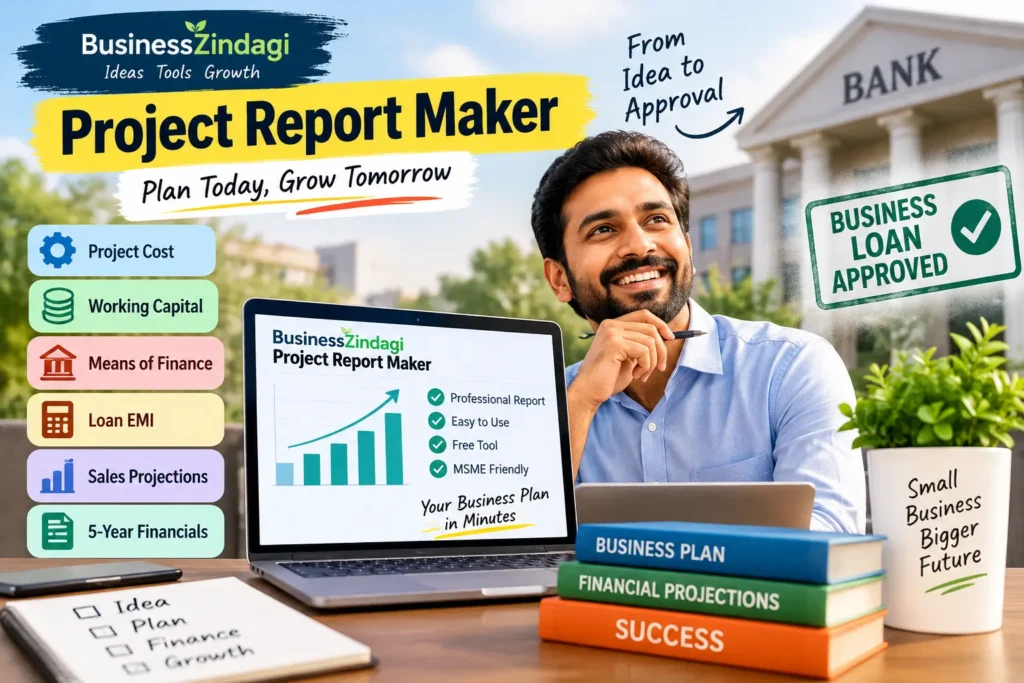
That is the idea behind the BusinessZindagi Project Report Maker.
What is a project report?
A project report is a structured document that explains a proposed business or project.
Depending on the purpose and requirements, it may cover areas such as:
- Business and promoter details
- Products or services
- Market and business overview
- Machinery and equipment
- Raw materials
- Manpower requirements
- Project cost
- Working capital
- Sources of finance
- Expected sales
- Operating expenses
- Profit projections
- Cash flow and other financial information
For an entrepreneur, the real value isn’t simply having these items in a document.
It is understanding what they mean for your business.
Why use a free project report maker?
A project report maker can be useful even before you approach a bank or financing institution.
1. Understand what a project report contains
If you are preparing your first report, it can be difficult to know where to start.
A guided tool gives you a practical way to see the different pieces that make up a project report.
2. Learn by creating your own report
Reading a sample project report is useful.
But creating one using your own business idea and your own assumptions can teach you much more.
You start thinking about questions such as:
- How much will I actually need to invest?
- What equipment will I require?
- How many people will I employ?
- What could my monthly sales be?
- What will my recurring expenses look like?
- How much working capital might I need?
- Can the expected revenue realistically support the proposed business?
3. Experiment with your assumptions
One of the biggest advantages of digital tools is that you can try different scenarios.
For example, you could change your estimated sales, investment or expenses and see how those assumptions affect the overall project.
This makes the project report more than a document.
It becomes a way to think through the business.
4. Prepare before approaching a lender
A project report should not be treated as something you prepare at the last minute simply because someone asks for it.
Preparing an initial version can help you understand your own proposal better before discussing financing.
From manually preparing reports to digital tools
This is perhaps the biggest change I have seen over the years.
Earlier, preparing a project report could involve a lot of manual work.
You had to collect information, organise the project costs, work through calculations, prepare projections and then put everything into a suitable format.
For someone who was already busy trying to establish a business, this could feel overwhelming.
Today, an entrepreneur can take a different approach.
You can start with an online project report maker, enter your proposed business information, work through the assumptions and generate a structured report.
More importantly, you can use the process to learn.
That is something I particularly wanted to bring into BusinessZindagi.
Don’t just generate a report. Understand it.
A first-time entrepreneur shouldn’t have to blindly copy somebody else’s project report simply because they don’t know where to begin.
A tool can give them a starting point.
They can create a report.
Read it.
Question the numbers.
Change the assumptions.
Create it again.
That process can help turn a confusing financial document into something much easier to understand.
How to create a project report online
Using the BusinessZindagi Project Report Maker is designed to make the initial process straightforward.
Step 1: Start with your business idea
Begin by providing information about the business or project you are planning.
Step 2: Enter your project details
Add relevant information such as investment, machinery, manpower, expenses and other business details required by the tool.
Step 3: Work through your financial assumptions
Think carefully about your expected sales, costs and other financial figures.
Don’t enter numbers simply because they make the project look attractive.
Use realistic assumptions.
Step 4: Generate your project report
The information you provide can then be organised into a structured project report.
Step 5: Read the report
This step is often overlooked.
Don’t simply generate the report and move on.
Read it from the perspective of someone evaluating your business.
Does the investment make sense?
Are your expected sales realistic?
Have you considered your major expenses?
Does the proposed funding requirement make sense?
Step 6: Refine your project
If something doesn’t look right, go back to your assumptions and improve them.
This is where the tool can become an educational exercise rather than just a document generator.
Project report maker vs downloading a sample report
A sample report can be helpful for understanding the general format.
But there is an important difference.
| Downloading a sample | Creating your own report |
|---|---|
| Shows another business | Uses your business idea |
| Contains someone else’s assumptions | Uses your own assumptions |
| Mainly useful for reference | Useful for learning and planning |
| May encourage copying | Encourages you to think through the numbers |
| Doesn’t necessarily reflect your situation | Can be tailored to your proposed project |
A simple way to put it is:
A sample report can show you what a report looks like. Creating your own report can help you understand your business.
Can a project report be useful for Mudra or PMEGP?
Project reports may be relevant when entrepreneurs are preparing proposals for different forms of business financing, including schemes or loan programmes where project details and financial viability need to be assessed.
For example, entrepreneurs may search for:
- Mudra loan project report
- PMEGP project report
- MSME loan project report
- Bank loan project report
- Business loan project report
However, the exact requirements can vary depending on the scheme, lender, business and nature of the proposal.
Therefore, a generated report should be treated as a starting point and working document—not as a guarantee that a bank or government agency will approve an application.
Who can use a project report maker?
A free project report maker can be useful for:
- First-time entrepreneurs
- Small-business owners
- MSMEs
- Entrepreneurs exploring business loans
- People considering Mudra or PMEGP-related financing
- Students learning business planning
- Entrepreneurs comparing different business ideas
- Anyone who wants to understand how a business looks financially on paper
You don’t necessarily need to be an experienced accountant to begin understanding your project.
You need to be willing to think honestly about your business assumptions.
A project report does not guarantee loan approval
This is important.
Creating a project report does not guarantee:
- Bank loan approval
- Government scheme approval
- Subsidy approval
- Financing approval
- Acceptance by a particular lender
Banks and other lending institutions conduct their own assessment and may ask for additional information or documents.
The quality of a project report ultimately depends on the quality and accuracy of the information behind it.
So don’t try to make your business look artificially profitable.
Realistic numbers are more useful than impressive numbers.
Try creating your own project report
If you have a business idea but have never prepared a project report before, you don’t necessarily have to begin with a complicated spreadsheet or a blank document.
You can start by experimenting.
Enter your business idea.
Work through the costs.
Think about your sales.
Consider your expenses.
Generate the report.
Then read it carefully.
Create → Experiment → Understand → Improve
That is the approach we want entrepreneurs to take with the BusinessZindagi Project Report Maker.
Create your free project report with BusinessZindagi Project Report Maker →
Frequently Asked Questions
Is there a free project report maker online?
Yes. BusinessZindagi provides an online Project Report Maker that allows entrepreneurs to create a structured project report using information about their proposed business.
Can I create a project report for a bank loan?
Yes, a project report can be prepared as part of the planning process for a business loan. However, banks may have their own requirements and may request additional information or documents.
Can I use a project report maker for a Mudra loan?
You can use a project report maker to help understand and prepare your business proposal. However, always check the current requirements of the relevant lender and scheme before submitting an application.
What information is normally needed for a project report?
It can include business details, promoter information, project cost, machinery, manpower, working capital, sales estimates, expenses, funding requirements and financial projections.
Is a project report the same as a DPR?
The terms are sometimes used interchangeably, although the exact scope and level of detail can vary depending on the project and purpose. A DPR generally provides a more detailed assessment of the proposed project.
Does creating a project report guarantee a business loan?
No. A project report is only one part of a financing proposal. The lender makes its own assessment based on factors such as the project, applicant, financial information, documentation, eligibility and lending criteria.
Final thought
When I look back at how project reports were prepared in my early days, the biggest difference today is not simply that technology can save time.
It is that entrepreneurs can learn by doing.
Earlier, many people encountered the project report only when they needed financing.
Today, you can create an initial version much earlier, experiment with your assumptions and start understanding your business before taking the next step.
And that, ultimately, is what a project report should help you do.
Not just prepare a document—but understand the business behind it.
Editorial Note
This article is based partly on the author’s own experience of preparing and working with business project reports in the early days of his entrepreneurial journey, including reports prepared in connection with small-business financing such as Mudra loans.
The purpose of this article is to help entrepreneurs understand what a project report is, why it can be useful and how digital tools can make the initial preparation and learning process easier.
BusinessZindagi believes that a project report should be more than a document prepared only because a lender asks for it. For a new entrepreneur, preparing one can also be a useful exercise for understanding project costs, expected sales, expenses, funding requirements and the overall financial logic of a proposed business.
Requirements for loans, government schemes and financial institutions can change. Readers should therefore verify the latest applicable requirements with the relevant government portal, lender or implementing agency before submitting an application.
AI & Tool Disclaimer
The BusinessZindagi Project Report Maker is designed for educational, planning and practical purposes. Users should verify all figures, assumptions and generated content before using a report for a loan or official application.
A generated report does not guarantee loan, subsidy or government approval. Banks and other institutions independently assess applications according to their applicable criteria.