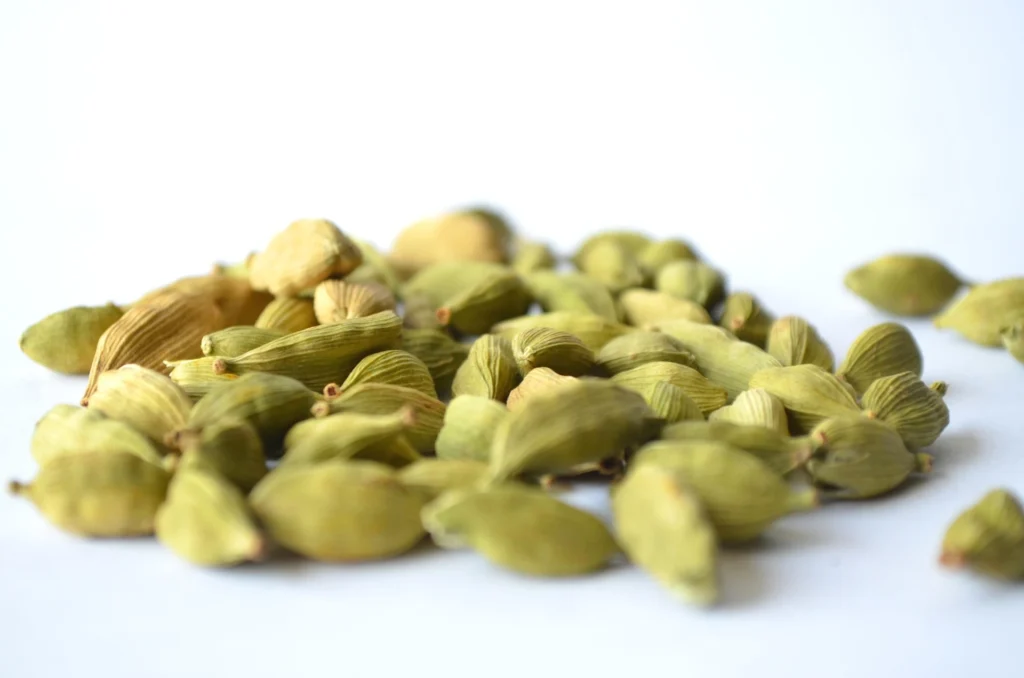
In India, few crops carry the scent of both fortune and fear like green cardamom (choti elaichi). Known as the “Queen of Spices,” it flavors sweets, perfumes, teas, and even medicines. Yet behind the fragrant pods lies one of India’s most unpredictable and volatile commodity markets.
The green cardamom business can turn small farmers and traders into overnight success stories — or leave them staring at heavy losses. I’ve lived both sides of that story.
you may also like to read: Inside the green Cardamom Auction Power System: How South India Built the Most Transparent Spice Marketplace”
How the Green Cardamom Business Works in India
The Growing Regions
Cardamom thrives in the misty high ranges of Kerala, Tamil Nadu, and Karnataka, especially in places like Idukki, Bodinayakanur, and Coorg. Kerala alone contributes nearly 60–70% of India’s green cardamom production, and most trade activity happens through regulated auctions overseen by the Spices Board of India.
The Auction Heartlands
Cardamom isn’t sold casually by buying directly from farmers and selling to buyers. It is generally sold through auction systems — primarily held at:
- Vandanmedu and Puttady (Kerala)
- Bodinayakanur (Tamil Nadu)
These are India’s main cardamom trading hubs. The Spices Board has authorized agencies like the South Indian Green Cardamom Company Ltd (SIGCC) to run e-auctions, where buyers and sellers meet digitally.
Farmers or registered growers deliver their dried, graded cardamom to local collection centers. The lots are weighed, tested for moisture, and then listed online for auction. Licensed buyers — exporters, traders, and packers — bid in real time, and once a bid is accepted, the payment is made to the farmer within about 10 working days.
This transparent mechanism ensures fair prices — though not stable ones.
Can Farmers Sell Directly Without Auction?
Yes, but with limits. Farmers can sell directly to private traders or exporters, but in reality:
- They get better reach and price visibility through auction houses.
- Auctions handle quality grading, documentation, and ensure guaranteed payment.
- Direct selling often requires strong networks and higher logistics costs.
So, most small and medium farmers rely on auctions to avoid risk and to get a competitive market rate.
The Wild Price Swings of Green Cardamom
If there’s one thing every cardamom trader learns early — it’s this: there are no guarantees.
Prices can rise faster than a summer storm and crash just as suddenly. For instance:
- In 2019, prices skyrocketed beyond ₹7,000 per kilo, leaving farmers celebrating.
- A few months later, they nosedived below ₹1,500, catching many traders off guard.
- Even in 2025, daily auction rates have ranged from ₹2,000 to ₹3,300 per kg, depending on grade and quality.
Unlike stable commodities like rice or tea, the green elaichi price behaves like a roller-coaster — thrilling for some, terrifying for others.
Profit Margin in Green Cardamom Business — Reality vs Expectation
When people talk about the profitability of the green cardamom business, there’s often a big gap between outside perceptions and the real economics on the ground.
💡🌿 Green Cardamom Prices in India
20-Year Historical Trend (2006–2025)
Unit: ₹ per kg
Basis: Annual average of major auction centres (Vandanmedu, Bodinayakanur, etc.)
📊 Year-wise price history (simple & clean)
| Year | Avg Price (₹/kg) | Market meaning |
|---|---|---|
| 2006 | 420 | Stable supply, moderate domestic demand |
| 2007 | 480 | Export demand improves |
| 2008 | 520 | Rising global spice prices |
| 2009 | 560 | Production dips slightly |
| 2010 | 780 | Sharp rise – lower output |
| 2011 | 1,100 | Peak – crop loss + strong exports |
| 2012 | 850 | Correction after high prices |
| 2013 | 720 | Higher arrivals cool market |
| 2014 | 680 | Stable but weak demand |
| 2015 | 650 | Oversupply phase |
| 2016 | 740 | Demand recovery begins |
| 2017 | 900 | Weather impact on crop |
| 2018 | 680 | Major crash – record production |
| 2019 | 520 | Lowest point of the decade |
| 2020 | 620 | COVID disruption, slow recovery |
| 2021 | 980 | Export revival + lower stocks |
| 2022 | 1,350 | Strong rally – supply tightens |
| 2023 | 1,650 | High export & festive demand |
| 2024 | 2,200 | Record highs – shortage + speculation |
| 2025* | 1,900 | Elevated but volatile (YTD average) |
*2025 = year-to-date average
source : Spices Board of India – Domestic Price Reports & Auction Data
https://www.indianspices.com/market/price/domestic
The story in plain English
What People Expect
From the outside, many believe cardamom trading or export means instant high profits — because:
- It is one of the most expensive spices in the world. In some export markets, cardamom commands prices equivalent to several hundred US dollars per 100 kg. ElmarSpices Company
- Auction prices can touch ₹2,500–₹3,300+ per kg for good quality cardamom in India’s major markets like Idukki or Bodinayakanur. Indian Spices
- Export unit prices internationally often translate to attractive rupee amounts when quality and grade are high. Tridge
This leads many to assume high double-digit profit margins (30 %–50 % or more) are standard — but that is usually not the full picture.
📉 The Realistic Profit Margins
In reality, profitability in cardamom business depends heavily on operational costs and market factors, not just price tags.
Here’s how margins look in practical terms:
1. Domestic Trading (Auction → Buyer)
- Farmers or traders sell at auction prices (often ₹2,000 – ₹3,300 per kg depending on grade and quality). Indian Spices
- From this sale price, brokerage, transport, drying, grading and handling reduce the net realisable amount — sometimes consuming 15 %–25 % of gross revenue.
2. Export/Processing Profit
- A small spice export business (not just cardamom) typically sees 20 %–30 % profit margins after all processing, packaging, compliance, shipping and logistics costs are included. Scribd
- For cardamom, higher quality export grades can lift margins, but competition from countries like Guatemala and fluctuating global demand also bite into pricing power. Investment Guru India
3. Farming Costs (If you cultivate)
- Cultivation and harvesting costs take time (3–4 years to full yield) and eat into profitability, meaning farmers’ net earnings per kilogram are lower than headline market prices. Project report builder for bank loan
So even though auction prices seem high, the net margin after costs realistically ranges between 15 %–30 % for many traders and exporters, once all expenses are accounted for.
Key Factors That Determine Profitability
Profit in the green cardamom business doesn’t come from price alone — it’s shaped by several critical factors:
🔹 Product Quality & Grade
Higher grades (uniform size, colour, low moisture) fetch premium prices at auctions and in export markets.
🔹 Timing & Market Cycles
Prices fluctuate sharply based on supply, weather, crop yields, and global demand. Buying or selling at the wrong time can drastically cut margins.
🔹 Logistics Costs
Transport from farming areas to auction centres or ports, warehousing, and handling can add significant cost.
🔹 Export Compliance & Documentation
For exports, expenses related to quality testing, certifications, documentation, and freight play a vital role in final profitability.
🔹 Market Access & Networks
Traders with strong buyer networks — especially overseas — often secure better pricing and faster turnover, boosting actual profit.
Bottom Line
Green cardamom can be profitable, but profits are not automatic just because market prices look high. The real margin depends on:
✔ how tightly you manage costs,
✔ your understanding of price cycles,
✔ and your ability to access the right markets at the right time.
Realistic profit margins for many players in this business tend to range from about 15 % to 30 % after costs, rather than the exceptionally high figures some outsiders expect. Effective risk management and strong market insight are what turn good sales into real profit.
My Experience: The Bitter Aftertaste of a Sweet Spice
When I first entered the green cardamom business, I thought I had it figured out. The prices were high; everyone was talking profits. I stocked heavily, confident that the rates would keep rising.
But a few months later, the market tumbled. Prices fell sharply, and my stocks — which once looked golden — turned into a pile of losses.
That experience taught me a crucial truth:
There is no guarantee of tomorrow’s price in the cardamom trade.
If it rises, it rises rapidly.
If it falls, it collapses like a card house.
So, my personal advice to beginners: do not hoard large stock. Trade cautiously, move your inventory faster, and always keep cash flow flexible.
The Auction Process: Step-by-Step Insight
- Harvest & Drying: Farmers harvest cardamom capsules and dry them to the required moisture level.
- Grading: The pods are sorted by size, color, and aroma. High-quality green pods fetch premium prices.
- Registration: Growers register with licensed auctioneers approved by the Spices Board of India.
- Lot Submission: Farmers submit cardamom to depots, where it’s tested and assigned lot numbers.
- E-Auction: Licensed buyers log into the e-platform and bid online. Highest bidder wins.
- Payment & Settlement: Once the sale is confirmed, payment is made through bank transfer — usually within ten days.
- Dispatch: Buyers arrange to collect their purchased lots for packaging or export.
This system ensures transparency, minimizes fraud, and connects small growers to big buyers.
The Harsh Truth — Why Cardamom Is Not for the Faint-Hearted
Even with an organized auction network, cardamom remains one of India’s most volatile agricultural commodities. Weather changes, pest attacks, export demand, and even international production (like Guatemala) can affect local prices overnight.
There’s no futures market guarantee — only risk, intuition, and experience.
If you’re entering this business:
- Start small. Test the waters with a few consignments.
- Monitor auction data regularly. (indianspices.com)
- Keep inventory light. Avoid storing huge volumes expecting a price surge.
- Network with experienced traders. Learn from their cycles of gain and loss.
Remember: in the green cardamom business, survival is the first profit.
The Bright Side — When Prices Work in Your Favor
While risky, cardamom also rewards timing. Traders who read the market right can earn handsome margins during sudden surges. The demand from the Middle East, Europe, and domestic confectionery markets remains strong — making cardamom an evergreen (and ever-unpredictable) spice.
If you can balance patience with caution, and data with instinct, the green cardamom business can still be deeply rewarding.
Play Smart, Not Blind
Cardamom is a royal spice — but it doesn’t offer royal guarantees. The auctions may bring fair play, but not price stability.
My experience taught me the hard way that this business rewards the informed and punishes the overconfident. For newcomers, treat it like a marathon — not a lottery. Buy smart, sell fast, and never let greed outweigh caution.
If you get that balance right, you can enjoy both the fragrance and fortune of India’s most prized spice.
✅ Frequently Asked Questions (FAQs)
1. Is the green cardamom business profitable in India?
Yes, the green cardamom business can be highly profitable due to strong domestic consumption and consistent export demand. Premium-quality cardamom often commands high prices in international markets, especially in the Middle East and Europe.
2. What is the current price trend of green cardamom?
Cardamom prices are known for volatility because they depend heavily on weather conditions, crop output, and export demand. However, long-term demand remains strong, making it a valuable spice commodity.
3. Which states produce the most green cardamom in India?
Kerala, Karnataka, and Tamil Nadu are the primary producers, with Kerala contributing the largest share of high-grade cardamom.
4. Who are the biggest buyers of Indian cardamom?
Major importers include the United Arab Emirates, Saudi Arabia, Kuwait, Qatar, and the United States, where cardamom is widely used in beverages, desserts, and traditional cuisine.
5. How much investment is required to start a cardamom trading business?
A small trading setup can start with moderate capital, but scaling the business—especially for exports—requires higher working capital due to fluctuating prices and inventory costs.
6. Is cardamom a good export business opportunity?
Yes. Cardamom is one of India’s high-value spice exports. With proper quality control, packaging, and certifications, exporters can achieve strong margins.
7. What are the biggest risks in the cardamom business?
Key risks include:
- Price fluctuations
- Climate impact on production
- Quality inconsistency
- Export regulation changes
Proper sourcing and risk management are essential.
About the Author
Tabrez Khan is an entrepreneur, trader, exporter, and business writer passionate about simplifying complex business topics for aspiring entrepreneurs and MSMEs. Having experienced the highs and lows of entrepreneurship firsthand—from early struggles to building an export-oriented business—he shares practical insights, real-world lessons, and emerging opportunities in trade and industry.
Through BusinessZindagi.com, his mission is to educate, inspire, and empower individuals to make informed business decisions and build sustainable ventures in India’s evolving economic landscape.
Official Reference Links
- Spices Board of India – Daily Cardamom Auction Prices
- South Indian Green Cardamom Company Ltd (SIGCC)
- Cardamom Auction Portal – Real-time Auction Data
- ResearchGate – Price Discovery and Market Efficiency of Cardamom in India