
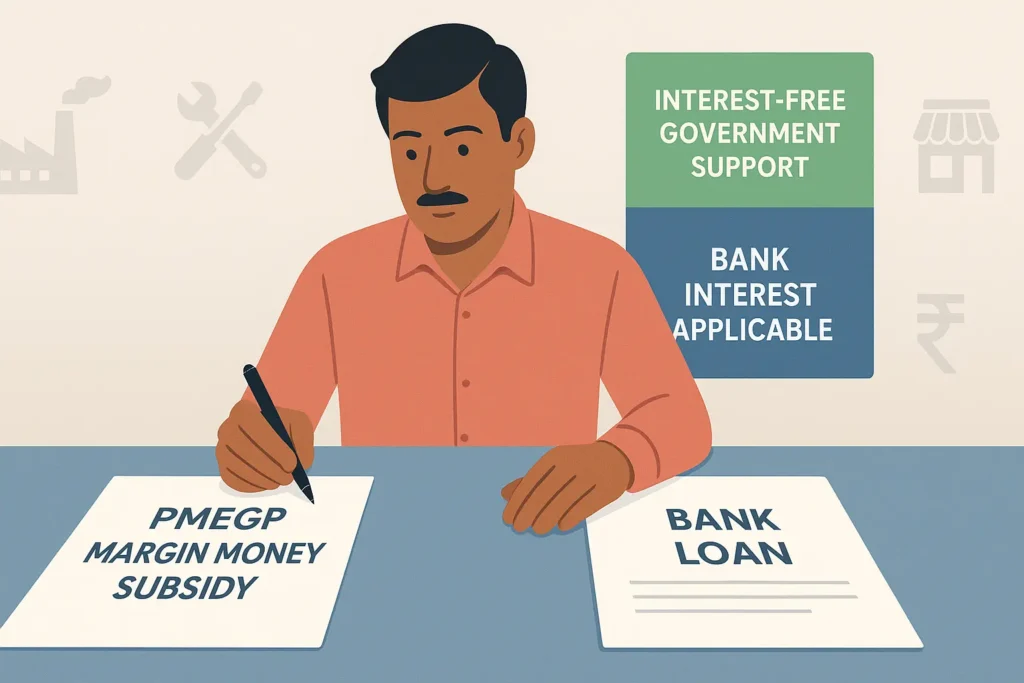
Many MSME owners believe that the PMEGP loan is popular because it offers a low interest rate.
That belief is wrong — and this misunderstanding alone costs entrepreneurs lakhs of rupees in poor financial decisions.
The real strength of the PMEGP scheme lies not in lower interest rates, but in something far more powerful:
👉 Margin Money Subsidy
In this guide, we’ll explain PMEGP margin money subsidy in simple language, backed by official government guidelines, real examples, and practical MSME logic.
Latest PMEGP margin money subsidy Update: ₹1,000 Crore Subsidy Released
Big PMEGP update in October 2026: The Government has released ₹1,000 crore in Margin Money subsidy under PMEGP to support 11,333 new micro-enterprises across India.
The supported projects have received around ₹3,260 crore in bank credit and are expected to create more than 1.02 lakh sustainable employment opportunities, particularly in rural areas.
The latest release also focuses on women entrepreneurs, SC/ST communities, the North Eastern Region and Aspirational Districts.
According to the Ministry of MSME, since 2014-15, PMEGP has helped establish over 8.38 lakh micro-enterprises, with more than ₹25,193 crore in Margin Money subsidy and approximately 75 lakh employment opportunities.
Source: Press Information Bureau (PIB) – Ministry of MSME
Updated: October 10, 2026
PMEGP continues to provide credit-linked Margin Money subsidy to eligible entrepreneurs. According to the latest MSME Ministry data, ₹13,957.72 crore in Margin Money subsidy has been disbursed for 4,25,965 units from FY 2021–22 to FY 2026–27 (data as of August 31, 2026). Official MSME PMEGP Dashboard
The government has also proposed speeding up PMEGP 2.0, a single-window digital system intended to improve application processing and real-time tracking. PIB Parliamentary Committee Report
Important: PMEGP Margin Money is a subsidy linked to the bank loan; it is not cash paid directly to the applicant.
you may also like to read: How to Write a PMEGP Project Report That Gets Approved – Lessons From My Own Startup Journey
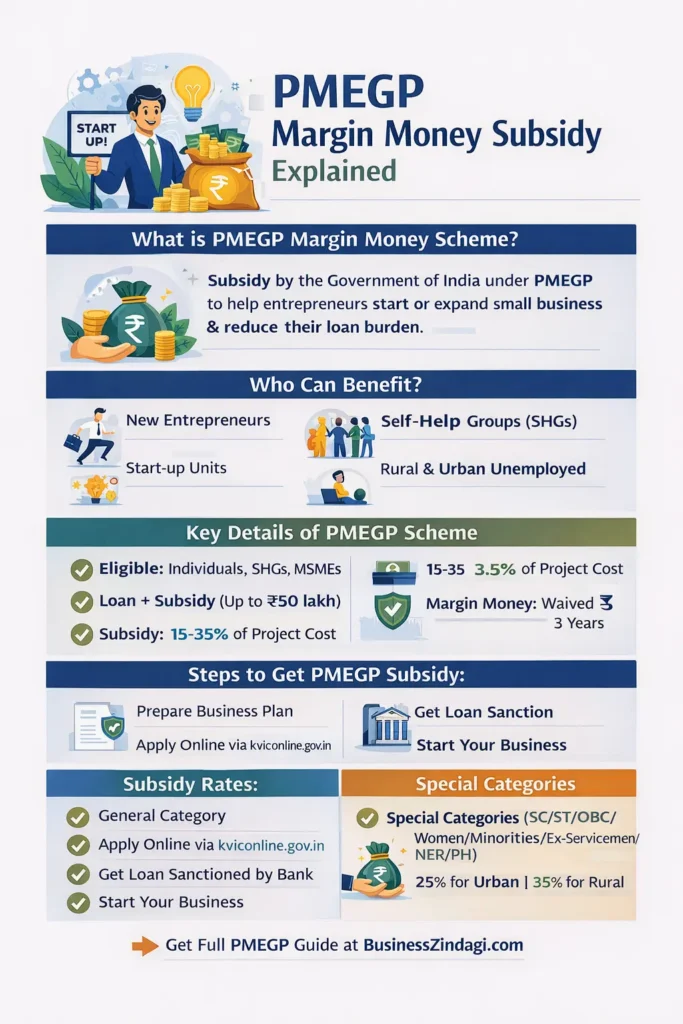
What Is PMEGP? (Quick Recap)
The Prime Minister’s Employment Generation Programme (PMEGP) is a government-backed credit-linked subsidy scheme launched in 2008 by the Ministry of MSME and implemented through KVIC, KVIBs, and District Industries Centres (DICs).
Its primary goal is to:
- Support first-time entrepreneurs
- Promote self-employment
- Encourage micro enterprises in manufacturing and services
related post: 10 Common Mistakes in PMEGP loan to Avoid While Applying.
Big Myth: PMEGP Offers Lower Interest Rates ❌
Let’s clear this upfront.
🔴 PMEGP does NOT provide a fixed or concessional interest rate.
According to official PMEGP guidelines:
Banks are free to charge their normal MSME lending rate on PMEGP loans.
This means:
- Interest rate varies from bank to bank
- It also depends on time, loan size, and credit policy
- There is no special PMEGP interest rate chart
So why is PMEGP still considered attractive?
you may also like to read:Affordable Finance for Entrepreneurs: How the Prime Minister’s Employment Generation Programme (PMEGP) is Empowering First-Generation Business Owners
The Real Benefit: What Is Margin Money Subsidy in PMEGP? ✅
What Has Changed?
If you are reading older information about PMEGP, keep these important points in mind:
- Maximum project cost: ₹50 lakh for manufacturing and ₹20 lakh for business/service projects.
- Subsidy: 15%–35% of eligible project cost, depending on your category and whether the unit is in an urban or rural area.
- Own contribution: 10% for General Category and 5% for Special Category applicants.
- The subsidy is not paid to you as cash upfront. It is kept with the bank in TDR/SRF and is generally adjusted against the loan after a 3-year lock-in period, subject to satisfactory physical verification.
- Udyam Registration is mandatory for new PMEGP units before physical verification and subsidy adjustment.
- Collateral: No collateral is required for PMEGP loans up to ₹20 lakh, subject to applicable RBI/banking guidelines.
- Existing successful PMEGP/REGP/MUDRA units may also qualify for a second loan for upgradation—up to ₹1 crore for manufacturing and ₹25 lakh for business/service projects.
In simple terms: PMEGP subsidy can significantly reduce the effective loan burden, but it should not be treated as an upfront cash grant.
Source: Ministry of MSME and official PMEGP portal.
Margin Money Subsidy Rates
| Category | Urban Area | Rural Area |
|---|---|---|
| General | 15% | 25% |
| SC / ST / OBC / Minority / Women / Ex-Servicemen | 25% | 35% |
Simple Example: How Margin Money Saves You Lakhs
Let’s say you apply for PMEGP with a ₹10 lakh project.
- Government subsidy (35%) → ₹3.5 lakh
- Bank loan ➝ ₹6.5 lakh
- Interest charged only on ➝ ₹6.5 lakh
💡 You never pay interest on ₹3.5 lakh. Ever.
This is the hidden saving most MSMEs completely miss.
Why PMEGP Is Cheaper Even With Normal Interest Rates
Even if a bank charges 11–12% interest:
- EMI is lower
- Total interest paid over loan tenure is lower
- Financial pressure in early years reduces
PMEGP vs Normal MSME Loan
| Feature | PMEGP Loan | Regular MSME Loan |
|---|---|---|
| Interest rate | Bank MSME rate | Bank MSME rate |
| Government subsidy | ✅ Yes | ❌ No |
| Interest on subsidy | ❌ Not charged | NA |
| Loan burden | Lower | Higher |
| First-time entrepreneur friendly | ✅ Yes | ❌ Often difficult |
Is There Any Interest Subsidy in PMEGP?
✅ Direct interest subsidy under PMEGP? → NO
✅ Indirect benefit? → YES
Here’s how:
- Margin money is kept separate (often locked for 3 years)
- That portion is interest-free
- You pay interest only on bank-financed portion
Special Case: 2018–2021 MSME Interest Subvention
Between 2018 and March 2021, the Government of India ran a 2% Interest Subvention Scheme for MSMEs.
If a PMEGP borrower:
- Was GST-registered
- Took eligible incremental credit
they may have received 2% interest relief.
⛔ This scheme is now discontinued.
PMEGP Interest Rate History Since Launch (2008)
Here’s the honest truth many sites won’t tell you:
- PMEGP never had a fixed interest rate
- Since 2008, banks have always applied prevailing MSME lending rates
- Rates generally ranged between 10%–13% depending on time & bank policy
- Government never published a year-wise PMEGP interest rate chart (because it doesn’t exist)
👉 Margin money subsidy has always been the core benefit, not interest control.
Maximum Interest Charged on PMEGP: What You Should Know
There is no official “maximum PMEGP interest rate”, but:
- Banks cannot charge arbitrary rates
- RBI MSME lending norms apply
- Rates must be disclosed in sanction letter
💡 Tip: Always compare PMEGP sanction rate with:
- MUDRA loan
- Regular MSME term loan
Why Margin Money Matters So Much for MSMEs
For small businesses:
- Cash flow is fragile
- Initial years decide survival
- High EMI kills growth
Margin money:
✅ Reduces risk
✅ Improves viability
✅ Encourages formal entrepreneurship
This is why PMEGP is not a cheap loan — it’s a smarter loan.
FAQs on PMEGP Margin Money Subsidy
Q1. Is PMEGP subsidy refundable?
No. It is a government grant, not a loan.
Q2. Will bank deduct subsidy from my loan?
Yes. Loan is calculated after subsidy adjustment.
Q3. Is interest charged on subsidy amount?
No. Zero interest.
Q4. Can banks refuse PMEGP due to low interest rates?
Banks don’t bear subsidy cost, so interest rate is not a loss to them.
Q5 Is PMEGP Margin Money subsidy given as cash to the applicant?
No. PMEGP Margin Money is a credit-linked subsidy associated with the bank-financed project. It is not normally paid directly as cash to the beneficiary. The subsidy is handled through the prescribed banking/PMEGP process and adjusted according to scheme conditions.
PMEGP is not about paying less interest per year.
It’s about borrowing less money and paying less interest overall.
Entrepreneurs who understand margin money:
- Plan better
- Borrow smarter
- Grow faster
Those who chase “cheap interest” often miss the bigger picture.
Disclaimer
PMEGP guidelines, subsidy rates, and interest policies are subject to change as per Government of India and bank norms. Interest rates vary by bank and time. Always verify details from official KVIC / MSME portals or your lending bank.
About the Author
BusinessZindagi focuses on practical MSME knowledge, government schemes explained in simple language, and real-world business insights for Indian entrepreneurs.
✅ Official References & Authentic Links
- Ministry of MSME – PMEGP Scheme Overview
https://msme.gov.in/schemes/prime-ministers-employment-generation-programme - KVIC – PMEGP Official Portal
https://www.kviconline.gov.in/pmegpeportal - PMEGP Applicant FAQs (Subsidy, Eligibility, Process)
https://www.kviconline.gov.in/pmegpeportal/jsp/SchemeFaqApplicant.html - PMEGP Scheme Guidelines (Official PDF)
https://www.kviconline.gov.in/pmegp/pmegpweb/docs/pdf/PMEGPscheme.pdf - Revised PMEGP Guidelines (Latest – 2023)
https://www.kviconline.gov.in/pmegpeportal/dashboard/notification/Revised_PMEGP_Scheme_Guidelines_07122023.pdf - Udyam Registration (Mandatory for MSMEs)
https://udyamregistration.gov.in