
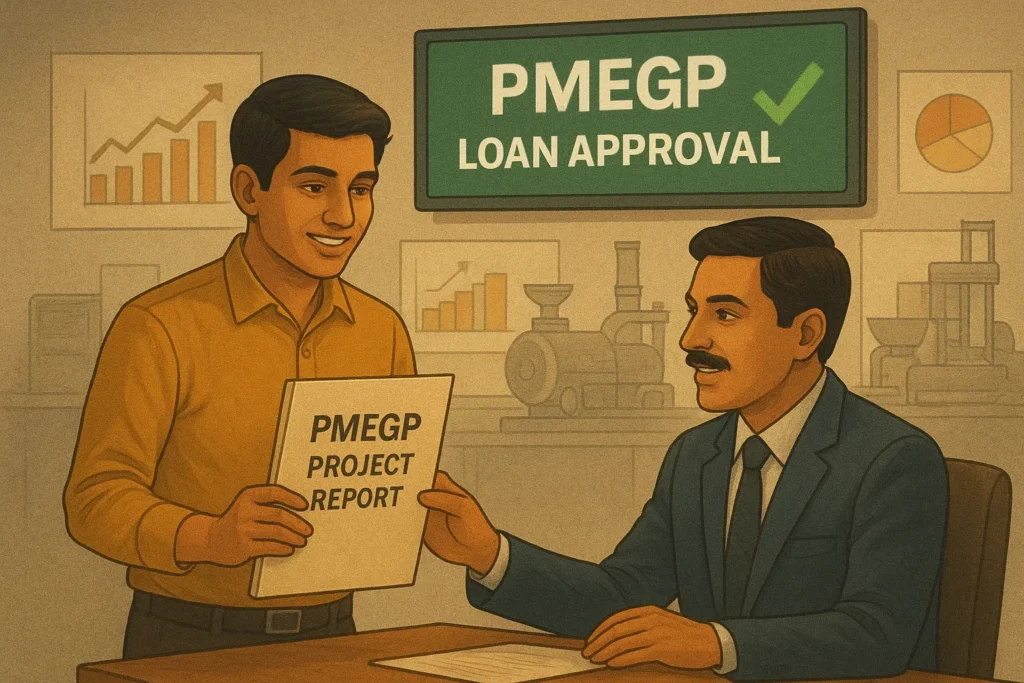
How to Prepare a PMEGP Project Report in 2026
A good PMEGP project report is more than a document you submit with your loan application.
It explains your business idea, investment, machinery, working capital, expected sales, employment generation, profitability and how the proposed business can become financially viable.
For many first-time entrepreneurs, preparing all these calculations and sections from scratch can be confusing.
That is why BusinessZindagi has created a simple PMEGP Project Report Generator that helps you build a structured project report by entering your own business details.
In this guide, I will explain what a PMEGP project report should contain, what information you should keep ready, common mistakes to avoid and how you can use the BusinessZindagi Project Report Generator to get started.
Don’t Start Your PMEGP Project Report From a Blank Page
Preparing a project report manually can mean dealing with project costs, machinery, working capital, sales projections, expenses, employment and profitability calculations.
You don’t have to start from scratch.
Build Your PMEGP Project Report With BusinessZindagi
Enter your business details step by step and use the BusinessZindagi PMEGP Project Report Generator to create a structured project report based on the information you provide.
✓ Enter your business details
✓ Add project costs and machinery
✓ Add sales, expenses and employment estimates
✓ Build your financial projections
✓ Generate your project report
👉 Start Building Your PMEGP Project Report
Important: The generator is a document-preparation and planning tool. It does not guarantee loan approval, subsidy approval or eligibility. Always check your figures and the latest official PMEGP requirements before submitting an application.
What Is a PMEGP Project Report?
A PMEGP project report is a structured document that explains how you plan to establish and operate your proposed business.
It generally brings together information about:
- The proposed business
- Products or services
- Promoter background
- Location
- Machinery and equipment
- Raw materials
- Project cost
- Working capital
- Expected sales
- Operating expenses
- Employment generation
- Profitability
- Cash flow and repayment capacity
The purpose is to present your business idea and its financial feasibility in a clear and understandable manner.
A project report should therefore be based on realistic figures rather than numbers copied from someone else’s project.
My Own Experience With Writing a PMEGP Project Report
When I applied for a loan under PMEGP, I had to create a detailed project report. At first, it felt like climbing a mountain — terms like “cash flow,” “fixed capital,” and “break-even ana
lysis” were new to me. But instead of outsourcing it blindly, I sat down and understood every single section.
The turning point came when I went to meet the bank manager. He asked me questions straight from my project report:
- How will you manage working capital in the first six months?
- What’s your plan if the market slows down?
- How many people will your unit employ?
Because I had studied my own report, I answered with confidence. That made all the difference. The manager realized I wasn’t just chasing subsidy money; I was serious about my business. And honestly, banks are eager to lend — but only to deserving entrepreneurs who can show clarity and commitment.
That experience taught me one important lesson: a PMEGP project report is not just paperwork. It’s the mirror of your business vision.
You may also like to read:10 Common Mistakes in PMEGP loan to Avoid While Applying for PMEGP loan
Key Elements of a Winning PMEGP Project Report
Executive Summary
Think of this as your business elevator pitch. Explain clearly what your idea is, where you’ll set up, and who your customers are.
Business Objectives
Keep it aligned with PMEGP’s purpose: generating employment, supporting rural industry, and promoting self-reliance.
Promoter’s Profile
This is where your personal story matters. Show your skills, experience, and why you’re passionate about this business.
Enterprise Details
Highlight whether it’s a manufacturing or service unit, production capacity, and why your chosen location gives you an edge.
Market Analysis
Prove there’s demand for your idea. Share details about target customers, competitors, and pricing. A well-researched market plan impresses banks.
Project Cost & Financials
Break down fixed assets, working capital, total cost, and how much loan/subsidy you need under PMEGP. Keep it realistic.
Profitability & Cash Flow
Show how you’ll make money. A 3–5 year projection of revenue, expenses, and profits makes the banker trust your repayment ability.
Employment Generation
Never forget — PMEGP is about jobs. The more employment your project creates, the stronger your case.
Risk Management
Talk about risks and how you’ll handle them. This proves you’re practical and prepared.
Need Help Preparing Your PMEGP Project Report?
Preparing a PMEGP project report can be challenging, especially when you need to calculate your project cost, working capital, loan requirement, expected sales and future financial performance.
Instead of doing everything manually, try the BusinessZindagi Project Report Maker.
Our free tool helps you organise important business and financial details, including project cost, working capital, means of finance, loan planning, sales projections and five-year financial estimates.
Create Your Business Project Report Free
Why Understanding Your PMEGP Project Report Matters
Most applicants think the report is only for the bank. But in reality, it’s also for you. When you understand your own numbers, strategy, and risks, you not only prepare for approval but also strengthen your confidence as an entrepreneur.
In my case, the project report wasn’t just a document — it was my rehearsal for entrepreneurship. By the time I got my approval, I already felt ready to run the business because I had thought through every detail.
Tips From My Journey
- Don’t just copy-paste a template. Customize it for your idea.
- Be realistic with numbers — overpromising backfires.
- Study your own project report thoroughly before facing the bank.
- Show how your project supports employment, because that’s the heart of PMEGP.
- Remember, confidence in explaining your project is as important as the report itself.
Conclusion
Writing a PMEGP project report may look tough at first, especially for first-time entrepreneurs. But if you take it seriously, it becomes your biggest strength. Banks want to support businesses that are genuine and sustainable, and your ability to explain your project confidently is what convinces them.
For me, the PMEGP project report was not just paperwork — it was the first step in proving to myself and the bank that I deserved to be an entrepreneur. And if I could do it, so can you.
About the Author
Tabrez – Founder of Business Zindagi
Tabrez is a first-generation entrepreneur who built his digital business without formal technical training. At Business Zindagi, he helps aspiring small-town entrepreneurs, women-led ventures, and rural artisans with actionable insights, scheme guides, and simplified business strategies.
Important
PMEGP rules, eligibility conditions, project-cost limits, subsidy provisions and application procedures may be revised by the Government from time to time.
Always verify the latest information from the official PMEGP/KVIC and Ministry of MSME websites before submitting an application or making financial decisions.
AI & Editorial Disclaimer
This article has been prepared and reviewed by BusinessZindagi for educational and informational purposes.
Some portions of the article, explanations, calculations, examples or supporting content may have been created or assisted using artificial intelligence (AI) tools and subsequently reviewed and edited by the BusinessZindagi editorial process.
AI assistance does not replace official Government notifications, PMEGP guidelines, professional financial advice or the assessment of a bank or implementing agency.
The BusinessZindagi PMEGP Project Report Generator is a document-preparation and business-planning tool. It uses the information and assumptions entered by the user to help create a structured project report.
The generated report:
- Does not guarantee PMEGP eligibility.
- Does not guarantee loan approval.
- Does not guarantee subsidy approval.
- Does not represent an official PMEGP/KVIC assessment.
- Should not be treated as a substitute for professional financial, accounting or legal advice.
- Should be carefully reviewed and corrected by the user before submission.
- Should use realistic and verifiable business figures wherever possible.
Users are responsible for verifying their personal information, project costs, machinery prices, sales assumptions, expenses, financial projections and other information before using a generated report for any official purpose.
⚠️ Always Verify Before Applying
Government schemes can change. Eligibility requirements, project limits, subsidy rules, documentation requirements and application procedures may be updated.
Before submitting a PMEGP application, check the latest information directly with the official PMEGP/KVIC portal and the concerned implementing agency or bank.
BusinessZindagi is an independent informational platform and is not KVIC, the Ministry of MSME, a bank or a PMEGP sanctioning authority.