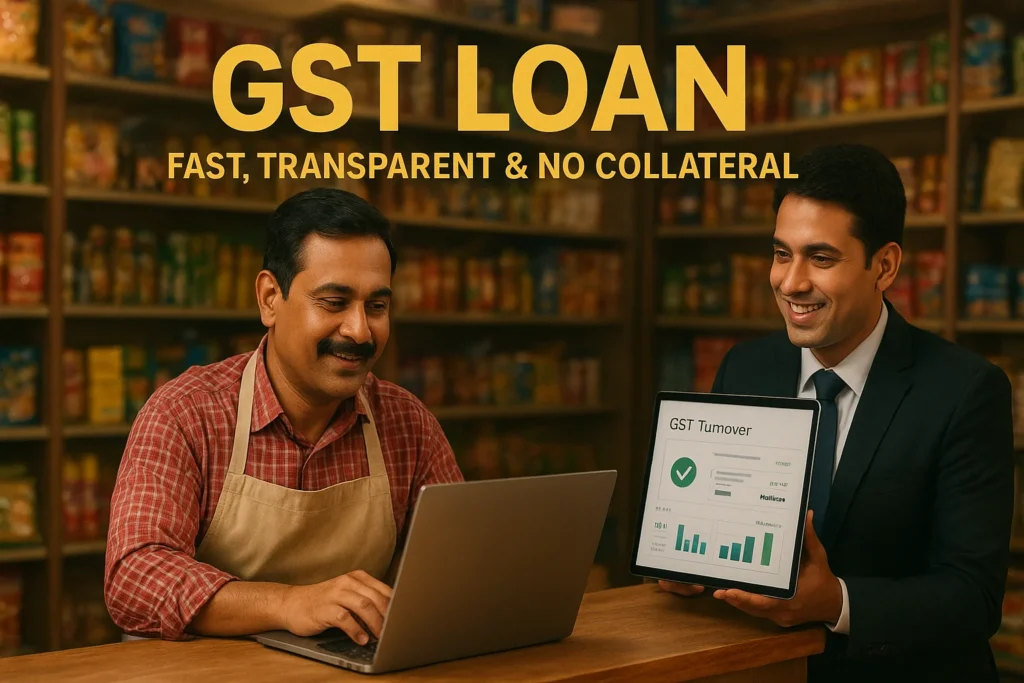
As an MSME owner, I’ve always believed that staying informed about financial products is just as important as managing daily operations. A few weeks ago, I came across the concept of a GST loan. At first, I didn’t pay much attention because I already had a Cash Credit (CC) loan to support my business. But the thought lingered—what if there was a smarter way to borrow, especially during peak seasons like Diwali or wedding orders?
After researching more, I realized that understanding a GST loan and its eligibility criteria could be a game-changer for many small business owners like me. Here’s my experience and what I learned.
What is a GST Loan?
A GST loan is a business loan offered by banks and NBFCs based on your GST returns. Instead of relying on heavy collateral or years of financial statements, lenders look directly at your GST filings to evaluate turnover and creditworthiness.
👉 The most important part: Banks have direct access to the GST portal data of registered businesses. This means they can see your actual GST turnover on their systems—making the process transparent and eliminating any chance of inflating sales figures to secure higher loans.
For an MSME like mine, that’s huge—it means:
- Faster approvals.
- Lesser paperwork.
- Unsecured funding (no collateral).
If your GST returns show stable monthly sales, you can qualify for funding 2–5 times your average monthly turnover.
You may also like to read: 5 Reasons to File GST Return filing by Yourself as a Small Business or MSME in India?
GST Loan Eligibility: What I Found Out
While exploring, I noted that lenders check for:
- Active GST registration.
- Regular GST filing for 6–12 months.
- Annual turnover (₹20–50 lakhs minimum, depending on lender).
- CIBIL score of 650+ for better approval chances.
This means if you’re disciplined with GST compliance, you can get quicker access to funds compared to traditional loans.
My Experience with a CC Loan vs. GST Loan
When I availed my CC loan, it helped me cover day-to-day working capital needs. The flexibility to withdraw and repay anytime was useful, but the process took time since it required collateral and multiple documents.
Comparing that with a GST loan:
- It looks much faster.
- Doesn’t need collateral.
- Slightly higher interest rates, but worth it for urgent needs.
- No manipulation possible since banks can see actual GST turnover directly from the system.
For me, CC remains useful for continuous liquidity, but a GST loan could be the perfect backup during festive seasons or bulk order demands.
GST Loan vs. Working Capital Loan vs. CC Loan: My Take
| Feature | GST Loan | Working Capital Loan | CC Loan |
|---|---|---|---|
| Basis | GST returns (direct portal access) | Financials/ITR | Collateral + banking history |
| Collateral | Not required | May be required | Usually required |
| Speed | Very fast | Moderate | Slower |
| Transparency | 100% (no sales manipulation possible) | Based on submitted docs | Based on collateral valuation |
| Best For | MSMEs with regular GST filings | Seasonal needs | Continuous liquidity |
Conclusion: Which is Best for MSMEs?
From my perspective as an MSME owner:
- CC Loan is best for ongoing working capital.
- Working Capital Loan works for one-time seasonal needs.
- GST Loan is the most convenient option if you want quick, collateral-free funding based on your GST compliance.
If you’re filing GST regularly, don’t ignore this option—it can be a lifesaver when opportunities knock.
:
🏦 Banks Offering GST-Based Loans in India
1. Punjab National Bank (PNB)
- PNB GST Express: Provides working capital based on GST returns, with loan amounts ranging from ₹10 lakh to ₹10 crore. Scribd
- PNB GST Sahay App: A mobile application enabling MSMEs to access instant loans using GST invoices, streamlining the loan process. ETBFSI.com
- PNB MSME Sahayak: Offers financing against input tax credit claims under GST, with loan amounts up to 80% of the input tax claim due on purchases. CreditMantri
2. ICICI Bank
- GST Business Loan: Offers loans up to ₹3 crore based on GST returns, with minimal documentation and quick processing. pnbfirst.pnbindia.in
3. HDFC Bank
- Xpress GST Overdraft: Provides overdraft facilities up to ₹50 lakh, leveraging GST returns for quick and collateral-free loans. ETBFSI.com
4. Axis Bank
- GST Overdraft Facility: Offers overdraft facilities based on GST returns, simplifying the loan process for MSMEs. ETBFSI.com
5. State Bank of India (SBI)
- SBI GST Loan: Provides loans based on GST returns, with competitive interest rates and flexible repayment options. ETBFSI.com
6. Bank of Baroda
- Baroda GST Loan: Offers working capital loans based on GST returns, with quick processing and minimal documentation. ETBFSI.com
❓ SEO-Friendly FAQs
1. What is a GST loan?
A GST loan is a business loan given by banks and NBFCs based on your GST returns. Lenders directly verify your GST turnover from the GST portal, making the process fast and transparent.
2. What is GST loan eligibility?
To be eligible, you need an active GST registration, regular GST filings for at least 6–12 months, a minimum turnover of ₹20–50 lakhs (varies by lender), and a decent CIBIL score (650+).
3. How is a GST loan different from a CC loan?
A GST loan is unsecured and based on GST filings, while a CC loan usually requires collateral. CC loans are more flexible for continuous liquidity, but GST loans are faster and more transparent.
4. Can businesses inflate sales to get a higher GST loan?
No. Banks have direct access to GST portal data and can see actual filed turnover. This eliminates any chance of manipulation or inflated sales figures.
5. Is GST loan good for MSMEs and small businesses?
Yes. It’s especially good for MSMEs that are GST-compliant but lack collateral. It provides quick, collateral-free funding for festive seasons, bulk orders, and urgent business needs.