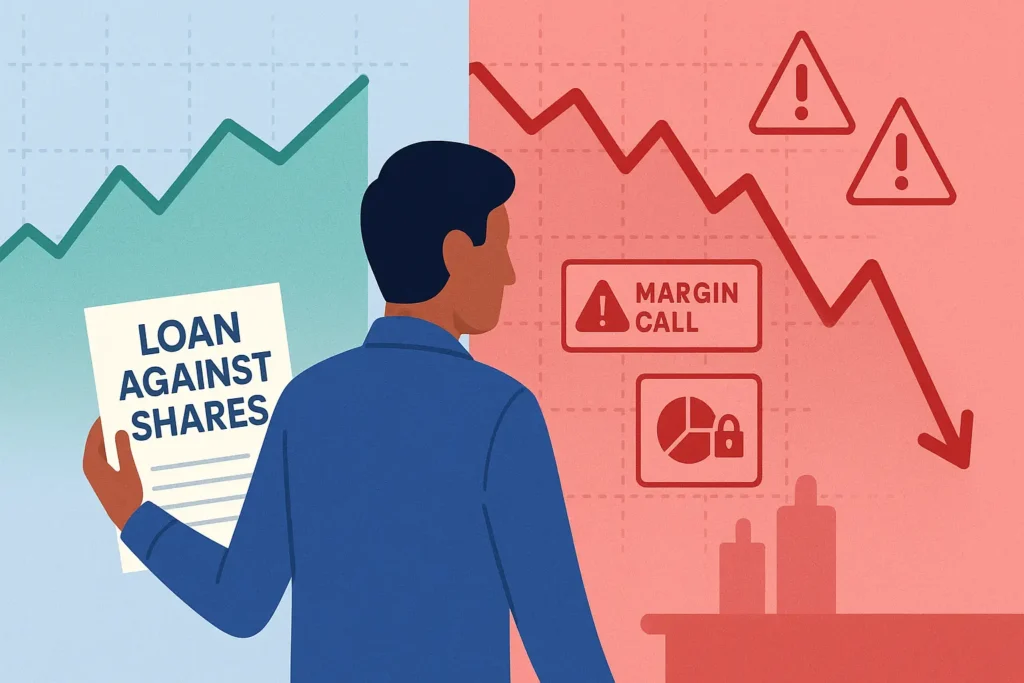
Most Indian MSMEs struggle with one thing more than sales, production, or marketing:
Business stability.
Cash flow is unpredictable. Payments get delayed.
Working capital dries up without warning.
So when a banker suggests Loan Against Shares, it feels like a blessing.
Fast approval.
Lower interest rates.
No need to sell your investments.
But what most MSME owners don’t realise is this:
Loan Against Shares works beautifully during a rising market…
but becomes risky during high volatility or sudden stock market crashes.
And in India, stock market volatility has become the new normal — geopolitical news, global cues, FIIs selling, quarterly results — even a single negative rumour can shake the market.
This article explains exactly how volatility impacts your Loan Against Shares, what MSMEs should be careful about, and how to use this financial tool without destroying your stability.
you may also like to read: Falling Gold Prices Shake MSME Finances: What Gold-Loan Borrowers Must Know
What Is a Loan Against Shares? (Simple MSME Explanation)
A Loan Against Shares allows you to pledge your equity shares, mutual funds, or ETFs and get funds from the bank without selling your investments.
But the value of your loan depends on the value of your shares, which changes every second in a volatile market.
This is where the real risk lies.
related post: OD Against Shares for MSMEs: The Smartest Way to Unlock Working Capital Without Selling Your Stocks
The Hidden Risk: Stock Market Volatility and Loan Against Shares
When the market is stable or rising, a loan against shares feels perfect.
But when the market falls sharply, everything changes overnight.
Let’s say:
- You pledge shares worth ₹10 lakh
- Bank gives you ₹6 lakh (LTV 60%)
- Suddenly market crashes
- Your shares drop to ₹7 lakh
Now your pledged security is no longer enough.
This is where the danger begins.
Margin Call: The Biggest Threat for MSMEs Taking Loan Against Shares
When share prices fall, the bank demands you to:
- Add more shares
- Or repay part of the loan
- Or face selling of your pledged shares
This is called a margin call.
For MSMEs struggling with daily cash flow, margin calls can be financially shocking.
Related post: The Hidden Risk in Gold Loans: What Margin Calls Mean for Small Business Borrowers
Why this is dangerous for MSMEs:
- You don’t always have free cash to add
- Banks give very short deadlines
- If you fail, the bank forcibly sells your shares
- You lose your long-term investments at the worst possible time
- And that too, at crash prices
This can destroy your financial stability in 24 hours.
Real Scenario: How Market Crashes Hurt LAS Borrowers
Think of March 2020.
Think of Adani stock crash in 2023.
Think of any global overnight crash.
If you had pledged shares and taken a Loan Against Equity Shares, your shares would have dropped 20–40% in days.
Banks would start sending emails and messages:
“Dear Customer, please provide additional margin today to maintain LTV.”
Most MSMEs don’t have spare money ready during a crisis.
This is how MSME owners lose years of investment in forced selling.
Loan Against Shares Interest Rates Aren’t the Only Thing That Matters
Yes, Loan Against Shares interest rates (9%–13%) are lower than unsecured loans.
But interest rate is not the biggest problem.
The real risk is this:
Loan Against Shares + Market Crash = Forced liquidation + Financial instability
Low interest is useless if your shares get sold at a loss.
How MSMEs Can Use Loan Against Shares Safely During Volatility
1. Never Pledge Highly Volatile Shares
Avoid:
- Small-cap stocks
- Newly listed IPO stocks
- High P/E, hype-based momentum stocks
- Penny stocks
Pledge only:
- Large-cap stable companies
- ETFs
- Mutual funds
- Blue-chip stocks
Stable shares = lower risk of margin calls.
2. Never Borrow the Maximum LTV
If banks offer 60–70% LTV, take only 30–40%.
This gives you a safety buffer during market drops.
3. Always Use Loan Against Shares for Short-Term Needs Only
For working capital, GST payments, raw material, or month-end cash crunch — okay.
For long-term loans, expansion, machinery, or repayment over years — very risky.
MSMEs should treat LAS as a temporary liquidity tool, not a long-term loan.
4. Keep a Backup Emergency Fund
If you take a Loan Against Shares, always keep an emergency fund that can handle:
- 10–15% market correction
- Sudden margin call
Even ₹50k–₹2 lakh kept aside can save you from forced selling.
5. Monitor the Market — Do Not Ignore the Red Flags
If the market suddenly shows signs of:
- High FII outflows
- War, elections, budget volatility
- Banking crisis news
- Global recession fears
Immediately reduce your LAS exposure.
Avoid taking new loans during these periods.
6. Set Alerts for Your Pledged Shares
Ask your bank/NBFC to set SMS or email alerts when your LTV changes.
This gives you early warning before the situation becomes critical.
7. Prepay When the Market Is Falling
If markets start dropping:
- Don’t wait
- Start reducing the loan
- Unpledge shares step by step
Many MSMEs ignore small corrections…
Then suddenly receive a huge margin call.
Where Loan Against Shares Still Works Well for MSMEs
Even with volatility risks, LAS is still useful, especially for:
- Exporters with temporary working capital needs
- Traders needing quick inventory
- Manufacturers needing raw material immediately
- Entrepreneurs covering urgent GST dues
The key is to use only part of your share portfolio, not 100% of it.
Final Conclusion: Loan Against Shares Is Powerful — But Only If You Respect the Risk
Loan Against Shares is not bad.
It is not dangerous by itself.
The danger comes when MSMEs use it blindly during volatile markets.
If you take LAS with stability, planning, and buffer handling, it becomes:
- A fast
- Low-cost
- Smart liquidity tool
But if you take LAS during hype, euphoria, or market topping, it becomes:
- A risky trap
- A forced-selling nightmare
- A threat to the long-term financial security of your business
Use it wisely.
Use it with buffers.
Use it with a clear exit plan.
Your business stability matters more than temporary liquidity.
FAQs on Loan Against Shares in Volatile Markets
1. Should MSMEs take Loan Against Shares during a falling market?
Better to avoid. Risk of margin calls increases.
2. Which shares are safest to pledge?
Blue-chips, ETFs, large-cap mutual funds.
3. What happens during a sudden crash?
Bank may demand more margin or sell your shares.
4. Are Loan Against Shares interest rates low?
Yes, usually 9%–13%, but interest rates don’t protect you from volatility risk.
5. Is LAS good for long-term borrowing?
No. Best suited for short-term MSME needs.
About the Author
I’m Tabrez Khan,entrepreneur ,expoter and founder of BusinessZindagi.com, sharing real-world MSME experiences, export learnings, and financial wisdom for small entrepreneurs across India.
✅ Authentic Links & References
1. RBI Official Documents
These clarify regulations around pledging of shares, credit policies, and overdraft norms:
- RBI – Master Circular on Loans and Advances
https://www.rbi.org.in/Scripts/NotificationUser.aspx?Id=11661&Mode=0 - RBI – FAQs on Pledge, Hypothecation & Securities
https://www.rbi.org.in/Scripts/FAQView.aspx?Id=75 - RBI – Fair Practices Code for Lending
https://www.rbi.org.in/Scripts/NotificationUser.aspx?Id=11222&Mode=0
2. SEBI Guidelines on Pledge of Shares
Explains rules regarding pledging equity shares via Demat account:
- SEBI – Pledge/ Re-pledge Mechanism
https://www.sebi.gov.in/legal/circulars/aug-2020/pledge-re-pledge-of-securities_47236.html - NSDL – Pledge of Shares FAQs
https://nsdl.co.in/faqs/pledge.php - CDSL – Pledge & Hypothecation Guide
https://www.cdslindia.com/downloads/FAQ-Pledge.pdf