
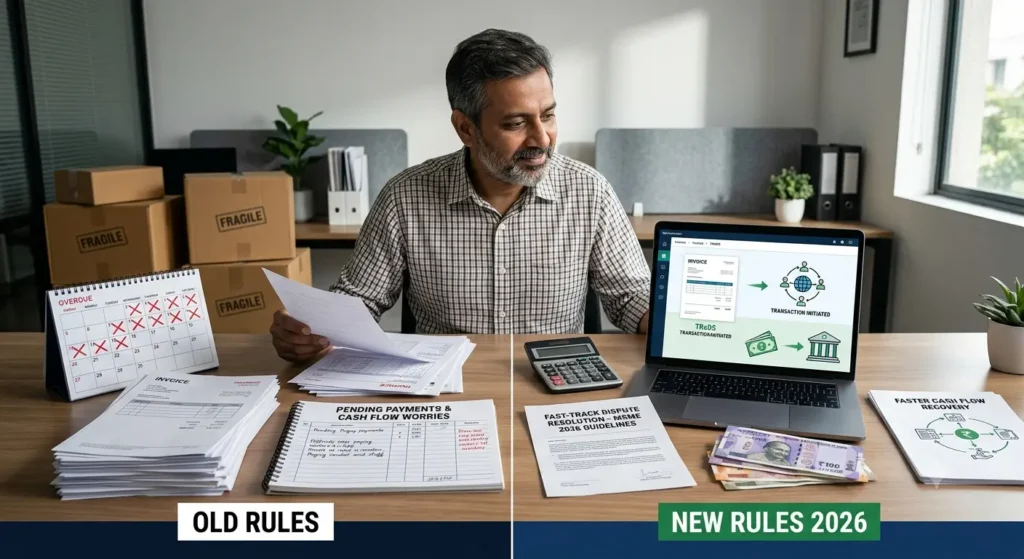
MSME Payment Rules 2026: What Has Actually Changed?
If you run a small business, you probably know the pain of waiting for a customer to pay.
You manufacture the goods.
You deliver the order.
You raise the invoice.
And then you wait.
30 days become 45 days.
45 days become 60 days.
60 days sometimes become several months.
For a micro or small enterprise, delayed payment is not just an inconvenience. It can affect working capital, salaries, raw-material purchases, loan repayments and even the ability to accept the next order.
That is why the Micro, Small and Medium Enterprises Development (Amendment) Act, 2026 is important.
But there is a lot of confusion about what has actually changed.
One common misconception is that the government has introduced a completely new 45-day MSME payment rule in 2026.
That is not correct.
The 45-day ceiling was already part of the MSMED Act.
The bigger 2026 changes are about how delayed-payment disputes are handled, TReDS-based invoice settlement, mediation, arbitration, appeals and recovery.
The amendment was passed by Parliament in August 2026 and received Presidential assent on 13 August 2026. However, the Act states that its provisions will come into force on dates notified by the Central Government.
So let’s compare the old MSME payment framework with the new 2026 framework.
🚨 Latest Update — 25 September 2026
A major development for MSME cash flow: CGTMSE guarantee cover is now operational on TReDS, with integration across M1xchange, RXIL and DTX (KredX).
This strengthens TReDS as a potential way for eligible MSMEs to convert unpaid invoices into working capital.
The 45-day MSME payment rule remains separate and continues to apply.
Source: Ministry of MSME, Government of India.
MSME Payment Rules: Old vs New at a Glance
| Issue | Earlier MSMED Act framework | 2026 amended framework |
|---|---|---|
| Payment period | Written agreement could not exceed 45 days | 45-day ceiling remains |
| No written payment agreement | Payment generally due within 15 days | Existing framework continues |
| Delayed-payment interest | Statutory interest protection existed | Continues |
| MSEFC dispute mechanism | Available | Strengthened |
| Mediation timeline | No specific 90-day statutory timeline in the Act | Mediation to be completed within 90 days |
| Arbitration after failed mediation | Existing mechanism | Reference to arbitration within 30 days |
| Time for arbitral award | No specific 90-day deadline in the old provision | Award within 90 days after completion of pleadings |
| 75% deposit for challenge | Applied to an award/order of the Council | Also extended to challenges against mediated settlements |
| Long-pending challenge | Court could order payment from deposited amount | At least 50% of awarded amount after specified six-month period |
| TReDS | Available as an invoice-financing mechanism | CPSEs required to route MSME invoice settlements through TReDS |
| Recovery | Existing legal mechanism | Enforcement/recovery framework strengthened |
The comparison is based on the MSMED Act, the 2026 amendment and the legislative analysis published by PRS.
1. The 45-Day MSME Payment Rule: What Changed?
OLD RULE
The 45-day payment ceiling was already present under the MSMED Act.
For an eligible micro or small enterprise, where there is a written agreement with the buyer, the agreed payment period cannot exceed 45 days.
Where there is no written agreement, the payment framework generally provides for payment within 15 days of acceptance or deemed acceptance.
NEW RULE
The 45-day ceiling has not suddenly been introduced by the 2026 amendment.
This is one of the most important things MSME owners should understand.
The 2026 reform focuses much more heavily on improving the machinery for resolving and recovering delayed payments.
2. What Happens When an MSME Buyer Doesn’t Pay?
Suppose your company supplies goods worth ₹5 lakh to a buyer.
The invoice says payment is due within 30 days.
The buyer doesn’t pay.
The first question is not simply:
“Can I complain?”
You should first establish:
- Are you an eligible micro or small enterprise?
- Is your Udyam registration valid?
- Was the order documented?
- Were the goods or services accepted?
- What does the purchase agreement say?
- What is the legally applicable payment date?
- Have you preserved the invoice and delivery evidence?
The MSMED Act provides a statutory mechanism for delayed payments to eligible micro and small enterprises. The Ministry of MSME has also established mechanisms including MSEFCs and the MSME Samadhaan system for delayed-payment cases.
3. Delayed-Payment Interest: Old vs New
OLD RULE
The MSMED Act already provided strong interest protection for delayed payments.
Under Section 16, where payment is delayed beyond the statutory period, the buyer can become liable for compound interest with monthly rests at three times the RBI bank rate.
NEW RULE
The 2026 amendment does not remove this basic delayed-payment interest framework.
The major reform is focused on making the dispute-resolution and enforcement process more structured.
Why this matters
A buyer shouldn’t assume:
“If I don’t pay the MSME, nothing happens until the supplier goes to court.”
The MSMED framework creates consequences for delayed payment.
4. Mediation Gets a Specific Timeline
This is one of the important changes under the 2026 amendment.
OLD RULE
The MSMED Act already provided for conciliation/mediation through the MSEFC mechanism.
However, the earlier framework did not contain the new specific 90-day statutory timeline for completing mediation.
NEW RULE
The 2026 amendment provides that mediation must be completed within 90 days from the date fixed for first appearance.
This is important because delayed-payment disputes can themselves become another source of delay.
For an MSME, there is a huge difference between:
“There is a legal mechanism.”
and
“There is a legal mechanism with defined timelines.”
5. Arbitration Gets a 30-Day Timeline
OLD RULE
If mediation failed, the dispute could move to arbitration under the existing MSMED framework.
NEW RULE
The amended framework adds a specific requirement that, where mediation fails, the dispute must be referred for arbitration within 30 days from termination of mediation.
This is designed to reduce the gap between failed mediation and the next stage of dispute resolution.
6. Arbitral Awards Get a 90-Day Timeline
This is another important change.
OLD RULE
The previous provision did not contain the new specific 90-day deadline for making an arbitral award after pleadings.
NEW RULE
The amendment provides that an arbitral award should be made within 90 days from completion of pleadings.
In simple terms:
Mediation fails → arbitration → pleadings completed → 90-day award timeline
The objective is to make the process more predictable for small suppliers.
7. The 75% Deposit Rule: Is This New?
This is another area where headlines can be misleading.
OLD RULE
The MSMED Act already required a party seeking to set aside an award/order of the Council to deposit 75% of the amount under the award/order before the application could be entertained.
NEW RULE
The 2026 amendment extends this mechanism to applications challenging a mediated settlement agreement as well.
The amendment also provides additional protection for the supplier while such a challenge remains pending.
So the correct headline is not:
“75% deposit rule introduced in 2026.”
It is:
“The 2026 amendment extends the 75% deposit framework to challenges involving mediated settlements and adds further protection for MSME suppliers.”
8. What Happens If the Case Remains Pending for More Than Six Months?
This is potentially one of the most important new protections.
OLD RULE
The court could order payment of a portion of the deposited amount to the MSME supplier while the matter was pending.
NEW RULE
The amended framework provides that if the challenge remains pending for more than six months, at least 50% of the awarded amount must be paid to the supplier from the deposited amount.
Example
Suppose:
Award = ₹10 lakh
A buyer challenges the award.
The applicable 75% deposit requirement means:
₹7.5 lakh deposited
If the specified challenge remains pending beyond six months, the new framework provides for at least:
₹5 lakh = 50% of the awarded amount
to be paid to the MSME supplier from the deposited amount.
This can be particularly significant for a small business whose working capital is already under pressure.
9. TReDS: One of the Biggest Changes for MSME Payments
The 2026 amendment also gives TReDS a much more prominent role.
TReDS stands for Trade Receivables Discounting System.
It is an RBI-regulated electronic platform through which MSMEs can get their trade receivables financed or discounted.
OLD POSITION
TReDS already existed.
MSMEs could use the platform to obtain financing against eligible invoices rather than waiting for the buyer’s payment.
BusinessZindagi previously explained how this works in detail:
TReDS in India: How MSMEs & Startups Can Unlock Faster Cash Flow
NEW 2026 FRAMEWORK
The amendment requires Central Public Sector Enterprises (CPSEs) to route settlement of invoices for goods and services procured from MSMEs through TReDS.
The government can also provide mechanisms for other public-sector entities to use TReDS.
This could be important because invoice financing can help MSMEs convert receivables into working capital rather than waiting for the entire credit period.
10. Why TReDS Could Be a Big Deal for Small Businesses
Imagine you supply goods worth:
₹20 lakh
to a large eligible buyer.
Your invoice is accepted, but payment is due later.
Instead of allowing that receivable to remain stuck in your books, TReDS can potentially allow the receivable to be financed.
The basic concept is:
MSME supplies goods
↓
Invoice is generated
↓
Buyer accepts invoice
↓
Invoice is placed through TReDS
↓
Financiers compete to finance the receivable
↓
MSME receives funds earlier
↓
Buyer pays according to the transaction terms
This is why TReDS is increasingly important in the government’s strategy for addressing MSME liquidity problems.
The Ministry of MSME says the value of invoices discounted through TReDS increased from ₹40,000 crore in 2022–23 to ₹3.47 lakh crore in 2025–26.
11. MSME Samadhaan Still Matters
TReDS is not a replacement for the delayed-payment dispute mechanism.
They address different problems.
TReDS
Primarily helps with:
Cash flow + invoice financing
MSME Samadhaan / MSEFC
Helps with:
Delayed-payment dispute resolution and recovery
The Ministry of MSME’s delayed-payment framework provides for eligible micro and small enterprises to approach the Facilitation Council in cases involving delayed payments.
12. What About MSME Classification?
The 2026 amendment also changes the broader MSME classification framework.
OLD
The 2006 framework used prescribed investment thresholds for plant and machinery in manufacturing and equipment in services.
NEW
The amended framework provides for classification based on:
- Investment in plant and machinery/equipment
- Turnover
with the applicable thresholds to be specified through notification.
This is broader than delayed-payment protection, but it is important because businesses should understand their classification and registration status before relying on MSME-specific benefits.
13. Who Is Protected by the Delayed-Payment Provisions?
This is extremely important.
The statutory delayed-payment provisions in Chapter V of the MSMED Act are specifically focused on micro and small enterprises.
Therefore, a business should not assume that simply being classified somewhere within the broader MSME category automatically gives it every delayed-payment protection.
Before taking action, check:
- Udyam registration
- Enterprise classification
- Business activity
- Nature of the buyer
- Invoice documentation
- Contract terms
- Acceptance of goods/services
For significant disputes, professional legal advice is advisable.
14. Old vs New: The Most Important Changes Explained Simply
🟢 What HAS NOT fundamentally changed?
45-day ceiling
The 45-day maximum agreed payment period was already part of the MSMED framework.
Delayed-payment interest
The statutory interest mechanism continues.
MSEFC
The Facilitation Council remains an important part of the delayed-payment mechanism.
MSME Samadhaan
The digital mechanism for delayed-payment applications remains relevant.
🔥 What HAS changed?
TReDS
CPSEs must route MSME invoice settlements through TReDS under the amended framework.
90-day mediation
Mediation gets a specific timeline.
30-day arbitration referral
Failed mediation must move to arbitration within the specified 30-day period.
90-day award
An arbitral award is to be made within 90 days after completion of pleadings.
Mediated settlements
The 75% deposit requirement is extended to challenges against mediated settlements.
Six-month protection
At least 50% of the awarded amount must be paid to the supplier in specified cases where the challenge remains pending beyond six months.
Recovery
The amended framework strengthens enforcement and recovery mechanisms.
These changes are among the central delayed-payment reforms identified in the legislative analysis and government explanation of the 2026 amendment.
15. What Should an MSME Do If a Buyer Doesn’t Pay?
Don’t wait until the buyer owes you a huge amount.
Build a payment-control system from the beginning.
Step 1: Put payment terms in writing
Clearly mention:
- Invoice date
- Credit period
- Due date
- Interest for delay where applicable
- Delivery and acceptance terms
Step 2: Keep proof of delivery
Maintain:
- Purchase order
- Invoice
- Delivery challan
- E-way bill where applicable
- Transport documents
- Goods receipt
- Email confirmation
- Payment correspondence
Step 3: Track every receivable
Create categories such as:
Not Due
Due Soon
Overdue
Seriously Overdue
Step 4: Send written reminders
Don’t depend only on phone calls.
A written communication creates a better documentary trail.
Step 5: Consider TReDS
If the transaction and buyer qualify, TReDS can potentially help convert receivables into earlier working capital.
Step 6: Consider the MSME delayed-payment mechanism
For eligible micro and small enterprises, the MSEFC/Samadhaan route may be relevant.
Step 7: Take professional advice for major disputes
If a large amount is involved, consult a qualified legal or tax professional before taking formal action.
16. The Biggest Lesson for MSME Owners
The biggest lesson from the 2026 reform is not:
“The government has introduced a new 45-day payment rule.”
It is:
India is trying to move from simply having MSME payment rights on paper toward faster digital settlement, dispute resolution and recovery.
That distinction is important.
A law can tell a buyer to pay.
But an MSME also needs:
Cash flow + documentation + enforcement + financing options.
That is where the combination of TReDS, MSEFC, Samadhaan, mediation and arbitration reforms becomes important.
17. Old vs New MSME Payment Rules: One-Minute Summary
If you remember only one thing from this article, remember this:
BEFORE
45-day payment ceiling
↓
Delayed-payment interest
↓
MSEFC/Samadhaan mechanism
↓
Dispute resolution
↓
Recovery
2026 REFORM
45-day framework continues
↓
TReDS strengthened for CPSE procurement
↓
90-day mediation timeline
↓
30-day arbitration referral
↓
90-day award timeline
↓
75% deposit framework extended to mediated settlements
↓
At least 50% payment after specified six-month pendency
↓
Stronger recovery/enforcement
The goal is to make the system faster and more effective for eligible micro and small suppliers.
What Does This Mean for a Small Business Owner?
If you are a manufacturer, service provider, contractor, wholesaler or supplier dealing with large companies or public-sector buyers, payment terms should become a much more important part of your business strategy.
Don’t simply ask:
“How much profit will I make on this order?”
Also ask:
“When will I actually receive the money?”
A ₹10 lakh order with a healthy margin can still create serious problems if ₹10 lakh remains stuck with the customer for months.
For an MSME, cash flow is survival.
The 2026 reforms are therefore worth watching—not because the government has created a completely new 45-day rule, but because the framework around TReDS, dispute resolution and recovery is becoming more structured.
Frequently Asked Questions
Is the 45-day MSME payment rule new in 2026?
No. The 45-day ceiling was already part of the MSMED Act. The 2026 amendment focuses on strengthening delayed-payment resolution, TReDS and enforcement.
What is the biggest MSME payment change in 2026?
Among the major changes are mandatory TReDS settlement for CPSE procurement from MSMEs, time-bound mediation and arbitration, a 90-day award timeline and stronger protections around challenges to awards and mediated settlements.
What is the new mediation timeline?
The amended framework provides for mediation to be completed within 90 days from the date fixed for first appearance.
What happens if mediation fails?
The dispute is to be referred to arbitration within 30 days from termination of mediation under the amended framework.
What is the 75% MSME deposit rule?
The MSMED Act already required a 75% deposit for certain applications challenging an award/order. The 2026 amendment extends this framework to challenges against mediated settlement agreements.
What happens if a case remains pending for more than six months?
The amended framework provides that at least 50% of the awarded amount must be paid to the supplier where the specified challenge remains pending for more than six months.
What is TReDS?
TReDS is an RBI-regulated electronic platform that enables MSMEs to finance or discount eligible trade receivables. The 2026 amendment requires CPSEs to route settlement of invoices for MSME procurement through TReDS.
Does every MSME get delayed-payment protection?
The statutory delayed-payment provisions are principally aimed at eligible micro and small enterprises. Businesses should verify their eligibility before relying on the mechanism.
Has the MSMED Amendment Act 2026 come into force?
The Act received Presidential assent on 13 August 2026. However, the Act itself provides that it will come into force on dates appointed by the Central Government through notification, and different provisions may commence on different dates.
BusinessZindagi Verdict
The MSME Payment Rules 2026 story is bigger than a simple 45-day payment rule.
The 45-day framework is not new.
The important change is the attempt to strengthen the system around it.
For eligible micro and small enterprises, the 2026 framework brings important developments around:
- TReDS
- Digital dispute resolution
- 90-day mediation
- 30-day arbitration referral
- 90-day arbitral awards
- Mediated settlements
- 75% deposit requirements
- 50% payment in specified long-pending challenges
- Stronger enforcement and recovery
For entrepreneurs, the practical lesson is simple:
Don’t treat a sale as cash until the money reaches your bank account.
Good credit control, written payment terms, proper documentation and awareness of MSME payment mechanisms can be just as important as getting the order itself.
Suggested BusinessZindagi Articles
TReDS in India: How MSMEs & Startups Can Unlock Faster Cash Flow
TReDS Portal Mandate 2026: What MSMEs Need to Know
6 New MSME Digital Platforms Every Small Business Should Know in 2026
CIBIL Rank & Company Credit Report: Why Every Indian MSME Should Care
Authentic Sources & References
1. Government of India — e-Gazette
The official Gazette records the Micro, Small and Medium Enterprises Development (Amendment) Act, 2026, Act No. 16 of 2026, published on 13 August 2026.
Official e-Gazette — MSMED Amendment Act 2026
2. Press Information Bureau — Ministry of MSME
The Government’s official explanation of the amendments, including TReDS, delayed payments and dispute-resolution reforms.
PIB — MSMED Amendment Bill 2026
3. PRS Legislative Research
Useful independent legislative analysis of the 2026 amendment, including the 90-day mediation period, 30-day arbitration referral, 90-day award timeline, 75% deposit and six-month protection.
PRS — MSMED Amendment Bill 2026
4. India Code — MSMED Act, 2006
Official text of the original MSMED Act, including the statutory delayed-payment framework.
5. Ministry of MSME — Delayed Payment / ODR Guidelines
Official Ministry material explaining the delayed-payment problem, MSEFC mechanism and MSME Samadhaan/ODR initiatives.
Ministry of MSME — Delayed Payment & ODR Guidelines
Editorial Disclosure
This article is prepared for general educational and informational purposes. BusinessZindagi uses publicly available government and legislative sources and aims to explain complex business-policy developments in simple language. Readers should verify the latest notifications and commencement dates before taking action.
AI Disclosure
AI tools may be used to assist BusinessZindagi with research, structure and editing. The article is reviewed and refined before publication, with important legal and policy claims checked against available authoritative sources.
Legal Disclaimer
This article is not legal, tax or financial advice. MSME eligibility, payment disputes, tax treatment and legal remedies depend on individual circumstances and applicable notifications. Consult a qualified professional for advice concerning a specific dispute.