
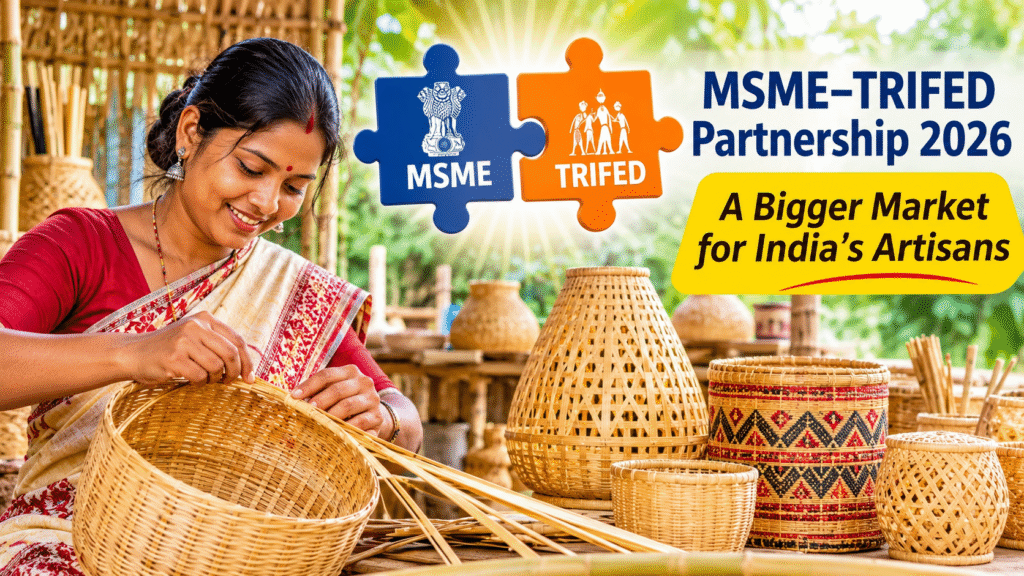
India’s traditional artisans may get new opportunities to reach customers across the country. On 5 November 2026, the Ministry of Micro, Small and Medium Enterprises (MSME) signed a Memorandum of Understanding (MoU) with the Tribal Cooperative Marketing Development Federation of India (TRIFED) to strengthen market access for eligible tribal artisans registered under the PM Vishwakarma Scheme.
The partnership aims to connect traditional artisans with the Tribes India retail network and online marketplace. It also proposes a dedicated Tribes India–PM Vishwakarma Collection, through which selected artisans can showcase and promote their products.
For thousands of traditional craftspeople, this initiative could create opportunities beyond local markets. However, what exactly does the partnership offer? Who can participate? How can artisans approach TRIFED? And what should small producers do to make their products suitable for larger markets?
Let’s understand the announcement and its practical implications for artisans, micro-enterprises and small business owners.
1. What Is the MSME TRIFED Partnership?
The Ministry of MSME and TRIFED signed an MoU on 5 November 2026 to improve market access for eligible tribal artisans registered under the PM Vishwakarma Scheme.
The collaboration brings together two important government-supported initiatives:
- PM Vishwakarma: A government scheme providing recognition, skill development, toolkit incentives, credit support and marketing assistance to eligible traditional artisans.
- TRIFED: An organisation under the Ministry of Tribal Affairs that promotes tribal products through marketing, retail outlets and digital platforms.
Under the partnership, TRIFED will facilitate the onboarding and capacity building of eligible artisans referred by the Ministry of MSME.
Participating artisans may get opportunities to display and sell their products through:
- Tribes India retail outlets.
- The Tribes India online marketplace.
- A proposed Tribes India–PM Vishwakarma Collection.
The collaboration also covers product aggregation, quality assurance, packaging support, product photography and cataloguing for mutually identified sellers.
Importantly, participation will be subject to applicable onboarding conditions, seller consent and TRIFED policies. Signing the MoU does not mean every PM Vishwakarma beneficiary will automatically receive a marketplace listing.
2. What Is TRIFED and How Does Tribes India Help Artisans?
TRIFED stands for Tribal Cooperative Marketing Development Federation of India.
It operates under the Ministry of Tribal Affairs and works to improve the marketing opportunities and economic prospects of tribal communities.
Its Tribes India brand provides a platform for promoting traditional products made by tribal artisans and producers.
These products include:
- Handicrafts and decorative items.
- Bamboo and cane products.
- Tribal textiles and handloom products.
- Traditional metal crafts.
- Jewellery.
- Pottery.
- Tribal paintings.
- Selected organic and natural products.
For a small artisan, finding customers beyond the local market can be difficult. A producer may have excellent craftsmanship but lack the resources to establish a retail outlet, develop an e-commerce website or market products nationally.
TRIFED’s retail and digital network can help bridge some of these gaps.
Official resource: TRIFED – Tribes India
3. What Products Can Artisans Promote Through The MSME Ministry–TRIFED Partnership 2026?
The MoU identifies several traditional trades covered under PM Vishwakarma for product-based market access.
Some of the relevant categories include:
| Traditional trade | Examples of products |
|---|---|
| Carpenter | Wooden furniture, household articles and decorative products |
| Metalsmith | Metal utensils and traditional metal products |
| Sculptor | Stone sculptures and decorative items |
| Goldsmith | Traditional jewellery |
| Potter | Clay pots, decorative pottery and household products |
| Shoemaker | Traditional footwear |
| Basket and mat maker | Baskets, mats and handmade household products |
| Coir weaver | Coir-based products |
| Doll and toy maker | Traditional handmade toys and dolls |
| Garland maker | Traditional decorative garlands |
The actual products accepted will depend on the applicable TRIFED policies, product quality, category requirements and onboarding decisions.
TRIFED already has a wider product portfolio that includes tribal textiles, cane and bamboo products, metal crafts, jewellery, pottery and tribal paintings.
This provides an opportunity to connect traditional craftsmanship with organised retail and digital commerce.
4. What Benefits Can Artisans Get From the MSME TRIFED Partnership 2026?
The partnership is particularly important because it focuses on the marketing side of traditional businesses.
Many artisans know how to manufacture quality products but struggle to sell them at profitable prices.
Here are the major forms of support outlined in the MoU.
A. Access to Tribes India retail outlets
Selected artisans may get opportunities to display their products through Tribes India retail outlets.
This can help products reach customers who may never visit the artisan’s village or local market.
Retail exposure can also improve product visibility and create opportunities to develop a wider customer base.
B. Online marketplace opportunities
The proposed Tribes India–PM Vishwakarma Collection will also be promoted through tribesindia.com.
For artisans who have limited experience with online selling, this could provide an additional marketing channel.
Online visibility may help traditional products reach buyers in different cities and regions.
However, an online listing does not guarantee orders or sales.
C. Product photography and cataloguing
Product presentation is important in modern retail and e-commerce.
A poorly photographed product may struggle to attract buyers even if its quality is excellent.
Under the MoU, TRIFED will work with the Ministry of MSME to facilitate initial product imaging and cataloguing support for mutually identified sellers.
This can help selected artisans present their products more professionally.
D. Packaging support
Packaging is not simply about making a product attractive.
It also protects products during transportation, improves customer experience and helps retailers handle inventory.
TRIFED will facilitate packaging support for market-ready products under the collaboration.
E. Quality assurance and product aggregation
Consistent quality is essential when selling through organised retail channels.
TRIFED will facilitate aggregation and quality assurance to help prepare products for the market.
Product aggregation can also be useful where individual artisans have limited production capacity but several producers can collectively meet a larger requirement.
F. Capacity building
Artisans may also receive capacity-building support to improve their understanding of product presentation, quality and market requirements.
The intention is to make traditional products more suitable for wider commercial markets.
Important: These are provisions of the MoU. The availability and extent of individual support depend on identification, onboarding and applicable policies. Artisans should not assume that every service is automatically available to every registered beneficiary.
5. Who Is Eligible to Benefit?
The new collaboration is intended for eligible tribal artisans registered under the PM Vishwakarma Scheme.
There are two separate considerations:
- Whether an artisan meets the eligibility requirements of PM Vishwakarma.
- Whether the artisan is identified, referred and accepted for onboarding under the TRIFED collaboration.
What is PM Vishwakarma?
PM Vishwakarma is a Central Sector Scheme launched on 17 September 2023 by the Government of India.
It aims to support traditional artisans and craftspeople working with their hands and tools in specified occupations.
The scheme covers 18 traditional trades:
- Carpenter.
- Boat maker.
- Armourer.
- Blacksmith/metalsmith.
- Hammer and tool kit maker.
- Locksmith.
- Goldsmith.
- Potter.
- Sculptor and stone breaker.
- Cobbler/shoesmith.
- Mason.
- Basket, mat and broom maker/coir weaver.
- Doll and traditional toy maker.
- Barber.
- Garland maker.
- Washerman.
- Tailor.
- Fishing net maker.
The scheme generally requires applicants to be at least 18 years old and engaged in an eligible trade on a self-employment basis, subject to other scheme conditions.
Not every PM Vishwakarma trade is necessarily a product-selling category under the new TRIFED partnership. The MoU focuses on relevant product-based trades.
What benefits does PM Vishwakarma provide?
Eligible beneficiaries can access several forms of assistance:
| Benefit | Support available |
|---|---|
| Recognition | PM Vishwakarma Certificate and ID Card |
| Basic training | 5–7 days |
| Advanced training | 15 days or more |
| Training stipend | ₹500 per training day |
| Toolkit incentive | Up to ₹15,000 through e-vouchers |
| First loan tranche | Up to ₹1 lakh |
| Second loan tranche | Up to ₹2 lakh |
| Interest rate | Concessional 5%, subject to scheme conditions |
| Digital incentives | Incentives for eligible digital transactions |
| Marketing support | Branding, exhibitions and market linkages |
The credit support is collateral-free and subject to the applicable eligibility and repayment conditions.
The toolkit incentive and credit support are existing PM Vishwakarma scheme benefits. They should not be confused with the new TRIFED partnership.
Official website: PM Vishwakarma Scheme
6. How Can Artisans Approach TRIFED to Sell Their Products?
This is one of the most important practical questions for potential beneficiaries.
TRIFED already has an official artisan information and empanelment section.
Artisans interested in supplying products can explore its registration facility.
Step 1: Check your PM Vishwakarma eligibility
Confirm that your occupation is included in the scheme and that you satisfy the relevant eligibility requirements.
If you are already registered, keep your PM Vishwakarma certificate and ID details available.
Step 2: Visit the official TRIFED artisan page
Visit:
TRIFED – Artisans and Empanelment
TRIFED’s artisan page provides information for independent artisans and organisations interested in supplying products.
It also provides an artisan registration option where applicants can select the relevant user type.
Step 3: Prepare product details
Before approaching a marketing organisation or retailer, prepare a basic product catalogue.
Include:
- Product name.
- Clear photographs.
- Materials used.
- Product dimensions and weight.
- Available designs and variations.
- Production capacity.
- Expected selling price.
- Packaging details.
Step 4: Calculate your product cost
Do not quote a price simply by looking at what competitors charge.
Calculate your actual production cost.
For example, consider an artisan manufacturing a handmade bamboo basket.
| Cost component | Illustrative amount |
|---|---|
| Bamboo and raw materials | ₹100 |
| Labour | ₹150 |
| Packaging | ₹30 |
| Other expenses | ₹20 |
| Total cost | ₹300 |
The artisan should consider transportation, applicable selling or platform charges, possible returns and the required profit margin before deciding the final quotation.
A retailer’s purchase price and the final consumer selling price may be different.
Step 5: Contact TRIFED for the applicable onboarding process
Ask whether your product category is being considered under the new collaboration.
Confirm the documentation, quality standards, pricing arrangements, product selection procedure and commercial terms.
Do not assume that registering on the existing artisan portal automatically enrols you in the new PM Vishwakarma collection.
7. Special Opportunities for Assam and Northeast Indian Artisans
The partnership is particularly interesting for the Northeast because the region has a rich tradition of handmade products, bamboo crafts, pottery and traditional metalwork.
Assam and other Northeastern states have many small artisan enterprises and community-based producers whose products have potential beyond local markets.
Some promising product categories include:
Bamboo and cane products
Assam has a long tradition of bamboo and cane craftsmanship.
Potential products include:
- Handmade baskets.
- Decorative lamps.
- Furniture and home accessories.
- Storage products.
- Traditional household articles.
<em>Business opportunity:</em> Producers can explore modern designs and attractive packaging while retaining traditional craftsmanship.
Bell metal and brass products
Traditional bell-metal and brass craftsmanship is associated with Assam, particularly Sarthebari.
Products such as traditional utensils, decorative items and gift articles can appeal to customers interested in regional craftsmanship.
Traditional pottery
Pottery producers can explore decorative products, household articles and other market-ready designs.
Proper packaging is particularly important because fragile products can be damaged during transportation.
Handmade decorative and household products
Traditional handmade products can also be developed for:
- Corporate gifting.
- Festivals.
- Home decoration.
- Tourism-related retail.
- Online gifting marketplaces.
Can artisans from Assam benefit?
Potentially, yes, if they meet the applicable eligibility conditions.
However, being an artisan from Assam or another Northeastern state does not automatically guarantee selection.
The new MoU specifically focuses on eligible tribal artisans registered under PM Vishwakarma. Other artisans may explore TRIFED’s existing programmes and other applicable government marketing initiatives separately.
8. How Can Artisans Make Their Products Ready for Larger Markets?
Access to a retail outlet or online marketplace is only one part of building a successful business.
Artisans must also understand how organised buyers evaluate products.
Here are six practical recommendations.
1. Maintain consistent product quality
A product that looks attractive in a photograph must also meet customer expectations when delivered.
Maintain consistent dimensions, finishing, materials and workmanship.
2. Improve packaging
Use packaging that protects products during storage and transportation.
For fragile pottery and decorative items, appropriate protective material is essential.
3. Create a professional product catalogue
Maintain good-quality photographs and accurate product descriptions.
Mention dimensions, materials, available colours and product variations.
4. Understand your actual production cost
Many small producers calculate only raw material and labour costs.
They sometimes forget packaging, electricity, transportation, wastage and other operating expenses.
These costs must be included when preparing a commercial quotation.
5. Develop the capacity to fulfil repeat orders
A retail buyer may want the same product in larger quantities.
Artisans should understand their monthly production capacity and the time required to fulfil orders.
Where appropriate, artisans can explore collective production through groups or cooperatives.
6. Understand commercial terms before accepting orders
Before supplying products, clarify:
- Who pays transportation costs?
- What is the payment timeline?
- Who bears the cost of damaged goods?
- What happens to unsold products?
- Are products purchased outright or sold on a consignment basis?
- What are the applicable commissions or deductions?
These details are important for protecting the artisan’s working capital and profitability.
9. What Are the Possible Challenges?
The partnership offers promising opportunities, but market access alone cannot solve every problem faced by traditional artisans.
Some challenges deserve attention.
Competition: Handmade products may compete with cheaper machine-made alternatives.
Production capacity: Individual artisans may find it difficult to fulfil large orders.
Transportation: Fragile and bulky products can involve significant shipping costs.
Quality consistency: Maintaining identical quality across multiple production batches can be challenging.
Pricing: Artisans need to ensure that their selling prices cover all costs while remaining commercially competitive.
Market demand: Product selection and listing do not guarantee customer demand.
Government marketing support can create opportunities, but the long-term success of an artisan business still depends on quality, pricing, customer satisfaction and reliable delivery.
10. Other Government Support Artisans Should Explore
The TRIFED partnership is not the only programme worth understanding.
Traditional artisans and small producers can also explore other government initiatives depending on their business requirements.
| Scheme or programme | How it may help |
|---|---|
| PM Vishwakarma | Training, toolkit, credit and marketing support for eligible traditional artisans |
| PMEGP | Financial assistance for eligible new micro-enterprises |
| MUDRA | Institutional credit for eligible micro businesses |
| Udyam Registration | Formal recognition within the MSME ecosystem |
| SFURTI | Support for eligible traditional industry clusters |
| GeM | Government procurement marketplace for eligible sellers |
The eligibility, application process and benefits differ across these programmes.
Explore our detailed guide:
50+ Government Schemes for MSMEs and Startups in India 2026
For entrepreneurs planning to establish a small manufacturing or handicraft business, our guide to PMEGP business opportunities may also be useful.
11. Is This Partnership a Major Opportunity for Traditional Artisans?
The MSME Ministry–TRIFED partnership is a positive development because it addresses an important problem: the gap between traditional production skills and access to organised markets.
India has many skilled artisans who produce valuable handmade products but lack access to professional marketing, product photography, packaging and wider distribution networks.
By connecting eligible PM Vishwakarma beneficiaries with the Tribes India retail and digital marketplace, the collaboration aims to reduce some of these barriers.
For artisans in Assam and the Northeast, it is also a reminder that traditional craftsmanship can become a viable business when combined with better product presentation, costing, packaging and market access.
However, the real impact will depend on how effectively artisans are identified, onboarded and supported, and whether participating products can generate sustainable demand.
For an artisan, the objective should not simply be to get a product listed. It should be to build a business capable of delivering quality products, satisfying customers and earning a sustainable profit.
Frequently Asked Questions (FAQs)
1. What is the MSME Ministry–TRIFED partnership?
It is an MoU signed on 5 November 2026 to strengthen market access for eligible tribal artisans registered under PM Vishwakarma through Tribes India retail outlets and its online marketplace.
2. Who can benefit from the new TRIFED partnership?
Eligible tribal artisans registered under PM Vishwakarma may be considered for onboarding, subject to identification, referral and applicable TRIFED policies.
3. Can every PM Vishwakarma beneficiary sell products through Tribes India?
No. Registration under PM Vishwakarma does not guarantee automatic onboarding. Eligible artisans must satisfy the applicable selection and onboarding conditions.
4. What is the Tribes India–PM Vishwakarma Collection?
It is a proposed collection through which products made by participating artisans may be displayed and promoted through Tribes India retail outlets and its online marketplace.
5. Does TRIFED provide free product photography and packaging?
The MoU provides for initial product imaging and cataloguing support for mutually identified sellers and facilitation of packaging support for market-ready products. Universal free services for every applicant have not been announced.
6. Can artisans from Assam benefit?
Eligible tribal artisans from Assam may potentially benefit if they meet the scheme and onboarding conditions. Location alone does not guarantee selection.
7. How can artisans register with TRIFED?
Artisans can visit the official TRIFED artisan page and explore the artisan empanelment facility. They should separately confirm the process for the new PM Vishwakarma collaboration.
8. Does the new partnership provide loans or subsidies?
The MoU does not announce a separate loan or subsidy. Eligible beneficiaries may access existing PM Vishwakarma benefits subject to the scheme’s rules.
9. Can self-help groups participate?
The MoU specifically concerns eligible tribal artisans registered under PM Vishwakarma. The role and eligibility of any group or organisation should be confirmed with TRIFED under its applicable policies.
10. Does TRIFED guarantee that it will purchase an artisan’s products?
No blanket purchase guarantee has been announced. The MoU provides for market access and promotion through retail and online channels, subject to applicable terms and seller participation.
Conclusion
The MSME Ministry–TRIFED partnership could become an important step towards connecting India’s traditional artisans with organised retail and digital commerce.
For small producers, the opportunity is not just about selling more products. It is about learning how to develop market-ready products, calculate costs, improve packaging, maintain quality and reach customers beyond their immediate locations.
Artisans interested in participating should monitor official announcements, explore TRIFED’s empanelment process and prepare their product details in advance.
Traditional skills have commercial value. With the right combination of quality, business planning and market access, they can become the foundation of sustainable small enterprises.
About the Author
Tabrez Khan is an entrepreneur, exporter, trader and blogger with around two decades of experience in domestic and international business. Through BusinessZindagi.com, he shares practical business experiences, MSME developments, entrepreneurship guidance and opportunities for small businesses in India.
Official Sources and References
- Press Information Bureau – MSME Ministry signs MoU with TRIFED, 5 November 2026
- TRIFED – Official website
- TRIFED – Artisans and Empanelment
- PM Vishwakarma – Official Government Portal
- Ministry of MSME – PM Vishwakarma scheme information
AI & Editorial Disclaimer
This article has been prepared with AI assistance and reviewed for editorial clarity and practical usefulness. It is intended for general information and educational purposes.
The information about the MSME Ministry–TRIFED partnership is based on the government announcement dated 5 November 2026. Actual eligibility, onboarding, product selection and support will depend on official guidelines and applicable policies. Readers should verify current requirements directly with the concerned government authorities before making business or financial decisions.
BusinessZindagi.com is an independent business information platform and is not affiliated with the Ministry of MSME or TRIFED.