
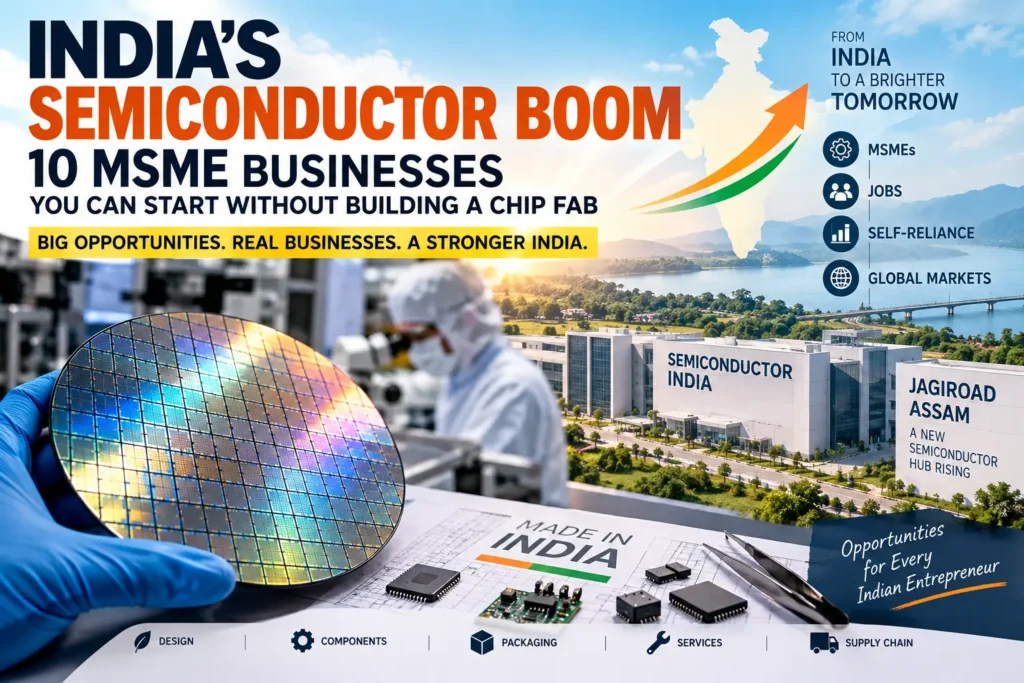
India’s semiconductor story is moving beyond government announcements and into actual production.
At SEMICON India 2026, the Government highlighted the next phase of India’s semiconductor strategy: Semicon 2.0, which expands support across chip design, manufacturing, semiconductor equipment and materials, advanced packaging, R&D and talent development.
The Government says 12 semiconductor manufacturing units have been approved with investment of more than ₹1.64 lakh crore, while five units have already started commercial production. Semicon 2.0 has a total outlay of ₹1,27,500 crore.
For entrepreneurs, the important point is this:
You don’t have to build a semiconductor fab to participate in India’s semiconductor boom.
A much larger business ecosystem is developing around the fabs, packaging facilities and electronics manufacturers.
This article looks at 10 semiconductor business opportunities that MSMEs and entrepreneurs can explore, including opportunities emerging around the Tata Electronics project in Jagiroad, Assam.
10 Semiconductor Business Opportunities for Indian MSMEs
1. Precision Engineering and CNC Components
Semiconductor manufacturing requires highly precise equipment and components.
Existing engineering MSMEs with CNC, VMC, EDM, grinding or precision-measurement capabilities could explore supplying:
- Precision-machined components
- Jigs and fixtures
- Tooling
- Mechanical assemblies
- Equipment parts
- Custom engineering components
The opportunity is particularly relevant for companies that already serve industrial customers.
The barrier is not simply buying a CNC machine. Semiconductor-related customers can require stringent tolerances, quality control, traceability and consistency.
Best suited for: existing engineering and precision-machining MSMEs.
2. Semiconductor Equipment Components
Semiconductor factories depend on specialised manufacturing equipment, which itself requires a large network of component suppliers.
Possible MSME opportunities include:
- Equipment frames
- Precision brackets
- Enclosures
- Fixtures
- Mechanical assemblies
- Specialised tooling
- Motion-system components
This is directly aligned with Semicon 2.0’s focus on semiconductor machines and materials.
The opportunity is therefore not necessarily to manufacture an entire semiconductor machine.
It could be to manufacture one critical component used by an equipment company.
3. PCB Assembly and Electronics Manufacturing
The semiconductor industry is closely connected to India’s broader electronics-manufacturing ecosystem.
MSMEs can explore:
- PCB assembly
- Electronic modules
- Cable harnesses
- Box-build assembly
- Prototyping
- Contract electronics manufacturing
- Testing and inspection
The Government is also expanding support for domestic electronics components manufacturing through the Electronics Components Manufacturing Scheme (ECMS).
For many MSMEs, entering electronics manufacturing may be more practical than attempting semiconductor fabrication.
4. Semiconductor Packaging and Testing Support
A semiconductor chip still needs to be assembled, packaged and tested after fabrication.
This is where ATMP/OSAT — Assembly, Testing, Marking and Packaging / Outsourced Semiconductor Assembly and Test — becomes important.
India’s approved semiconductor ecosystem includes multiple packaging projects.
MSMEs can potentially participate around these facilities through:
- Packaging-related components
- Precision tooling
- Automation
- Inspection systems
- Equipment maintenance
- Material handling
- Technical services
This is especially important for Assam, because the Tata Electronics project at Jagiroad is an assembly and testing facility.
🌿 Assam’s Semiconductor Opportunity
For entrepreneurs in Assam and the Northeast, India’s semiconductor story has a particularly important local dimension.
Tata Electronics is establishing a semiconductor facility at Jagiroad, Morigaon district, Assam, with an approved investment of approximately ₹27,120 crore and planned production capacity of around 48 million units per day.
The latest industry developments make the supplier angle particularly interesting.
Tata Electronics has said it is developing a broader supplier ecosystem around its semiconductor operations, with partnerships covering areas such as equipment, infrastructure, gases, chemicals and talent development.
What could this mean for Assam MSMEs?
Potential areas include:
- Precision engineering
- Industrial fabrication
- Electrical services
- Industrial automation
- HVAC
- Clean-room services
- Packaging
- Warehousing
- Transportation
- Facility maintenance
- Industrial safety
- Technical manpower
- IT and digital services
- Industrial consumables
- Component sourcing
This does not mean every local business will automatically become a Tata supplier.
The practical opportunity is to identify what the semiconductor ecosystem needs and then upgrade an existing business to meet those requirements.
An Assam MSME should ask:
What do semiconductor plants and their suppliers need that my business can already provide?
That is a much more practical starting point than trying to create an entirely new semiconductor company.
5. Industrial Automation and Machine Vision
Semiconductor and electronics factories require high levels of automation and process control.
This creates opportunities for MSMEs providing:
- PLC systems
- Robotics
- Machine vision
- Sensors
- Industrial controls
- Automated material handling
- Factory monitoring
- Data acquisition
An existing automation company could potentially become a supplier to semiconductor and electronics facilities.
Best suited for: automation, electrical and industrial-control companies.
6. Inspection, Metrology and Quality-Control Services
Precision manufacturing creates demand for accurate measurement and quality verification.
Potential businesses include:
- Dimensional inspection
- Calibration
- Optical inspection
- Machine vision
- Surface measurement
- Quality testing
- Failure analysis
Existing engineering MSMEs with strong quality-control capabilities could use this opportunity to move into higher-value industrial customers.
The key requirement is capability — not simply purchasing inspection equipment.
7. Chip Design and Embedded Engineering
Not every semiconductor opportunity requires a factory.
Technology startups and MSMEs can participate through:
- Chip design
- Embedded systems
- FPGA development
- Firmware
- IoT hardware
- Semiconductor IP
- System-on-Chip development
- Electronics product design
The Government says 24 semiconductor design projects have been approved, while more than 1 lakh engineers from 500 organisations have received access to advanced chip-design tools under the wider ecosystem.
The Design Linked Incentive (DLI) programme is also designed to support eligible domestic companies, startups and MSMEs working on semiconductor design.
Official Design Linked Incentive Portal
Best suited for: electronics engineers, embedded developers, technology startups and engineering firms.
8. Clean-Room, HVAC and Facility Services
Semiconductor and advanced-electronics facilities require tightly controlled environments.
That creates opportunities in:
- Clean-room construction
- HVAC
- Air filtration
- Temperature/humidity control
- ESD flooring
- Electrical systems
- Fire and safety systems
- Facility monitoring
- Specialised maintenance
This could be particularly relevant around Jagiroad, where a major semiconductor packaging facility is being developed.
Existing Assam businesses in HVAC, electrical contracting, industrial maintenance and facility services could examine whether their capabilities can be upgraded for this market.
9. Industrial Materials, Consumables and Technical Packaging
Semiconductor and electronics facilities need specialised industrial supplies.
Potential areas include:
- Technical packaging
- ESD-safe products
- Clean-room consumables
- Industrial safety products
- Specialised containers
- Manufacturing consumables
- Approved industrial materials
However, entrepreneurs should be careful with highly specialised semiconductor chemicals, gases and ultra-high-purity materials.
These areas involve significant technical, safety and quality requirements.
For a conventional MSME, technical packaging or approved industrial supplies may be a more realistic entry point.
10. Semiconductor Logistics and Supply-Chain Services
Semiconductor and electronic components can be high-value and time-sensitive.
That creates potential opportunities in:
- Specialised warehousing
- Secure transportation
- Technical packaging
- Inventory management
- Freight forwarding
- Customs documentation
- Component sourcing
- Supply-chain software
For entrepreneurs already working in logistics, import/export or industrial trading, this could be one of the most accessible ways to participate in the semiconductor ecosystem.
Which Semiconductor Business Fits Your Existing Business?
You may not need to start from zero.
| Your Existing Business | Potential Semiconductor Opportunity |
|---|---|
| CNC/engineering workshop | Precision components |
| Electrical contractor | Industrial electrical systems |
| HVAC company | Clean-room and facility services |
| Automation company | Factory automation |
| Electronics unit | PCB/electronic assembly |
| Software company | Embedded systems/design |
| Testing laboratory | Inspection/calibration |
| Packaging company | Technical packaging |
| Logistics company | Semiconductor supply chain |
| Industrial trader | Components and consumables |
This adjacency strategy may be more practical than trying to enter semiconductor manufacturing from scratch.
How an MSME Can Enter the Semiconductor Supply Chain
Before investing in machinery or infrastructure, follow these steps.
1. Identify your existing capability
Start with what you already know:
CNC, fabrication, electronics, HVAC, automation, logistics, software, packaging or trading.
2. Identify the customer requirement
Find out what semiconductor plants, equipment manufacturers and electronics companies actually need.
3. Check qualification requirements
Study:
- Technical specifications
- Tolerances
- Quality systems
- Certifications
- Testing requirements
- Traceability
- Supplier audits
4. Find potential customers
Look beyond the semiconductor plant itself.
Potential customers may include:
- Semiconductor manufacturers
- ATMP/OSAT companies
- Equipment manufacturers
- Electronics manufacturers
- Tier-1 suppliers
- Industrial contractors
5. Calculate before investing
Don’t purchase expensive machinery simply because the semiconductor sector is growing.
First establish:
Product → customer → specification → expected price → investment → production cost → margin
Then decide whether the opportunity makes commercial sense.
Use BusinessZindagi Tools Before Making the Investment
A new manufacturing project can involve machinery, working capital, imported equipment, financing and operating expenses.
Before investing, you can use relevant BusinessZindagi tools such as:
📊 Profit Margin Calculator
Estimate product-level profitability before committing capital.
BusinessZindagi Profit Margin Calculator
💰 Cash Credit Interest Calculator
Estimate the interest cost of working-capital finance.
BusinessZindagi Cash Credit Interest Calculator
📦 Import Landed Cost Calculator
Useful when machinery, components or raw materials need to be imported.
BusinessZindagi Import Landed Cost Calculator
🌍 Export Profit Calculator
If your semiconductor-related business eventually targets overseas customers, calculate the complete export economics before quoting.
BusinessZindagi Export Profit Calculator
Government Programmes Worth Monitoring
Semicon 2.0
Semicon 2.0 is the Government’s next major phase of semiconductor development.
Its six pillars cover:
- Design
- Machines and materials
- New fabs
- ATMP/OSAT
- Research and development
- Talent development
The programme has a total outlay of ₹1,27,500 crore.
India Semiconductor Mission — Semicon 2.0
Design Linked Incentive
Technology startups and MSMEs working on semiconductor design should examine the DLI programme.
Official Design Linked Incentive Portal
Electronics Components Manufacturing Scheme
If semiconductor fabrication is too capital-intensive, the broader electronics-components ecosystem may offer a more realistic entry point for many MSMEs.
Monitor the official ECMS programme and its implementation opportunities.
A Reality Check for Entrepreneurs
The semiconductor sector has enormous potential, but it is also one of the most technically demanding industries.
Avoid these mistakes:
❌ Buying machinery before finding customers
❌ Assuming government incentives guarantee profitability
❌ Entering without understanding quality requirements
❌ Assuming every semiconductor project needs the same suppliers
❌ Treating a news headline as proof of market demand
Instead:
Find the requirement → identify the customer → understand specifications → calculate investment → qualify as a supplier → scale gradually.
Why Assam Should Pay Attention Now
The semiconductor opportunity is particularly interesting for Assam because the state is no longer merely waiting for investment to arrive.
A major semiconductor assembly and testing project is being developed at Jagiroad. The latest industry developments also show that semiconductor companies are actively building wider supplier networks around their facilities.
That creates a potential opportunity for Assam’s existing MSME base.
A local engineering workshop may not become a chip manufacturer.
But it could potentially become:
a component supplier.
A local HVAC company could potentially become:
a clean-room contractor.
A logistics company could potentially become:
an electronics supply-chain partner.
A technical institute or training business could potentially become:
a talent-development partner.
The opportunity is to build capabilities before the ecosystem becomes fully mature.
Final Takeaway
India’s semiconductor boom is much bigger than chip fabrication.
The emerging ecosystem needs:
Precision engineering
Equipment components
Electronics manufacturing
Automation
Testing
Design
Packaging
Clean-room services
Materials
Logistics
For most MSMEs, the smarter question is not:
“Can I build a semiconductor fab?”
It is:
“What can my existing business supply to India’s semiconductor ecosystem?”
And for Assam entrepreneurs, there is an additional question:
“What will the Jagiroad semiconductor ecosystem need — and can my business become one of its suppliers?”
That is where India’s semiconductor boom could turn into a practical MSME opportunity.
🔗 Related BusinessZindagi Resources
If you are evaluating a new manufacturing or technology business, these resources can help:
- BusinessZindagi Home — MSME, entrepreneurship and business resources
- Profit Margin Calculator
- Cash Credit Interest Calculator
- Import Landed Cost Calculator
- Export Profit Calculator
- PMEGP 2.0 Portal Guide
- PMEGP Business Ideas 2026
- MSME ZED Certification Guide
📚 Authentic Sources & References
1. Ministry of Electronics & IT / PIB — SEMICON India 2026
The official Government update covering SEMICON India 2026, Semicon 2.0, new production lines and India’s semiconductor roadmap.
PIB — SEMICON India 2026 and Semicon 2.0
2. PIB — Semicon 2.0 Implementation
Official details of the six pillars, ₹1,27,500 crore outlay and semiconductor ecosystem strategy.
PIB — Semicon 2.0: Design, Machines, Fabs, Packaging, R&D and Talent
3. PIB — India’s Semiconductor Progress
Official Government overview of approved semiconductor units, investments, design projects and Semicon 2.0.
PIB — India Building Semiconductor Future
4. India Semiconductor Mission
Official Government portal for semiconductor schemes and investment information.
5. Design Linked Incentive
Official Government portal for semiconductor design support.
Design Linked Incentive Portal
6. Approved Semiconductor Manufacturing Projects
Official Government document listing approved semiconductor projects, including the ₹27,120 crore Assam project and its planned 48 million-unit-per-day capacity.
PIB — Approved Semiconductor Manufacturing Projects
7. Current Industry Development
Tata Electronics has recently highlighted the development of a broader supplier ecosystem around its semiconductor operations, including partnerships covering equipment, infrastructure, gases, chemicals and talent.
Editorial Disclaimer
This article is for general business education and informational purposes only. Semiconductor projects, government schemes, incentives, eligibility conditions and commercial opportunities can change. Verify the latest official guidelines and conduct your own technical and financial due diligence before investing.
AI Disclaimer
This article was prepared with AI assistance and reviewed against available government and industry sources. It should not be treated as financial, investment, legal or technical advice.
Last reviewed: 19 September 2026