
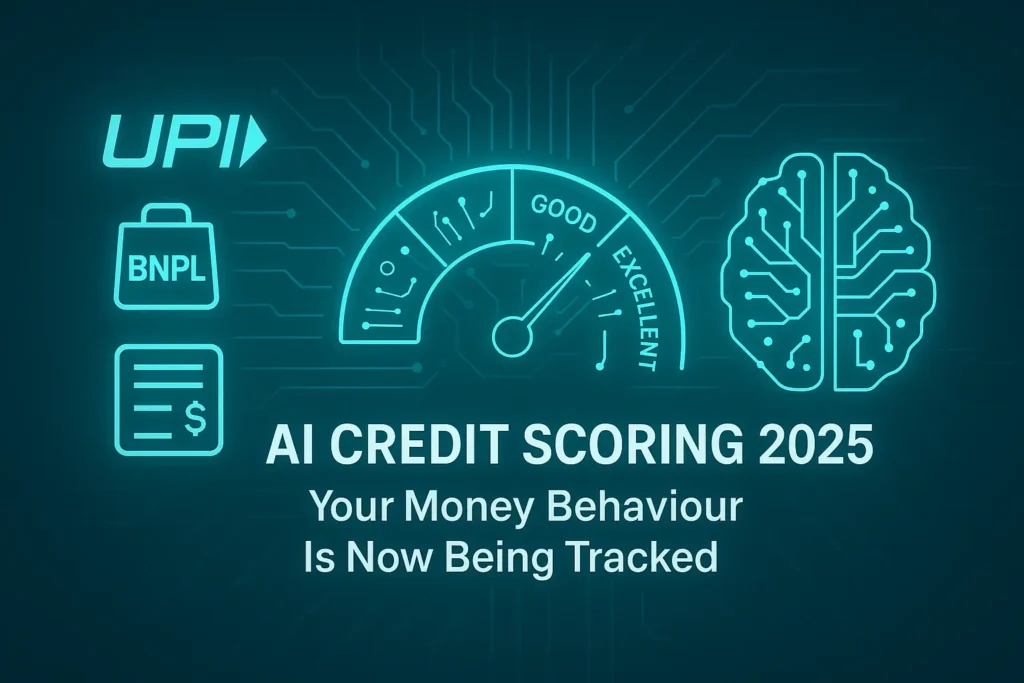
There was a time when your credit score depended only on loans, EMIs and credit cards. That model is now disappearing. In 2025, a new system called AI credit scoring is quietly reshaping how banks, fintech lenders and credit bureaus judge your risk. Your UPI spending patterns, bank balance history, BNPL payments, subscription auto-debits, rent transfers, salary consistency, even overdraft behaviour are now analysed by AI models to predict whether you are financially disciplined.
This means your credit score can now change even if you have never taken a loan in your life.
You may also like to read: CIBIL Rank & Company Credit Report: Why Every Indian MSME Should Care
What Is AI Credit Scoring?
AI credit scoring is a new method of risk assessment where lenders do not rely only on past credit history. Instead, they analyse real-time data such as bank transactions, income flow, expense rhythm, UPI activity, subscription history, and Buy-Now-Pay-Later behaviour. The goal is to forecast future financial behaviour instead of only recording past borrowing behaviour.
Your lifestyle signals are now part of your credit file, not just your loan history.
Why Banks and Credit Bureaus Are Moving to AI-Based Scoring
- The old credit bureau system cannot score millions of people who have no loans or credit cards.
- AI can detect repayment risk earlier by analysing digital money patterns.
- Lenders want to judge real-time behaviour, not three-month-old CIBIL reports.
- Open-banking and Account Aggregator frameworks now allow consent-based cash-flow data sharing.
- Competition from fintech lenders is forcing traditional credit bureaus to modernise.
Real-World Examples of AI Credit Scoring in Use
Experian launched a “Cashflow Score” that uses bank-transaction data instead of only loan history.
In the UK, the Financial Conduct Authority reported that alternative credit agencies now score customers using open-banking data.
In India, lenders like Axis Bank, HDFC, Navi, Indifi and multiple NBFC-fintechs use the Account Aggregator framework to assess borrowers based on cash-flow instead of CIBIL history.
The US Consumer Financial Protection Bureau recently moved to regulate data brokers because AI-based credit models now depend heavily on behavioural data, not only loan data.
These examples prove that AI credit scoring is no longer experimental – it is already active in mainstream lending systems.
Why This Makes Your Credit Score More Vulnerable
Under traditional credit scoring, your score changed slowly. Under AI credit scoring, it can change instantly. Behaviour that was invisible earlier is now measured and flagged. Here are situations that can lower your score without any loan default:
- Repeated low UPI balance or overdrafts
- Multiple BNPL instalments in a single billing cycle
- Subscription auto-debit failures (Netflix, Swiggy One, insurance, etc.)
- Irregular freelance or gig income
- Sudden spending spikes without matching deposits
- Paying only minimum amount on credit cards
- Too many quick loan or BNPL applications
- Delayed rent or utility transfers through UPI or bank
AI does not care whether the transaction was “small.” It cares about financial discipline patterns.
How to Protect Yourself in the AI Credit Scoring Era
- Maintain a buffer balance in your main bank account
- Avoid short-term overdrafts even for a day
- Track all active auto-debits and UPI mandates
- Limit BNPL usage to one or two active plans at a time
- Spread your EMIs and due dates through the month
- Monitor all four bureau reports (CIBIL, Experian, Equifax, CRIF)
- Revoke Account Aggregator consent if not needed
- Keep subscription payments in a single controlled account
- Avoid too many micro-loans or instant-credit apps
In AI scoring, financial behaviour is the new collateral.
Impact on MSMEs, Freelancers and Self-Employed Indians
AI credit scoring will benefit those who are “credit invisible” but financially active. A trader, delivery partner, freelancer or small business owner with no past loan history can now be approved for credit if their bank cash-flow looks steady.
However, MSMEs with irregular inflow or heavy UPI reliance without structured banking may face downward risk signals. In India, the Account Aggregator system is now a core part of cash-flow based lending. If your income is scattered across wallets, UPI apps and informal accounts, AI models may treat it as unstable.
In simple words: discipline is now more important than documents.
FAQ: AI Credit Scoring
Does UPI spending affect credit score?
Not in traditional CIBIL, but yes in AI credit scoring models that use cash-flow data.
Can my score drop without a loan default?
Yes. Behavioural signals like overdrafts or BNPL delays can affect internal scores.
Who uses AI credit scoring today?
Experian, TransUnion, Equifax, CRIF, multiple Indian banks, fintech NBFCs, BNPL apps and open-banking lenders.
Can I stop data access?
Yes. In India, Account Aggregator data is consent-based. You can revoke access anytime.
Relevant Sources (Short Clickable Links)
Experian Cashflow Score
FCA UK Report on Open-Banking Credit Models
CFPB Data Broker Regulation Update
Account Aggregator India Overview
BNPL Credit Impact Industry Report
About the Author
Tabrez is a trader, entrepreneur and exporter who writes about MSMEs, digital tools, finance and business growth on Business Zindagi.