
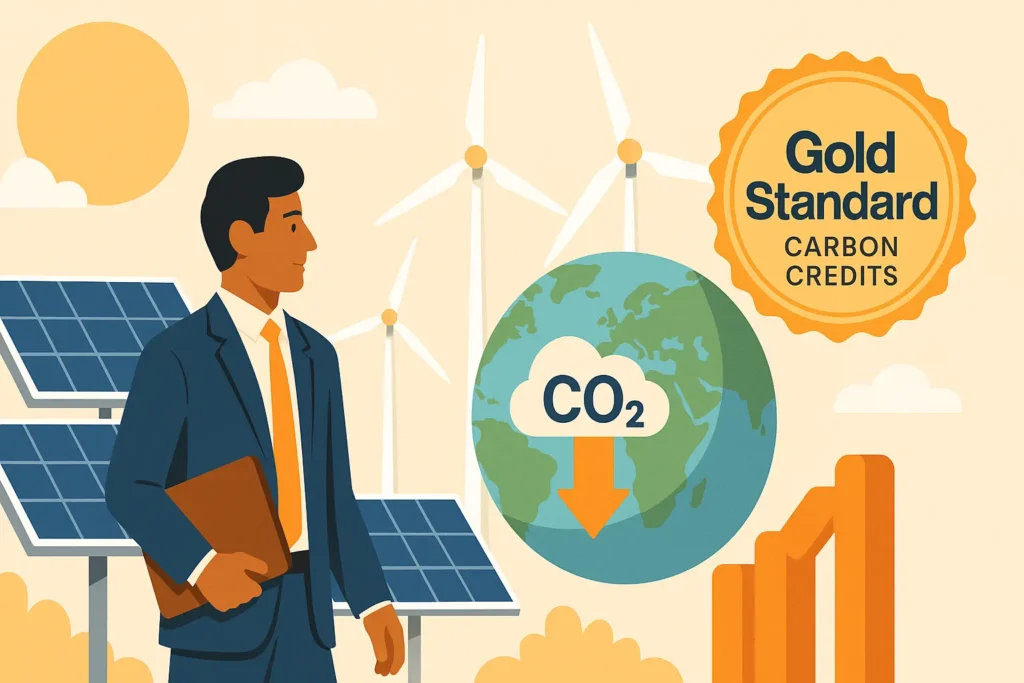
The global carbon market is full of different standards, certifications, and project types. But among them all, Gold Standard carbon credits are widely considered the most trusted, high-quality, and impact-driven credits available today.
If you’re exploring carbon credits for investment, sustainability goals, or business opportunities, understanding Gold Standard carbon credits is essential.
What Are Gold Standard Carbon Credits?
Gold Standard carbon credits are carbon offsets certified by Gold Standard, a non-profit organisation founded by the World Wildlife Fund (WWF) and other international NGOs in 2003.
Each Gold Standard credit represents:
👉 1 tonne of CO₂ reduced, avoided, or removed
👉 Verified using the industry’s most stringent rules
👉 Projects that must also deliver social and economic benefits aligned with the UN Sustainable Development Goals (SDGs)
Gold Standard and the Paris Agreement: What Changed in 2026?
One of the most important developments for Gold Standard carbon credits is the move toward Paris Agreement-aligned methodologies.
Gold Standard established 1 January 2026 as the transition point for its methodology framework. The organisation is updating existing methodologies so that they align with the principles and objectives of the Paris Agreement. Non-Paris-aligned methodologies are being retired as the corresponding aligned methodologies become available.
This matters because carbon-credit buyers increasingly want to understand whether a credit represents a credible emission reduction or removal under a changing global climate-policy environment.
The transition is intended to strengthen areas such as:
- Baseline credibility
- Emission-reduction quantification
- Monitoring and verification
- Alignment with national climate targets
- Avoidance of over-crediting
- Compatibility with emerging international carbon-market rules
Gold Standard is publishing updated methodologies through its Paris Agreement Alignment Documents as the transition progresses.
Gold Standard Carbon Credits and CORSIA: A Major 2026 Development
Another important development is the growing use of Gold Standard carbon credits under CORSIA — the Carbon Offsetting and Reduction Scheme for International Aviation, administered by ICAO.
In March 2026, Gold Standard announced the first large-scale retirement of its carbon credits by a commercial airline for CORSIA Phase 1. A total of 180,000 Gold Standard credits were retired by Shell on behalf of Japan Airlines. The credits came from projects supporting cleaner cooking and energy efficiency in Malawi and Tanzania.
Gold Standard has also been approved to supply eligible emission units for CORSIA’s Second Phase covering 2027–2029.
However, this does not mean that every Gold Standard carbon credit can automatically be used for CORSIA.
Specific eligibility conditions apply. Gold Standard’s July 2026 guidance states that credits need to meet the relevant CORSIA requirements, including conditions relating to host-country authorisation and avoidance of double claiming. Eligible credits are identified through labels in the Gold Standard Impact Registry.
Why this matters
For carbon-credit buyers, the development shows that the market is increasingly moving toward use-case-specific eligibility.
A credit may be suitable for a voluntary corporate purpose but not necessarily for a particular compliance programme.
Therefore, always check the specific credit, project, vintage and eligibility label before purchasing carbon credits for a regulated use.
What does this mean for buyers?
A buyer should not assume that every Gold Standard credit has exactly the same characteristics.
Before purchasing or using a credit, check its:
- Vintage
- Methodology and methodology version
- Project details
- Registry status
- Intended use
- Authorisation or eligibility requirements, where applicable
For important transactions, buyers should verify the specific credit rather than relying only on the Gold Standard name.
⭐ Why Gold Standard Is So Important in the Carbon Credit Market
1. The Highest Level of Credibility
The main challenge in the carbon market is trust. Not all credits are equal.
Gold Standard fixes this by ensuring:
- Real and measurable emission reductions
- Independent third-party verification
- No double counting
- Transparent public registry
This makes the credits credible for companies, governments, and investors.
2. Strong Co-Benefits (Beyond Carbon Reduction)
Most standards focus only on carbon emissions.
Gold Standard requires projects to contribute to at least 3 SDGs such as:
- Clean drinking water
- Job creation
- Women’s empowerment
- Biodiversity restoration
This makes the credits more impactful and often more valuable.
3. Higher Market Demand & Better Prices
Because they guarantee quality, Gold Standard credits usually sell at premium prices.
Companies prefer them because:
- They reduce reputational risk
- They strengthen ESG reports
- They are considered “future proof” against stricter regulations
In short: High-quality credits = high demand + higher profits for project developers.
4. Transparency & Traceability
Every Gold Standard credit is listed on a public registry with:
- Project details
- Auditor reports
- Verification documents
- Serial numbers
- Retirement records
This makes fraud or double selling almost impossible.
5. Essential for Climate-Sensitive Industries
Industries like travel, manufacturing, FMCG, and digital companies rely on reliable offset mechanisms to meet:
- Net-zero goals
- Carbon-neutral certifications
- Compliance reporting
Most sustainability consultants and auditors prefer Gold Standard carbon credits for their safety and reputation.
🔍 Examples of Gold Standard Projects
- Clean cookstove programs reducing firewood burning
- Biogas plants in rural areas
- Solar and wind energy projects
- Reforestation and mangrove restoration
- Clean water purification systems
Each project not only cuts carbon but also improves lives.
New Gold Standard Carbon-Credit Methodologies in 2026
Gold Standard is also expanding and updating the methodologies used to quantify climate benefits.
In 2026, Gold Standard launched consultations on five new or updated methodologies covering areas including carbon removals, forestry, agriculture and community services. One notable development is its first proposed methodology specifically for biochar carbon removal.
The proposed biochar methodology focuses specifically on durable carbon removal rather than avoided emissions and includes requirements relating to carbon stability, monitoring and digital chain-of-custody tracking.
Agriculture is another important area. Gold Standard issued its first rice methane reduction credits from a project in Pakistan using Alternative Wetting and Drying (AWD), a technique designed to reduce methane emissions from rice cultivation.
This development is particularly relevant to countries such as India, where rice cultivation is an important agricultural activity.
The broader trend is clear: carbon-credit methodologies are becoming more specialised, data-driven and focused on demonstrating measurable climate impact.
Gold Standard Is Also Moving Toward Digital Carbon-Credit Monitoring
Another emerging development is the use of digital monitoring, reporting and verification (dMRV).
In 2026, Gold Standard and ATEC Global announced the first fully digitised cookstove carbon credits issued under Gold Standard using digital monitoring, reporting and verification. The project used connected devices to track usage data, with the information made publicly traceable through the Hedera Guardian infrastructure.
Digital MRV can potentially improve the speed, transparency and traceability of carbon-credit data.
For buyers, this reinforces an important principle: the quality of a carbon credit depends not only on the name of the certification standard, but also on how the underlying climate impact is measured, verified and recorded.
What Should You Check Before Buying Gold Standard Carbon Credits in 2026?
If you are a business considering Gold Standard carbon credits, don’t select a credit simply because it carries a recognised certification name.
Check the specific project and credit carefully.
Before purchasing, look at:
1. Project
Understand what activity generated the credit.
2. Methodology
Check which Gold Standard methodology was used and whether the relevant methodology is Paris Agreement aligned.
3. Vintage
The vintage indicates the year in which the emission reduction or removal occurred.
4. Registry information
Verify the credit and project through the Gold Standard Impact Registry.
5. Intended use
Determine whether you are buying for a voluntary corporate claim, CORSIA or another specific purpose.
6. Authorisation and eligibility
Where required, check host-country authorisation, corresponding-adjustment status and applicable eligibility labels.
7. Additional environmental and social impact
Consider whether the project delivers benefits beyond carbon reduction, such as cleaner cooking, health, livelihoods or biodiversity.
The key lesson
Don’t buy a carbon credit based only on its label. Check the underlying project, methodology, vintage, registry information and intended use.
Conclusion
The carbon market will keep growing as the world moves toward low-carbon development.
But only high-quality, verifiable credits will survive long-term.
This is why Gold Standard carbon credits remain one of the most reliable, transparent, and impactful instruments in global climate action.
If you want to understand carbon markets seriously — this is where you should start.
❓ FAQs About Gold Standard Carbon Credits
1. Are Gold Standard carbon credits better than other credits?
Yes. They are considered among the highest-quality credits due to strict verification and social impact requirements.
2. Can individuals buy Gold Standard credits?
Yes. You can buy them directly through the Gold Standard Marketplace.
3. What makes Gold Standard unique?
Unlike other standards, Gold Standard requires projects to deliver climate impact + social impact.
4. Are Gold Standard credits expensive?
They are usually priced higher because they ensure higher integrity and additional community benefits.
5. Where can I see Gold Standard projects?
All projects are listed on their public online registry, where you can view audits, documents, and credit issuance.
📚 Suggested Articles
Want to understand carbon credits, green business opportunities and sustainability better? Read these related BusinessZindagi guides:
- Carbon Credit Trading Scheme (CCTS): What Every Indian MSME & Exporter Should Know (2026)
- Carbon Credits for MSMEs: From Myths to Market Opportunities
- Major Solar Panel Financing Schemes for MSMEs in India in 2026
👤 Author Bio (for BusinessZindagi.com)
Tabrez from BusinessZindagi.com writes about entrepreneurship, digital growth, MSME opportunities, and emerging business trends. His content focuses on simplifying complex business ideas into practical, easy-to-understand insights for Indian entrepreneurs and solopreneurs.
🔗 Authentic Clickable References & Sources
- Gold Standard Official Site
https://www.goldstandard.org - Gold Standard Marketplace
https://marketplace.goldstandard.org - What Is the Gold Standard? (SustainCERT explanation)
https://www.sustain-cert.com - UN Sustainable Development Goals
https://sdgs.un.org/goals - Carbon Markets Overview (World Bank)
https://www.worldbank.org/en/topic/climatechange/brief/carbon-pricing
AI Disclosure
This article was researched and prepared with the assistance of AI tools. Information was reviewed against publicly available sources, including official Gold Standard publications. Readers should verify important carbon-market, regulatory or financial decisions with the relevant official authority or qualified professional