
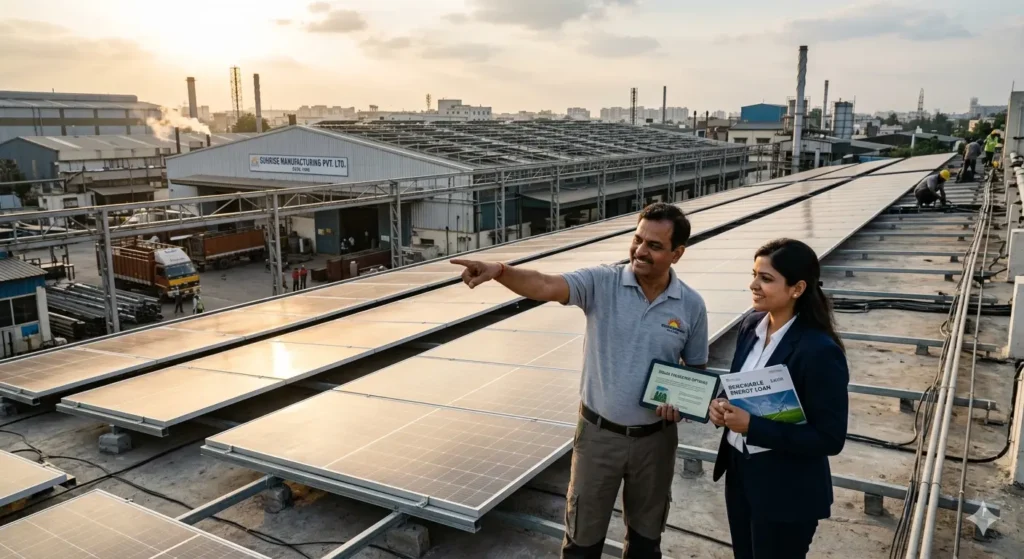
Rising electricity costs are becoming a major concern for Indian MSMEs.
Factories, tea processing units, warehouses, hotels, cold storages, workshops, and manufacturing businesses across India are increasingly exploring rooftop solar systems to reduce operational expenses.
However, one major challenge continues to slow adoption:
the high upfront cost of solar installation.
This is why solar panel financing schemes are becoming extremely important for Indian MSMEs.
Banks, financial institutions, government-backed agencies, NBFCs, and renewable energy companies are now offering multiple financing options to help small businesses adopt solar energy through loans, EMIs, and green finance models.
Here are the major solar panel financing schemes and financing options currently available for MSMEs in India.
related article: Can Solar Energy Really Reduce Costs for Indian MSMEs in 2026?
1. SIDBI Green Finance & 4E Scheme as Solar Panel Financing Schemes.
Small Industries Development Bank of India has become one of the most important institutions supporting renewable energy financing for MSMEs.
Under SIDBI’s green finance initiatives and 4E (End to End Energy Efficiency) programme:
- MSMEs can obtain financing for rooftop solar projects,
- energy-efficient machinery,
- and clean energy transition projects.
Key Features
- Financing support for solar rooftop systems
- Funding support for MSME energy-efficiency projects
- Loan amount may go up to ₹50 crore depending on project scale
- Repayment tenure may extend up to 10 years
- Special focus on MSME sustainability and energy savings
SIDBI has also partnered with several renewable energy companies to simplify financing access for MSMEs.
Why This Scheme Is Important
This is one of the most MSME-focused green financing ecosystems currently available in India.
2. IREDA Renewable Energy Financing as Solar Panel Financing Schemes.
Indian Renewable Energy Development Agency is a government-owned institution under the Ministry of New and Renewable Energy focused on renewable energy financing.
IREDA provides financing for:
- rooftop solar projects,
- industrial solar systems,
- renewable energy infrastructure,
- and commercial solar adoption.
Key Features
- Financing support for renewable energy projects
- Commercial and industrial rooftop solar funding
- Structured renewable infrastructure finance
- Suitable for medium and large MSME projects
Best Suited For
- manufacturing industries,
- institutional projects,
- larger MSMEs,
- and industrial energy transition.
3. SBI Solar Loan Schemes under Solar Panel Financing Schemes
State Bank of India is among the leading banks supporting rooftop solar financing in India.
SBI and several other public sector banks now offer:
- rooftop solar loans,
- EMI-based solar financing,
- and renewable energy lending products.
Key Features
- Long repayment tenure
- EMI-based repayment
- Financing for rooftop solar installations
- May support both residential and commercial systems
- Easier accessibility through bank branches
Why MSMEs Prefer Bank Financing
Many businesses prefer traditional bank financing because:
- they already maintain banking relationships,
- documentation may feel more familiar,
- and branch-level discussions are easier.
4. Axis Bank Rooftop Solar Panel Financing Schemes for MSMEs
Axis Bank recently introduced dedicated rooftop solar financing solutions for MSMEs.
The financing initiative is aimed at helping businesses:
- reduce electricity costs,
- improve sustainability,
- and transition toward cleaner energy solutions.
Key Features
- Dedicated rooftop solar financing
- EMI repayment structures
- Focus on MSMEs and commercial users
- Renewable energy transition support
Why This Matters
Private sector banks are now aggressively entering India’s green financing market, increasing financing options for businesses.
5. Vendor-Linked Solar Panel Financing Schemes
One of the fastest-growing trends in India’s solar sector is vendor-linked financing.
Many solar companies now partner directly with:
- banks,
- NBFCs,
- fintech lenders,
- and renewable finance companies
to offer bundled “solar + financing” solutions.
Key Features
- Lower upfront payment
- Faster approvals
- Bundled installation and financing
- EMI-based repayment
- Simplified documentation
Several solar companies now advertise:
- low down-payment models,
- quick approvals,
- and “zero upfront” financing structures.
6. NBFC & Fintech Solar panel Financing schemes
Apart from banks, many NBFCs and fintech lenders are increasingly entering the renewable energy financing market.
These lenders often target:
- smaller MSMEs,
- semi-urban businesses,
- and businesses lacking large collateral.
Key Features
- Faster loan processing
- Flexible repayment structures
- Smaller ticket-size loans
- Simplified approval process
This segment is growing rapidly because many MSMEs struggle to access large traditional bank loans.
7. Tata Power Solar & SIDBI Partnership Model solar panel financing schemes
Tata Power Solar and SIDBI have partnered to improve solar financing access for MSMEs.
The objective is to:
- simplify financing,
- encourage solar adoption,
- and help businesses reduce long-term electricity expenses.
Why This Partnership Is Important
Such partnerships show how India’s solar financing ecosystem is becoming increasingly integrated between:
- financial institutions,
- renewable energy companies,
- and MSME-focused lenders.
What MSMEs Usually Need for Solar Financing
Most lenders typically require:
- GST registration,
- business financial statements,
- electricity bills,
- bank statements,
- project quotation,
- KYC documents,
- and rooftop ownership details.
Larger projects may require more technical documentation.
Typical Features of Solar Panel Financing schemes in India
| Feature | Typical Range |
|---|---|
| Repayment tenure | 5–10 years |
| Financing coverage | 70%–100% project cost |
| Interest rate | Depends on borrower profile |
| Repayment method | EMI-based |
| Security requirement | Depends on loan size |
Important Things MSMEs Should Analyse Before Taking Solar Loans
Before taking solar financing, businesses should carefully evaluate:
- actual electricity consumption,
- expected energy savings,
- repayment burden,
- maintenance costs,
- system quality,
- and vendor credibility.
Many businesses wrongly assume solar systems automatically eliminate electricity bills completely.
In reality, savings depend on:
- sunlight conditions,
- operational pattern,
- electricity usage,
- and system performance.
Why Solar Panel Financing schemes are Becoming Important for MSMEs
For many businesses, solar energy is no longer only about environmental sustainability.
It is increasingly about:
- reducing operational expenses,
- improving long-term cost stability,
- and protecting business margins from rising electricity tariffs.
This is why solar financing demand among MSMEs is expected to continue growing rapidly in the coming years.
Final Thoughts
India’s Solar Panel Financing scheme ecosystem is expanding rapidly in 2026.
From SIDBI and IREDA to public sector banks, private banks, NBFCs, and vendor-linked financing models, MSMEs now have significantly more financing options for rooftop solar adoption.
However, businesses should approach solar investments carefully.
Before taking any financing decision, MSMEs should:
- compare lenders,
- analyse repayment obligations,
- evaluate long-term savings,
- and verify installation quality properly.
For many Indian MSMEs, rooftop solar may gradually become not just a sustainability decision — but an important financial strategy.
Things MSMEs Should Check Before Taking a Solar Loan under any Solar Panel Financing scheme
Before signing a financing agreement:
- Compare interest rates from at least three lenders.
- Check processing charges.
- Verify the EPC company’s warranty.
- Understand annual maintenance costs.
- Confirm net-metering rules in your state.
- Calculate actual payback period after subsidy and tax benefits.
Reality Check: Financing Has Improved, but Challenges Remain
Industry reports indicate that despite increased government support, some businesses and households still experience delays in loan approvals due to documentation requirements, property records and lender-specific policies. Therefore, MSMEs should keep GST registration, Udyam Registration, financial statements and ownership documents ready before applying for solar finance.
FAQ
What is Solar Panel Financing scheme for MSMEs?
Solar panel financing allows MSMEs to install solar systems through loans, EMIs, green finance schemes, or leasing models instead of paying the full amount upfront.
Which is the best solar financing scheme for MSMEs in India?
SIDBI green finance schemes are among the most MSME-focused financing options currently available for renewable energy projects.
Does SBI provide solar loans?
Yes. SBI offers rooftop solar financing and renewable energy loan products for eligible borrowers.
What is IREDA financing?
IREDA provides financing support for renewable energy projects including rooftop solar and industrial clean energy infrastructure.
Are solar loans available without collateral?
Some smaller rooftop solar financing schemes may offer partially collateral-free structures depending on project size and borrower profile.
Suggested Articles
If you found this guide helpful, you may also like:
- How to Get a Collateral-Free MSME Loan in India (Complete Guide)
- CGTMSE Scheme Explained: Loan Guarantee Benefits for MSMEs
- Udyam Registration Benefits Every Small Business Should Know
- How to Reduce Electricity Costs in Your Small Business
- How I Started an Export Business with Almost No Investment – My Real Journey
About the Author
Business Zindagi Editorial Team writes on MSMEs, finance, renewable energy, exports, technology, and emerging business trends affecting Indian entrepreneurs and small businesses.
AI Disclaimer: This article was researched and written with the assistance of AI and carefully reviewed, fact-checked, and edited by the BusinessZindagi editorial team. We strive to keep the information accurate and up to date; however, readers should verify the latest scheme guidelines and lender policies from official sources before making financial decisions.
Affiliate Disclosure: Some links in this article may be affiliate links. If you purchase or sign up through these links, BusinessZindagi may earn a small commission at no extra cost to you. We recommend only products and services that we believe can genuinely benefit entrepreneurs and MSMEs.