
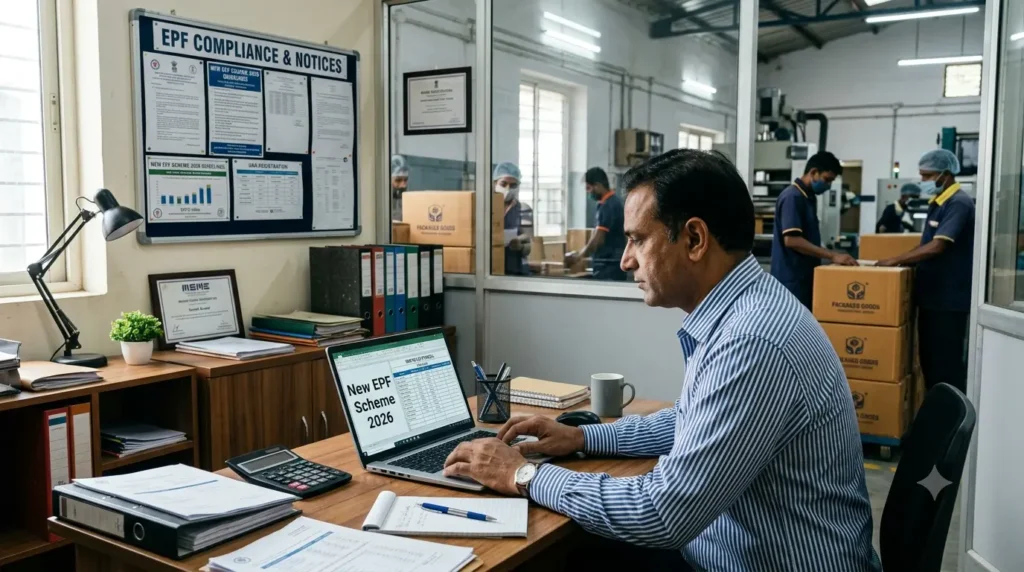
For many small business owners, the announcement of the New EPF Scheme 2026 created one immediate question:
“Do I need to worry about this?”
Social media posts and news headlines suggest that the Employees’ Provident Fund (EPF) system has undergone a major overhaul. While that is true from a legal and administrative perspective, the reality is that not every MSME will be equally affected.
If you run a small manufacturing unit, retail business, trading firm, restaurant, export business, or startup, understanding whether the new rules actually apply to you is far more important than simply knowing that a new scheme has been introduced.
In this guide, let’s simplify everything.
What is the New EPF Scheme 2026?
The Government of India has notified the Employees’ Provident Fund (EPF) Scheme, 2026, replacing the decades-old EPF Scheme, 1952 under the Code on Social Security, 2020.
The objective is not to completely change the Provident Fund system but to modernize it through:
- Better digital compliance
- Simplified administration
- Stronger governance
- Faster claim processing
- Improved portability for employees
The good news is that employee and employer contribution rates remain unchanged in most cases, and existing EPF members continue without disruption.
The Biggest Mistake MSME Owners Are Making
Many business owners assume that every company in India must now follow the New EPF Scheme.
That is not correct.
The first question every entrepreneur should ask is:
“Is my business actually covered under EPF?”
If the answer is No, then most of the recent changes will not affect your business today.
Which MSMEs Should Be Most Concerned About the New EPF Scheme?
1. Businesses with 20 or More Employees
Generally, establishments employing 20 or more persons are required to comply with EPF provisions.
Examples include:
- Manufacturing units
- Tea processing units
- Packaging businesses
- Food processing companies
- Garment manufacturers
- Warehouses
- Logistics companies
- IT companies
- BPOs
- Hotels
These businesses should pay close attention to the New EPF Scheme because compliance is becoming increasingly digital.
2. Fast Growing Startups
Today you may have:
- 15 employees
Six months later:
- 22 employees
Crossing the employee threshold can trigger EPF obligations.
Growing businesses should prepare their payroll and HR systems before expansion instead of waiting until compliance becomes mandatory.
3. Businesses Using Contract Workers
Some MSMEs believe contract workers have nothing to do with EPF.
That assumption can be risky.
Depending on the employment arrangement and applicable law, employers may still have responsibilities relating to contract labour.
This is one area where businesses should seek professional advice.
Which Small Businesses Are Mostly Unaffected?
This is where many MSME owners will find relief.
Sole Proprietors Without Employees
Examples include:
- Freelancers
- Consultants
- Online sellers
- Bloggers
- Digital marketers
- Individual exporters
If you work alone, the New EPF Scheme generally has no practical impact on your business.
Family-Run Businesses
Suppose a grocery shop is managed only by:
- Husband
- Wife
- Parents
- Children
with no eligible employees.
In such situations, EPF provisions generally do not apply.
Small Businesses With Fewer Than 20 Employees
Many businesses such as:
- Retail stores
- Cafes
- Bakeries
- Small trading firms
- Repair shops
- Local service businesses
may not be required to register under EPF if they remain below the statutory threshold and are not otherwise covered or voluntarily registered.
However, this should not be confused with being permanently exempt.
As the business grows, compliance requirements can change.
Important: Once Covered, You Usually Continue to Be Covered
One misconception deserves special attention.
Imagine your company had:
- 24 employees in 2025
and therefore became covered under EPF.
Later, due to business slowdown, your workforce reduces to:
- 16 employees.
Many owners assume EPF registration automatically ends.
In reality, establishments that have already come under EPF generally continue to remain covered even if employee strength subsequently falls below the threshold. Businesses should verify their specific circumstances before making compliance decisions.
What Has Actually Changed Under the New EPF Scheme?
For most MSMEs, the biggest changes are administrative rather than financial.
Greater Digital Compliance
Businesses should expect:
- More online filings
- Better employee record maintenance
- Accurate Aadhaar and UAN details
- Improved payroll documentation
Faster Claim Processing
The government aims to make PF withdrawals faster through upgraded digital systems.
This benefits employees while reducing administrative delays.
Stronger Governance
The scheme places greater emphasis on:
- Compliance
- Transparency
- Record keeping
- Digital verification
Businesses relying on manual paperwork may eventually need better payroll systems.
What Has NOT Changed?
This is equally important.
The New EPF Scheme does not significantly change:
✅ Employer contribution rate
✅ Employee contribution rate
✅ Universal Account Number (UAN)
✅ Basic EPF benefits
✅ Existing wage ceiling
These remain largely unchanged under the new framework.
Practical Checklist for MSME Owners
If your business is covered under EPF, consider this checklist.
✔ Verify employee records
✔ Update Aadhaar and UAN information
✔ Deposit EPF contributions on time
✔ Maintain digital payroll records
✔ Review contract labour compliance
✔ Use reliable payroll software
✔ Keep HR documentationupdated
My Practical View as an Entrepreneur
As someone involved in business, I believe the New EPF Scheme is less about increasing employer costs and more about improving compliance and digitisation.
If your payroll records are already organised, the transition should be relatively smooth.
However, MSMEs still managing employee records manually should use this opportunity to modernise their HR and payroll systems. Doing so can reduce compliance risks and improve employee confidence.
Frequently Asked Questions (FAQs)
Is EPF mandatory for every MSME?
No. Coverage generally depends on factors such as the nature of the establishment and employee strength.
Has the employer contribution increased?
No. The contribution rate remains largely unchanged under the New EPF Scheme.
Does the New EPF Scheme affect sole proprietors?
If you have no eligible employees, the scheme generally has little or no practical impact.
What is the biggest change?
The biggest change is greater emphasis on digital compliance, governance, and simplified administration rather than higher PF contributions.
Final Thoughts
The New EPF Scheme 2026 is an important reform, but not every MSME owner needs to panic.
Instead of asking “What changed?”, ask:
“Does this actually apply to my business?”
For many small businesses, the answer may be not yet.
For growing MSMEs, however, this is the right time to strengthen payroll systems, maintain proper employee records, and stay prepared for future compliance requirements.
A proactive approach today can save significant time, penalties, and administrative headaches tomorrow.
📚 Suggested Articles
If you found this guide helpful, you may also like:
- Udyam Registration Explained: Benefits, Eligibility & How to Apply
- CGTMSE Loan Scheme: How MSMEs Can Get Collateral-Free Business Loans
- MSME Registration vs GST Registration: What’s the Difference?
- Top 7 Business Secrets Every MSME Owner Must Protect: The Hidden Advantages That Keep Competitors Behind
About the Author
Tabrez khan is the founder of BusinessZindagi.com, where he shares practical insights on MSMEs, entrepreneurship, export-import business, government schemes, and small business growth. His articles combine real-world business experience with research to help entrepreneurs make informed decisions.
AI Disclosure
This article was researched and drafted with the assistance of AI and carefully reviewed for accuracy. Readers should refer to official government notifications or consult a qualified labour law professional before making compliance decisions.
Authentic Sources & References
- Ministry of Labour & Employment / EPF Scheme 2026 Notification (news coverage): Business Today – New EPF Scheme 2026 notified
- Official EPFO Website: Employees’ Provident Fund Organisation (EPFO)
- Official EPFO Updates & Circulars: EPFO Circulars
- The Times of India – New EPF Scheme 2026 Explained: New EPF Scheme 2026: What it means for your provident fund savings
- LiveMint – EPF Scheme 2026 withdrawal rules: EPF Scheme 2026: New rules on withdrawal, eligibility and limits explained
- All India Radio (News on Air): Government notifies Employees’ Provident Fund Scheme 2026