
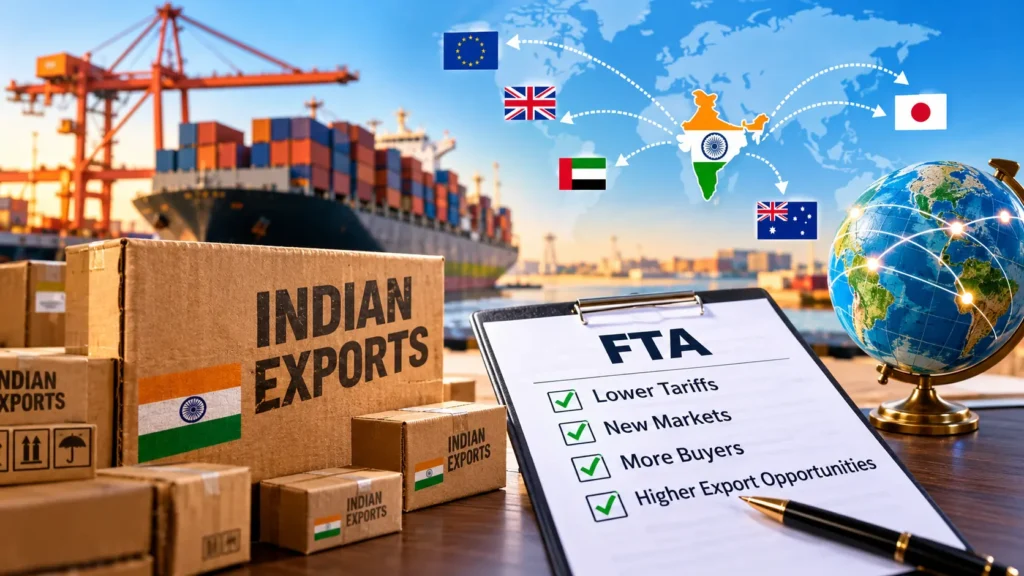
India has signed several trade agreements that can provide Indian exporters with preferential access to overseas markets. But simply having an FTA does not automatically create an export order.
The real opportunity lies in identifying the right market, checking whether your product qualifies for preferential tariff treatment, understanding the applicable Rules of Origin, completing the required Certificate of Origin process and using the potential tariff advantage when approaching overseas buyers.
This is now receiving greater attention from the Government of India.
In September 2026, Union Commerce and Industry Minister Piyush Goyal called for a nationwide effort to maximise FTA utilisation and ensure that preferential market access reaches MSMEs, traders, entrepreneurs and businesses across India.
DGFT Director General Lav Agarwal also urged industry associations to move beyond simply creating awareness about FTAs and export schemes and help convert market access into actual export shipments, including through mentoring and hand-holding of potential exporters.
More recently, the Department of Commerce organised a “Leveraging FTAs” outreach programme in Jaipur on October 17, 2026, specifically aimed at helping exporters understand and effectively utilise India’s trade agreements.
For an Indian MSME, the message is clear:
Don’t just know that an FTA exists. Find out whether it can help you win an export order.
What Are FTA Benefits for Indian Exporters?
A Free Trade Agreement (FTA) is a trade agreement between countries or trading blocs that provides agreed market-access benefits for eligible products.
Depending on the agreement and product, an Indian exporter may be able to help an overseas buyer obtain preferential tariff treatment compared with the normal tariff applicable to imports.
The benefit could include:
- Zero customs duty
- Reduced customs duty
- Phased tariff reductions
- Tariff-rate quotas
- Other preferential market-access provisions
However, an FTA does not automatically mean zero duty for every product.
The actual benefit depends on factors such as:
- The specific trade agreement
- Product HS code
- Destination country
- Applicable tariff schedule
- Rules of Origin
- Certificate of Origin requirements
The government has specifically highlighted the importance of helping exporters convert preferential market access into actual business opportunities.
Why DGFT Is Asking Businesses to Actually Use FTAs
India has been expanding its network of trade agreements, but the government increasingly wants businesses to make greater practical use of the market access created by these agreements.
The Department of Commerce has said that the focus is shifting from simply negotiating market access towards helping Indian enterprises actually use it. Recent outreach programmes are intended to provide exporters with practical information, capacity building and coordination with government and industry bodies.
DGFT has similarly called on industry associations to help translate FTAs and export schemes into actual shipments and to mentor potential exporters at district and cluster levels.
This is particularly relevant for MSMEs.
A small manufacturer or first-time exporter may not know:
- Which FTA applies to its product
- Which HS code should be used
- What the normal import duty is
- What preferential duty may be available
- What Rules of Origin apply
- How the Certificate of Origin works
- How to identify buyers in the target market
- How to communicate the potential tariff advantage to those buyers
As a result, an FTA may exist, but the business may never actually use it.
How Can an Indian MSME Use an FTA?
Step 1: Identify Your Correct HS Code
Start with the product you want to export.
The HS code is important because tariff treatment and Rules of Origin are generally linked to product classification.
For example, an exporter of tea, spices, garments, engineering components or processed food should first establish the appropriate HS classification.
Do not start by choosing an FTA country. Start by correctly identifying your product.
An incorrect HS code can result in checking the wrong tariff or even the wrong Rules of Origin.
Step 2: Identify Potential FTA Markets
Once you know your product and HS code, identify countries where India has a relevant trade agreement.
India’s current trade-agreement network includes agreements covering markets such as the UAE, Australia, EFTA countries and Oman, while newer agreements and arrangements continue to expand India’s preferential market access. The government maintains official information on India’s trade agreements and their implementation.
But don’t choose a country simply because India has an FTA with it.
Ask three questions:
- Is there demand for my product?
- Does the FTA provide a meaningful tariff advantage?
- Can I competitively supply that market?
An FTA is most useful when preferential market access and genuine buyer demand come together.
Step 3: Compare the Normal Tariff With the Preferential Tariff
This is where an FTA becomes commercially interesting.
Suppose an overseas buyer normally pays a 10% import duty on a particular product, while the applicable FTA provides a preferential rate of 0%.
For a shipment with a customs value of $10,000:
| Particular | Without FTA | With FTA |
|---|---|---|
| Customs value | $10,000 | $10,000 |
| Illustrative duty | 10% | 0% |
| Duty payable | $1,000 | $0 |
| Potential difference | — | $1,000 |
This is only an illustration. The actual rate depends on the specific product, HS code, agreement, destination country and eligibility conditions.
The important point is that a genuine tariff advantage can become part of your sales proposition to the buyer.
Step 4: Check the Rules of Origin
This is one of the most important parts of FTA utilisation.
An exporter cannot simply assume:
“The goods are being shipped from India, so they qualify for the FTA.”
The product must satisfy the applicable Rules of Origin under the relevant agreement.
These rules determine whether the product qualifies as originating in India for preferential treatment.
Depending on the agreement and product, requirements can include:
- Wholly obtained criteria
- Change in tariff classification
- Minimum value addition
- Product-specific requirements
- Processing requirements
The government’s FTA information explains that exporters generally need to provide proof of origin to establish eligibility for preferential tariff treatment.
Why this matters for MSMEs
Suppose an Indian manufacturer imports raw materials and uses them to manufacture a finished product.
The exporter should not automatically assume that the finished product qualifies for preferential treatment.
The applicable agreement needs to be checked to determine whether the required value addition or other origin criteria are satisfied.
Step 5: Complete the Certificate of Origin Process
A preferential Certificate of Origin (CoO) provides evidence that goods meet the relevant origin requirements under a trade agreement.
DGFT’s CoO system provides a digital platform for Certificates of Origin covering FTAs/PTAs. Preferential CoO applications are handled through the newer eCoO 2.0 system on the Trade Connect platform.
DGFT Certificate of Origin Platform
DGFT has also introduced an Open API facility allowing eligible exporters to connect their ERP or accounting systems directly with the Certificate of Origin system. The facility covers preferential and non-preferential Certificates of Origin.
Exporters should check the specific documentation and certification requirements applicable to their product and agreement before shipment.
Step 6: Tell the Overseas Buyer About the Potential FTA Advantage
This is an important commercial step.
Suppose you have identified an importer in an FTA market.
Don’t simply say:
“India has an FTA with your country.”
Instead, investigate the applicable tariff and explain the potential benefit carefully.
For example:
“Our product may qualify for preferential tariff treatment under the applicable India–[country] trade agreement, subject to the relevant HS classification and Rules of Origin.”
This gives the buyer a reason to investigate your offer.
The buyer can then compare:
Supplier price + normal import duty
with
Indian supplier price + applicable preferential duty
If the Indian product provides a genuine landed-cost advantage, the FTA can become part of your sales pitch.
Step 7: Calculate Your Export Price and Profit
An FTA advantage does not eliminate the need to calculate your own export costs.
Before accepting an order, consider:
- Product cost
- Packaging
- Inland transportation
- Port charges
- Documentation
- Freight
- Insurance
- Banking charges
- Commission
- Other export expenses
- Exchange-rate impact
- Profit margin
You can use the BusinessZindagi Export Profit Calculator to estimate export costs, selling price and potential profit.
If you are comparing FOB and CIF pricing, you can also use the BusinessZindagi FOB vs CIF Calculator.
Remember that the FTA benefit is generally a tariff advantage for qualifying imports, not an automatic increase in the exporter’s profit.
Step 8: Find Buyers in the FTA Market
Finding an attractive FTA market is only half the job.
The next question is:
Who is actually importing my product?
For example, an Indian tea exporter could identify countries where preferential access is attractive and then research companies already importing similar tea products.
Shipment data can help exporters investigate:
- Importing companies
- Existing buyers
- Supplier countries
- Shipment volumes
- Product descriptions
- Import trends
- Potential target markets
You can research international buyers and shipment data with Volza.
BusinessZindagi affiliate disclosure: The above is an affiliate link. If you sign up or purchase through the link, BusinessZindagi may receive a commission at no additional cost to you.
The objective should not be to collect hundreds of random importer contacts.
Instead, identify companies that:
- Import your product
- Buy from overseas suppliers
- Operate in your target market
- Have a requirement matching your product
- Appear commercially relevant
Then approach them with a researched offer.
For more practical guidance, see the BusinessZindagi guide on finding export buyers.
From FTA to Export Order: A Practical Process
An MSME can simplify the process into this workflow:
1. Select your product
↓
2. Determine the HS code
↓
3. Identify suitable FTA markets
↓
4. Check market demand
↓
5. Check normal import duty
↓
6. Check preferential FTA duty
↓
7. Verify Rules of Origin
↓
8. Check Certificate of Origin requirements
↓
9. Calculate your export price and margin
↓
10. Research potential buyers
↓
11. Explain the potential tariff advantage
↓
12. Negotiate the order
↓
13. Complete export and origin documentation
↓
14. Ship
The objective is to move from market access to an actual commercial transaction.
Why Many MSMEs Are Not Using FTA Benefits
The challenge is often not the absence of trade agreements. It is practical utilisation.
1. They don’t know which FTA applies
India has multiple trade agreements with different provisions.
2. They don’t check the HS code
Without the correct classification, tariff research can go wrong.
3. They don’t compare tariffs
Knowing that an FTA exists is not enough. The exporter needs to check the product-specific preferential rate.
4. They don’t understand Rules of Origin
An exporter may qualify for an FTA benefit only if the product satisfies the applicable origin requirements.
5. They are unfamiliar with the Certificate of Origin process
First-time exporters may not know where or how to complete the preferential CoO process.
6. They don’t communicate the advantage to buyers
Even when a product qualifies, the overseas buyer may not realise that sourcing from India could provide preferential tariff treatment.
What Should an MSME Check Before Using an FTA?
Before approaching an overseas buyer, create a simple checklist:
| Check | What to Find Out |
|---|---|
| Product | Exactly what are you exporting? |
| HS Code | What is the correct classification? |
| Market | Which FTA country has demand? |
| Normal tariff | What duty would normally apply? |
| Preferential tariff | What rate applies under the FTA? |
| Rules of Origin | Does your product qualify? |
| Certificate of Origin | What documentation is required? |
| Buyer | Which companies import the product? |
| Export price | What is your competitive selling price? |
| Profit | Is the transaction commercially viable? |
If all of these questions can be answered, an FTA becomes much more than a government announcement—it becomes a potential sales tool for your export business.
Frequently Asked Questions
Does an FTA mean zero import duty?
No. An FTA may provide zero duty, reduced duty, phased reductions or other preferential treatment depending on the agreement and product.
How can an Indian exporter check FTA benefits?
Start with the correct HS code, identify the applicable agreement, check the preferential tariff and verify the Rules of Origin and Certificate of Origin requirements.
What are Rules of Origin?
Rules of Origin determine whether goods qualify as originating in a particular country for purposes such as preferential tariff treatment.
What is a Preferential Certificate of Origin?
It is documentation used to establish that goods qualify as originating goods under the relevant trade agreement so that preferential treatment can be claimed, subject to the importing country’s requirements.
Can MSMEs use India’s FTAs?
Yes. The government’s current FTA utilisation drive specifically aims to extend preferential market-access opportunities to MSMEs, traders, entrepreneurs and businesses across India.
Should an exporter reduce the selling price because of an FTA?
Not automatically. First calculate the buyer’s potential tariff advantage and your own export costs and margin. The tariff advantage can strengthen your offer without requiring you to give away the entire benefit through a lower selling price.
Disclaimer
Disclaimer: This article is provided for general informational and educational purposes only. FTA tariff rates, Rules of Origin, product eligibility, Certificate of Origin requirements and other trade conditions can vary by product, HS code, destination country and specific trade agreement. Government rules and procedures may also change. Exporters should verify the latest applicable provisions with DGFT, the Department of Commerce, the relevant Certificate of Origin authority and the importing country’s customs authorities before making commercial decisions. BusinessZindagi does not provide legal, customs, tax or professional trade advice.
Affiliate disclosure: Some links in this article may be affiliate links. If you use an affiliate link and make a qualifying purchase or signup, BusinessZindagi may receive a commission at no additional cost to you.
Official References
- Ministry of Commerce & Industry — Nationwide FTA Utilisation Drive
- Department of Commerce — Leveraging FTAs Outreach Programme, October 2026
- PIB — India’s Trade Agreements in Action
- PIB — Government Expands FTAs and Export Promotion Measures
- DGFT — Certificate of Origin Platform
- PIB — DGFT Open API for Certificate of Origin