
For years, UPI has been one of the biggest advantages for Indian small businesses. A neighbourhood shop, restaurant, trader, service provider or street vendor could put up a QR code and accept digital payments without worrying about a traditional merchant fee.
That is about to change for some higher-value merchant transactions.
But there is an important point many headlines are missing:
UPI is not becoming chargeable for everyone.
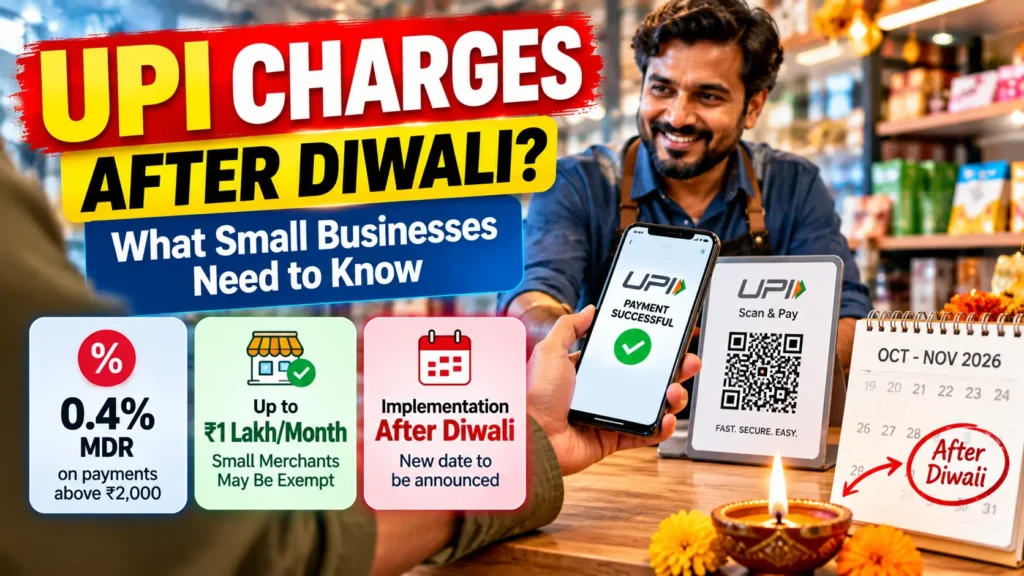
The National Payments Corporation of India (NPCI) had planned to introduce a 0.4% Merchant Discount Rate (MDR) on specified UPI merchant payments above ₹2,000 from October 15, 2026. However, NPCI has now deferred the implementation until after Diwali, with the new date to be announced separately.
For small businesses, the real question is not simply “Will UPI become chargeable?”
It is:
Will my business have to pay anything when customers pay me through UPI?
Here is what small merchants and MSMEs need to know.
UPI Charges for Small Businesses:What is changing in UPI payments?
The new framework introduces MDR on specified Person-to-Merchant (P2M) transactions above ₹2,000.
The standard MDR is 0.4%, subject to a maximum of ₹300 per transaction for transactions of ₹75,000 and above.
However, the framework does not apply to every UPI payment.
The government’s clarification says:
- Person-to-person UPI payments remain free.
- Merchant payments up to ₹2,000 remain free.
- Eligible small merchants covered under the zero-MDR framework remain protected.
- MDR applies only to specified merchant transactions above ₹2,000.
- Customers are not supposed to be charged MDR separately.
So the popular statement “UPI will now charge 0.4% on every payment above ₹2,000” is too simplistic.
Why was the UPI charge postponed?
The original implementation date was October 15, just ahead of India’s major festive shopping period.
NPCI subsequently decided to defer implementation until after Diwali, citing the festive season. A fresh implementation date will be announced separately.
For retailers, this means there is currently no need to panic or immediately change your pricing because of the proposed MDR.
But this is a good time to understand your exposure before the new implementation date arrives.
Will small businesses have to pay UPI charges?
Not necessarily.
This is probably the most important part of the entire announcement.
The Ministry of Finance says small merchants receiving up to ₹1 lakh per month through UPI QR codes under the P2PM category will continue to receive zero MDR on their transactions.
The government specifically mentions protection for street vendors, neighbourhood shops and other small businesses.
So a small retailer receiving modest amounts through a qualifying UPI QR arrangement may remain outside the MDR.
However, businesses should not assume that simply being an MSME automatically means zero MDR.
Your merchant category and payment arrangement matter.
Businesses should confirm their classification with their acquiring bank or payment service provider.
What happens to a ₹2,000, ₹10,000 or ₹50,000 payment?
For a standard eligible transaction subject to the 0.4% MDR:
| Customer pays | 0.4% MDR |
|---|---|
| ₹2,000 | ₹0 |
| ₹2,500 | ₹10 |
| ₹5,000 | ₹20 |
| ₹10,000 | ₹40 |
| ₹25,000 | ₹100 |
| ₹50,000 | ₹200 |
| ₹75,000 | ₹300* |
| ₹1,00,000 | ₹300* |
*The MDR is capped at ₹300 for transactions of ₹75,000 and above under the announced framework.
These examples are useful because a 0.4% charge sounds tiny, but the impact depends on how much money a business receives through eligible higher-value transactions.
The ₹2,000 difference that every retailer should understand
Consider two customers.
Customer A pays:
₹2,000
Customer B pays:
₹2,001
Under the announced framework, a qualifying transaction above ₹2,000 can attract MDR, while a payment of ₹2,000 remains free.
India Today highlighted this threshold effect using NPCI’s published framework and examples.
That makes transaction-value monitoring important for businesses with many higher-value UPI payments.
A grocery shop where most UPI payments are ₹200–₹1,000 could have a very different impact from a furniture dealer, electronics retailer, wholesaler or service business where customers regularly pay ₹10,000, ₹25,000 or more.
What about customers?
Customers should not be asked to pay an additional UPI MDR charge.
The Ministry of Finance has explicitly clarified that MDR is a merchant-side payment ecosystem charge, not a tax collected by the government.
Banks have also been advised to ensure merchants do not pass MDR on to customers, while UPI application providers cannot impose hidden platform charges.
So a shop should not simply add:
“UPI surcharge – 0.4%”
to the customer’s bill.
Businesses should instead understand the actual settlement cost applicable to their merchant account.
What does this mean for different types of small businesses?
1. Kirana stores
For most neighbourhood grocery stores, the impact may be relatively limited because individual transactions are generally much smaller than ₹2,000.
The government’s zero-MDR protection for qualifying small merchants is also particularly relevant to this segment.
2. Restaurants and cafés
Restaurants can have a mixture of small and larger transactions.
A ₹500 or ₹1,500 bill is different from a ₹5,000 family order or corporate bill.
Restaurants should therefore examine their average UPI transaction value rather than assuming the new rule will affect every payment.
3. Electronics and mobile shops
This category could be more sensitive.
A smartphone, laptop, television or other electronic purchase can easily cross ₹2,000.
Businesses with frequent higher-value UPI payments should pay particular attention to their merchant category and settlement statements once the new framework comes into effect.
4. Traders and wholesalers
Wholesalers and B2B traders could have considerably larger UPI payments.
For these businesses, even a small percentage-based cost can become meaningful when monthly transaction volumes are high.
5. Service businesses
Consultants, agencies, repair businesses, contractors and other service providers may also receive higher-value payments.
They should calculate the potential annual cost rather than looking only at the MDR on one transaction.
How much could it cost your business?
Suppose an eligible business receives:
₹10 lakh per month through transactions that attract the 0.4% MDR.
A simple calculation gives:
₹10,00,000 × 0.4% = ₹4,000 per month
That is:
₹48,000 per year
But this is only a simple illustration.
The actual impact could be substantially different because:
- Not every UPI transaction will necessarily attract MDR.
- Payments up to ₹2,000 remain free.
- Qualifying small merchants may remain under zero MDR.
- Certain sectors have different treatment.
- The ₹300 per-transaction cap applies to transactions of ₹75,000 and above.
- Merchant classification matters.
Therefore, don’t multiply your entire monthly UPI collection by 0.4% and assume that is your final cost.
Some sectors have different MDR treatment
The framework also provides special treatment for certain essential and thin-margin sectors.
The government says specified transactions above ₹2,000 in sectors including railways, telecommunications, insurance, fuel and agricultural inputs will attract a flat ₹5 MDR rather than the standard 0.4% rate.
Capital-market transactions such as those involving mutual funds, securities and stockbrokers have a separate 0.02% MDR, capped at ₹300.
Businesses should therefore check the category applicable to their particular transactions rather than relying on a single 0.4% assumption.
🔗 Useful BusinessZindagi links
- UPI Charges 2026: Latest MDR Rules — for readers who want the detailed UPI/MDR breakdown. Read the UPI Charges 2026 guide
- Payment Gateway Fee Calculator — calculate payment fees, GST and net settlement. Try the Payment Gateway Fee Calculator
- Raw Material Price Increase Calculator — useful for seeing how small cost increases affect margins. Calculate the impact on your profit
- CostTrack — track and understand recurring business costs. Open CostTrack
UPI MDR is not the same as payment gateway charges
This is another area where small businesses can get confused.
UPI MDR relates to the merchant payment ecosystem under the announced UPI framework.
A payment gateway fee is a separate commercial charge associated with processing online payments through a payment gateway.
If your business accepts payments through an ecommerce website, payment gateway, payment link or other online checkout, you may have a completely different fee structure.
BusinessZindagi has a free Payment Gateway Fee Calculator that can help estimate gateway charges, GST, net settlement, monthly payment-processing costs and potential savings.
What should small businesses do now?
There is no reason to panic.
Instead, use the period before the new implementation date to understand your numbers.
Step 1: Check your UPI merchant category
Ask your bank or payment service provider which merchant category your QR code is operating under.
Don’t assume that being registered as an MSME automatically gives you zero MDR.
Step 2: Check your monthly UPI collections
Look at the last three to six months.
How much do you receive through UPI every month?
More importantly, how many transactions are above ₹2,000?
Step 3: Calculate your average transaction value
A business receiving ₹10 lakh through 5,000 transactions has a very different payment profile from a business receiving ₹10 lakh through 200 transactions.
The number of higher-value transactions matters.
Step 4: Watch your settlement statements
Once the revised MDR becomes operational, check your bank/payment provider settlement statements.
Don’t rely solely on assumptions made before the final implementation date.
Step 5: Don’t add a UPI surcharge without checking the rules
The government has said MDR should not be passed on to customers.
Therefore, businesses should not simply add a separate “UPI fee” to customer invoices.
Step 6: Look at your complete payment cost
UPI isn’t the only payment-related cost a growing business needs to monitor.
If you sell online, also consider:
- payment gateway charges
- GST on applicable service fees
- refunds
- settlement charges
- payment-link fees
- card processing charges
- international payment costs
Understanding the total cost of collecting money is more useful than focusing on one fee.
A simple example for an MSME
Imagine a small furniture business.
It receives:
- ₹2 lakh through small UPI payments below ₹2,000
- ₹3 lakh through eligible UPI payments above ₹2,000
- ₹5 lakh through bank transfers and other payment methods
The business should not simply calculate 0.4% on the entire ₹10 lakh.
Instead, it needs to determine:
- Which transactions are actually covered?
- Which transactions qualify for zero MDR?
- What merchant category applies?
- Whether the ₹300 cap affects any large transactions?
- What settlement arrangement does the bank/payment provider apply?
This is why understanding your payment data is more important than simply knowing the headline MDR percentage.
Will UPI become less attractive for small businesses?
Probably not for everyday low-value transactions.
The government’s own clarification says approximately 96% of P2M UPI transactions will remain unaffected, while MDR is expected to apply only to specified merchant transactions above ₹2,000.
For a typical small retailer where customers frequently pay ₹100, ₹300, ₹500 or ₹1,000, the practical impact may therefore be much smaller than the headlines suggest.
The impact could be more significant for businesses with a high proportion of larger-ticket UPI payments.
The bigger issue for MSMEs: small costs become big when margins are small
For a large company, a fraction of a percentage point may appear insignificant.
For a small business operating on a thin margin, however, payment costs can accumulate.
That is why MSMEs should start treating payment processing as part of cost management, just like:
- rent
- packaging
- transport
- raw materials
- labour
- commissions
This is also where proper expense tracking becomes useful.
BusinessZindagi’s CostTrack helps businesses record expenses as they happen and understand the actual cost and profitability of a project or business activity.
For businesses selling products, the BusinessZindagi Raw Material Price Increase Calculator can also help analyse how changes in individual costs—including payment-related costs—can affect margins.
What should retailers watch for after Diwali?
The most important thing is the final implementation date and operational instructions from NPCI/payment providers.
The October 15 rollout has already been deferred. NPCI has said implementation will take place immediately after Diwali on a date to be notified separately.
Until then, businesses should avoid treating unofficial social-media posts or WhatsApp messages as final rules.
Instead, check:
- NPCI announcements
- Ministry of Finance/PIB clarifications
- your acquiring bank
- your UPI/payment service provider
Bottom line
UPI is not becoming universally chargeable after Diwali.
The announced framework targets specified higher-value merchant transactions, while P2P payments remain free, merchant payments up to ₹2,000 remain free, and qualifying small merchants continue to receive zero-MDR protection.
For most small businesses, the smartest response isn’t to stop accepting UPI or start charging customers.
It is to understand your transaction pattern, merchant category and actual payment-processing cost.
And for businesses with a large number of higher-value UPI payments, now is the right time to calculate the possible impact on margins before the revised MDR rollout begins.
Official sources and references
- Ministry of Finance / PIB — UPI Continues to Remain Free for P2P Transactions and 96% of Merchant Transactions — Government clarification on the ₹2,000 threshold, small-merchant protection, MDR rates and customer charges.
- Reuters — India postpones UPI payment fee rollout until after Diwali — Report on NPCI’s postponement of the October 15 rollout.
- Hindustan Times — NPCI pushes UPI merchant fee rollout until after Diwali — Details on the deferred implementation and 0.4% MDR framework.
- India Today — Most merchants will pay a fee on UPI payments above ₹2,000 — Useful transaction examples and analysis of the threshold.
BusinessZindagi editorial note: UPI/MDR implementation details can change. The final implementation date and operational treatment should be verified against the latest NPCI, bank/payment-provider and government communications before making pricing or payment decisions.