As Indian startups, exporters, D2C brands and digital businesses go global, one question becomes extremely important:
How do you protect your brand in multiple countries?
If you register a trademark in India only, your brand remains unprotected in:
- USA
- Europe
- Middle East
- Asia-Pacific
- Africa and other international regions
Filing separate trademark applications in every country is expensive, time-consuming and legally complicated.
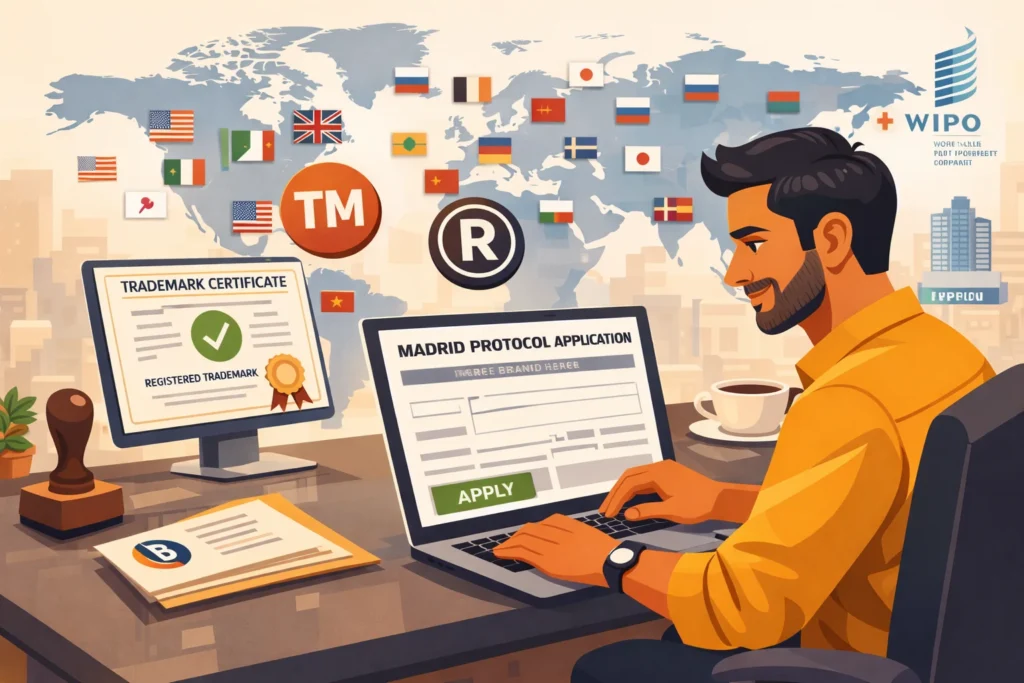
That is where the Madrid Protocol trademark system becomes the smartest solution for global businesses.
It allows you to apply for trademark protection in multiple countries through one single application.
This long-form guide explains:
- what Madrid Protocol trademark is
- who should use it
- how Indian businesses can apply
- costs, process and benefits
- mistakes to avoid
- whether it suits your business
What is Madrid Protocol Trademark
The Madrid Protocol is an international treaty administered by WIPO (World Intellectual Property Organization).
It allows trademark owners to:
- file one application
- in one language
- pay one set of fees
- and protect the brand in multiple countries
Instead of filing separately in each nation, Madrid Protocol gives a central international filing system.
Today, it covers 130+ member countries, including:
- United States
- Canada
- European Union
- United Kingdom
- UAE
- Singapore
- Japan
- Australia
- China
- Brazil
For Indian brands looking to expand globally, the Madrid Protocol trademark route is highly beneficial and practical.
Why Madrid Protocol Matters for Indian Businesses
Indian businesses are increasingly becoming global through:
- Amazon FBA and ecommerce exports
- SaaS and technology startups
- international franchising
- manufacturing and brand licensing
- D2C brands selling worldwide
- overseas subsidiaries
Without international trademark protection, risks include:
- brand copying
- domain hijacking
- product counterfeits
- legal disputes in foreign markets
- loss of brand ownership internationally
Madrid Protocol trademark helps protect brand identity beyond India.
Who Can Apply Under Madrid Protocol Trademark from India
To apply under Madrid Protocol, an applicant must have either:
- a registered trademark in India
or - a pending Indian trademark application
This is called the basic trademark application or base registration.
Eligible applicants include:
- proprietors
- partnership firms
- LLPs
- private limited / limited companies
- startups
- individuals
So if you already applied for a trademark in India, you can extend protection globally via Madrid Protocol.
Benefits of Madrid Protocol Trademark for Indian Entrepreneurs
Single Application, Multiple Countries
One application covers any number of member countries.
Lower Filing and Legal Cost
Far cheaper than filing separate country-wise applications.
Simplified Administration
Single:
- renewal
- modification
- ownership change management
Centralized Communication
WIPO coordinates communication between all countries.
Add More Countries Later
As your business grows, existing registration can be expanded.
Strong Global Brand Identity
Protects brand reputation in multiple markets.
Ideal for Digital and Export Businesses
Especially helpful for:
- exporters
- SaaS companies
- D2C brands
- aggregators
- franchise brands
Step-by-Step Process — Madrid Protocol Trademark Filing from India
Here is the process in simple language.
Step 1 — Apply or Register Trademark in India
Indian application becomes the base for Madrid Protocol filing.
Step 2 — Identify Countries of Interest
Choose countries where:
- you sell now
- plan expansion soon
- distributors or partners exist
Step 3 — File International Application Through IP India
File via the Controller General of Patents, Designs and Trademarks.
Step 4 — Application is Forwarded to WIPO
WIPO checks formal compliance and issues International Registration Number.
Step 5 — Designated Countries Examine Application
Every selected country examines the mark separately.
Step 6 — Approval or Objection
Countries may:
- approve
- partially accept
- raise objections
Step 7 — Trademark Protection Granted
Upon approval, your trademark is protected in those countries.
Important Point — Madrid Protocol Does Not Guarantee Approval Everywhere
Madrid Protocol simplifies filing, but each country:
- has its own trademark laws
- conducts independent examination
- can approve or object individually
So results may vary across jurisdictions.
Costs Involved in Madrid Protocol Filing
The cost depends on:
- number of countries
- number of classes
- type of mark (word or logo)
Total cost generally includes:
- Indian trademark filing fee
- WIPO fee (basic fee + individual country fee)
- professional or attorney charges if hired
Difference Between Madrid Protocol and Country-Wise Filing
Madrid Protocol is better when:
- multiple countries are required
- long-term global expansion is planned
- centralized management preferred
Countrywise filing may be better when:
- only one or two countries needed
- legal complexity exists in target country
- highly customized application required
Many companies use a hybrid approach.
Documents Required for Madrid Protocol Filing
Generally required documents include:
- Indian trademark registration or application number
- applicant name and address
- representation of mark
- list of countries designated
- class of goods or services
- power of attorney in some cases
Common Mistakes to Avoid
- weak base trademark in India
- generic brand names
- selecting too many countries without purpose
- inconsistent brand logo versions
- wrong class selection
Well-planned strategy increases success chances.
Should Your Business apply for the Madrid Protocol trademark?
The Madrid Protocol trademark is not necessary for every business. If you currently sell only within India and have no plans to expand internationally, a domestic trademark registration may be sufficient for now.
However, if your business has global ambitions, registering your trademark internationally at the right time can save you from costly legal disputes and brand conflicts in the future.
You should seriously consider the Madrid Protocol if you:
- 🌍 Export products or plan to enter international markets.
- 🛒 Sell through global e-commerce platforms such as Amazon Global, Etsy, or your own international online store.
- 🚀 Own a startup, D2C brand, or manufacturing business that aims to build a recognised brand overseas.
- 💻 Develop software, mobile apps, SaaS products, or digital services for customers in multiple countries.
- 🤝 Plan to appoint overseas distributors, franchise partners, or licensing partners under your brand name.
- 📦 Invest in branding, packaging, and marketing and want to protect your brand identity before expanding internationally.
BusinessZindagi Tip: Don’t wait until your exports start growing to think about trademark protection. If you already have confirmed overseas buyers or plan to enter foreign markets within the next couple of years, it’s a good time to evaluate international trademark registration. Protecting your brand early is usually simpler and more affordable than dealing with a trademark dispute after your business has expanded.
It may not be necessary if you operate only within India.
Latest Madrid Protocol Trademark Updates (2026): What Indian Startups and MSMEs Should Know
As more Indian businesses expand into global markets, international trademark protection has become an essential part of business strategy rather than just a legal formality. Whether you’re exporting products, selling through international e-commerce platforms, or offering digital services worldwide, protecting your brand early can help prevent costly trademark disputes in the future.
In 2026, the World Intellectual Property Organization (WIPO) continues to strengthen the Madrid System by improving its digital eMadrid platform and updating fee schedules for several member countries, including India. These ongoing improvements are making it easier for businesses to file, manage, renew, and monitor international trademark registrations online.
Why Global Trademark Protection Is More Important Than Ever
Today, even small businesses can reach customers across the world through platforms like Amazon Global, Shopify, Etsy, and their own websites. As international sales grow, so does the risk of someone registering a similar trademark in another country.
A registered trademark not only protects your brand identity but also builds trust with customers, distributors, investors, and international business partners.
Businesses that should seriously consider international trademark protection include:
- Exporters of tea, spices, textiles, handicrafts, engineering goods, pharmaceuticals, and other products.
- D2C (Direct-to-Consumer) brands selling internationally through online marketplaces or their own e-commerce websites.
- Software companies, SaaS businesses, AI startups, and mobile app developers serving customers in multiple countries.
- Food processing and packaged food MSMEs looking to enter overseas retail markets.
- Fashion, jewellery, cosmetics, and lifestyle brands building international brand recognition.
- Businesses planning overseas franchising, licensing, or distributor partnerships under their brand name.
BusinessZindagi Tip: Don’t wait until your products become popular overseas to think about trademark protection. If you’re already exporting, negotiating with international buyers, or planning to enter foreign markets in the next few years, it’s worth evaluating whether the Madrid Protocol is the right option for protecting your brand internationally.
New Nice Classification Changes Effective in 2026
One of the most important updates in 2026 is the implementation of the latest Nice Classification edition for trademark registration.
Under the new classification system:
- AI-based services have received clearer trademark categories,
- digital and cloud-based business models have been updated,
- wearable technology and smart products classifications have changed,
- several ecommerce-related goods and services categories have been revised.
For Indian startups and MSMEs, selecting the correct trademark class has become even more important because incorrect classification may lead to:
- trademark objections,
- provisional refusals,
- delays in international approval,
- higher legal costs.
Businesses filing through the Madrid Protocol should carefully verify their product and service categories before submitting international applications.
Increasing Provisional Refusals for International Trademark Applications
Trademark experts have observed that many international applications filed by Indian businesses are facing provisional refusals due to:
- vague product descriptions,
- improper class selection,
- similarity with existing foreign trademarks,
- incomplete documentation.
This trend highlights the importance of conducting proper trademark searches and preparing accurate specifications before filing under the Madrid Protocol.
For MSMEs with limited legal budgets, avoiding such mistakes can save significant time and money.
Why Madrid Protocol Is Becoming Popular Among Indian MSMEs
The Madrid Protocol system offers several advantages for Indian businesses planning overseas expansion:
1. Single International Application
Businesses can apply for trademark protection in multiple countries through one centralized filing process.
2. Cost Efficiency
Instead of hiring separate trademark agents in each country initially, startups can reduce filing costs through the Madrid system.
3. Easier Trademark Management
Renewals, ownership changes, and modifications can be managed centrally.
4. Better Brand Protection for Export Businesses
Export-oriented MSMEs can protect their brand identity before entering foreign marketplaces.
Important Advice for Indian Startups in 2026
Before filing an international trademark application through the Madrid Protocol, startups should:
- conduct proper trademark availability searches,
- choose correct Nice Classification categories,
- prepare clear product and service descriptions,
- ensure their Indian trademark application is properly filed,
- seek professional advice for multi-country expansion strategies.
As global competition increases, trademark protection is becoming a critical business asset rather than just a legal formality.
Future of International Trademark Filing for Indian Businesses
With growing digitization, rising exports, and the expansion of Indian startups into global markets, international trademark filings from India are expected to increase significantly in coming years.
The Madrid Protocol is likely to play a major role in helping Indian MSMEs build internationally recognized brands while simplifying the global trademark registration process.
For Indian entrepreneurs planning global presence, the Madrid Protocol trademark system is one of the smartest tools to secure international brand identity.
It offers:
- simplicity
- cost-efficiency
- legal strength
- administrative convenience
But expert guidance is recommended when:
- objections arise
- brand similarity issues exist
- high-risk markets are targeted
Right strategy + early filing = stronger international brand protection.
FAQs — Madrid Protocol Trademark
What is Madrid Protocol in trademark registration?
It is an international system allowing trademark protection in multiple countries with a single application.
Can an Indian trademark owner apply through Madrid Protocol?
Yes. A registered or pending Indian trademark application is required as the base.
How many countries are covered under Madrid Protocol?
More than 130 member countries.
Do all countries automatically approve my trademark?
No. Each country examines and decides independently.
Is Madrid Protocol cheaper than filing separately in each country?
In most cases yes, especially when multiple countries are selected.
Can I add new countries later?
Yes, additional countries can be added after initial registration.
Is Madrid Protocol useful for startups?
Yes, especially for exporters, SaaS startups, D2C brands and international e-commerce sellers.
📚 Suggested Articles
Continue learning with these practical BusinessZindagi guides:
- Best Free Import Export Databases for Exporters
- How to Use Global Trade Data to Find Verified International Buyers
- PMEGP 2.0 Explained: Latest Updates and How to Apply
- CGTMSE Scheme Explained: Collateral-Free Loans for MSMEs
- Accounting Outsourcing Business: A Growing Opportunity for Indian Professionals
👨💼 About the Author
Tabrez Khan is the founder of BusinessZindagi.com and an entrepreneur with practical experience in exports and MSMEs. He writes simple, practical guides on business, government schemes, AI, exports, and entrepreneurship to help Indian startups and small businesses grow.
🤖 AI Transparency
This article was created with AI assistance and carefully reviewed, edited, and fact-checked by the BusinessZindagi team. Please refer to official government or WIPO sources for the latest rules and updates.
Affiliate Disclosure
Some links on this page may be affiliate links. If you purchase through them, BusinessZindagi.com may earn a small commission at no extra cost to you. We only recommend products and services we believe are useful for our readers.
Authentic Sources and Reference Links
WIPO Madrid System Official Portal
https://www.wipo.int/madrid/en/
IP India Trademark Portal
https://ipindia.gov.in
Madrid Member Countries List
https://www.wipo.int/madrid/en/members/
Indian Trade Marks Act, 1999
https://legislative.gov.in
WIPO Guide on International Trademark Registration
https://www.wipo.int/madrid/en/guide/