
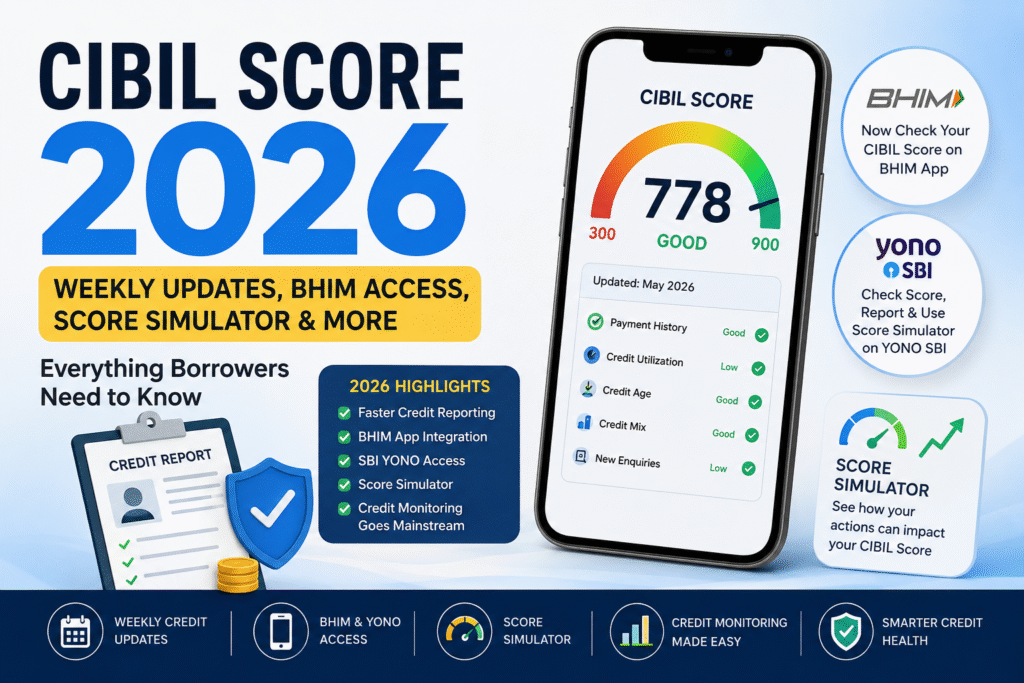
CIBIL Score 2026 is becoming easier to monitor, understand and manage. From accessing your CIBIL Score through the BHIM Payments App to checking it through SBI’s YONO app and using a CIBIL Score Simulator, Indian borrowers now have more ways to keep track of their credit health.
At the same time, changes in the frequency of credit-information reporting mean that important updates such as loan repayments can reach credit information companies faster than under the older reporting framework.
But there is one important misconception to clear up:
More frequent credit reporting does not mean that your CIBIL Score will automatically change every week.
So, what has actually changed in 2026?
And what should borrowers do differently?
Let’s understand it simply.
What Is New About CIBIL Score in 2026?
There are several developments worth knowing about:
- Credit information is being reported more frequently than under the older monthly framework.
- CIBIL Score and Credit Information Report access has been integrated into the BHIM Payments App.
- SBI’s YONO app now offers CIBIL Score, report analysis and a CIBIL Score Simulator.
- Credit monitoring is becoming much more common among Indian consumers.
- CIBIL information is increasingly becoming part of everyday digital financial management rather than something people check only when applying for a loan.
These developments could make it easier for borrowers to identify problems and manage their credit profile proactively.
1. Does CIBIL Score Now Update Every Week?
This is probably the biggest question borrowers have.
The short answer: Not necessarily.
It is important to distinguish between credit information reporting and CIBIL Score updating.
The Reserve Bank of India has moved the credit-reporting framework toward more frequent submission of credit information by lenders to credit information companies.
The objective is to make credit information available more quickly, particularly when important changes such as loan repayments take place.
But this does not mean:
“Your CIBIL Score will definitely be recalculated every seven days.”
If your credit information has not materially changed, there may be no reason for your score to change.
Think of it this way:
Lender
↓
Reports updated information
↓
Credit Information Company
↓
Information is processed
↓
Your credit report and score may change if relevant information changes.
So, don’t panic if you don’t see a new score every week.
2. Why Does More Frequent Credit Reporting Matter?
Imagine you have a personal loan with an outstanding balance of ₹2 lakh.
You make a substantial repayment and reduce the outstanding amount.
Under a slower reporting cycle, there could be a longer wait before the updated information reaches the credit information company.
More frequent reporting can potentially reduce this waiting period.
That means your credit report can reflect important changes sooner.
This can be useful when you have:
- Repaid a loan
- Reduced outstanding debt
- Cleared credit-card dues
- Closed a credit account
- Corrected an error with your lender
However, faster reporting does not guarantee a higher CIBIL Score.
Your score depends on the overall information in your credit profile and the applicable scoring methodology.
3. CIBIL Score Is Now Available Through BHIM
One of the interesting 2026 developments is the integration of CIBIL Score and Credit Information Report into the BHIM Payments App.
TransUnion CIBIL announced the integration with NPCI BHIM Services Limited in April 2026.
According to TransUnion CIBIL, BHIM users can access and track their CIBIL Score and key credit information within the app through a consent-based process.
Why Is This Important?
BHIM is already associated with everyday digital payments.
Now, credit monitoring can become part of the broader digital financial ecosystem.
Instead of checking your credit profile only when you need a loan, you can potentially make credit monitoring part of your regular financial routine.
The integration is described as consent-based, meaning the user’s approval is required for access to the credit information.
4. You Can Also Access CIBIL Through SBI YONO
Another significant development came in February 2026.
TransUnion CIBIL announced that SBI YONO customers can access and monitor their CIBIL Score and wider credit information through the YONO app.
The integration includes:
- CIBIL Score
- CIBIL Report
- Report analysis
- Credit education
- Frequently asked questions
- CIBIL Score Simulator
This is particularly interesting because the integration isn’t limited to showing a number.
It also attempts to help users understand their credit profile.
5. What Is the CIBIL Score Simulator?
This is one of the most interesting developments in the 2026 credit ecosystem.
The CIBIL Score Simulator available through SBI YONO allows users to explore different credit scenarios and understand their potential implications.
Examples mentioned by TransUnion CIBIL include:
- Opening a loan
- Closing a loan
- Opening a credit card
- Closing a credit card
- Late payments
- Clearing credit-card dues
- New credit enquiries
This addresses a common question:
“What could happen to my credit profile if I do this?”
6. But Don’t Treat a Credit Simulator as a Guaranteed Prediction
This is extremely important.
Suppose a simulator indicates that a particular action could have a certain effect.
That does not mean:
“My CIBIL Score will definitely increase by 20 points.”
Credit scoring involves multiple pieces of information.
Your actual score can depend on the information contained in your credit profile when the score is calculated.
Therefore, treat a simulator as a scenario-analysis and educational tool, rather than a guarantee of your future score.
Example
Imagine someone has:
Credit-card limit: ₹2,00,000
Outstanding: ₹1,00,000
Their utilisation is:
50%
They then repay ₹40,000.
New outstanding:
₹60,000
New utilisation:
30%
The calculation is:
₹60,000 ÷ ₹2,00,000 × 100 = 30%
That is a meaningful improvement in the user’s credit-utilisation position.
But it would be incorrect to say:
“Your CIBIL Score will definitely increase by X points.”
The better statement is:
The change may improve a factor considered in credit assessment, but the actual score impact cannot be guaranteed from this calculation alone.
7. Credit Monitoring Is Becoming Mainstream in India
There is another fascinating development behind all this.
TransUnion CIBIL reported in March 2026 that 183 million Indians had self-monitored their CIBIL Score as of December 2025.
It also reported that first-time credit monitoring increased 27% year-on-year.
According to the same report, nearly 45% of consumers who monitored their CIBIL Score improved their score within six months of monitoring.
That does not prove that simply checking your score causes it to improve.
Rather, it suggests an interesting relationship between credit awareness, monitoring and financial behaviour.
TransUnion CIBIL described credit monitoring as increasingly becoming a form of ongoing financial hygiene rather than something consumers do only when they need a loan.
8. Why Should You Monitor Your CIBIL Score?
You don’t need to obsessively check your score.
But periodically reviewing your credit information can help you identify problems.
For example, you may discover:
An Account You Don’t Recognise
Perhaps a loan or credit card appears that you don’t remember applying for.
An Incorrect Outstanding Balance
You repaid a loan, but the report hasn’t been updated correctly.
An Incorrect Payment Status
A payment made on time may be incorrectly reported.
An Unexpected Credit Enquiry
A lender enquiry appears that you don’t recognise.
A Closed Loan Still Showing Incorrectly
The account may not have been updated as expected.
These are reasons why checking the underlying credit report can be just as important as looking at the score itself.
9. Your CIBIL Score Is Not the Whole Credit Story
A common mistake is to think:
CIBIL Score = entire credit profile
It isn’t.
Your credit report contains considerably more information.
For example, lenders may consider information such as:
- Existing credit accounts
- Repayment behaviour
- Outstanding balances
- Credit utilisation
- Credit enquiries
- Credit history
- Types of credit
- Other information contained in the credit profile
Therefore, someone shouldn’t focus exclusively on moving from 750 → 800 without understanding the underlying credit behaviour.
10. Does Checking Your Own CIBIL Score Hurt Your Score?
This is another common concern.
Consumers often worry:
“If I check my CIBIL Score, will my score fall?”
There is an important distinction between checking your own credit information and a lender making a credit enquiry when you apply for credit.
The key point is that consumers should not avoid responsible credit monitoring simply because they are afraid that viewing their own credit information will automatically damage their score.
Always use authorised channels when accessing your credit information.
11. What Should You Do After Repaying a Loan?
Suppose you have just made the final payment on a loan.
Don’t simply assume everything has been updated immediately.
A sensible checklist is:
- Keep your payment confirmation.
- Obtain the lender’s closure or no-dues documentation where applicable.
- Allow time for the lender to report the updated information.
- Review your credit report later.
- If information appears incorrect, contact the relevant lender and credit information company through their official grievance or dispute process.
More frequent reporting can help make updates reach credit information companies sooner, but it doesn’t eliminate the possibility of reporting or processing errors.
12. What About Credit-Card Utilisation?
Credit-card utilisation is another area borrowers should understand.
Suppose you have:
Credit limit: ₹3,00,000
Outstanding: ₹1,50,000
Your utilisation is:
50%
If you reduce the outstanding to ₹60,000:
Utilisation becomes 20%.
The calculation is:
Outstanding ÷ Total credit limit × 100
So:
₹60,000 ÷ ₹3,00,000 × 100 = 20%
Lower utilisation is generally viewed as healthier from a credit-management perspective, but there is no universal formula that lets us say:
“20% utilisation will give you exactly X CIBIL points.”
Avoid websites or tools making such guaranteed claims.
13. What Should Borrowers Do Differently in 2026?
Here is a practical checklist.
Check Your Credit Report Periodically
Don’t wait until you are applying for a major loan.
Pay EMIs and Card Bills on Time
Payment history is an important part of responsible credit management.
Watch Your Credit-Card Utilisation
High revolving balances can indicate greater credit dependence.
Avoid Unnecessary Credit Applications
Don’t apply for multiple loans or cards simply to see which one approves you.
Check Unfamiliar Enquiries
If something doesn’t look right, investigate it.
Review Your Report After Major Changes
Especially after:
- Loan repayment
- Loan closure
- Credit-card closure
- Major repayment
- Correction of an error
Don’t Chase a Number Blindly
A healthy credit profile is more important than obsessing over a particular score.
14. CIBIL Score 2026: Myth vs Reality
Myth: My CIBIL Score must change every week.
Reality: More frequent reporting does not guarantee a weekly score change.
Myth: Checking my own score automatically lowers it.
Reality: Personal monitoring and lender credit enquiries are different.
Myth: Paying one loan will guarantee a higher score.
Reality: Score impact depends on the overall credit profile.
Myth: A 750 score guarantees a loan.
Reality: Lenders use their own eligibility and underwriting criteria.
Myth: Closing a credit card always improves my score.
Reality: The effect can depend on the overall credit profile.
Myth: One late payment has the same effect on everyone.
Reality: Credit impact depends on the wider profile and reporting.
Myth: A simulator predicts my exact future score.
Reality: It is better understood as scenario analysis.
Myth: CIBIL Score is the only thing lenders consider.
Reality: Lenders can consider broader financial and credit information.
15. What This Means for Indian MSMEs and Business Owners
For small-business owners, there is another important angle.
Many entrepreneurs use personal credit alongside business finance.
For example, an entrepreneur might have:
- Personal credit card
- Home loan
- Personal loan
- Business loan
- Working-capital facility
This makes credit management more complicated.
A business owner shouldn’t automatically assume:
“My company has a business loan, so my personal credit doesn’t matter.”
Depending on the borrowing structure and lender requirements, personal credit information can be relevant to lending decisions.
That’s why entrepreneurs should understand both:
Personal credit health
and
Business credit information.
For MSMEs, this becomes particularly important when applying for larger facilities or trying to build a stronger borrowing profile.
16. CIBIL Score vs CIBIL Rank: Don’t Confuse Them
This distinction is particularly important for business owners.
CIBIL Score
Generally refers to an individual’s consumer credit score.
CIBIL Rank
Relates to commercial or business credit information and is designed for businesses.
So an entrepreneur shouldn’t assume:
“My personal CIBIL Score is good, therefore my company’s credit profile must also be good.”
They are different aspects of credit information.
👉 Read more: CIBIL Rank & Company Credit Report: Why It Matters for Indian MSMEs
17. What If You Find an Error in Your CIBIL Report?
Don’t ignore it.
Start by identifying exactly what appears incorrect.
For example:
Problem: Loan shown as active
Your records: Loan completely repaid
Then:
- Collect payment and closure documents.
- Contact the lender.
- Raise the appropriate dispute or correction request through the official credit-information process.
- Keep records of your communication.
- Recheck the report after the correction process.
Never pay an unknown third party simply because someone promises:
“We can increase your CIBIL Score by 100 points.”
There is no legitimate shortcut that guarantees a specific score increase.
18. Can AI or a Calculator Predict My CIBIL Score?
Be careful.
You may see online tools asking for:
- Monthly income
- Loan amount
- Credit-card balance
- Number of loans
and then claiming:
“Your CIBIL Score will be 780.”
That’s not something BusinessZindagi recommends.
A responsible tool can help you understand:
- Credit utilisation
- EMI burden
- Debt levels
- Credit enquiries
- Payment behaviour
- Credit-health indicators
But it should not pretend to reproduce an official bureau score.
This is also why credit-health calculators should be designed as planning and educational tools, rather than fake CIBIL Score calculators.
19. The Biggest Change May Not Be the Score Itself
Perhaps the most interesting 2026 development is not a particular change to the scoring number.
It is the changing behaviour around credit.
TransUnion CIBIL’s research indicates that credit monitoring is becoming a regular financial habit for millions of Indians.
By December 2025, 183 million consumers had self-monitored their CIBIL Score, according to the company.
And the availability of CIBIL information through platforms such as BHIM and SBI YONO makes that monitoring more integrated into everyday digital financial activity.
The shift is therefore:
Earlier:
Need a loan → Check CIBIL
Increasingly:
Monitor credit → Understand problems → Improve financial behaviour → Apply for credit when needed
That is a much healthier approach.
What Should You Remember About CIBIL Score in 2026?
If you remember only five things, remember these:
1. More frequent reporting doesn’t mean your score changes every week.
Credit information can be reported more frequently, but score changes depend on changes in your credit information and scoring process.
2. BHIM now provides access to CIBIL Score and credit information.
The integration announced in April 2026 is consent-based.
3. SBI YONO now offers CIBIL Score, reports and a Score Simulator.
The simulator can help users explore different credit scenarios.
4. Credit monitoring is becoming mainstream.
TransUnion CIBIL reported 183 million self-monitoring consumers as of December 2025.
5. Don’t chase a score — manage your credit.
Pay on time, monitor your report, avoid unnecessary borrowing and investigate incorrect information.
Frequently Asked Questions
Does CIBIL Score update every week?
Not necessarily. More frequent reporting of credit information does not mean every individual’s CIBIL Score will automatically change every week.
How often is credit information reported to CIBIL?
RBI has moved the framework toward more frequent reporting than the earlier monthly cycle, including at least fortnightly reporting under its revised framework, with shorter intervals possible where agreed.
Can I check my CIBIL Score on BHIM?
TransUnion CIBIL announced in April 2026 that CIBIL Score and Credit Information Report had been integrated into the BHIM Payments App through a consent-based model.
Can I check my CIBIL Score through SBI YONO?
Yes. TransUnion CIBIL announced in February 2026 that SBI YONO customers can access their CIBIL Score and report, along with analysis and a Score Simulator.
What is the CIBIL Score Simulator?
It allows users to explore scenarios such as opening or closing credit accounts, late payments, clearing card dues and new enquiries to understand their potential implications for their credit profile.
Does paying off a loan immediately increase my CIBIL Score?
Not necessarily. Repaying debt can improve aspects of your credit profile, but the effect on your score depends on your overall credit information.
Does checking my CIBIL Score hurt my credit score?
Consumers should distinguish between checking their own credit information for monitoring and lender enquiries made as part of a credit application. Responsible credit monitoring is an important part of managing your credit profile.
Is 750 a good CIBIL Score?
CIBIL Scores generally range from 300 to 900. A higher score generally indicates stronger credit history, but lenders may use their own criteria when evaluating applications.
Does a high CIBIL Score guarantee a loan?
No. A credit score is only one part of a lender’s assessment. Income, existing obligations, loan type, lender policy and other factors can also matter.
BusinessZindagi’s Take
The biggest CIBIL development in 2026 isn’t simply that people can see their score in more places.
It is the movement toward more accessible and proactive credit monitoring.
With CIBIL information becoming available through platforms such as BHIM and SBI YONO, and with millions of Indians already monitoring their credit profiles, checking your credit report may gradually become as normal as checking your bank balance.
But borrowers should avoid one common mistake:
Don’t become obsessed with the score. Become obsessed with good credit behaviour.
Pay on time.
Keep borrowing manageable.
Monitor your report.
Check for errors.
Avoid unnecessary applications.
And understand what you’re agreeing to before taking new credit.
That is likely to matter much more over the long term than chasing a particular number.
Related BusinessZindagi Articles
👉 CIBIL Rank & Company Credit Report: Why It Matters for Indian MSMEs
👉 AI Credit Scoring: How Your Money Behaviour Is Being Analysed
Official Sources & References
Reserve Bank of India
RBI — Credit Information Reporting Framework
https://www.rbi.org.in/scripts/BS_PressReleaseDisplay.aspx?prid=58448
RBI’s framework explains the move toward more frequent credit-information reporting and the objective of making borrower information available more quickly.
TransUnion CIBIL — BHIM
CIBIL Score Now Available on BHIM Payments App
https://newsroom.transunioncibil.com/cibil-score-now-available-on-bhim-payments-app
Official announcement regarding CIBIL Score and Credit Information Report access through BHIM.
TransUnion CIBIL — SBI YONO
CIBIL Score & Simulator on SBI YONO
Official announcement regarding CIBIL Score, credit reports and the Score Simulator through SBI YONO.
TransUnion CIBIL — Credit Monitoring
Credit Monitoring Goes Mainstream: 183 Million Indians Now Self-Monitor Their CIBIL Score
Official research on the growth of credit monitoring among Indian consumers.
Official CIBIL
About the Author
Tabrez — Founder, BusinessZindagi
Tabrez writes about MSMEs, entrepreneurship, finance, technology, exports and practical business tools. Through BusinessZindagi, he focuses on explaining complicated business and financial developments in simple, practical language for Indian entrepreneurs and small-business owners.
His approach is simple:
Less jargon. More practical information.
AI-Assisted Content Disclosure
This article was researched and drafted with the assistance of AI. BusinessZindagi reviewed the information against official sources, including the Reserve Bank of India and TransUnion CIBIL, and retains editorial responsibility for the final article.
AI was used as a research and drafting assistant. Readers should verify important financial or regulatory information with the relevant official institution.
Financial Disclaimer
Disclaimer: This article is intended for general educational and informational purposes only. It does not constitute financial, legal, lending or credit-repair advice.
CIBIL Scores, credit reports, reporting practices, lender policies and financial products can change. A particular CIBIL Score does not guarantee loan approval, a particular interest rate or eligibility for any financial product.
Readers should verify important information with TransUnion CIBIL, their lender, RBI or another relevant official source before making financial decisions.
BusinessZindagi does not guarantee that any action discussed in this article will increase or decrease a person’s CIBIL Score by a specific number.