
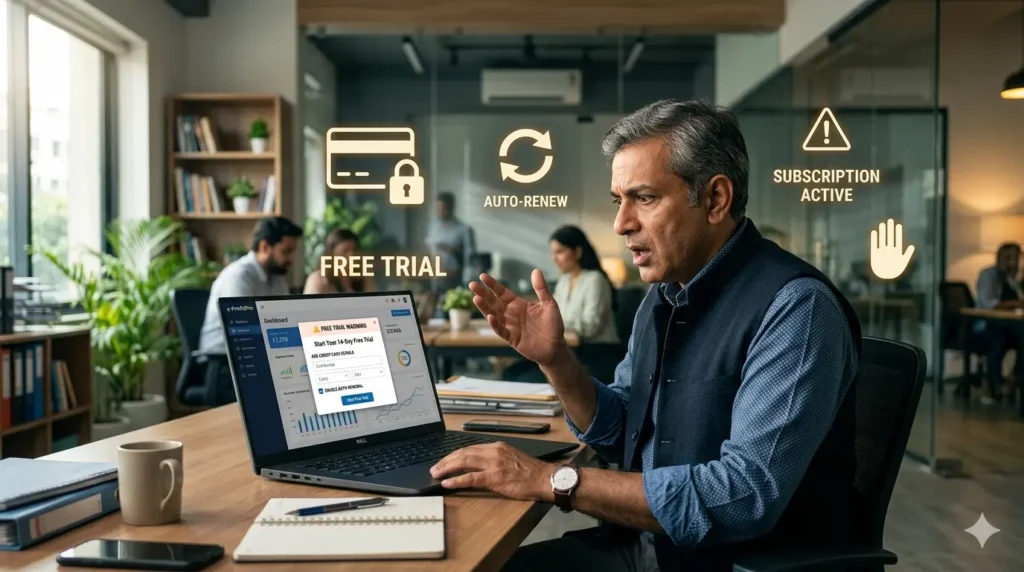
Imagine this.
You are searching for an SEO tool, accounting software, AI platform, email marketing service, or design application. Suddenly a pop-up appears:
“Get 7 Days Free Trial – No Risk!”
Excited by the opportunity, you click the button. A few screens later, you are asked to enter your credit card details.
At this point, many business owners start wondering:
“If this is a free trial, why do they need my credit card details”
This situation is becoming increasingly common in the digital world. While many free trials are legitimate, MSME owners must understand how the Free Trial Subscription Trap works and how to protect themselves from unexpected charges.
In this article, we will explain everything you need to know before entering your card details for any free trial offer.
You may also like to read:Why You Should Never Max Out Your Credit Cards Limit: My Experience with SBI and ICICI Credit Cards
What Is the Free Trial Subscriptions Trap?
The Free Trial Subscription Trap refers to a situation where users sign up for a free trial but unknowingly agree to an automatic paid subscription once the trial period ends.
In many cases:
- The trial starts immediately.
- Credit card details are collected upfront.
- Auto-renewal is enabled by default.
- Users forget to cancel.
- The payment is automatically deducted.
The user may genuinely believe they are only testing a service for free, while the company expects them to become a paying customer unless they actively cancel.
This is why understanding the Free Trial Subscription Trap is important for every entrepreneur and small business owner.
Why Do Companies Ask for Credit Card Details During a Free Trial?
Many users assume that asking for a credit card is suspicious.
However, there are legitimate business reasons behind it.
1. To Verify Genuine Users
Companies want to reduce fake registrations and multiple trial accounts.
2. To Increase Paid Conversions
Businesses know that many users will continue using the service if they find value during the trial period.
3. To Prevent Abuse
Without payment verification, some users may repeatedly create new accounts to access free services indefinitely.
Therefore, asking for a card does not automatically mean a company is dishonest.
The key issue is understanding the terms before signing up.
How the Free Trial Subscription Trap Usually Works
A typical sequence looks like this:
Step 1
You see a free trial advertisement.
Step 2
You create an account.
Step 3
The platform asks for card details.
Step 4
You agree to the terms and conditions.
Step 5
You start using the service.
Step 6
The trial period expires.
Step 7
The subscription automatically renews and your card is charged.
Many users forget they authorized automatic billing during signup.
Why MSME Owners Are More Vulnerable
Small business owners often experiment with multiple software tools.
Examples include:
- SEO tools
- AI writing tools
- Accounting software
- CRM systems
- Email marketing platforms
- Project management tools
- Graphic design applications
When managing day-to-day operations, it becomes easy to forget cancellation dates.
As a result, multiple subscriptions may continue charging every month without delivering enough value.
For a bootstrapped MSME, even small recurring expenses can add up significantly over time.
Common Warning Signs of a Free Trial Subscription Trap
Watch for these red flags before entering your card details.
The Pricing Is Hidden
If pricing information is difficult to find, proceed carefully.
Cancellation Terms Are Unclear
A trustworthy company clearly explains how to cancel.
Refund Policy Is Missing
Always check whether refunds are available after the first charge.
Auto-Renewal Is Enabled by Default
Many subscriptions automatically renew unless cancelled.
Frequent Marketing Emails
Aggressive sales pressure during the trial period may indicate strong conversion-focused tactics.
Real Cost of Forgetting a Trial Subscription
Many entrepreneurs focus on business growth and overlook software subscriptions.
The consequences may include:
- Unnecessary monthly expenses
- International transaction charges
- GST on software subscriptions
- Currency conversion costs
- Reduced business cash flow
For startups and small businesses, controlling expenses is just as important as increasing revenue.
How to Avoid the Free Trial Subscription Trap
Fortunately, protecting yourself is simple.
Set a Reminder Immediately
The moment you start a trial, create a calendar reminder for at least two days before the trial expires.
Read the Billing Terms
Never click “Accept” without understanding:
- Trial duration
- Subscription cost
- Renewal date
- Cancellation process
Review Pricing First
Know exactly what you will pay if the trial converts into a paid plan.
Monitor Your Bank Alerts
Enable SMS and email transaction notifications.
Cancel Early If Unsure
If you have finished testing the service, cancel immediately rather than waiting until the last day.
What Should You Do If You Are Charged Unexpectedly?
If a payment is deducted unexpectedly:
Contact Customer Support
Many companies may offer goodwill refunds depending on their policies.
Check the Subscription Settings
Ensure the service has actually been cancelled.
Contact Your Bank
Banks may guide you regarding dispute procedures and card controls.
Maintain Records
Keep screenshots and email confirmations related to cancellation requests.
Are All Free Trials Bad?
Absolutely not.
Many excellent software companies offer free trials because they genuinely want customers to evaluate their products before purchasing.
In fact, free trials can help MSMEs:
- Reduce risk before buying software
- Compare competing solutions
- Test features before investing money
- Improve operational efficiency
The problem is not the free trial itself.
The problem is entering payment details without understanding the terms.
Lessons for MSME Owners
Before entering your credit card details for any online trial, ask yourself:
- How much will this cost after the trial?
- Is auto-renewal enabled?
- Can I easily cancel?
- Do I genuinely need this software?
- Have I set a cancellation reminder?
These simple questions can save your business money and prevent unnecessary frustration.
Conclusion
The digital economy is full of useful tools that can help businesses grow. However, every entrepreneur should understand the risks associated with the Free Trial Subscription Trap.
A free trial is not necessarily free forever.
Before entering your card details, take a few minutes to read the billing terms, understand the cancellation policy, and set a reminder.
For MSME owners, smart expense management is just as important as generating revenue. By staying informed and cautious, you can enjoy the benefits of free trials without falling into costly subscription surprises.
Frequently Asked Questions (FAQ)
What is a Free Trial Subscription Trap?
A Free Trial Subscription Trap occurs when a user signs up for a free trial and is automatically enrolled into a paid subscription after the trial period ends.
Why do companies ask for credit card details for free trials?
Companies use card verification to prevent misuse, reduce fake accounts, and increase conversion to paid plans.
Can a company legally charge me after a free trial?
If the terms and conditions clearly mention auto-renewal and you accepted them, the company may charge according to the agreed terms.
How can MSMEs avoid unexpected subscription charges?
Set reminders, review billing terms, monitor bank alerts, and cancel unused subscriptions before the trial expires.
Are all free trials dangerous?
No. Many reputable companies offer legitimate free trials. The key is understanding the renewal and billing conditions before signing up.
AI Disclosure
This article was researched and drafted with the assistance of AI and reviewed for accuracy and readability. Readers should independently verify subscription terms, pricing, and consumer policies before making financial decisions.
Affiliate Disclosure
Some links on BusinessZindagi.com may be affiliate links. If you purchase through such links, we may earn a commission at no additional cost to you. This helps support our independent content.
Sources
- Federal Trade Commission (FTC) – Getting In and Out of Free Trials, Auto-Renewals, and Negative Option Subscriptions
- Consumer Financial Protection Bureau (CFPB) – Guidance on Subscription and Negative Option Practices
- Federal Trade Commission (FTC) – Click-to-Cancel Rule Announcement
- Consumer Financial Protection Bureau (CFPB) Statement on Click-to-Cancel Rule
- Federal Trade Commission – Negative Option Rule Information Page
About the Author
Tabrez Khan is an entrepreneur, exporter, and founder of BusinessZindagi.com. Through Business Zindagi, he shares practical insights on MSMEs, entrepreneurship, exports, government schemes, finance, and digital business tools based on real-world business experience.