
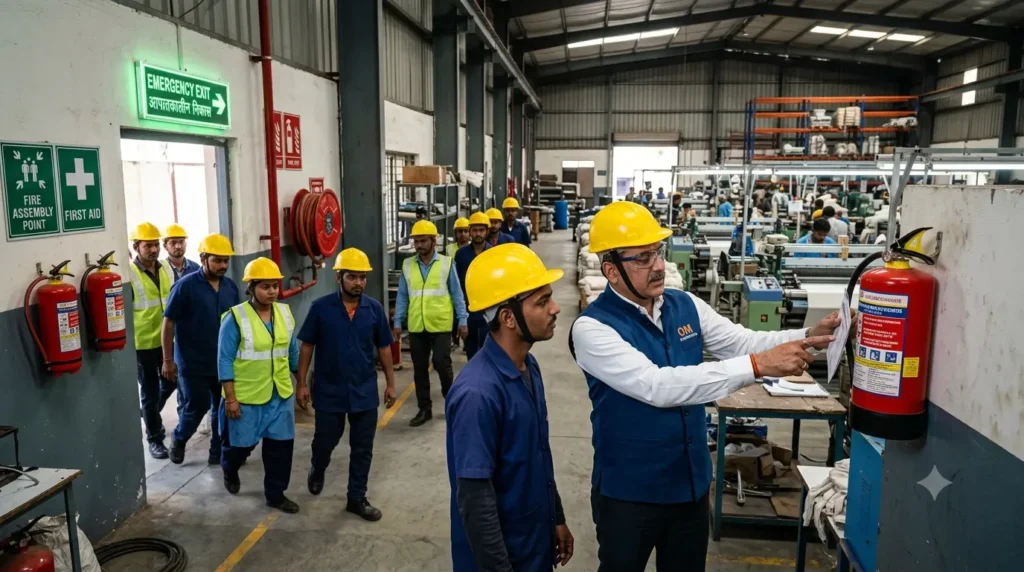
Imagine spending years building your business, investing lakhs of rupees in machinery, inventory, and infrastructure—only to see everything destroyed within a few hours due to a fire accident.
Unfortunately, this is not a hypothetical situation. Every year, thousands of small factories, warehouses, offices, retail stores, and MSME units suffer devastating losses due to electrical short circuits, improper storage of flammable materials, overheating machinery, and lack of basic fire safety measures.
The good news is that most fire accidents are preventable.
In this guide, we will discuss Fire Safety Compliance for MSMEs in India, the legal requirements, practical safety measures, and the global best practices followed by successful businesses worldwide.
read also: Insurance for msme: Critical Policies Small Businesses Can’t Afford to Ignore
Fire Safety Compliance: Why Fire Safety Matters for MSMEs and small business.
Large corporations may survive a fire incident through insurance and financial reserves. Most MSMEs cannot.
A major fire can result in:
- Loss of machinery
- Loss of inventory
- Business interruption
- Employee injuries
- Legal liabilities
- Cancellation of customer orders
- Permanent closure of the business
For many small business owners, a fire accident can wipe out years of hard work overnight.
Common Causes of Fire in MSMEs
Before discussing compliance, let’s understand the most common reasons behind industrial and commercial fires.
Electrical Short Circuits
Old wiring, overloaded sockets, loose connections, and poor maintenance remain the leading causes of fires in India.
Improper Storage of Flammable Materials
Many small businesses store chemicals, packaging materials, solvents, fuels, and gases without proper precautions.
Overheated Machinery
Poor maintenance can lead to overheating, sparks, and ignition.
Human Error
Careless smoking, welding operations, and improper handling of equipment can trigger fires.
Lack of Housekeeping
Accumulation of waste paper, dust, cardboard, tea packaging materials, and combustible waste increases fire risk.
Fire Safety Compliance for MSMEs in India
India does not have a separate fire law exclusively for MSMEs.
Instead, compliance requirements arise from multiple regulations.
1. National Building Code (NBC) of India
The National Building Code provides guidelines on:
- Fire exits
- Emergency evacuation
- Fire-resistant construction
- Fire alarms
- Emergency lighting
- Fire protection systems
Although not every MSME must implement every provision, NBC serves as the benchmark for fire safety planning.
2. State Fire Department Regulations
Most states require certain categories of buildings to obtain a Fire NOC (No Objection Certificate).
Depending on:
- Building size
- Occupancy type
- Number of floors
- Hazard category
Businesses may require inspections and approvals from the local fire department.
3. Factories Act and Occupational Safety Regulations
Manufacturing units and factories are expected to:
- Provide firefighting equipment
- Maintain emergency exits
- Train workers
- Conduct safety inspections
- Ensure safe storage of hazardous materials
Fire Safety Compliance Checklist for MSMEs
If you own a factory, warehouse, office, tea packaging unit, retail store, or workshop, this checklist can significantly help you reduce fire risks.
Fire Extinguishers
Ensure suitable extinguishers are installed:
- ABC Extinguishers
- CO₂ Extinguishers
- Foam Extinguishers
Employees should know how to use them.
Emergency Exit Routes
Emergency exits should:
- Remain unlocked during working hours
- Be clearly marked
- Remain free from obstruction
Never use exit routes for storage.
Smoke Detection Systems
Install:
- Smoke detectors
- Heat detectors
- Fire alarms
Early detection saves lives and property.
Emergency Contact Display
Display important numbers:
- Fire Brigade
- Police
- Ambulance
- Facility Manager
These should be visible to all employees.
Electrical Safety Audit
Conduct annual inspections of:
- Wiring
- Switchboards
- Machinery connections
- Distribution panels
Many fires originate from neglected electrical systems.
Safe Storage Practices
Separate:
- Chemicals
- Fuels
- Packaging materials
- Gas cylinders
Maintain adequate ventilation.
Fire Insurance Coverage
Many MSMEs spend lakhs on machinery but ignore fire insurance.
Fire insurance may help recover losses related to:
- Building damage
- Machinery damage
- Inventory loss
- Business interruption
Fire Safety Compliance:How Developed Countries Handle Fire Safety?
Countries such as the United States, United Kingdom, Singapore, Canada, Australia, and Germany generally enforce stricter fire safety standards.
Several practices are mandatory there but often ignored by small businesses in India.
Written Fire Safety Plan
In developed countries Most businesses maintain documented procedures covering:
- Fire hazards
- Emergency contacts
- Evacuation routes
- Equipment locations
- Employee responsibilities
Regular Fire Drills
Many organizations conduct:
- Quarterly drills
- Half-yearly drills
- Annual emergency exercises
This helps employees react calmly during emergencies.
Fire Wardens
Some workplaces appoint trained personnel responsible for:
- Coordinating evacuations
- Checking exits
- Assisting visitors
- Communicating with emergency responders
Detailed Record Keeping
Inspections, maintenance activities, employee training records, and equipment testing are documented and retained.
Fire Safety Compliance: Major Differences Between India and Global Best Practices
| Area | India (Typical MSME) | Global Best Practice |
|---|---|---|
| Fire Safety Plan | Often absent | Documented |
| Fire Drills | Rare | Regular |
| Employee Training | Limited | Mandatory |
| Risk Assessment | Usually ignored | Regularly conducted |
| Documentation | Minimal | Detailed |
| Equipment Testing | Irregular | Scheduled |
| Fire Wardens | Rare | Common |
| Compliance Audits | Occasional | Frequent |
Fire Safety Compliance: Global Best Practices Every Indian MSME Should Adopt
Even if not legally required, these measures can dramatically improve safety.
Conduct Fire Drills Twice a Year
Practice evacuation procedures regularly.
Perform Annual Fire Risk Assessments
Identify hazards before they become disasters.
Install Smoke Detectors
A low-cost investment with potentially life-saving benefits.
Create Evacuation Maps
Display them prominently throughout the premises.
Train Every Employee
Fire safety knowledge should not be limited to management.
Inspect Fire Extinguishers Periodically
Expired or damaged extinguishers can fail when needed most.
Maintain Good Housekeeping
Clean workplaces reduce fire loads significantly.
Special Advice for Manufacturing MSMEs
Manufacturing businesses face higher fire risks.
Examples include:
- Tea packaging units
- Food processing plants
- Plastic manufacturing
- Printing presses
- Textile units
- Chemical processing units
Such businesses should consider:
- Fire hydrant systems
- Automatic sprinklers
- Dedicated safety officers
- Emergency response teams
Fire Safety: Expense or Investment?
Many small business owners see fire safety as a compliance cost.
In reality, it is a business continuity investment.
A few thousand rupees spent on:
- Fire extinguishers
- Electrical inspections
- Employee training
- Safety signage
can prevent losses running into lakhs or even crores.
Final Thoughts
Fire does not distinguish between a startup, an MSME, or a large corporation.
The difference lies in preparedness.
The most successful businesses worldwide understand that fire safety is not merely about legal compliance—it is about protecting people, preserving assets, maintaining customer trust, and ensuring business continuity.
For Indian MSMEs, adopting global fire safety best practices today can prevent tomorrow’s disaster.
If your business does not currently have a fire safety plan, the best time to create one is now.
Frequently Asked Questions (FAQs)
Is Fire NOC mandatory for every MSME?
No. Requirements vary depending on state regulations, building size, occupancy type, and risk category.
Which fire extinguisher is best for small businesses?
ABC-type extinguishers are commonly recommended because they can handle multiple types of fires.
How often should fire drills be conducted?
At least once or twice a year. High-risk facilities may require more frequent drills.
Is fire insurance compulsory?
Generally no, but it is highly recommended for protecting business assets.
What is the biggest fire risk for MSMEs?
Electrical faults and short circuits remain among the leading causes of fire incidents.
AI Disclaimer
This article is intended for educational and informational purposes only. Fire safety regulations vary by state, industry, building type, and local authority requirements. Readers should consult qualified fire safety professionals, local fire departments, architects, or legal advisors before implementing compliance measures.
Affiliate Disclaimer
Some articles on BusinessZindagi.com may contain affiliate links. If you purchase a product or service through such links, we may earn a small commission at no additional cost to you. This helps support our independent business education platform.
About the Author
Tabrez Khan is an entrepreneur, exporter, and founder of BusinessZindagi.com. Drawing from real-world experience in MSMEs, exports, tea packaging, and small business operations, he shares practical insights to help entrepreneurs build safer, stronger, and more profitable businesses.
Authentic Sources
- National Building Code of India (Fire & Life Safety)
- Directorate General Factory Advice Service & Labour Institutes (DGFASLI)
- National Disaster Management Authority (NDMA) Fire Safety Guidelines
- Occupational Safety and Health Administration (OSHA) Fire Safety Standards
- National Fire Protection Association (NFPA)