
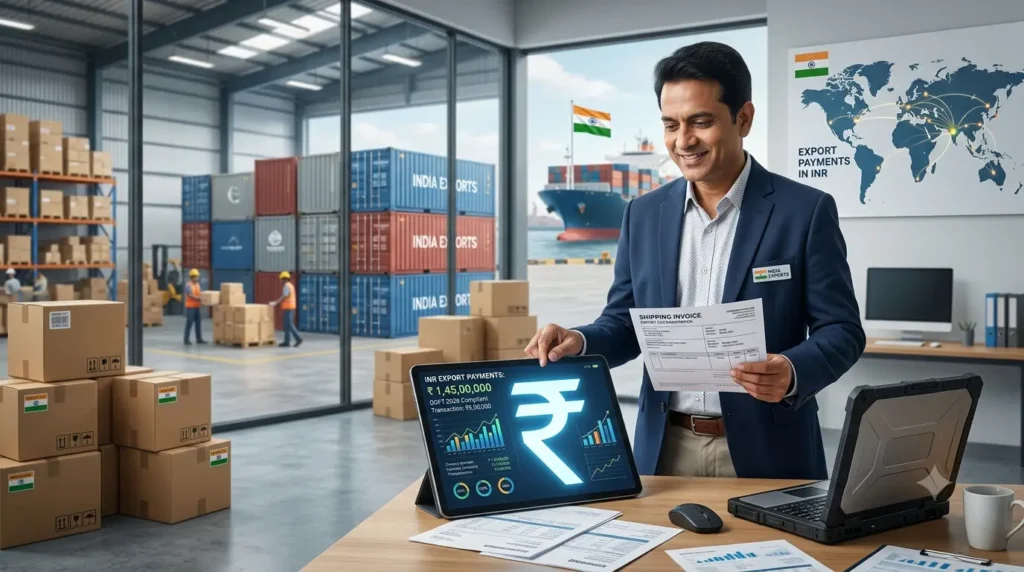
Indian exporters can now benefit from greater clarity around export payments in INR. The latest DGFT amendment explains how eligible rupee export payments can be treated under India’s Foreign Trade Policy. Here’s what Indian MSMEs and exporters need to know.
For decades, the US dollar has been the default currency for many international transactions.
An Indian exporter gets an order from a foreign buyer and the conversation usually starts with:
“What is your price in USD?”
But the Indian rupee is gradually becoming another option.
On 20 August 2026, the Directorate General of Foreign Trade (DGFT) issued Notification No. 30/2026-27, amending Paragraphs 2.52 and 2.53 of the Foreign Trade Policy (FTP) 2023.
The change is important for businesses interested in rupee export payments, export payments in INR and international trade settlement in Indian rupees.
Most importantly, eligible exports realised in INR can receive applicable Foreign Trade Policy benefits and incentives and can count towards fulfilment of export obligations, subject to the relevant conditions.
So what does this actually mean for an Indian exporter?
Let’s break it down.
What Are Rupee Export Payments?
Rupee export payments are export proceeds received by an Indian exporter in Indian rupees (INR) instead of a foreign currency such as USD, EUR or GBP, through a permitted international trade settlement mechanism.
The idea is simple:
Traditional transaction
Foreign buyer → USD/EUR → Indian bank → INR
Possible INR transaction
Foreign buyer → permitted INR settlement mechanism → Indian exporter
However, an exporter cannot simply ask every overseas buyer to transfer rupees to an ordinary Indian bank account.
The transaction must comply with the applicable RBI, FEMA, DGFT and banking rules.
🆕 What Did DGFT Change in 2026?
The latest DGFT Notification No. 30/2026-27 dated 20 August 2026 amended Paragraphs 2.52 and 2.53 of FTP 2023.
The amendment provides greater clarity around:
- Denomination of export contracts and invoices
- Realisation of export proceeds in INR
- FTP benefits for eligible INR-realised exports
- Fulfilment of export obligations through eligible INR export realisation
This is why DGFT rupee export payment rules 2026 are relevant to Indian exporters.
💰 Can Indian Exporters Receive Payment in INR?
Yes, eligible export transactions can be settled in Indian rupees, subject to the applicable regulations and banking arrangements.
The latest DGFT amendment is particularly significant because eligible exports realised in INR can receive applicable FTP benefits and incentives and count towards applicable export obligations on a basis comparable with exports realised in foreign currency.
But there is an important distinction:
Permission to use INR does not mean unrestricted payment directly into any Indian bank account.
The exporter needs to use the appropriate banking mechanism.
This is where the RBI’s framework becomes important.
🏦 How Does INR International Trade Settlement Work?
The RBI introduced an additional framework for INR international trade settlement in July 2022.
One of the key mechanisms is the Special Rupee Vostro Account (SRVA).
Under this arrangement, a foreign bank can maintain a rupee account with an authorised Indian bank.
Eligible international trade transactions can then be settled through the permitted banking arrangement.
RBI — International Trade Settlement in Indian Rupees
RBI — Special Rupee Vostro Account FAQ
What Is a Special Rupee Vostro Account?
The name sounds complicated.
The concept isn’t.
A Special Rupee Vostro Account is a rupee account maintained by a foreign correspondent bank with an authorised Indian bank under the RBI’s framework.
It can facilitate eligible rupee settlement for international trade.
So the process isn’t simply:
Foreign buyer → your normal savings/current account
Instead, the transaction moves through the approved banking infrastructure.
That is why exporters should always speak with their Authorised Dealer (AD) bank before agreeing to an INR export-payment arrangement.
Why Are Rupee Export Payments Important for MSMEs?
For a large exporter, foreign-exchange management may be routine.
For a small business, currency movements can directly affect profit.
Suppose you quote an overseas customer:
USD 20,000
You may receive the money weeks later.
If the exchange rate changes, the final INR value of your export receipt changes.
With an eligible INR-denominated export transaction, some of that currency exposure may potentially be reduced.
That makes export payments in INR particularly interesting for MSMEs whose expenses are mainly in rupees.
5 Potential Benefits of Export Payments in INR
1. Another payment option
Indian exporters can potentially offer INR alongside USD, EUR and other permitted currencies.
2. Lower currency mismatch
If your expenses are mostly in INR, an INR export invoice may better match your revenue and costs.
3. Potentially fewer currency conversions
Depending on the transaction structure, INR settlement may reduce some currency conversions and related costs.
4. Greater flexibility with buyers
Some overseas buyers may prefer INR-based arrangements.
5. FTP benefits and export obligations
Eligible INR-realised exports can receive applicable FTP benefits and incentives and count towards applicable export obligations, subject to the scheme’s conditions.
Is INR Always Better Than USD?
No.
This is an important point.
The new INR export payment rules do not mean exporters should stop using dollars.
USD may still be easier for many buyers because:
- Their bank already supports USD
- Their suppliers invoice them in USD
- Their customers pay them in USD
- Their business accounts are maintained in USD
- Dollar trade finance is widely available
INR should therefore be considered an additional option.
The best currency depends on the transaction.
Which Countries Can Use INR Settlement?
The rules are not identical for every country.
The revised DGFT framework contains specific provisions relating to:
Nepal and Bhutan
Separate provisions apply.
ACU Countries
Specific ACU and RBI provisions need to be considered.
Iran
Additional requirements apply, including the provisions under Para 2.19 of FTP.
Russia
INR settlement may be commercially interesting, but exporters must still consider banking arrangements, sanctions and compliance requirements.
Therefore:
Never assume that one INR payment structure works for every export destination.
Check the country-specific rules with your bank.
What About Export Payments to Russia?
Russia is one market where alternative payment mechanisms have attracted considerable attention.
However, exporters should not assume that the latest DGFT rule automatically solves Russia-related payment challenges.
You still need to consider:
- Banking relationships
- Sanctions compliance
- Correspondent banking
- Currency conversion
- Payment routing
- Export-control requirements
If you are negotiating an export order with a Russian buyer, get confirmation from your AD bank before shipping the goods.
🧾 How Should INR Be Shown on an Export Invoice?
If you agree to export payment in Indian rupees, the currency should be clearly mentioned in your quotation and export documents.
For example:
Total Export Value: INR ₹10,00,000
If the transaction is linked to a foreign-currency value, agree beforehand on:
- Exchange-rate source
- Exchange-rate date
- Conversion method
- Bank charges
- Responsibility for charges
Don’t leave these points unclear.
Your quotation, purchase order, proforma invoice and commercial invoice should be consistent.
👉 Read BusinessZindagi’s practical Export Proforma Invoice Guide.
INR Payment Does Not Eliminate Export Payment Risk
This is one of the most important lessons for new exporters.
Receiving INR does not automatically protect you against:
- Buyer default
- Delayed payment
- Documentation problems
- Bank compliance checks
- Country risk
- Contract disputes
Currency and payment security are two different issues.
For example, an open-account transaction can still expose an exporter to buyer risk even if the invoice is denominated in INR.
🔎 First Find the Buyer
A new payment option is useless if you don’t have a genuine overseas buyer.
For exporters, one useful approach is to identify companies that are already importing your product.
Trade-data platforms such as Volza can help exporters research shipment activity, importers and potential markets.
👉 Explore Volza for International Buyer Research
BusinessZindagi Tip: Don’t just search for companies that sell your product. Find companies that are already importing it.
That can give you a much stronger starting point for buyer outreach.
📋 7 Questions to Ask Your AD Bank
Before accepting an INR export order, ask your bank:
1. Can this transaction be settled in INR?
2. What INR settlement mechanism will be used?
3. Does the buyer’s bank have the necessary arrangement?
4. What documents are required?
5. Will the transaction qualify for the relevant FTP benefit?
6. Can it count towards my applicable export obligation?
7. What bank and correspondent charges will apply?
Do this before shipment.
Not after the buyer says:
“Payment has been sent.”
Example: How This Could Help an Assam MSME
Imagine an Assam tea exporter selling tea to an overseas importer.
The exporter has most expenses in:
INR → tea + packaging + labour + transport + electricity
The buyer is comfortable with an eligible INR settlement arrangement.
Instead of taking USD exposure, the exporter may be able to structure the transaction in INR, subject to the applicable banking framework.
That could potentially make the exporter’s revenue and domestic expenses better aligned.
For a small exporter, even a small reduction in currency uncertainty can matter.
If these developments continue, rupee settlement could become increasingly relevant to Indian MSMEs.
🧠 BusinessZindagi Take
The biggest takeaway from the latest DGFT rupee export payment rules is simple:
Don’t think “rupee instead of dollar.”
Think:
“Rupee as another export-payment option.”
If your overseas buyer is comfortable with INR, the banking mechanism is available and the transaction meets the applicable rules, rupee export payments could potentially give your business more flexibility.
But don’t change your payment terms blindly.
Check with your AD bank before you ship.
The government may open the door.
Your bank tells you whether your particular transaction can walk through it.
❓ Frequently Asked Questions
Can Indian exporters receive export payments in INR?
Yes. Eligible exports can be realised in INR subject to applicable DGFT, RBI, FEMA and banking requirements.
What is the latest DGFT notification on INR export payments?
DGFT Notification No. 30/2026-27 dated 20 August 2026 amended Paragraphs 2.52 and 2.53 of FTP 2023.
Can INR-realised exports receive export benefits?
Eligible INR-realised exports can receive applicable Foreign Trade Policy benefits and incentives subject to the conditions of the relevant scheme.
Can INR exports count towards export obligations?
Eligible INR-realised exports can count towards applicable export obligations under the revised framework, subject to the prescribed conditions.
Can every foreign buyer pay in INR?
No. The buyer and banking arrangement must meet the applicable requirements.
Is INR replacing the US dollar?
No. INR is an additional international trade settlement option.
A Special Rupee Vostro Account is a rupee account maintained by a foreign correspondent bank with an authorised Indian bank under the RBI’s framework for eligible international trade settlement.
Should I accept an INR export order without asking my bank?
No.
Always confirm the settlement mechanism, documentation, reporting requirements and charges with your AD bank first.
🔗 Useful BusinessZindagi Guides
Export Proforma Invoice Guide — Create a better export quotation.
How to Find International Buyers — Find potential overseas customers.
India Wants $1 Trillion in Exports: What Does It Mean for Small Exporters?
📚 Authentic Sources & References
DGFT Notification No. 30/2026-27
20 August 2026 — Amendment in Para 2.52 and 2.53 of FTP 2023
DGFT Foreign Trade Policy
DGFT Foreign Trade Policy 2023
RBI — INR International Trade Settlement
A.P. (DIR Series) Circular No. 10 dated 11 July 2022
RBI — International Trade Settlement in Indian Rupees
RBI — Special Rupee Vostro Accounts
RBI — Special Rupee Vostro Account FAQ
RBI — Export of Goods and Services
RBI — Master Direction on Export of Goods and Services
📝 Editorial Note
This article explains the latest rupee export payments framework in practical language for Indian MSMEs and exporters. It has been prepared with reference to the latest available DGFT and RBI material, particularly DGFT Notification No. 30/2026-27 dated 20 August 2026.
Export rules may vary depending on the destination country, transaction structure, export scheme and banking arrangement. Readers should verify the latest requirements with DGFT, RBI and their Authorised Dealer bank before acting.
🤖 AI Disclaimer
This article was created with the assistance of artificial intelligence for research, organisation and drafting. Information has been checked against available official sources, but AI-assisted content may contain errors or omissions.
This article is for general educational purposes only and should not be considered legal, financial, tax, banking or export-compliance advice.
Always verify the latest requirements with the relevant authorities and your Authorised Dealer bank.
💼 Affiliate Disclosure
Some links in this article may be affiliate links. If you purchase or sign up through an affiliate link, BusinessZindagi may earn a commission at no additional cost to you.
Affiliate relationships do not influence our editorial opinions or recommendations.
Last updated: 22 August 2026