Going green is no longer just a sustainability decision for Indian small businesses. For many MSMEs, it is becoming a cost, competitiveness and financing decision.
A textile unit replacing old machinery with energy-efficient equipment, a manufacturer installing solar power, a food-processing business reducing water consumption or a small factory investing in waste-management technology may all face the same problem:
The technology can save money in the long run, but the upfront investment can be expensive.
This is where the MSE-GIFT Scheme 2026 becomes relevant.
The MSE Green Investment and Financing for Transformation (MSE-GIFT) scheme is a sub-scheme under the government’s Raising and Accelerating MSME Performance (RAMP) programme. Its objective is to help Micro and Small Enterprises access institutional finance at a concessional cost for adopting clean and green technologies. SIDBI is the implementing agency.
The important part for an MSME owner is simple:
Eligible MSEs can receive a 2% per annum interest subvention on qualifying term loans up to ₹2 crore, subject to the scheme’s conditions.
So, if your business is considering solar, energy-efficient machinery, waste management or another eligible green investment, MSE-GIFT could potentially reduce the cost of financing that investment.
But there are important eligibility conditions and procedural requirements.
Let’s understand them.
What is the MSE-GIFT Scheme?
MSE-GIFT stands for Micro and Small Enterprise Green Investment and Financing for Transformation.
The scheme was launched by the Ministry of MSME under the RAMP programme to encourage Micro and Small Enterprises to adopt green technologies, clean energy and more sustainable business practices.
The idea is to address one of the biggest barriers to green transformation:
An MSME may want to adopt cleaner technology, but the initial investment may be too high.
MSE-GIFT attempts to make institutional financing more affordable through an interest subvention component and also provides a Risk Sharing Facility (RSF) for eligible loans.
The scheme has an overall outlay of ₹478 crore, including ₹350 crore for interest subvention and ₹125 crore for the risk-sharing component.
What is the biggest benefit of MSE-GIFT?
The most attractive feature for an MSME borrower is the:
2% interest subvention
According to SIDBI’s MSE-GIFT FAQ, eligible Micro and Small Enterprises can receive 2% interest subvention per annum on qualifying term loans up to a limit of ₹2 crore, for a maximum period of five years.
In simple terms, if your business takes an eligible term loan for a qualifying green investment, the scheme can provide interest support that reduces the effective financing burden.
Example
Suppose an eligible MSME takes a qualifying ₹50 lakh term loan for an eligible green technology project.
A 2% annual interest subvention on ₹50 lakh would represent a theoretical ₹1 lakh per year of interest support before considering the actual loan structure, outstanding balance, lender terms and scheme conditions.
Therefore, the actual benefit should not be calculated simply by multiplying the original loan amount by 2% for every year.
The benefit depends on the applicable loan and scheme conditions.
Who can apply for MSE-GIFT?
This is one of the most important points.
The scheme is aimed at Micro and Small Enterprises (MSEs).
SIDBI’s eligibility guidance states that Udyam-certified Micro and Small Enterprises in both manufacturing and service sectors can be eligible for the interest-subvention component.
That means the scheme isn’t restricted only to traditional factories.
Depending on the eligible project and technology requirements, businesses in areas such as manufacturing and services can potentially benefit.
However, being an MSME alone does not automatically mean that every loan or every purchase qualifies.
The project, technology, loan and lender must satisfy the applicable MSE-GIFT conditions.
What green projects can qualify?
This is where MSE-GIFT becomes particularly interesting for ordinary business owners.
SIDBI’s FAQ identifies several categories of green projects, including:
1. Renewable energy
Examples include:
- Solar panels
- Wind energy
- Biogas-based energy generation
- Other eligible renewable-energy investments
2. Energy efficiency
This can include:
- Energy-efficient machinery
- LED lighting
- Smart energy-management systems
- Other qualifying energy-saving technologies
3. Waste management
Businesses investing in technologies for:
- recycling
- efficient waste disposal
- waste reduction
- conversion of waste into energy
may potentially fall within the relevant green categories.
4. Green buildings
Energy-efficient and environmentally sustainable building-related projects can also fall within the scheme’s identified green-technology categories, subject to the scheme’s rules.
5. Clean transportation
Examples identified by SIDBI include:
- Electric vehicles
- Hybrid vehicle fleets
- Other lower-emission transportation initiatives
6. Water management
Potential areas include:
- Water-saving technologies
- Wastewater treatment
- Rainwater harvesting
7. Circular-economy practices
Projects designed to reduce waste and encourage reuse and recycling can also be relevant.
Important: These examples do not mean that every expenditure under these categories automatically qualifies. The project and equipment must meet the scheme’s eligibility requirements.
What is the ₹2 crore MSE-GIFT loan limit?
The MSE-GIFT FAQ states that the interest-subvention component applies to term loans up to ₹2 crore for eligible Micro and Small Enterprises. It also states that loans under the financing facility are above ₹10 lakh.
So, don’t confuse:
₹2 crore = maximum term-loan limit for the interest-subvention component
with:
₹2 crore = guaranteed amount automatically available to every MSME.
The lender will still assess the business, project, repayment capacity and other applicable requirements.
Is MSE-GIFT a government loan?
Not exactly.
This is an important distinction.
MSE-GIFT is designed to help MSEs access institutional finance at a concessional cost for eligible green investments. The actual financing comes through participating financial institutions rather than the government simply depositing ₹2 crore into an entrepreneur’s bank account.
Participating financial institutions can include scheduled commercial banks, All India Financial Institutions including SIDBI, Small Finance Banks and eligible NBFCs that participate in the scheme.
So the practical process is closer to:
MSME → eligible green project → participating lender → loan sanction → scheme benefit
rather than:
MSME → government → direct cash grant.
What is the Risk Sharing Facility under MSE-GIFT?
MSE-GIFT has another component called the Risk Sharing Facility (RSF).
Under this component, eligible loans to MSEs up to ₹2 crore can receive risk-sharing support for participating lending institutions. The RAMP portal states that the facility provides 75% guaranteed coverage for eligible loans, backed by a ₹125 crore risk-sharing allocation.
This is important because one of the challenges in green financing is that lenders may perceive newer technologies or investments as carrying additional risks.
The risk-sharing mechanism is designed to help participating financial institutions extend financing for eligible green investments.
However, RSF should not be interpreted as a guarantee that an MSME’s loan application will be approved.
What are the eligibility conditions?
Apart from having an eligible MSE, several conditions matter.
According to SIDBI’s scheme documentation:
- The enterprise should have valid Udyam Registration.
- Both manufacturing and service-sector MSEs can be covered.
- The project must meet the applicable green-technology requirements.
- The relevant loan must be sanctioned under the scheme’s conditions.
- The enterprise should not be in default with banks, financial institutions or NBFCs.
- Promoters/directors/partners/proprietors should not appear on applicable defaulter or caution lists.
- Certain civil works or major construction expenditure is excluded.
- Specific technology requirements apply to the eligible machinery/project.
There is another important point:
You cannot simply assume that MSE-GIFT and CGTMSE guarantees can both be used for the same purpose.
SIDBI’s guidelines state that MSEs availing guarantee cover under CGTMSE cannot also avail guarantee cover under MSE-GIFT within the maximum limit permitted under CGTMSE.
This is something an entrepreneur should clarify with the participating lender before structuring the loan.
What is the 890-technology requirement?
This is one of the most important details that many simplified articles about MSE-GIFT miss.
SIDBI’s FAQ states that, for the interest-subvention component, the machines should be available in the scheme’s 890-technology list of machinery.
That means an entrepreneur shouldn’t simply purchase any machine marketed as “green” and assume that the MSE-GIFT interest benefit will apply.
Before taking the loan, ask the lender:
“Is the machinery/project eligible under the MSE-GIFT technology requirements?”
This single question could prevent a costly mistake.
How can an MSME apply for MSE-GIFT?
The process is not simply a matter of filling out a government subsidy form.
SIDBI’s FAQ describes the broad process as follows:
Step 1: Identify the green project
First identify the investment your business wants to make.
For example:
Old machinery → energy-efficient machinery
or
Grid electricity → eligible solar installation
or
High water consumption → water-saving technology
Step 2: Check eligibility
Confirm:
- Udyam registration
- enterprise classification
- project eligibility
- technology eligibility
- loan size
- lender participation
Step 3: Approach a participating financial institution
MSEs need to approach a financial institution participating in the scheme and submit the project proposal.
Step 4: Obtain loan sanction
The lender evaluates the proposal according to its lending norms and the scheme requirements.
Step 5: Implement the eligible project
Once approved, the MSME proceeds according to the sanctioned project and scheme conditions.
Step 6: Submit required documentation
SIDBI’s FAQ identifies documents including:
- sanction letter
- declaration and undertaking between the PFI and borrower
- tax invoice for eligible plant and machinery
- geotagged snapshot of the project site
These documents are used for review and approval of the interest-subvention benefit.
What documents should an MSME keep ready?
Before approaching a lender, it makes sense to organise a basic project file.
Depending on the lender and project, this can include:
Business documents
- Udyam Registration
- PAN
- GST-related documents where applicable
- business constitution documents
Financial documents
- bank statements
- financial statements
- income-tax-related records
- existing loan details
Project documents
- machinery quotation
- technology specifications
- supplier details
- project cost
- expected energy/water/waste savings
- implementation plan
MSE-GIFT-related documents
- sanction letter
- declaration/undertaking
- eligible machinery invoice
- project-site geotagged photograph
The lender may ask for additional documents.
Can a service business use MSE-GIFT?
Potentially, yes.
This is an important point because many entrepreneurs assume that a green financing scheme must be meant only for factories.
SIDBI’s eligibility documentation explicitly covers Udyam-certified MSEs in both manufacturing and service sectors for the interest-subvention component.
For example, a service enterprise investing in eligible energy-efficient equipment or another qualifying green technology could explore whether its project fits the scheme.
The key question isn’t simply:
“Am I a manufacturer?”
It is:
“Is my enterprise an eligible MSE and is my proposed project eligible under MSE-GIFT?”
Is MSE-GIFT the same as a green loan?
Not necessarily.
Banks and NBFCs may have their own green-finance products.
MSE-GIFT is a specific government-backed scheme under RAMP, with defined eligibility conditions and benefits.
Therefore, an entrepreneur should compare:
MSE-GIFT financing
with
the lender’s normal green loan
before choosing the financing structure.
Look at:
- interest rate
- processing fees
- collateral requirements
- repayment period
- interest-subvention eligibility
- technology eligibility
- guarantee requirements
- total financing cost
The lowest advertised interest rate is not always the lowest overall cost.
Why should MSMEs care about green finance in 2026?
For a small business, “going green” can sound like an environmental slogan.
But the economics are more important.
Consider a manufacturing unit that spends heavily on electricity.
If it replaces inefficient machinery with eligible energy-efficient equipment, the business could potentially get two benefits:
Financial benefit
Lower operating expenses over time.
Financing benefit
Potential interest support under an eligible financing scheme.
That changes the conversation from:
“Should my business spend money to become greener?”
to:
“Can a green investment reduce my operating costs while also receiving financing support?”
That is a much more relevant question for an MSME owner.
MSE-GIFT vs doing nothing: a simple example
Imagine a small manufacturing unit has old machinery.
The owner has three choices:
Option A
Continue using the old machinery.
Immediate investment: Low
Energy efficiency: Low
Long-term operating cost: Potentially high
Option B
Buy new machinery entirely from internal funds.
Interest cost: None
Cash-flow impact: High
Option C
Explore eligible MSE-GIFT financing.
Financing: Through participating institution
Potential interest support: 2% per annum, subject to eligibility
Maximum term-loan limit for interest subvention: ₹2 crore
Potential duration: Up to five years, subject to scheme conditions
For an MSME with limited working capital, Option C can therefore be worth investigating.
Don’t make this mistake before applying
One of the biggest mistakes an MSME can make is:
Buy the equipment first and ask about the scheme later.
The scheme has specific requirements concerning sanction, eligible machinery, documentation and project implementation.
Therefore, if you’re planning a major green investment:
First ask the lender about MSE-GIFT eligibility.
Then structure the project.
Then proceed according to the lender’s and scheme’s requirements.
This is especially important because SIDBI’s documentation requires specific evidence such as the sanction letter, eligible machinery invoice and geotagging documentation for the interest-subvention process.
A practical MSE-GIFT checklist for MSME owners
Before approaching a lender, ask yourself:
☐ Is my business registered on Udyam?
☐ Am I classified as a Micro or Small Enterprise?
☐ Is my proposed investment genuinely a green/clean technology project?
☐ Is the proposed machinery/project included within the applicable MSE-GIFT technology requirements?
☐ Is the proposed loan within the applicable ₹2 crore limit?
☐ Does the lender participate in MSE-GIFT?
☐ Am I currently in default with any bank, FI or NBFC?
☐ Have I prepared quotations and technical details?
☐ Can I demonstrate the expected business benefit from the investment?
☐ Have I confirmed the scheme eligibility before purchasing the equipment?
If you cannot answer the last question, don’t rush into the purchase.
MSE-GIFT can be more than a subsidy story
There is a bigger trend behind this scheme.
India’s MSMEs are under increasing pressure to become:
more energy efficient + more competitive + more resource efficient + more export-ready.
Green technology can therefore become a business strategy rather than simply a compliance exercise.
A factory that consumes less electricity can potentially compete better.
A business that reduces waste can reduce costs.
A company that adopts cleaner technology may become more attractive to global buyers and supply chains.
And businesses entering export markets may increasingly encounter sustainability-related expectations from customers and supply chains.
This is why green finance could become an increasingly important part of MSME financing, rather than remaining a niche category.
What should an MSME owner do now?
If your business is planning to purchase machinery, install renewable energy, reduce energy consumption, improve waste management or invest in another eligible green technology, don’t look only at the equipment price.
Look at the total financing structure.
Your five-step approach should be:
1. Identify the green investment
↓
2. Check whether the technology qualifies
↓
3. Find a participating financial institution
↓
4. Ask specifically about MSE-GIFT interest subvention
↓
5. Compare the final financing cost before signing
The scheme does not mean every green investment automatically receives government support.
But for an eligible Micro or Small Enterprise, it can be an opportunity worth investigating before taking a conventional business loan.
One more thing: use the green transition to improve your business, not just your machinery
If you’re investing in energy-efficient machinery, solar power, digital monitoring, waste reduction or other green technologies, you should also start measuring your business’s costs more carefully.
Track:
- electricity cost per unit of production
- fuel consumption
- raw-material wastage
- water consumption
- machine downtime
- maintenance cost
- production cost
- profit per product
This is where a simple business-management system can become useful.
For MSMEs that want to organise expenses, invoices, inventory and business finances digitally, Zoho’s business software ecosystem can be worth exploring.
👉 Explore Zoho’s business tools: Zoho Business Software
Affiliate disclosure: This is an affiliate link. If you purchase a qualifying Zoho product through this link, BusinessZindagi may receive a commission, at no additional cost to you. Our recommendations are based on relevance to small-business users.
Frequently Asked Questions About MSE-GIFT
What is MSE-GIFT Scheme 2026?
MSE-GIFT is the Micro and Small Enterprise Green Investment and Financing for Transformation Scheme, a sub-scheme under the RAMP programme designed to help eligible MSEs finance clean and green technology at a concessional cost.
How much interest subsidy is available under MSE-GIFT?
The scheme provides 2% per annum interest subvention on eligible term loans up to ₹2 crore, for a maximum period of five years, subject to scheme conditions.
Who is eligible for MSE-GIFT?
Udyam-certified Micro and Small Enterprises in both manufacturing and service sectors can be eligible for the interest-subvention component, subject to the scheme’s conditions.
Can a service-sector MSME apply?
Yes. The scheme’s eligibility documentation covers eligible Udyam-certified MSEs in both manufacturing and service sectors.
What can MSE-GIFT financing be used for?
Eligible areas include renewable energy, energy-efficient machinery, waste management, green buildings, clean transportation, water management and circular-economy practices, subject to the scheme’s technology and project requirements.
Is MSE-GIFT a direct government loan?
No. The scheme facilitates access to institutional finance through participating financial institutions, with interest subvention and a risk-sharing mechanism for eligible projects.
Is Udyam Registration required?
Yes. SIDBI’s eligibility criteria require Udyam-certified Micro and Small Enterprises for the relevant scheme benefits.
Can I buy machinery first and apply later?
Entrepreneurs should not assume that. Because the scheme has specific requirements regarding loan sanction, eligible machinery and documentation, it is safer to establish eligibility with the participating lender before making the investment.
Final Word
For India’s MSMEs, the green transition is gradually moving from a “nice to have” idea to a financial and competitive necessity.
The MSE-GIFT Scheme gives eligible Micro and Small Enterprises a reason to look at that transition differently.
Instead of asking:
“How much will going green cost my business?”
ask:
“Can I finance the right green technology at a lower effective cost?”
With 2% annual interest subvention on eligible term loans up to ₹2 crore, MSE-GIFT could be worth exploring for businesses planning a genuine green investment.
But remember: eligibility is project-specific, technology-specific and lender-dependent. Always verify the latest scheme conditions and eligibility with SIDBI/your participating financial institution before committing funds. SIDBI’s MSE-GIFT page was updated on September 1, 2026, so entrepreneurs should use the latest official information rather than relying on old articles or social-media claims.
BusinessZindagi takeaway:
Don’t treat green technology only as an environmental expense. For the right MSME, it could be an opportunity to lower operating costs, modernise the business and potentially access cheaper financing at the same time.
Editorial & AI Disclaimer: This article was researched and prepared with AI assistance and reviewed for BusinessZindagi. Government schemes, eligibility and lending rules can change, so readers should verify the latest details with official sources before making any financial decision.
Affiliate Disclosure: Some links on BusinessZindagi are affiliate links. We may earn a small commission if you purchase through them, at no extra cost to you. Our editorial content and recommendations remain independent.
Absolutely. I’d optimize these for search CTR + Google Discover, while keeping the wording natural rather than keyword-stuffed.
SEO Meta Title
MSE-GIFT Scheme 2026: Get 2% Interest Support for Green MSME Loans
Length: ~65 characters
Meta Description
MSE-GIFT Scheme 2026 can help eligible MSMEs get 2% interest subvention on green technology loans up to ₹2 crore. Check eligibility, benefits and how to apply.
Featured Image Prompt — Google Discover
Use a 16:9 editorial business-news image, with no excessive text:
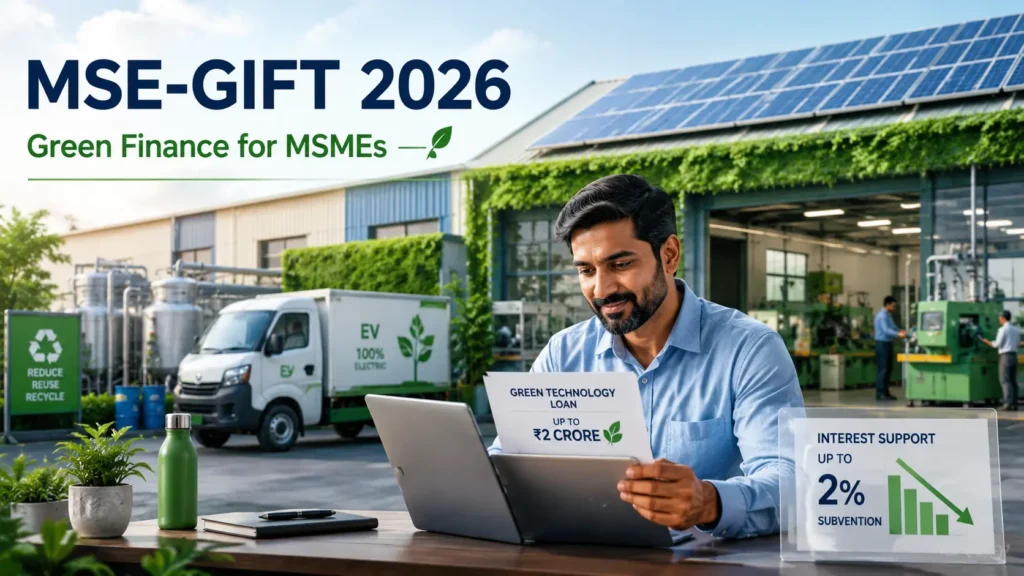
Create a premium editorial-style featured image for a BusinessZindagi article about the MSE-GIFT Scheme 2026 and green finance for Indian MSMEs. Show a modern Indian small manufacturing business/factory transitioning toward green technology: rooftop solar panels, energy-efficient machinery, an electric delivery vehicle and subtle recycling/water-management elements. In the foreground, show a confident Indian MSME entrepreneur reviewing a business financing document on a laptop/tablet, with a subtle visual representation of financial support such as a ₹2 crore loan document and a downward interest-rate graphic. Blend clean green technology with professional financial/business imagery. Background should look like a realistic modern Indian MSME industrial unit, not a large corporate factory. Premium Indian business magazine photography, realistic people, natural lighting, sophisticated blue-and-green business aesthetic, strong visual hierarchy, clean negative space, highly clickable, trustworthy government-scheme/news article feel. Avoid cartoon style, avoid generic stock-photo appearance, avoid excessive icons, avoid clutter. Include only minimal readable headline text: “MSE-GIFT 2026” and smaller text “Green Finance for MSMEs”. 16:9 horizontal composition, optimized for Google Discover thumbnail and mobile screens.
Best visual hook: entrepreneur + solar/green factory + money/financing cue. That communicates “government scheme + MSME + money + green technology” instantly, which is much stronger for Discover than a generic solar-panel image.
Yes. I’d make the disclosures transparent but not overly legalistic, consistent with the disclosure style already appearing on your recent BusinessZindagi articles.
For this particular article, I’d also add 3 internal links rather than stuffing the article with links. These are the most relevant existing BusinessZindagi pieces I found.
Recommended internal links
- Major Solar Panel Financing Schemes for MSMEs in India in 2026 — perfect contextual link from the section discussing solar/renewable-energy investments.
Read: Major Solar Panel Financing Schemes for MSMEs in India in 2026 - TReDS Registration for MSMEs 2026: Step-by-Step Guide — link from the financing/working-capital section as a related MSME finance resource.
Read: TReDS Registration for MSMEs 2026 - IITF 2026 for MSMEs: Dates, Eligibility, Application & Guide — useful as a broader MSME opportunity/trade article, especially near the conclusion.
Read: IITF 2026 for MSMEs: Dates, Eligibility, Application & Guide
Add this near the end of the article
Editorial, AI & Affiliate DisclosureEditorial, AI & Affiliate Disclosure
Editorial & AI Disclosure:
This article has been researched and prepared with the assistance of AI tools for research, structuring and editing, and has been reviewed and refined for BusinessZindagi. We aim to provide practical, accurate and useful information for MSMEs and entrepreneurs. However, government schemes, eligibility criteria, lending conditions, interest rates and application procedures can change. Readers should always verify the latest information with SIDBI, the Ministry of MSME and the relevant participating financial institution before making any financial or business decision.
BusinessZindagi is an independent business and MSME information platform and is not affiliated with, endorsed by, or representing the Ministry of MSME, SIDBI or the Government of India.
Affiliate Disclosure:
Some links on BusinessZindagi may be affiliate links. If you purchase or sign up for a product or service through an eligible affiliate link, BusinessZindagi may receive a small commission at no additional cost to you.
Affiliate relationships do not determine our editorial conclusions, rankings or recommendations. We only recommend or mention products and services that we believe may be relevant and useful to entrepreneurs, MSMEs and small-business owners.
Where we provide links to official government, regulatory or institutional sources, those links are included to help readers independently verify important information.
You May Also Like
Looking at solar to reduce your MSME’s electricity costs?
Major Solar Panel Financing Schemes for MSMEs in India in 2026
Want to improve your MSME cash flow instead of waiting for invoices to be paid?
TReDS Registration for MSMEs 2026: Step-by-Step Guide
Planning to find buyers and expand through trade fairs?
IITF 2026 for MSMEs: Dates, Eligibility, Application & Guide
One SEO tweak I’d make
I would not place all three links together as a “Suggested Articles” block only. Put the first two contextually inside the article:
- After mentioning solar/renewable energy → link to the solar-financing article.
- After discussing institutional finance/cash flow → link to the TReDS guide.
- Keep IITF as a “You May Also Like” recommendation near the end.
That gives Google clearer topical relationships between your green finance → MSME finance → trade/export content clusters, rather than looking like a generic list of internal links. Your existing solar-financing article is especially valuable because it already covers SIDBI, solar, energy efficiency and MSME financing.
Also, there’s a useful credibility point you could add to the MSE-GIFT article: SIDBI’s annual report says 1,958 green loans had been covered under MSE-GIFT during FY2025, with 560+ MSMEs having availed the interest subvention. That gives readers evidence that this isn’t merely a theoretical scheme.
Sure — here are short, clean, copy-paste-ready versions.
Sources & References
-
SIDBI – MSE-GIFT Scheme: Official scheme overview, objectives and latest update.
SIDBI: MSE-GIFT Scheme -
MSME RAMP Portal – MSE-GIFT: Official information on 2% interest subvention, ₹2 crore loan limit, eligibility and covered green sectors.
MSME RAMP: MSE-GIFT Risk Sharing Facility -
SIDBI – MSE-GIFT FAQs: Official details on eligibility, 2% interest subvention, five-year period and the 890-technology list.
SIDBI: MSE-GIFT FAQs -
MSME RAMP Portal – Scheme Guidelines: Official Ministry of MSME repository for MSE-GIFT scheme guidelines.
MSME RAMP: Official Scheme Guidelines -
SIDBI Annual Report: Official data on MSE-GIFT implementation and green loans covered under the scheme.
SIDBI Annual Report: MSE-GIFT Implementation
Editorial & AI Disclaimer
This article was researched and prepared with AI assistance and reviewed for BusinessZindagi. Government schemes, eligibility and lending rules can change, so readers should verify the latest details with official sources before making any financial decision.
Affiliate Disclosure
WritingAffiliate Disclosure: Some links on BusinessZindagi are affiliate links. We may earn a small commission if you purchase through them, at no extra cost to you. Our editorial content and recommendations remain independent.
You may also like to read:-
Solar financing:
Major Solar Panel Financing Schemes for MSMEs in India in 2026
TReDS:
TReDS Registration for MSMEs 2026: Step-by-Step Guide
IITF:
IITF 2026 for MSMEs: Dates, Eligibility, Application & Guide