
Updated: 17 September 2026
For a small business trying to enter international markets, even a relatively small compliance requirement can become a real hurdle when an export order needs to be shipped quickly.
That is why the government’s latest change to the RCMC requirement for small-value exports is important for MSMEs, first-time exporters, artisans and small businesses.
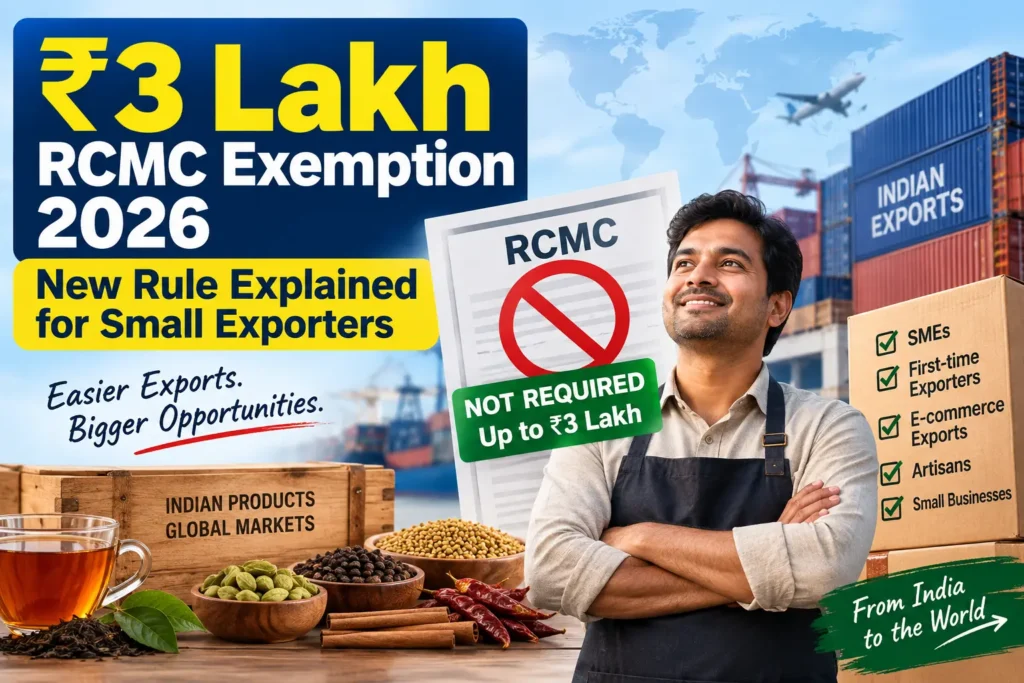
The Directorate General of Foreign Trade (DGFT) has amended the Foreign Trade Policy, 2023 to provide an exemption from the requirement of a Registration-cum-Membership Certificate (RCMC) or Certificate of Registration for export consignments with a Free-on-Board (FOB) value of up to ₹3 lakh, wherever such certificate would otherwise be required under the Foreign Trade Policy. The amendment took effect immediately.
For a small exporter, this can remove one important hurdle at the beginning of an export journey.
What has changed?
DGFT has amended Paragraph 2.57 of the Foreign Trade Policy, 2023.
The new provision says that an RCMC or Certificate of Registration is not required for an export consignment where the FOB value does not exceed ₹3,00,000.
For consignments above ₹3 lakh, the existing RCMC or Certificate of Registration requirement continues wherever it is otherwise applicable under the Foreign Trade Policy.
In simple terms
| Export consignment FOB value | RCMC requirement |
|---|---|
| Up to ₹3 lakh | Exempt where RCMC would otherwise be required |
| Above ₹3 lakh | Existing requirement continues where applicable |
The ₹3 lakh limit is based on the FOB value of the individual export consignment, not simply your annual export turnover.
Why this matters to a small exporter
This change may look small on paper.
But anyone who has actually tried to start exporting on a small scale knows that timing and paperwork matter.
When a buyer gives you an export order and expects shipment quickly, having to complete another registration before you can proceed can create an additional delay.
I know this from my own experience.
My experience as a small tea exporter
When I was exporting tea as a small exporter, there were occasions when I wanted to explore exporting spices as well.
The problem was that my existing registration did not simply cover everything I wanted to export.
If I wanted to move into another product category, I had to go through the process of applying for the relevant RCMC again.
From my experience, the process could take around 6–10 days.
For a large established exporter, a few days of additional compliance may not seem like a major issue.
But for a small exporter who has just received an order and wants to ship immediately, those days can become a genuine hurdle.
You may have the buyer.
You may have the product.
You may have the money and logistics ready.
But if one registration is still pending, the shipment may have to wait.
That is why I see the new ₹3 lakh exemption as more than just a paperwork change.
For a small exporter trying to test a new overseas market, it can remove one of the initial barriers between receiving a small export order and actually shipping it.
This is my personal experience as an exporter and is not a statement that every exporter previously experienced the same processing time.
What exactly is RCMC?
RCMC stands for Registration-cum-Membership Certificate.
It is generally issued by the relevant Export Promotion Council, Commodity Board or other prescribed organisation, depending on the exporter’s product and applicable rules.
Where required, it can be part of the exporter’s compliance and registration framework.
The new DGFT provision does not abolish RCMC.
Instead, it creates a de minimis exemption for low-value export consignments up to ₹3 lakh FOB.
Who can benefit from the ₹3 lakh exemption?
The measure is particularly relevant to:
- First-time exporters
- MSMEs
- Small manufacturers
- Artisans
- Small traders
- Entrepreneurs testing overseas markets
- Occasional exporters
- E-commerce exporters
- Postal exporters
- Courier exporters
The government specifically says the measure is intended to facilitate small-value exports through Postal, Courier and other emerging channels.
A simple example
Suppose a small Indian business receives an overseas order.
Example 1: ₹1.5 lakh FOB
The export consignment has an FOB value of ₹1.5 lakh.
If RCMC would otherwise have been required under the FTP, the new exemption means the exporter does not need that RCMC for the eligible consignment.
Example 2: ₹3 lakh FOB
The consignment has an FOB value of exactly ₹3 lakh.
It falls within the exemption threshold.
Example 3: ₹3.25 lakh FOB
The consignment exceeds ₹3 lakh.
The new exemption does not apply, and the exporter needs to follow the existing RCMC/Certificate of Registration requirement wherever applicable.
Does this mean you can export without RCMC for everything?
No.
This is an important distinction.
The government has not removed RCMC requirements across the board.
The exemption applies to an eligible export consignment with a FOB value up to ₹3 lakh, where RCMC or a Certificate of Registration would otherwise be required under the Foreign Trade Policy.
Other export requirements can still apply.
For example:
- IEC
- Customs procedures
- GST/export requirements
- Product-specific licences
- Restricted-item permissions
- Export documentation
- Destination-country requirements
- Payment and foreign-exchange requirements
So don’t interpret the new rule as:
“Exports below ₹3 lakh need no compliance.”
That would be incorrect.
The more accurate interpretation is:
“The RCMC/Certificate of Registration requirement is exempted for eligible export consignments up to ₹3 lakh FOB.”
Why the government introduced the exemption
There is an interesting reason behind the change.
Government data for 2021-22 to 2025-26 showed that export consignments valued up to US$3,000 accounted for about 43% of shipping bills, while representing only around 0.86% of India’s total merchandise export value.
In other words, small-value shipments represent a significant number of export transactions but a very small share of total export value.
The government therefore wants to reduce the compliance burden associated with these smaller shipments and make it easier for new exporters to enter international markets.
Why this could help first-time exporters
For a first-time exporter, international trade can already involve learning:
- IEC
- HS codes
- Proforma invoices
- Commercial invoices
- Packing lists
- Shipping Bills
- Customs procedures
- Freight
- Incoterms
- International payments
- Buyer verification
- Product certifications
Removing one registration hurdle for small consignments can make the starting process simpler.
It may also allow a business to test an overseas market with a smaller shipment before committing to larger exports.
That is particularly relevant for MSMEs that are still learning how international buyers, logistics and payments work.
What about e-commerce exports?
This change is especially relevant to the growing number of businesses selling internationally through:
- E-commerce
- Postal channels
- Courier
- Direct-to-consumer exports
- Small international orders
A traditional bulk export may involve a large shipment.
But an online business could receive many smaller international orders.
The government specifically identified e-commerce, postal, courier and other emerging channels as areas that can benefit from the relaxation.
What happens when your business grows?
The exemption is designed for small-value consignments.
Once your consignments exceed ₹3 lakh, the existing RCMC/Certificate of Registration framework continues wherever applicable.
As the export business grows, exporters can obtain membership of the relevant Export Promotion Council or Commodity Board and access the wider export-promotion and institutional support available through these organisations.
So the new rule does not eliminate the importance of RCMC.
It simply gives small exporters more room to start small.
A practical export checklist for small exporters
Even when the RCMC requirement does not apply, don’t forget the rest of your export preparation.
Before shipping, check:
☐ IEC is available and valid
☐ Product HS code has been identified
☐ Product is freely exportable or required permission has been obtained
☐ FOB value of the individual consignment has been calculated
☐ RCMC exemption has been checked
☐ Commercial/proforma invoice is prepared
☐ Packing list is prepared
☐ Shipping and customs documentation is ready
☐ GST/export procedure has been checked
☐ Buyer and destination-country requirements have been verified
☐ Product-specific certification requirements have been checked
☐ Payment terms are clear
☐ Freight and insurance costs have been considered
What small exporters should remember
The new rule can be reduced to four simple points:
₹3 lakh
The threshold refers to the FOB value of the export consignment.
RCMC exemption
Eligible consignments up to ₹3 lakh are exempt from RCMC/Certificate of Registration where that certificate would otherwise be required under the FTP.
Above ₹3 lakh
Existing RCMC/registration requirements continue wherever applicable.
Other compliance remains
The exemption does not remove other export, customs, tax, product or destination-country requirements.
My view as a small exporter
For someone who has never exported, registration and compliance requirements can sometimes look like small formalities.
But when you are operating a small business, every additional day and every additional procedural hurdle matters.
My own experience of exporting tea and later wanting to explore spices showed me this very clearly.
If you have a buyer waiting and you are ready to ship, having to wait several days for another registration can be frustrating.
A large exporter may have a dedicated export team handling such processes.
A small entrepreneur may be doing everything alone — finding the buyer, arranging the product, negotiating the price, preparing documents, coordinating logistics and managing payment.
For such exporters, simplifying the first small shipment can make a meaningful difference.
The new ₹3 lakh RCMC exemption therefore has the potential to make the first step into exporting a little easier for India’s small businesses.
Final takeaway
The government has introduced a ₹3 lakh FOB exemption from the RCMC/Certificate of Registration requirement for eligible export consignments where the certificate would otherwise be required under the Foreign Trade Policy. The change took effect immediately following DGFT’s amendment to Paragraph 2.57.
For a small exporter, this could mean one less registration hurdle when testing an overseas market with a small shipment.
But remember:
RCMC exemption does not mean compliance exemption.
Before exporting, always check the latest DGFT rules, customs requirements, product-specific regulations and destination-country requirements.
Useful BusinessZindagi Export Resources
Planning your first or next export?
Use these practical BusinessZindagi resources:
- Proforma Invoice Generator — prepare a professional export quotation/invoice.
- Export Profit Calculator — estimate your export costs and potential profit.
- First Export Order Guide — practical guidance for handling your first export order.
- BusinessZindagi Export Tools & Resources — explore our business and export tools.
Official Sources
- PIB — Government Eases RCMC Requirement for Export Consignments up to ₹3 Lakh — official government announcement.
- DGFT — Official Website — check the latest Foreign Trade Policy, notifications and export regulations.
- Ministry of Commerce & Industry — official trade-policy information.
- CBIC — Central Board of Indirect Taxes and Customs — customs and export-related information.
Frequently Asked Questions
1. What is the ₹3 lakh RCMC exemption?
The government has exempted eligible export consignments with an FOB value up to ₹3 lakh from the requirement to obtain an RCMC or Certificate of Registration where that certificate would otherwise be required under the Foreign Trade Policy.
2. Is the ₹3 lakh limit based on FOB value?
Yes. The DGFT amendment specifically refers to the Free-on-Board (FOB) value of the export consignment.
3. Can I export a ₹2 lakh shipment without RCMC?
If RCMC or Certificate of Registration would otherwise have been required under the FTP, the new exemption means that eligible ₹2 lakh FOB consignments do not require it.
4. What happens if my shipment is ₹3.5 lakh?
The ₹3 lakh exemption does not apply. The existing RCMC/Certificate of Registration requirement continues wherever applicable.
5. Does this exemption remove the need for IEC?
No. The new provision concerns RCMC/Certificate of Registration. Other applicable export requirements, including IEC and customs procedures, continue.
6. Does this apply to e-commerce exports?
The government specifically says the measure is intended to facilitate exports through Postal, Courier and other emerging channels, which includes the growing small-value e-commerce export ecosystem.
7. Can I export any product without permission if the value is below ₹3 lakh?
No. Product-specific restrictions, licences, authorisations and other regulatory requirements may still apply.
8. Is RCMC completely abolished for small exporters?
No. The exemption applies to eligible consignments up to ₹3 lakh FOB. The existing framework continues for consignments above ₹3 lakh wherever RCMC is otherwise required.
9. When did the new rule take effect?
DGFT issued Notification No. 36/2026-27 dated 15 September 2026, amending Paragraph 2.57 of the Foreign Trade Policy, 2023, with immediate effect.
10. Where should I check before relying on the exemption?
Check the latest DGFT notification and Foreign Trade Policy, along with applicable customs, product-specific and destination-country requirements.
AI & Editorial Disclaimer
AI Disclaimer: This article was prepared with AI assistance and checked against available official government information. Rules and procedures can change, so exporters should verify the latest DGFT notification before acting.
Editorial Disclaimer: BusinessZindagi provides educational information and does not provide legal, tax, customs or professional export advice. The personal export experience shared in this article reflects the author’s own experience and should not be treated as a statement about every exporter’s circumstances.