CBIC EMI Scheme 2026 has become simpler for eligible manufacturer-importers. From 15 September 2026, the application process requires only three key document uploads under the revised process. But what exactly has changed, who can use the facility, and how can manufacturers benefit from the improved Customs-duty payment cycle?
Here is the practical breakdown.
What Changed in the CBIC EMI Scheme 2026?
The Central Board of Indirect Taxes and Customs (CBIC) has simplified the application process for its Eligible Manufacturer Importer (EMI) Scheme.
Under the revised process effective 15 September 2026, the mandatory document-upload requirement has been reduced, with greater verification being carried out through backend systems.
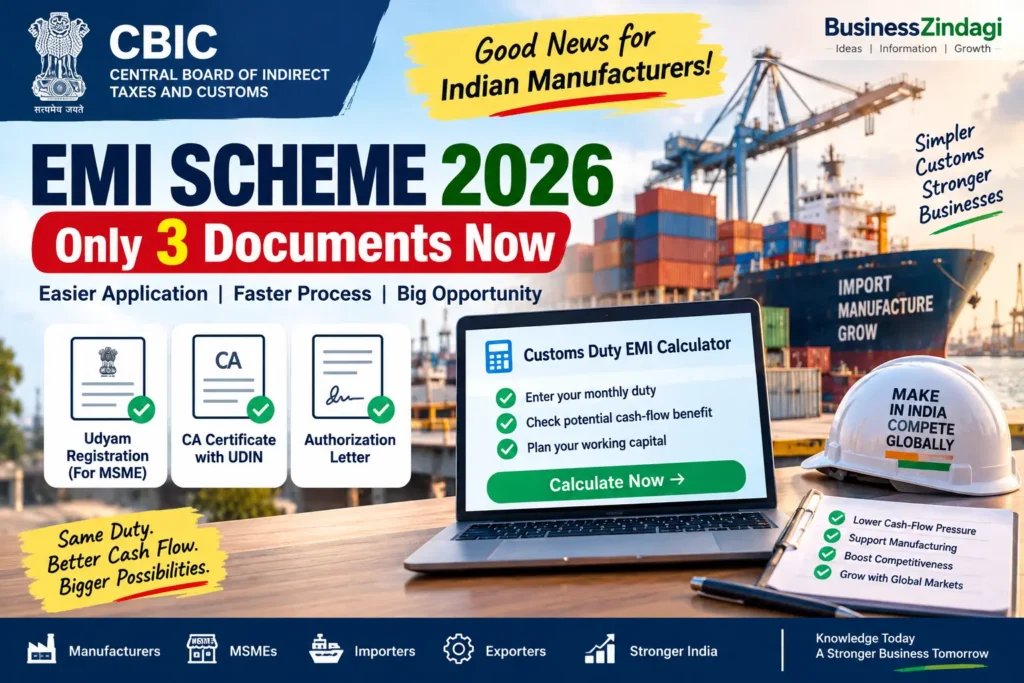
The three key documents highlighted under the simplified process are:
- Udyam Registration Certificate — where MSME status is being claimed
- CA Certificate with UDIN
- Authorization Letter
Important: “Only 3 documents” does not mean that an applicant no longer needs to satisfy the EMI Scheme’s eligibility or compliance requirements. The Customs/AEO process continues to involve verification of business, tax, financial and import-export information.
What Is the EMI Scheme?
The EMI Scheme is a CBIC facility designed to make Customs compliance and duty-payment processes easier for eligible manufacturer-importers.
The facility can provide a pathway toward the Authorised Economic Operator (AEO) ecosystem while allowing eligible manufacturers to use a simplified online application route.
For businesses importing raw materials, components or other inputs regularly, improvements in the Customs payment cycle can potentially help working-capital management.
But there is one crucial point:
EMI does not mean Customs duty is waived.
The benefit is related to the timing and facilitation of eligible duty payments, subject to the applicable rules and approval.
💰 How Much Working Capital Could EMI Free Up?
The effect can vary significantly from one importer to another.
For example, suppose a manufacturer normally pays:
₹5 lakh in Customs duty every month
and the applicable payment timing gives the business an average 30-day deferment.
That could mean approximately:
₹5 lakh of duty payment remains available for working-capital use during that period.
This is not a subsidy or saving. It is a cash-flow timing benefit.
BusinessZindagi EMI Cash-Flow Benefit Estimator
Use the calculator below to estimate the potential cash-flow timing impact using your own numbers.
EMI Cash-Flow Benefit Estimator
Estimate how much Customs duty could remain available as working capital when payment is deferred under the CBIC Eligible Manufacturer Importer (EMI) facility.
[INSERT important: This calculator provides an estimate for understanding potential cash-flow timing. EMI does not waive Customs duty. Actual eligibility, deferment, applicable duty, approval and benefit depend on CBIC rules and the applicant’s circumstances.
Enter:
- Average Customs duty paid per month
- Average deferment period in days
The calculator estimates:
- Annual Customs duty
- Approximate duty amount deferred at any one time
- Potential cash-flow timing benefit
Important: This calculator is an estimate based on user-entered assumptions. EMI does not waive Customs duty. Actual eligibility, approval, applicable duty liabilities, deferment and benefits depend on CBIC rules and the applicant’s circumstances.
Who Should Look at the CBIC EMI Scheme 2026
The facility is particularly relevant to businesses that:
- Manufacture in India
- Regularly import inputs or components
- Have a valid Importer Exporter Code (IEC)
- Maintain an active GST registration
- Have an established import-export track record
- Want to improve Customs compliance and trade facilitation
- Are interested in progressing toward the AEO framework
Key Eligibility Conditions
The official EMI Scheme information includes conditions relating to the applicant’s business, tax compliance, financial position and import-export activity.
Key requirements include:
- Valid IEC
- Importer must be a manufacturer or meet the applicable eligible manufacturer/job-work structure
- Active GST registration
- PAN-level turnover generally exceeding ₹5 crore
- At least 2 financial years of relevant business history
- Compliance with applicable GST return requirements
- Financial solvency
- No disqualifying compliance or Customs-related issues
- Minimum EXIM document requirements
EXIM Document Relaxation for MSMEs
One particularly useful point for MSMEs is the lower minimum EXIM-document threshold.
The requirement is generally:
- 25 EXIM documents in the previous financial year for other applicants
- 10 EXIM documents for eligible MSME applicants
This can make the route more accessible to smaller manufacturers with regular but comparatively lower import-export volumes.
What Documents Are Important?
Although the revised process simplifies mandatory uploads, applicants should still keep their underlying business records ready for verification.
These can include:
- IEC details
- PAN
- GST registration
- Udyam Registration, if applicable
- Audited financial statements
- CA certificate with UDIN
- Import-export records
- GST compliance records
- Financial solvency information
- Authorisation documents
- Other documents relevant to the applicant’s route and circumstances
The key distinction is:
3 mandatory uploads under the simplified process ≠ only 3 documents needed for the entire eligibility assessment.
Why Is This Important for MSME Manufacturers?
For an importer-manufacturer, Customs duty can represent a significant recurring cash-flow requirement.
A business importing:
₹50 lakh → ₹1 crore → ₹5 crore+
worth of inputs can have substantial amounts tied up in taxes and duties during the import cycle.
Even where the duty itself does not change, improving the timing of payment can potentially help a business:
- Maintain working capital
- Reduce pressure on short-term borrowing
- Fund inventory purchases
- Manage supplier payments
- Improve cash-flow planning
- Handle larger import orders
The actual benefit depends on the individual business and applicable Customs rules.
EMI Scheme vs AEO
The EMI Scheme should not simply be described as “AEO registration.”
Rather, it is a separate simplified route/facility associated with the AEO framework for eligible manufacturer-importers.
The official AEO India information indicates that the EMI facility window is available up to 31 March 2028.
The process is online and there is no application fee.
For eligible businesses, the EMI route can therefore be worth examining as part of a broader Customs-compliance and trade-facilitation strategy.
How to Apply for the EMI Scheme?
The application process is online through the official AEO India system.
A simplified overview is:
Step 1: Check whether your business satisfies the EMI eligibility conditions.
Step 2: Keep your IEC, GST, financial, Udyam and other relevant records ready.
Step 3: Prepare the required documents, including the applicable CA certificate with UDIN and authorisation documents.
Step 4: Submit the EMI application through the official online system.
Step 5: Customs authorities verify the information and supporting records.
Step 6: If approved, use the facility according to the applicable EMI/AEO framework and conditions.
Official EMI Scheme
Read the latest eligibility requirements and application information before applying:
AEO India — EMI Scheme:
https://www.aeoindia.gov.in/Website_files/screens/emi-scheme
AEO India — Resources:
https://aeoindia.gov.in/Website_files/screens/resources
Common Mistakes Manufacturers Should Avoid
Before applying, check these points carefully:
1. Assuming “3 documents” means no other compliance checks
The simplified upload requirement does not remove the underlying eligibility requirements.
2. Ignoring GST compliance
GST compliance remains an important part of the eligibility assessment.
3. Claiming MSME status without valid Udyam records
If you are relying on the MSME relaxation, ensure your Udyam information is valid and current.
4. Treating EMI as a duty waiver
It is not.
The value is primarily about trade facilitation and payment timing, subject to the applicable rules.
5. Applying without checking the EXIM-document requirement
Check whether your business satisfies the applicable minimum transaction/document threshold.
What Should Importer-Manufacturers Do Now?
If your business regularly imports raw materials, components or machinery for manufacturing, this is a good time to review your Customs compliance position.
Use this simple checklist:
IEC ✔
GST active ✔
Udyam registration, if applicable ✔
2+ years of business history ✔
Required turnover ✔
Required EXIM documents ✔
GST compliance ✔
Financial solvency ✔
No disqualifying compliance issues ✔
If most of these boxes are checked, the EMI Scheme may be worth investigating.
Related BusinessZindagi Resources
If you import or export for your business, these guides may also help:
- BusinessZindagi Global Trade Data
- BusinessZindagi Interest Subsidy Scheme for Exporters
- BusinessZindagi TReDS Guide for MSMEs
- TReDS Registration for MSMEs in 2026
- DGFT LIFT Scheme
- Payment Risks in Exports
- SWIFT gpi for Exporters
Frequently Asked Questions
What is the CBIC EMI Scheme?
The Eligible Manufacturer Importer (EMI) Scheme is a CBIC facility for eligible manufacturer-importers that simplifies the route into the AEO ecosystem and can improve Customs trade facilitation.
What changed in the EMI Scheme from 15 September 2026?
The application process has been simplified, with the mandatory document-upload requirement reduced to three key documents under the revised process and greater backend verification.
What are the three key documents?
The three key documents highlighted under the simplified process are the Udyam Registration Certificate where MSME status is claimed, a CA Certificate with UDIN, and an Authorization Letter.
Does EMI waive Customs duty?
No. EMI is not a Customs-duty waiver or subsidy. Any benefit relates to facilitation and payment timing under the applicable framework.
Is EMI the same as AEO?
No. EMI is a separate facility/route for eligible manufacturer-importers associated with the AEO framework.
Can MSMEs benefit from the EMI Scheme?
Potentially, yes. Eligible MSMEs can benefit from certain relaxations, including a lower minimum EXIM-document threshold, subject to all applicable conditions.
Is there an application fee?
The official AEO India information states that the EMI application process is online and does not carry an application fee.
Bottom Line
The biggest takeaway from the latest CBIC change is simple:
The EMI application process is becoming easier, but eligibility requirements still matter.
For an Indian manufacturer that regularly imports, the opportunity is bigger than just “three documents.”
The real question is:
Can better Customs facilitation and payment timing improve your working capital?
If your business imports regularly and meets the eligibility conditions, the EMI Scheme deserves a closer look.
Official Sources
- AEO India – EMI Scheme
- CBIC Circular No. 39/2026-Customs
- EMI Scheme – Official FAQ
- EMI Application User Guide
Editorial & AI Disclosure:
This article is intended for general business information and educational purposes. It has been prepared using official government information and analysis. Rules, eligibility conditions, application procedures and benefits can change. Readers should verify the latest requirements with CBIC/AEO India before making a business or financial decision. AI assistance may have been used in drafting or structuring this article; the final content should be checked against the latest official notification/circular.
Last updated: September 2026