
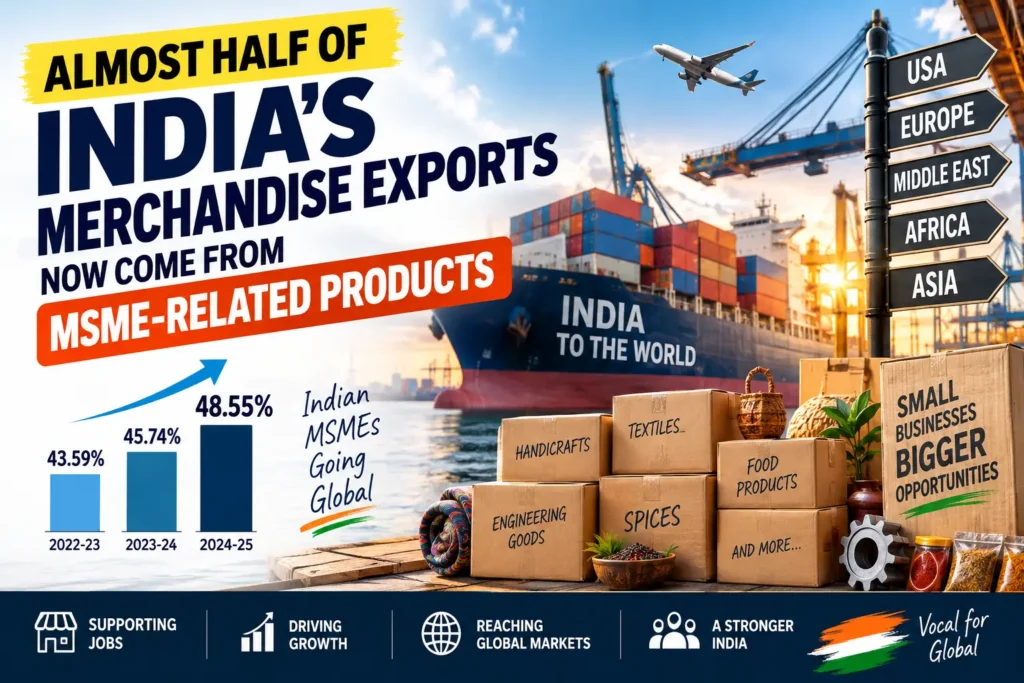
India’s MSME sector is becoming an increasingly important part of the country’s export economy.
According to the Ministry of MSME, MSME-related products accounted for 48.55% of India’s total merchandise exports in 2024-25, up from 45.74% in 2023-24 and 43.59% in 2022-23.
In simple terms, almost half of India’s merchandise export value was represented by MSME-related products in 2024-25.
But there is an important clarification.
The 48.55% figure refers to MSME-related products, and should not be interpreted as saying that 48.55% of India’s exports were directly shipped by enterprises classified as MSMEs.
Still, the number highlights the growing importance of smaller businesses in India’s global trade ecosystem.
And for an entrepreneur who has never exported before, the more important question is:
How can a small Indian business actually find overseas buyers and start exporting?
India’s MSME export share is rising
The government’s data shows a clear upward trend:
| Financial year | Share of MSME-related products in merchandise exports |
|---|---|
| 2022-23 | 43.59% |
| 2023-24 | 45.74% |
| 2024-25 | 48.55% |
The share increased by nearly 5 percentage points in two years.
The Economic Survey 2025-26 separately reported that MSMEs accounted for approximately 48.58% of India’s exports, using its own measure.
These figures are not necessarily identical because the underlying definitions and methodology differ. For this article, the 48.55% figure refers specifically to the government’s data on MSME-related products in merchandise exports.
Why this matters to a small business
Exporting is often associated with large factories, containers and multinational companies.
But a small business can participate in international trade in several ways.
You can:
- Export your own manufactured products
- Source products from Indian manufacturers and act as a merchant exporter
- Sell through international e-commerce channels
- Supply products to larger exporters
- Develop private-label products for overseas buyers
- Become a supplier to an international distributor
The biggest mistake is to think that exporting begins with finding a huge foreign order.
It actually begins with finding the right product-market opportunity.
How to Start Exporting From India
If you are a small manufacturer, trader or entrepreneur considering exports, here is a practical roadmap.
1. Start with a product you understand
Don’t start by asking:
“Which country should I export to?”
Start with:
“Which product can I supply consistently and profitably?”
For example, an Indian MSME may explore:
- Tea
- Spices
- Processed foods
- Textiles
- Garments
- Handicrafts
- Engineering components
- Machinery parts
- Packaging products
- Furniture
- Auto components
- Industrial products
Your product should have three basic characteristics:
Demand + Competitive Pricing + Reliable Supply
If you cannot maintain consistent quality or supply, finding the buyer is only the beginning of the problem.
2. Choose the right export market
Once you know your product, identify countries where there is actual import demand.
Don’t select a country simply because you think the market is attractive.
Research:
- How much the country imports your product
- Which countries currently supply it
- Average import prices
- Major importers
- Existing competition
- Import duties
- Product standards
- Labelling requirements
- Certifications
- Payment risks
- Shipping costs
For example, if you manufacture Assam tea, your research should go beyond:
“Which countries drink tea?”
You should ask:
“Which countries import the type and grade of tea I can supply, at what price, and who are the active importers?”
That difference can save a small exporter a lot of time and money.
3. Find genuine overseas buyers
This is where many first-time exporters struggle.
Searching Google for:
“tea importer Dubai”
or
“spice buyer Russia”
may give you companies, but it doesn’t necessarily tell you whether those companies are actively importing your product.
For serious buyer research, look for evidence of actual import activity.
You can investigate:
- Importers
- Distributors
- Wholesalers
- Trading companies
- Shipment history
- Product descriptions
- Import quantities
- Supplier countries
- Ports
- Recent transactions
🔎 Research export buyers with shipment data
If you are serious about finding overseas buyers, Volza can help you research importers and shipment activity before approaching them.
Explore Volza for Export Buyer Research
Instead of contacting hundreds of random companies, use shipment intelligence to identify companies that are actually involved in importing products similar to yours, then shortlist prospects for direct outreach.
BusinessZindagi tip: Don’t treat a database result as proof that a company will buy from you. Use it as a lead, then independently verify the company’s website, business activity, contact details and payment credibility.
4. Verify the buyer before accepting an order
Finding a buyer is not the same as finding a safe buyer.
Before accepting a significant order, check:
Company identity
- Legal company name
- Website
- Physical address
- Registration details where available
- Business activity
Import activity
- Does the company actually import your product?
- Does its historical activity match what it claims?
Commercial details
- Requested quantity
- Target price
- Delivery location
- Payment terms
- Product specifications
Payment risk
Be particularly careful when a completely unknown buyer asks you to manufacture or ship a large order on unsecured credit.
For a small exporter, one bad transaction can wipe out the profit from several successful orders.
5. Understand your HS code
Your product’s HS code is fundamental to export research.
It affects:
- Product classification
- Customs documentation
- Import tariffs
- Market research
- Trade statistics
- Certain regulatory requirements
Before approaching buyers, identify the correct HS classification for your product.
Don’t simply copy an HS code from another exporter.
For complicated products, confirm the classification through the appropriate customs/DGFT channels or a qualified professional.
6. Calculate the real export price
Never quote an overseas buyer by simply adding a small margin to your purchase price.
Your calculation should consider:
Product cost
Packaging
Local transportation
Testing/certification where applicable
Documentation and handling
Customs/port-related costs
Freight
Insurance where applicable
Banking/payment costs
Commission
Your profit margin
Only after calculating the complete economics should you decide your export quotation.
Also understand the difference between EXW, FOB, CIF, CFR and other Incoterms before agreeing to a price.
A price that looks profitable on paper can become a loss once freight, handling and other charges are included.
7. Decide how you will receive payment
Payment terms are one of the biggest risks for a new exporter.
Common arrangements can include:
- Advance payment
- Letter of Credit
- Documentary collection
- Open account
- Other agreed trade-finance arrangements
The right structure depends on the buyer, country, transaction size and risk.
For a first transaction with an unknown buyer, don’t blindly accept long credit periods simply because the buyer demands them.
Your objective is not just to get an export order. Your objective is to get paid safely.
8. Complete your export documentation
Before shipping, understand the documentation applicable to your transaction.
Depending on the product, destination and shipping method, this can involve documents such as:
- Commercial invoice
- Packing list
- Shipping bill
- Bill of lading or airway bill
- Certificate of origin where required
- Product-specific certificates
- Insurance documents where applicable
- Other customs or regulatory documents
For e-commerce and courier exports, the documentation process can differ from conventional commercial shipments. DGFT’s MSME e-commerce export handbook provides specific guidance for postal and courier routes.
For preferential trade, DGFT also operates the electronic Certificate of Origin system.
Always check the latest DGFT, Customs and destination-country requirements before shipping.
9. Start with a manageable order
A first export transaction is a learning exercise.
You are learning:
- How the buyer communicates
- How the product performs
- How documentation works
- How customs clearance works
- How freight behaves
- How payment works
- Whether the buyer actually pays on time
Therefore, a small business should be careful about taking an unusually large first order that it cannot comfortably finance or fulfil.
A successful small transaction can lead to a much larger repeat order.
10. Turn the first buyer into a repeat buyer
Exporting becomes much more attractive when the same buyer orders repeatedly.
After the first shipment, track:
- Delivery performance
- Product complaints
- Payment behaviour
- Reorder cycle
- Quantity
- Margin
- Logistics cost
- Buyer feedback
Then improve the next shipment.
The goal should be to create a repeatable export system, not simply to collect one purchase order.
Government support for MSME exporters
The government has introduced several measures to strengthen the export ecosystem.
The Export Promotion Mission (EPM) has a total outlay of ₹25,060 crore for FY 2025-26 to FY 2030-31.
It has two broad components:
NIRYAT PROTSAHAN
Focused on improving access to trade finance for MSME exporters.
NIRYAT DISHA
Focused on non-financial support such as:
- Export quality and compliance
- International branding
- Packaging
- Trade fairs
- Export warehousing
- Logistics
- Trade intelligence
- Capacity building
The Ministry’s International Cooperation Scheme also provides support in certain areas for eligible MSMEs, including participation in international exhibitions and buyer-seller meets. Support for first-time micro and small exporters can include specified costs related to RCMC, export insurance premium and testing/quality certification, subject to scheme conditions.
The biggest lesson for a first-time exporter
The 48.55% figure tells us that MSME-related products already have a major place in India’s merchandise exports.
But that does not mean every MSME should immediately start exporting.
Exporting requires preparation.
A better approach is:
Product → Market → Buyer → Verification → Price → Payment → Documentation → Shipment → Repeat order
If you get these steps right, exporting can become another sustainable sales channel for a small Indian business.
And you don’t have to begin with a container.
You can begin with one product, one market and one carefully verified buyer.
Final takeaway
India’s MSME-related products accounted for 48.55% of total merchandise exports in 2024-25, according to the Ministry of MSME.
For small businesses, the bigger message is not simply that India’s exports are growing.
It is that international markets are already an important part of the ecosystem in which Indian MSMEs operate.
If you are considering exports, don’t start by chasing the biggest buyer you can find.
Start by finding a market where your product is competitive, identify genuine importers, verify them carefully, calculate your complete export cost and execute the first shipment properly.
That is how a small business can gradually build an export business.
Frequently Asked Questions
What is India’s MSME export share?
The Ministry of MSME reported that MSME-related products represented 48.55% of India’s total merchandise exports in 2024-25.
Does 48.55% mean MSMEs directly exported 48.55% of India’s exports?
No. The statistic refers to the share of MSME-related products in merchandise exports. It should not automatically be interpreted as the percentage of exports directly shipped by enterprises classified as MSMEs.
How can a small business start exporting from India?
Start by selecting a suitable product, identifying target markets, researching import demand, finding and verifying buyers, calculating the complete export cost, understanding payment terms and completing the applicable export documentation.
How can I find foreign buyers for my products?
You can research importers, distributors, wholesalers, trade fairs, industry associations and trade-data platforms. Shipment data can be particularly useful for identifying companies that have actually imported similar products.
Is exporting profitable for every MSME?
No. Profit depends on product cost, selling price, freight, duties, compliance, payment terms, competition, buyer reliability and other factors. Always calculate the complete transaction economics before accepting an order.
Editorial Disclaimer: This article is based on publicly available government information and is intended for general business education. Export rules, scheme guidelines, eligibility and compliance requirements can change. Verify the latest requirements with the relevant authorities before making business decisions.
AI Disclosure: This article was prepared with AI assistance and reviewed/structured for BusinessZindagi. Readers should independently verify current government rules, eligibility and export requirements from official sources before acting.
Authentic sources
- Ministry of MSME / PIB — MSME export share and Export Promotion Mission
- PIB — MSME export support and International Cooperation Scheme
- Economic Survey 2025-26 — MSME contribution to exports
- DGFT — E-Commerce Exports Handbook for MSMEs
- DGFT — Certificate of Origin platform
Absolutely. I’d make the article much tighter around the 48.55% news, then use the second half to give a genuinely useful “How can my small business start exporting?” roadmap. I’d also place the Volza CTA immediately after the buyer-research section, where it has the strongest contextual relevance.
Recommended SEO setup
Primary keyword: MSME exports in India
Secondary keywords:MSME export share India, MSME contribution to exports, MSME exports 2024-25, MSME related products exports, how to export from India, how MSMEs can start exporting, find buyers for export, export buyer research, Indian exporters
SEO title:
MSME Exports in India Reach 48.55%: How Small Businesses Can Export
Slug:/msme-exports-in-india/
MSME Exports in India Reach 48.55%: How Small Businesses Can Export
MSME Exports in India Reach 48.55%: How Small Businesses Can Export
India’s MSME sector is becoming an increasingly important part of the country’s export economy.
According to the Ministry of MSME, MSME-related products accounted for 48.55% of India’s total merchandise exports in 2024-25, up from 45.74% in 2023-24 and 43.59% in 2022-23.
In simple terms, almost half of India’s merchandise export value was represented by MSME-related products in 2024-25.
But there is an important clarification.
The 48.55% figure refers to MSME-related products, and should not be interpreted as saying that 48.55% of India’s exports were directly shipped by enterprises classified as MSMEs.
Still, the number highlights the growing importance of smaller businesses in India’s global trade ecosystem.
And for an entrepreneur who has never exported before, the more important question is:
How can a small Indian business actually find overseas buyers and start exporting?
India’s MSME export share is rising
The government’s data shows a clear upward trend:
| Financial year | Share of MSME-related products in merchandise exports |
|---|---|
| 2022-23 | 43.59% |
| 2023-24 | 45.74% |
| 2024-25 | 48.55% |
The share increased by nearly 5 percentage points in two years.
The Economic Survey 2025-26 separately reported that MSMEs accounted for approximately 48.58% of India’s exports, using its own measure.
These figures are not necessarily identical because the underlying definitions and methodology differ. For this article, the 48.55% figure refers specifically to the government’s data on MSME-related products in merchandise exports.
Why this matters to a small business
Exporting is often associated with large factories, containers and multinational companies.
But a small business can participate in international trade in several ways.
You can:
- Export your own manufactured products
- Source products from Indian manufacturers and act as a merchant exporter
- Sell through international e-commerce channels
- Supply products to larger exporters
- Develop private-label products for overseas buyers
- Become a supplier to an international distributor
The biggest mistake is to think that exporting begins with finding a huge foreign order.
It actually begins with finding the right product-market opportunity.
How to Start Exporting From India
If you are a small manufacturer, trader or entrepreneur considering exports, here is a practical roadmap.
1. Start with a product you understand
Don’t start by asking:
“Which country should I export to?”
Start with:
“Which product can I supply consistently and profitably?”
For example, an Indian MSME may explore:
- Tea
- Spices
- Processed foods
- Textiles
- Garments
- Handicrafts
- Engineering components
- Machinery parts
- Packaging products
- Furniture
- Auto components
- Industrial products
Your product should have three basic characteristics:
Demand + Competitive Pricing + Reliable Supply
If you cannot maintain consistent quality or supply, finding the buyer is only the beginning of the problem.
2. Choose the right export market
Once you know your product, identify countries where there is actual import demand.
Don’t select a country simply because you think the market is attractive.
Research:
- How much the country imports your product
- Which countries currently supply it
- Average import prices
- Major importers
- Existing competition
- Import duties
- Product standards
- Labelling requirements
- Certifications
- Payment risks
- Shipping costs
For example, if you manufacture Assam tea, your research should go beyond:
“Which countries drink tea?”
You should ask:
“Which countries import the type and grade of tea I can supply, at what price, and who are the active importers?”
That difference can save a small exporter a lot of time and money.
3. Find genuine overseas buyers
This is where many first-time exporters struggle.
Searching Google for:
“tea importer Dubai”
or
“spice buyer Russia”
may give you companies, but it doesn’t necessarily tell you whether those companies are actively importing your product.
For serious buyer research, look for evidence of actual import activity.
You can investigate:
- Importers
- Distributors
- Wholesalers
- Trading companies
- Shipment history
- Product descriptions
- Import quantities
- Supplier countries
- Ports
- Recent transactions
🔎 Research export buyers with shipment data
If you are serious about finding overseas buyers, Volza can help you research importers and shipment activity before approaching them.
Explore Volza for Export Buyer Research
Instead of contacting hundreds of random companies, use shipment intelligence to identify companies that are actually involved in importing products similar to yours, then shortlist prospects for direct outreach.
BusinessZindagi tip: Don’t treat a database result as proof that a company will buy from you. Use it as a lead, then independently verify the company’s website, business activity, contact details and payment credibility.
4. Verify the buyer before accepting an order
Finding a buyer is not the same as finding a safe buyer.
Before accepting a significant order, check:
Company identity
- Legal company name
- Website
- Physical address
- Registration details where available
- Business activity
Import activity
- Does the company actually import your product?
- Does its historical activity match what it claims?
Commercial details
- Requested quantity
- Target price
- Delivery location
- Payment terms
- Product specifications
Payment risk
Be particularly careful when a completely unknown buyer asks you to manufacture or ship a large order on unsecured credit.
For a small exporter, one bad transaction can wipe out the profit from several successful orders.
5. Understand your HS code
Your product’s HS code is fundamental to export research.
It affects:
- Product classification
- Customs documentation
- Import tariffs
- Market research
- Trade statistics
- Certain regulatory requirements
Before approaching buyers, identify the correct HS classification for your product.
Don’t simply copy an HS code from another exporter.
For complicated products, confirm the classification through the appropriate customs/DGFT channels or a qualified professional.
6. Calculate the real export price
Never quote an overseas buyer by simply adding a small margin to your purchase price.
Your calculation should consider:
Product cost
Packaging
Local transportation
Testing/certification where applicable
Documentation and handling
Customs/port-related costs
Freight
Insurance where applicable
Banking/payment costs
Commission
Your profit margin
Only after calculating the complete economics should you decide your export quotation.
Also understand the difference between EXW, FOB, CIF, CFR and other Incoterms before agreeing to a price.
A price that looks profitable on paper can become a loss once freight, handling and other charges are included.
7. Decide how you will receive payment
Payment terms are one of the biggest risks for a new exporter.
Common arrangements can include:
- Advance payment
- Letter of Credit
- Documentary collection
- Open account
- Other agreed trade-finance arrangements
The right structure depends on the buyer, country, transaction size and risk.
For a first transaction with an unknown buyer, don’t blindly accept long credit periods simply because the buyer demands them.
Your objective is not just to get an export order. Your objective is to get paid safely.
8. Complete your export documentation
Before shipping, understand the documentation applicable to your transaction.
Depending on the product, destination and shipping method, this can involve documents such as:
- Commercial invoice
- Packing list
- Shipping bill
- Bill of lading or airway bill
- Certificate of origin where required
- Product-specific certificates
- Insurance documents where applicable
- Other customs or regulatory documents
For e-commerce and courier exports, the documentation process can differ from conventional commercial shipments. DGFT’s MSME e-commerce export handbook provides specific guidance for postal and courier routes.
For preferential trade, DGFT also operates the electronic Certificate of Origin system.
Always check the latest DGFT, Customs and destination-country requirements before shipping.
9. Start with a manageable order
A first export transaction is a learning exercise.
You are learning:
- How the buyer communicates
- How the product performs
- How documentation works
- How customs clearance works
- How freight behaves
- How payment works
- Whether the buyer actually pays on time
Therefore, a small business should be careful about taking an unusually large first order that it cannot comfortably finance or fulfil.
A successful small transaction can lead to a much larger repeat order.
10. Turn the first buyer into a repeat buyer
Exporting becomes much more attractive when the same buyer orders repeatedly.
After the first shipment, track:
- Delivery performance
- Product complaints
- Payment behaviour
- Reorder cycle
- Quantity
- Margin
- Logistics cost
- Buyer feedback
Then improve the next shipment.
The goal should be to create a repeatable export system, not simply to collect one purchase order.
Government support for MSME exporters
The government has introduced several measures to strengthen the export ecosystem.
The Export Promotion Mission (EPM) has a total outlay of ₹25,060 crore for FY 2025-26 to FY 2030-31.
It has two broad components:
NIRYAT PROTSAHAN
Focused on improving access to trade finance for MSME exporters.
NIRYAT DISHA
Focused on non-financial support such as:
- Export quality and compliance
- International branding
- Packaging
- Trade fairs
- Export warehousing
- Logistics
- Trade intelligence
- Capacity building
The Ministry’s International Cooperation Scheme also provides support in certain areas for eligible MSMEs, including participation in international exhibitions and buyer-seller meets. Support for first-time micro and small exporters can include specified costs related to RCMC, export insurance premium and testing/quality certification, subject to scheme conditions.
The biggest lesson for a first-time exporter
The 48.55% figure tells us that MSME-related products already have a major place in India’s merchandise exports.
But that does not mean every MSME should immediately start exporting.
Exporting requires preparation.
A better approach is:
Product → Market → Buyer → Verification → Price → Payment → Documentation → Shipment → Repeat order
If you get these steps right, exporting can become another sustainable sales channel for a small Indian business.
And you don’t have to begin with a container.
You can begin with one product, one market and one carefully verified buyer.
Final takeaway
India’s MSME-related products accounted for 48.55% of total merchandise exports in 2024-25, according to the Ministry of MSME.
For small businesses, the bigger message is not simply that India’s exports are growing.
It is that international markets are already an important part of the ecosystem in which Indian MSMEs operate.
If you are considering exports, don’t start by chasing the biggest buyer you can find.
Start by finding a market where your product is competitive, identify genuine importers, verify them carefully, calculate your complete export cost and execute the first shipment properly.
That is how a small business can gradually build an export business.
Frequently Asked Questions
What is India’s MSME export share?
The Ministry of MSME reported that MSME-related products represented 48.55% of India’s total merchandise exports in 2024-25.
Does 48.55% mean MSMEs directly exported 48.55% of India’s exports?
No. The statistic refers to the share of MSME-related products in merchandise exports. It should not automatically be interpreted as the percentage of exports directly shipped by enterprises classified as MSMEs.
How can a small business start exporting from India?
Start by selecting a suitable product, identifying target markets, researching import demand, finding and verifying buyers, calculating the complete export cost, understanding payment terms and completing the applicable export documentation.
How can I find foreign buyers for my products?
You can research importers, distributors, wholesalers, trade fairs, industry associations and trade-data platforms. Shipment data can be particularly useful for identifying companies that have actually imported similar products.
Is exporting profitable for every MSME?
No. Profit depends on product cost, selling price, freight, duties, compliance, payment terms, competition, buyer reliability and other factors. Always calculate the complete transaction economics before accepting an order.
Meta title
MSME Exports in India Reach 48.55%: How Small Businesses Can Export
Meta description
MSME-related products reached 48.55% of India’s merchandise exports in 2024-25. Learn how Indian MSMEs can find buyers and start exporting.
Editorial disclaimer
Editorial Disclaimer: This article is based on publicly available government information and is intended for general business education. Export rules, scheme guidelines, eligibility and compliance requirements can change. Verify the latest requirements with the relevant authorities before making business decisions.
AI disclaimer
AI Disclosure: This article was prepared with AI assistance and reviewed/structured for BusinessZindagi. Readers should independently verify current government rules, eligibility and export requirements from official sources before acting.
Authentic sources
- Ministry of MSME / PIB — MSME export share and Export Promotion Mission
- PIB — MSME export support and International Cooperation Scheme
- Economic Survey 2025-26 — MSME contribution to exports
- DGFT — E-Commerce Exports Handbook for MSMEs
- DGFT — Certificate of Origin platform
Best placement for the Volza CTA: keep it exactly after “Find genuine overseas buyers”. That’s where the reader has reached the problem Volza solves, so it feels like a useful resource rather than a generic affiliate advertisement.
Ad
Give a suggested clickable links from relevant articles of businesszindagi.com
Yes. For this article, I would keep the internal links highly relevant and limited rather than adding many unrelated links.
Recommended BusinessZindagi internal links
- How to Start Tea Export From India — best if you mention tea/spices as examples of MSME export products. It includes your personal export experience and practical export process.
Link: How to Start Tea Export From India - How to Use Global Trade Data to Find Verified International Buyers — most important internal link because the new article has a major section on finding overseas buyers.
Link: How to Use Global Trade Data to Find Verified International Buyers - DGFT Source from India: How Exporters Can Find Foreign Buyers — excellent immediately after discussing government-supported ways of finding buyers.
Link: DGFT Source from India: Find Foreign Buyers - How to Find International Buyers Without Visiting Trade Fairs — useful in the buyer-discovery section, particularly for first-time exporters.
Link: How to Find International Buyers Without Visiting Trade Fairs - First Export Order: Proforma Invoice, CHA, Shipping Bill & Port Choice — very relevant when the article moves from finding a buyer to actually executing the first export order.
Link: First Export Order: Proforma Invoice, CHA, Shipping Bill & Port Choice - Export Proforma Invoice Format — place this specifically in the section discussing quotations, Incoterms, payment terms and export documentation.
Link: Export Proforma Invoice Format & Guide - DGFT LIFT Scheme — particularly valuable because you’re based in Assam/Northeast and the article discusses export opportunities. The article specifically covers MSME exporters in the Northeast and products including spices, plantation products, processed food, textiles and handicrafts.
Link: DGFT LIFT Scheme for MSME Exporters
Where I’d place them
After “Choose the right export market”
Before entering a market, it is important to understand import demand, competitors and potential buyers. Read our guide on how to use global trade data to find verified international buyers.
Inside “Find genuine overseas buyers”
You can also explore the government’s DGFT Source from India platform and learn how to find international buyers without visiting trade fairs.
Then put your Volza affiliate CTA immediately after this paragraph. This creates a very natural progression:
Learn buyer research → Government buyer platform → Volza shipment intelligence → Contact/verify buyer
Inside “Calculate the real export price”
Link to your Export Profit Calculator if you want to push one of your own tools. Your homepage currently positions the Export Profit Calculator around shipment cost and profit calculation.
Inside “Complete your export documentation”
For a practical look at what happens after receiving your first order, see our guide on First Export Order: Proforma Invoice, CHA, Shipping Bill & Port Choice.
Inside the Assam/Northeast angle
Add:
MSMEs in Assam and other Northeastern states should also check the DGFT LIFT Scheme, which provides support related to inland transportation for eligible products and exporters.
My recommendation
Don’t use all 7 links in the article. Use 5–6 maximum, with these four being the most important:
Global Trade Data → DGFT Source from India → First Export Order → DGFT LIFT Scheme
And keep the Volza CTA directly after the buyer-research section. That gives you a strong internal-link structure without making the article look artificially SEO-optimized.
Make it short and crunchy
Also read on BusinessZindagi:
- Find International Buyers Using Global Trade Data
→ In “Find Genuine Overseas Buyers”
Global Trade Data Guide - DGFT Source From India
→ Same buyer section
Find Foreign Buyers Through DGFT - First Export Order Guide
→ In “Complete Your Export Documentation”
First Export Order Guide - Export Proforma Invoice Guide
→ In “Calculate the Real Export Price”
Export Proforma Invoice - DGFT LIFT Scheme
→ Near the Assam/Northeast exporter discussion
DGFT LIFT Scheme