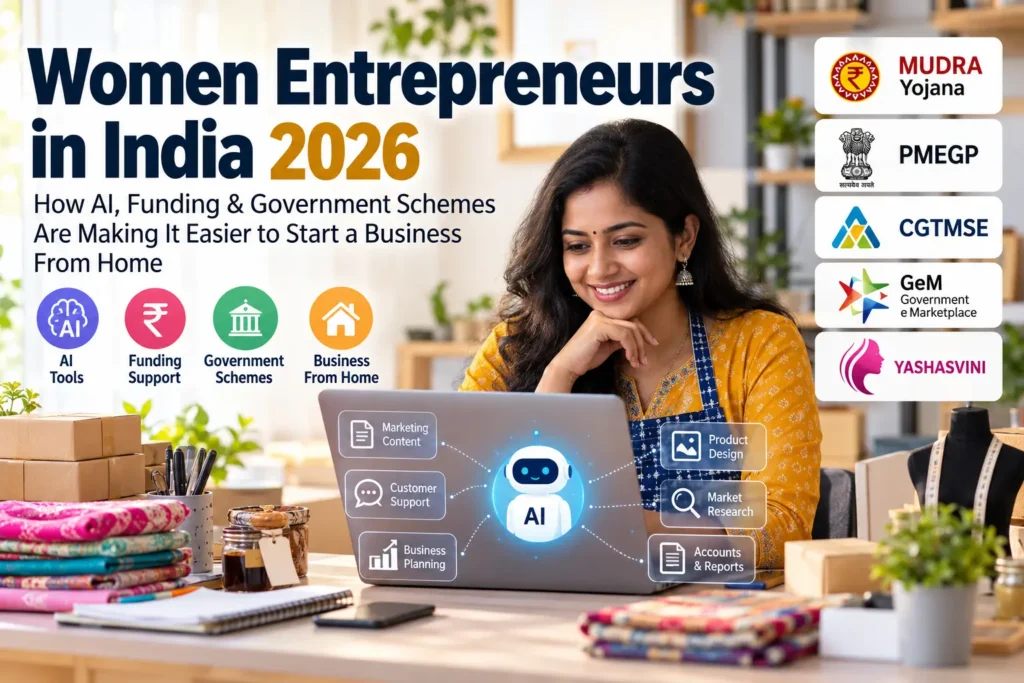
Starting a business from home has traditionally meant doing almost everything yourself — finding customers, creating marketing content, handling accounts, answering enquiries and managing operations.
But in 2026, two things are changing that equation:
Government support for women entrepreneurs is expanding, while AI is making many business tasks faster and cheaper.
The scale of women’s participation in India’s formal business ecosystem is already significant. The Government of India reported approximately 3.69 crore registered MSMEs were women-owned as of October 2026, representing around 38% of registered MSMEs. Separately, the Yashasvini Campaign facilitated more than 22 lakh women-owned MSME registrations by July 2026. PIB: Women, Work and Enterprise
So, could AI + government support make it easier for more women to start and grow businesses from home?
The answer is increasingly yes — although neither AI nor government schemes guarantee business success.
Women Entrepreneurs: Growing opportunities in india.
The government says India’s female Labour Force Participation Rate increased from 23.3% in 2017-18 to 40% in 2025.
The startup ecosystem is also seeing greater participation. More than 1.07 lakh recognised startups had at least one woman director or partner by March 2026. PIB: Women, Work and Enterprise
At the MSME level, initiatives such as Yashasvini are encouraging women to formalise their businesses and access government support.
What does the 22 lakh figure of Women Entrepreneurs mean.
The Yashasvini Campaign had facilitated more than 22 lakh women-owned MSME registrations by July 2026.
This is not the total number of women-owned MSMEs in India. It is the number of registrations facilitated through the campaign. The much larger 3.69 crore figure represents the broader number of registered women-owned MSMEs reported by the government. PIB: Yashasvini & Women-led MSMEs
Where Can Women Entrepreneurs in india Get Financial Support?
Several government programmes can be relevant, depending on the business and the entrepreneur’s eligibility.
PM MUDRA Yojana
The Pradhan Mantri MUDRA Yojana (PMMY) provides collateral-free credit for eligible income-generating activities.
The current categories include:
- Shishu: Up to ₹50,000
- Kishor: Above ₹50,000 to ₹5 lakh
- Tarun: Above ₹5 lakh to ₹10 lakh
- Tarun Plus: Above ₹10 lakh to ₹20 lakh for eligible borrowers who have successfully repaid a previous Tarun loan. PIB: PM MUDRA Yojana
Women have a particularly strong presence under PMMY, with the government reporting that around two-thirds of sanctioned PMMY loans were to women entrepreneurs as of April 2026. PIB: Women-led MSME support
PMEGP: Support for New Micro Enterprises
The Prime Minister’s Employment Generation Programme (PMEGP) can help eligible entrepreneurs establish new micro-enterprises in the non-farm sector.
For eligible women beneficiaries, the margin-money subsidy can be:
- 25% in urban areas
- 35% in rural areas
subject to the scheme’s conditions. Official PMEGP Portal
It can be relevant to businesses such as manufacturing, food processing, tailoring, services and other eligible activities.
CGTMSE: When Collateral Is a Problem
For many first-generation entrepreneurs, access to collateral can be a major barrier.
The Credit Guarantee Scheme for Micro and Small Enterprises, implemented through CGTMSE, supports eligible MSE lending through credit guarantees.
For eligible women-led MSEs, the government provides 90% guarantee coverage, along with a 10% concession in guarantee fees. PIB: CGTMSE support for women-led MSEs
This does not mean every woman entrepreneur automatically receives a loan. The lender and scheme eligibility conditions still apply.
Government Can Also Become a Customer
Funding is only one side of entrepreneurship.
A business also needs customers.
The government’s Womaniya initiative on GeM aims to help women entrepreneurs access government procurement opportunities.
The government reported that more than 2.17 lakh women-owned MSEs were registered on GeM by July 2026, while contracts worth more than ₹28,000 crore were awarded to women MSEs during FY 2025-26. PIB: Women entrepreneurs and GeM
For a suitable business, the opportunity can therefore extend beyond selling locally or through social media.
Now if we Add AI to the Equation Women Entrepreneurship in India becomes even more interesting.
A small business traditionally needed different people for:
- marketing
- content creation
- customer support
- research
- administration
- data analysis
AI can now assist with many of these activities.
For example, a woman running a home-based food, fashion, handicraft, consulting or online service business can use AI to help:
Find and understand customers
Analyse customer segments, competitors and potential markets.
Create marketing content
Draft social-media posts, product descriptions, email campaigns and advertisements.
Handle routine customer questions
AI-powered chatbots can respond to repetitive enquiries and FAQs.
Prepare business documents
AI can help draft quotations, proposals, product catalogues and business communications.
Analyse business data
AI can help identify expenses, sales trends and customer patterns from organised business data.
AI does not replace business judgement. But it can reduce repetitive work and allow a solo entrepreneur to operate more efficiently.
For more on this, see BusinessZindagi’s AI for Indian MSMEs and AI Agents for Small Business guides.
A New Model: One Woman + AI + Digital Tools
Imagine someone starts a small business from home.
Step 1 — Start small
Test the product or service with real customers.
Step 2 — Go digital
Use WhatsApp, social media and a simple website to reach customers.
Step 3 — Use AI
Automate or simplify content, research and routine customer support.
Step 4 — Formalise
Explore Udyam Registration and other registrations applicable to the business.
Step 5 — Track the numbers
Know your actual sales, expenses and profit.
Step 6 — Explore funding
Depending on eligibility, investigate PMMY, PMEGP, CGTMSE and other relevant programmes.
Step 7 — Expand the market
Consider institutional buyers, GeM and online markets.
Step 8 — Scale
Reinvest profits, hire employees and expand production or services when demand justifies it.
A business can start in a home kitchen, bedroom or small workshop without necessarily remaining small.
What Should a Woman Entrepreneur Do Before Taking a Loan?
Government funding can help, but the loan should follow the business opportunity — not replace it.
Before borrowing, ask:
- Who is my customer?
- What problem am I solving?
- What will customers actually pay?
- What is my profit per sale?
- How much capital do I really need?
- How will I repay the borrowing?
- Can I test the business on a smaller scale first?
A good business model is more important than simply obtaining funding.
7 Things Women Entrepreneurs Can Do in 2026
1. Start with a real customer problem.
2. Use AI to reduce repetitive work, not to replace business judgement.
3. Keep proper records from day one.
4. Explore Udyam Registration and applicable government schemes.
5. Compare funding options before borrowing.
6. Look beyond local customers — explore digital and institutional markets.
7. Reinvest profits into activities that genuinely increase sales or capacity.
BusinessZindagi Resources for Entrepreneurs
BusinessZindagi also provides practical resources that can help entrepreneurs manage and grow their businesses.
- BusinessZindagi Tools — business calculators and practical tools.
- CostTrack — track project expenses and understand actual project costs.
- AI CashBook — simplify everyday business income and expense tracking.
- Government Schemes for MSMEs — explore MSME and startup schemes.
- AI for Indian MSMEs — practical applications of AI for small businesses.
- AI Agents for Small Business — understand how AI agents can assist small businesses.
The Bigger Opportunity
The most important development is not just the number of women-owned MSMEs.
It is the combination of formalisation, finance, digital markets and AI.
A woman can potentially start with a small business from home, use AI to reduce operating costs, access appropriate government support, reach customers digitally and gradually build a larger enterprise.
The starting point may be one person and one product.
But the ambition does not have to remain small.
AI can reduce the cost of doing many business tasks. Government programmes can improve access to finance and markets. But the entrepreneur remains at the centre of the business.
India’s growing women-owned MSME ecosystem suggests that this combination could create a powerful new generation of women entrepreneurs.
Frequently Asked Questions
How many women-owned MSMEs are there in India?
The Government of India reported approximately 3.69 crore registered MSMEs were women-owned as of October 2026, around 38% of registered MSMEs. PIB: Women, Work and Enterprise
What is the 22 lakh Yashasvini figure?
It refers to more than 22 lakh women-owned MSME registrations facilitated through the Yashasvini Campaign by July 2026, not the total number of women-owned MSMEs. PIB: Yashasvini Campaign
Which schemes can help women entrepreneurs?
Depending on eligibility, options may include PMMY, PMEGP, CGTMSE, Startup India programmes and government procurement opportunities through GeM.
Can AI help start a business from home?
Yes. AI can assist with research, marketing, content, customer support, administration and data analysis. It cannot guarantee customers or profitability.
Authentic Government Sources
- PIB — Women, Work and Enterprise
- PIB — Yashasvini & Women-led MSMEs
- PIB — PM MUDRA Yojana
- PIB — CGTMSE
- Official PMEGP Portal
- Government e-Marketplace (GeM)
Disclaimer
This article is for general information and educational purposes. Government schemes have specific eligibility conditions, documentation requirements and lending criteria. Udyam Registration does not automatically guarantee funding or subsidies. Scheme rules and figures can change, so readers should verify the latest information on official government portals before applying or making financial decisions.