Starting, running or expanding a business needs money. But the right funding option depends on what you need the money for, how much you need and how comfortably your business can repay it.
A manufacturing MSME may need money for machinery. A trader may need working capital. A startup may need equity funding, while an exporter may need finance against an export order.
So, instead of asking “Which is the best MSME loan?”, ask:
“Which funding option is best for my business?”
This guide explains the major MSME funding options in India and when you should consider each one.
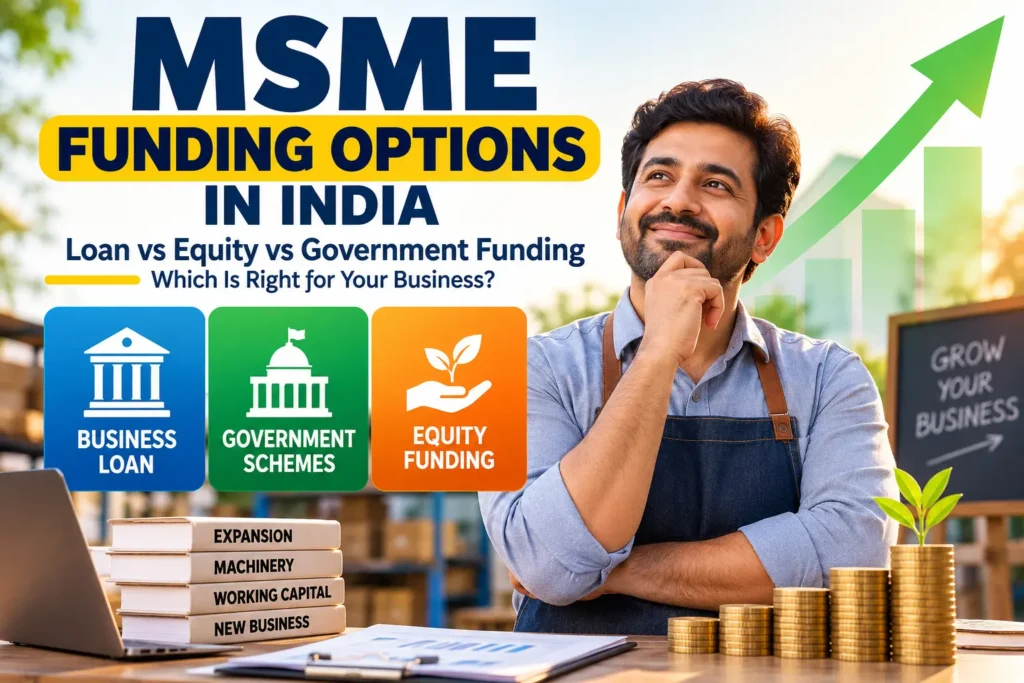
MSME Funding Options in india at a Glance
| Funding Option | Best For | Repayment | Ownership Dilution |
|---|---|---|---|
| 🏦 Business Loan | Working capital, machinery, expansion | Yes | No |
| 🏛️ Government Schemes | Eligible businesses/projects | Depends on scheme | Usually no |
| 🤝 Equity Funding | High-growth startups/MSMEs | No regular EMI | Yes |
| 📦 Export Finance | Export orders & receivables | Usually | No |
| 📈 Growth/Capital Market Funding | Established growing businesses | Depends | May involve dilution |
The Ministry of MSME maintains multiple schemes covering areas such as credit, employment generation, marketing, technology and international cooperation.
1. Business Loans – The Most Common Funding Route
A business loan may be suitable when you need capital for:
- Working capital
- Machinery and equipment
- Business expansion
- Inventory
- Infrastructure
- Day-to-day business requirements
For short-term requirements, businesses may consider working-capital facilities such as cash credit, overdraft or receivables finance.
For long-term assets such as machinery, a term loan may be more appropriate.
👉 BusinessZindagi: Explore our MSME Loan & Working Capital Guide
Before taking a loan, check:
- Interest rate
- Processing charges
- Collateral requirement
- Repayment period
- EMI/cash-flow impact
- Guarantee or other charges
Don’t borrow simply because a lender is willing to lend.
2. Government Schemes – Can They Help Your Business?
Government support for MSMEs can come in different forms.
It may include:
- Credit guarantees
- Subsidies
- Grants
- Interest support
- Technology assistance
- Marketing assistance
- Procurement support
- Other financial assistance
The official Ministry of MSME portal lists schemes such as PMEGP, CGTMSE, Procurement & Marketing Support, International Cooperation and other MSME programmes.
Important:
Government scheme ≠ always free money.
Some schemes support your financing indirectly, while others provide assistance for specific activities or eligible projects.
👉 BusinessZindagi: Explore MSME Government Schemes
3. CGTMSE – When Collateral Is a Problem
One important option for eligible Micro and Small Enterprises is CGTMSE-backed credit.
CGTMSE provides guarantee support to eligible lending institutions, helping facilitate credit to MSEs without the usual collateral/third-party guarantee requirement, subject to applicable scheme and lender conditions.
Remember: CGTMSE does not simply hand the entrepreneur a loan. The credit is provided by the participating lender, while the guarantee mechanism supports the lender.
👉 BusinessZindagi: Read our Collateral-Free MSME Finance Guide
👉 Official: CGTMSE
4. PMEGP – For New Micro Enterprises
If you are planning to start a new micro enterprise, Prime Minister’s Employment Generation Programme (PMEGP) is one government programme worth investigating.
PMEGP is designed to support new micro-enterprises and employment generation in the non-farm sector. The current official PMEGP portal states a maximum project cost of ₹50 lakh for manufacturing projects and ₹20 lakh for service projects.
The programme combines bank finance with eligible margin-money subsidy, subject to the scheme’s conditions.
👉 Official: PMEGP Official Portal
Always check the latest official guidelines before applying because scheme conditions can change.
5. Equity Funding – When You Don’t Want More Debt
Not every business should keep increasing its loans.
A startup or high-growth MSME may instead consider equity funding.
The basic difference is simple:
Loan:
You receive money → repay it with applicable interest.
Equity:
You receive investment → give the investor a percentage of the business.
Equity may be suitable when:
- The business has high growth potential
- Cash flow is uncertain
- Large capital is required
- The founders are willing to dilute ownership
- Investors can bring strategic value, contacts or expertise
But equity is not free money.
You may give up:
- Ownership
- Some control
- A portion of future business value
Government programmes have also recognised the need for equity support for growth-oriented MSMEs, including the Fund of Funds approach.
6. Export Finance – For Exporting MSMEs
Exporters often face a unique funding cycle.
You may receive an export order but need money to:
- Purchase raw materials
- Manufacture goods
- Pack the shipment
- Pay suppliers
- Ship the goods
- Wait for payment from the overseas buyer
Therefore, exporters can explore pre-shipment and post-shipment finance and other trade-finance solutions.
For an exporter, the question should not simply be:
“Where can I get a loan?”
It should be:
“How can I finance my export cycle without putting unnecessary pressure on my working capital?”
👉 BusinessZindagi: Explore Export & MSME Guides
7. Which MSME Funding Options in India Is Right for Your Business?
Use this quick guide:
| Your Requirement | First Option to Explore |
|---|---|
| Short-term working capital | Working-capital finance |
| Machinery/equipment | Term loan + applicable government support |
| Starting a new micro business | PMEGP + bank finance, if eligible |
| Need collateral-free credit support | CGTMSE-backed lending, if eligible |
| High-growth startup | Equity/angel/VC funding |
| Export order | Export/trade finance |
| Rapid expansion | Combination of debt + equity |
| Want to retain ownership | Debt/government-supported finance |
| Already have heavy EMI obligations | Reassess debt before borrowing more |
This is only a starting framework. Actual eligibility, pricing and approval depend on the scheme, lender and business.
8. Don’t Make These Funding Mistakes
❌ Borrowing more than you actually need
A bigger loan does not automatically mean a stronger business.
❌ Using long-term debt for every short-term requirement
Match the financing period with the purpose.
❌ Assuming every government scheme gives a direct subsidy
Read the actual scheme guidelines.
❌ Giving away equity too early
If a manageable loan can fund your requirement without creating excessive repayment pressure, equity dilution may not always be necessary.
❌ Looking only at the interest rate
Also compare processing fees, guarantee charges, documentation costs and other applicable expenses.
9. Ask These 5 Questions Before Raising Money
Before applying for funding, ask yourself:
1. Why do I need the money?
Working capital, machinery, expansion, export, startup or technology?
2. How much do I actually need?
3. How quickly can the business repay it?
4. Can my current cash flow handle additional debt?
5. Am I willing to give up part of my ownership?
These five questions can help narrow down the most suitable funding route.
10. Government Funding Is Not One-Size-Fits-All
A new entrepreneur may look at PMEGP.
An eligible Micro or Small Enterprise looking for credit support may explore CGTMSE.
An established MSME looking to improve technology, market access or competitiveness may find other Ministry programmes more relevant.
The official Ministry of MSME portal currently provides information on multiple schemes and services.
👉 BusinessZindagi: Explore MSME Government Schemes & Updates
11. The Bottom Line
There is no single best funding option for every MSME.
For one entrepreneur, a business loan may be the right choice.
For another, a government-supported programme may reduce the financing burden.
For a high-growth startup, equity may be more suitable.
For an exporter, trade finance may be more appropriate.
The smart approach is to match the funding source with your business purpose, cash flow, repayment capacity and growth stage.
More BusinessZindagi Resources
👉 MSME Government Schemes & Updates
👉 BusinessZindagi – MSME & Business Guides
👉 Coming soon: BusinessZindagi MSME Funding & Scheme Eligibility Tool
Official Sources
- Ministry of MSME – Schemes & Services
- Ministry of MSME – Scheme Booklet
- CGTMSE – Official Website
- PMEGP – Official Portal
- MyMSME – Ministry of MSME
- MSME RAMP Portal
Editorial Disclaimer
Editorial Disclaimer: This article is intended for general educational and informational purposes only. Government schemes, eligibility criteria, loan limits, interest rates, subsidies, guarantee coverage and application procedures may change. Always verify the latest information from the relevant official government, scheme or lending institution website before applying or making a financial decision. BusinessZindagi does not guarantee loan approval, subsidy or eligibility.
Last reviewed: October 2026
⭐ Explore More
👉 Visit BusinessZindagi – Practical Guides for MSMEs, Entrepreneurs & Small Businesses