
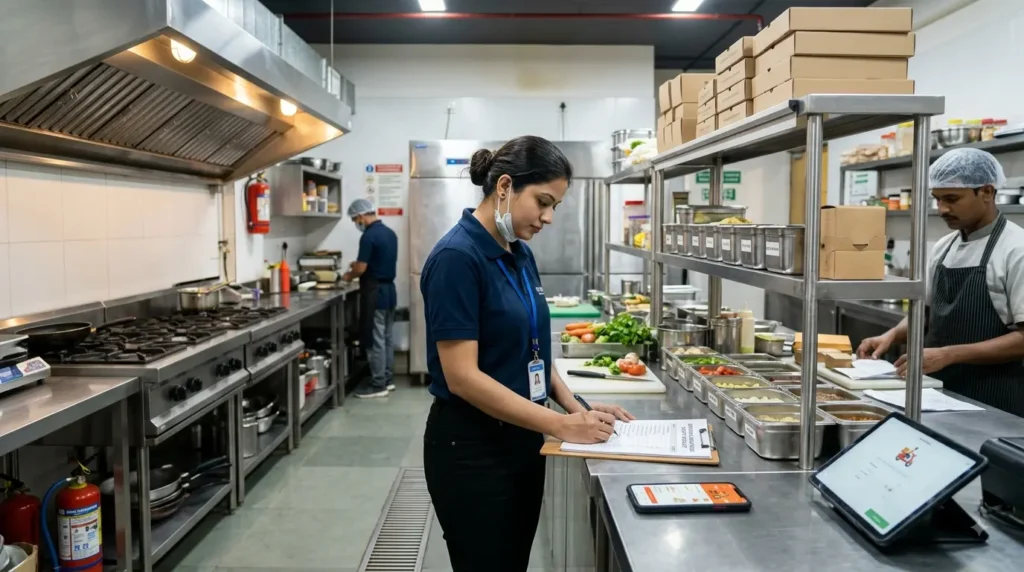
🚨 Cloud Kitchens Are Facing More Food-Safety Scrutiny in 2026
A cloud kitchen may not have a dining room, but it is still a food business — and that means food safety and licensing cannot be treated casually.
In 2026, authorities in several cities have increased scrutiny of food businesses operating through online platforms.
In Pune, the FDA has recently inspected cloud kitchens amid concerns about hygiene, licensing and transparency.
In Hyderabad, authorities instructed Swiggy and Zomato to remove food outlets whose licences are expired, cancelled or suspended.
And Maharashtra’s latest food-safety drive has involved inspections of businesses selling and delivering food through online platforms, with improvement notices and licence suspensions issued.
What does this mean for a cloud-kitchen entrepreneur?
Having a good menu and joining Swiggy or Zomato is not enough.
Your kitchen needs to be properly licensed, hygienic, documented and compliant.
🏠 What Is a Cloud Kitchen?
A cloud kitchen, also called a delivery-only or virtual kitchen, prepares food primarily for online orders rather than serving customers in a traditional dining area.
The model can be attractive because it can reduce some of the costs associated with a conventional restaurant.
But lower setup costs do not mean zero compliance.
📋 Is FSSAI Licence Required for a Cloud Kitchen?
Yes.
FSSAI states that every Food Business Operator in India is required to be licensed or registered under the food-safety framework.
For a cloud kitchen, the FSSAI registration/licence should correspond to the food business and premises from which it operates.
Applications are handled through FoSCoS, the official FSSAI system.
👉 Apply for FSSAI Licence/Registration through FoSCoS
Important 2026 update
FSSAI’s March 2026 FAQ states that licences/registrations issued on or after 1 April 2026 have perpetual validity, subject to the applicable regulatory requirements.
That is an important change for new food businesses, but perpetual validity does not mean a business can ignore compliance or operate without meeting food-safety requirements.
🧼 Cloud Kitchen Food-Safety Checklist
Before opening or scaling your cloud kitchen, pay attention to:
1. Valid FSSAI registration/licence
Keep your FSSAI details accurate and current.
2. Clean kitchen
Maintain proper cleaning and sanitation of:
- Cooking surfaces
- Utensils
- Storage areas
- Refrigerators
- Floors and work surfaces
3. Safe food storage
Raw materials, cooked food and other ingredients should be stored appropriately.
Temperature-sensitive foods deserve particular attention.
4. Pest control
Cockroaches, rodents and other pests can create serious food-safety problems.
Recent inspections in India have highlighted how quickly hygiene violations can attract regulatory action.
5. Staff hygiene
Food handlers should follow appropriate personal hygiene and food-safety practices.
6. Ingredient traceability
Know:
Where did the ingredient come from?
When was it purchased?
How was it stored?
Good records can become extremely valuable during an inspection or customer complaint.
7. Proper packaging
Food packaging should be suitable for the food being sold and should protect it during delivery.
📱 Can Swiggy or Zomato Remove a Cloud Kitchen?
Yes, platform availability can be affected by licensing and regulatory compliance.
In July 2026, Hyderabad authorities instructed Swiggy and Zomato to delist food businesses whose FSSAI or other required licences were expired, cancelled or suspended.
This sends an important message to cloud-kitchen owners:
Your food-delivery platform listing is not a substitute for regulatory compliance.
A cloud kitchen should therefore treat its FSSAI documentation as a core business asset — not just paperwork needed during registration.
💰 What Does This Mean for Someone Starting a Cloud Kitchen?
The biggest mistake is thinking:
Low rent = low-risk business.
A cloud kitchen still has expenses such as:
- Kitchen equipment
- Raw materials
- Packaging
- Delivery commissions/fees
- Staff
- Electricity and gas
- Marketing
- Food wastage
- Technology
- Licences and compliance
- Refunds and customer complaints
And there is another challenge:
Online competition is brutal.
You may have hundreds of restaurants competing for the same customers on a delivery app.
So your business needs more than a kitchen.
It needs:
Good food + hygiene + pricing + reviews + packaging + consistency + repeat customers
🚀 How to Start a Cloud Kitchen More Safely in 2026
If you’re a first-time entrepreneur, don’t rush to rent a huge commercial kitchen.
Step 1: Choose one food category
For example:
- Biriyani
- Snacks
- Healthy meals
- Assamese food
- Bakery products
- Regional cuisine
- Office meals
Step 2: Understand your local requirements
Check FSSAI requirements and any applicable municipal, trade, fire, building, waste-management or other local requirements.
Requirements can vary depending on the location and nature of the operation.
Step 3: Build a compliance file
Keep copies of:
FSSAI documents + supplier records + invoices + food-safety records + cleaning records + other applicable licences
Step 4: Start with a focused menu
A 50-item menu isn’t necessarily better.
Start with products you can prepare consistently.
Step 5: Control food costs
Know your actual cost per order.
Don’t calculate profit using only:
Selling price − ingredient cost
Also account for:
Packaging + platform costs + labour + utilities + wastage + marketing + taxes/other expenses
⚠️ 7 Mistakes Cloud Kitchen Owners Should Avoid
1. Operating without the required FSSAI registration/licence
2. Treating hygiene as an occasional cleaning exercise
3. Using expired or poorly stored ingredients
4. Ignoring pest control
5. Failing to maintain basic records
6. Depending completely on one food-delivery platform
7. Competing only by offering discounts
The current enforcement environment shows why compliance needs to become part of the daily operation rather than something done only when an inspection is expected.
💡 BusinessZindagi Tip
A cloud kitchen may look like a simple business:
Cook → Pack → Deliver
But a sustainable cloud kitchen is really:
Food + Compliance + Cost Control + Branding + Customer Experience
Don’t build the business around a delivery app.
Build a food brand that happens to use delivery apps as a sales channel.
Is a Cloud Kitchen Still a Good Business in 2026?
It can be — but it is not easy money.
The opportunity remains attractive for entrepreneurs who can identify a clear niche, control costs and maintain consistent quality.
But the latest food-safety enforcement is a reminder that compliance and hygiene are becoming increasingly important competitive advantages.
If you’re considering starting one, don’t ask only:
“How much does it cost to start a cloud kitchen?”
Also ask:
“Can I operate it consistently, profitably and compliantly?”
That is the question that matters.
📌 Quick Cloud Kitchen Compliance Checklist
Before launching, check:
- FSSAI registration/licence
- Applicable local business/trade permissions
- Clean and hygienic kitchen
- Safe food storage
- Pest-control arrangements
- Proper food-handling practices
- Supplier and purchase records
- Suitable food packaging
- Accurate business information on delivery platforms
- Basic cost and sales tracking
🔎 Official FSSAI Resources
For the latest licensing and registration requirements, use FSSAI’s official FoSCoS portal, rather than relying solely on third-party consultants or social-media posts.
Apply for FSSAI Licence/Registration
🍳 Want to Start a Food Business?
A cloud kitchen is only one way to enter the food industry.
If you’re planning a food business, first understand your licensing, food-safety, costing and compliance requirements before investing heavily in equipment or rent.
👉 Use the official FSSAI FoSCoS portal to check the applicable registration/licensing process.
🤖 AI Disclaimer
AI Disclaimer: This article was prepared with AI assistance for research and drafting. Food-safety regulations, licensing requirements and local rules can change. Always verify the latest requirements with FSSAI and your relevant local authority before starting or operating a cloud kitchen.
💼 Affiliate Disclaimer
Affiliate Disclaimer: Some links on BusinessZindagi may be affiliate links. If you purchase a product or service through an eligible link, we may earn a commission at no additional cost to you. We recommend products based on relevance to our readers.
📚 Suggested BusinessZindagi Reads
Food Business Ideas in India — Explore practical food-business opportunities for entrepreneurs.
Why Cloud Kitchen Startup Businesses Fail : The Hidden Reality Behind the Food Delivery Boom
How to Start Cloud Kitchen From Home in India: Legal, Practical and Step-by-Step Guide
Sources & References
- FSSAI — Official Food Safety and Standards Authority of India
- FSSAI FoSCoS — New Licence/Registration
- FSSAI 2026 Licensing/Registration FAQ
- Pune cloud-kitchen food-safety inspections
- Hyderabad direction to delist unlicensed food outlets
- Maharashtra 2026 food-safety inspection drive