The Dark Side of Collateral Free Loan What No One Tells You (Until It’s Too Late)
Collateral-free business loans have become extremely popular among startups and small businesses. They promise no security, no property, fast approval, minimal documentation — exactly what a new entrepreneur dreams of.It is sometimes good also .And i have also availed it in the past
But behind this convenience lies a side that most founders only discover after signing the loan agreement… and by then, it’s usually too late.
Before diving into my personal experience, let’s break it down.
you may also like to read: Why Collateral-Free business Loan may also become Game Changers for New & Marginalized Entrepreneurs.
What Exactly Is a Collateral Free Loan?
A collateral-free business loan is an unsecured loan offered by banks, NBFCs, and fintech lenders. You are not required to pledge property, machinery, gold, or any asset.
Lenders instead rely on:
- Credit score
- Business turnover
- Bank statements
- GST filings
- Income and cash flow projections
- Sometimes… pure risk appetite
These loans are common in the MSME space and widely used by startup founders looking for fast funding.
⭐ Why is a Collateral Free Loan So Attractive?
There’s a reason thousands of entrepreneurs apply for them every day:
- No property or assets needed
- Quick disbursal
- Minimal paperwork
- Government-backed guarantee schemes (CGTMSE, Stand-Up India, Mudra loans, etc.)
But now let’s talk about the part that nobody wants to highlight…
1. Extremely High Interest Rates of Collateral Free Loan
Since these loans are unsecured, lenders safeguard themselves with high interest rates.
- Secured loans: ~8% to 12%
- Collateral-free loans: 14% to 24%+
This means borrowing ₹5 lakh can feel like paying for ₹7.5–₹8 lakh in the end.
For a new business with unstable revenue, this alone can become a trap.
2. Collateral Free Loan usually have Lower Loan Amount & Short Tenure = EMI Pressure
Most lenders offer:
- ₹50,000 to ₹50 lakh (average MSME gets less than ₹10 lakh)
- 12–36 months tenure
This creates:
- Sky-high EMIs
- Cash flow pressure
- Risk of default if business doesn’t scale quickly
Secured loans offer 5–15 years and much lower EMI burden — but startups often don’t qualify.
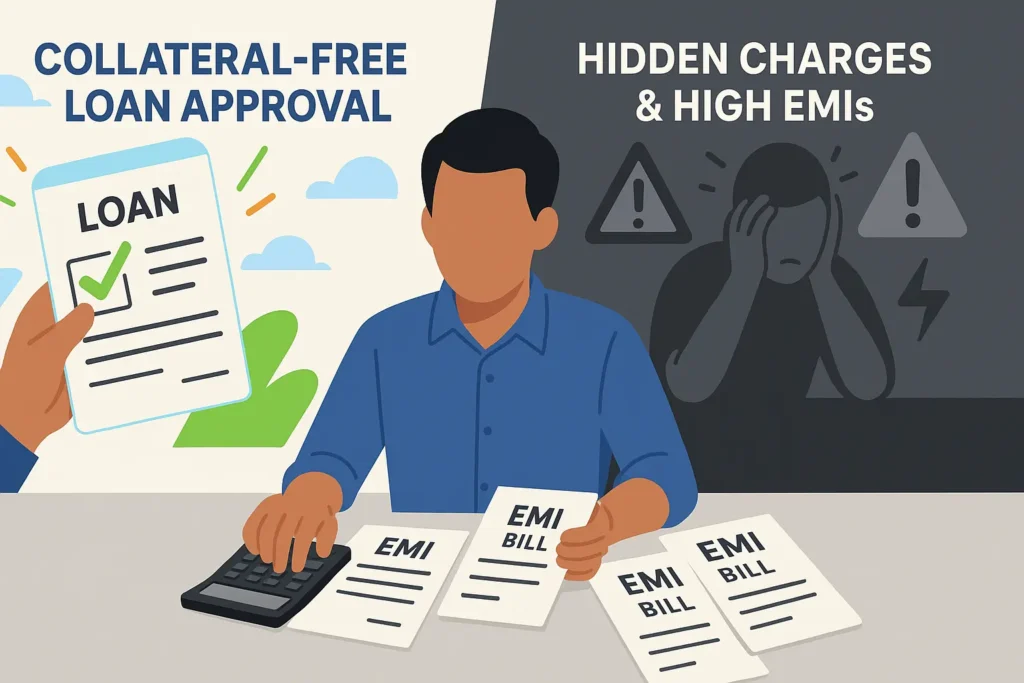
3.Collateral Free Loan has Hidden Charges: The Silent Profit Machine
Most founders sign without reading the fine print. That’s where lenders make their money:
- 2–3% processing fee
- Insurance add-ons
- Prepayment penalties
- Auto-debit charges
- Late fee + penal interest
One month of delayed EMI can wipe out your profit.
4.Collateral Free Loan tacitly need Personal Guarantees: The Hidden Collateral
Even though lenders call it “collateral free,” most still ask for personal guarantees.
Meaning:
YOU become the collateral.
If the business fails, the founder is personally liable.
Your personal credit score, savings, future loan eligibility — everything gets affected.
5.Collateral Free Loan has Aggressive Recovery Tactics (Especially NBFCs & Fintechs)
When you delay or default:
- Daily calls
- Calls to family members
- Threatening legal notices
- Public embarrassment
- Harassment
Many entrepreneurs face mental stress because of constant pressure.
6. Your Credit Score Takes the Hit
Every EMI is tracked by CIBIL / Experian / CRIF.
Even one late payment can cause:
- Score drop
- Difficulty getting home or car loan
- Higher interest in future
7. Collateral Free Loan can Pressure to Grow Too Fast
Short tenure + high EMI = founders rushing growth.
This causes:
- Poor decisions
- Quick scaling without foundation
- Stress and burnout
- Business decisions driven by loan pressure, not strategy
Collateral Free Loan and My Real Story: A Wake-Up Call I Didn’t Expect
I had taken collateral-free loans in the past for my small business in my early days.
Like many founders, I believed:
“No collateral = low risk. Quick funding = fast growth.”
But here’s what actually happened:
- My loan had a high interest rate, which I underestimated due to excitement.
- EMI pressure hit hard during months when payments/receivables were delayed (a very common scenario).
- Auto-debits bounced when my customers delayed payments, leading to penalties.
- Recovery teams began calling aggressively even though I had never defaulted earlier.
- My credit score dropped due to two late EMIs caused purely by cash flow timing.
That experience changed how I look at collateral-free loans forever.
It was a painful but powerful lesson:
Collateral free does NOT mean consequence free.
The borrower — not the business — takes the real risk.
Conclusion: Borrow… But Carefully
Collateral-free loans are not bad.
They are extremely useful when:
- Your business has predictable cash flow
- You’re confident about repayment timelines
- You have no asset to pledge
- You need quick short-term capital
But if you borrow without understanding the risks, they can quickly turn into a trap.
Always compare:
- Interest rate
- Total cost of loan
- Processing fees
- EMI impact
- Personal guarantee terms
- Recovery policies
Sometimes, it’s smarter to wait, bootstrap, or take smaller funding steps than to take a fast, expensive loan that controls your business.
FAQs
1. Are collateral-free business loans safe?
Yes, but only if taken from regulated banks/NBFCs and if you understand the terms clearly.
2. Why do unsecured loans have high interest rates?
Because lenders take more risk without security, so they charge more to compensate.
3. Can a collateral-free loan affect my CIBIL score?
Absolutely. Late EMIs or defaults impact personal and business credit scores.
4. Do all lenders ask for personal guarantees?
Most do — even though the loan is unsecured.
5. Can these loans lead to harassment?
If taken from unregulated fintechs or NBFCs, aggressive recovery tactics are common.
About the Author
Tabrez khan is an entrepreneur, exporter, and founder of BusinesZindagi.com a platform dedicated to MSMEs, small businesses, and startups. After facing real financial and operational challenges in his own entrepreneurial journey, he now writes practical, experience-based guides that help business owners avoid costly mistakes and grow with clarity.
Authentic Links & Resources
(Non-promotional, government-backed information sources)
- RBI Guidelines for MSME Loans
https://www.rbi.org.in/Scripts/BS_CircularIndexDisplay.aspx?Id=12177 - CGTMSE Scheme Details
https://www.cgtmse.in/ - SIDBI MSME Loan Schemes
https://www.sidbi.in/ - MSME Ministry Official Website
https://msme.gov.in/ - CIBIL Basics for Business Owners
https://www.cibil.com/msme
Disclaimer
The information in this article is for educational and awareness purposes only. It is based on general industry practices, publicly available data, and the author’s personal experience as an entrepreneur. This content should not be considered financial, legal, or professional loan advice.
Loan terms, interest rates, eligibility, and lender policies vary widely across banks, NBFCs, and fintech companies. Before applying for any collateral-free or secured business loan, readers are strongly advised to:
- Review the official terms and conditions of the lender,
- Consult a certified financial advisor if needed, and
- Carefully evaluate their own financial situation, cash flow, and repayment ability.
The author and Business Zindagi are not responsible for any financial decisions or consequences arising from the use of this information. Always borrow responsibly.