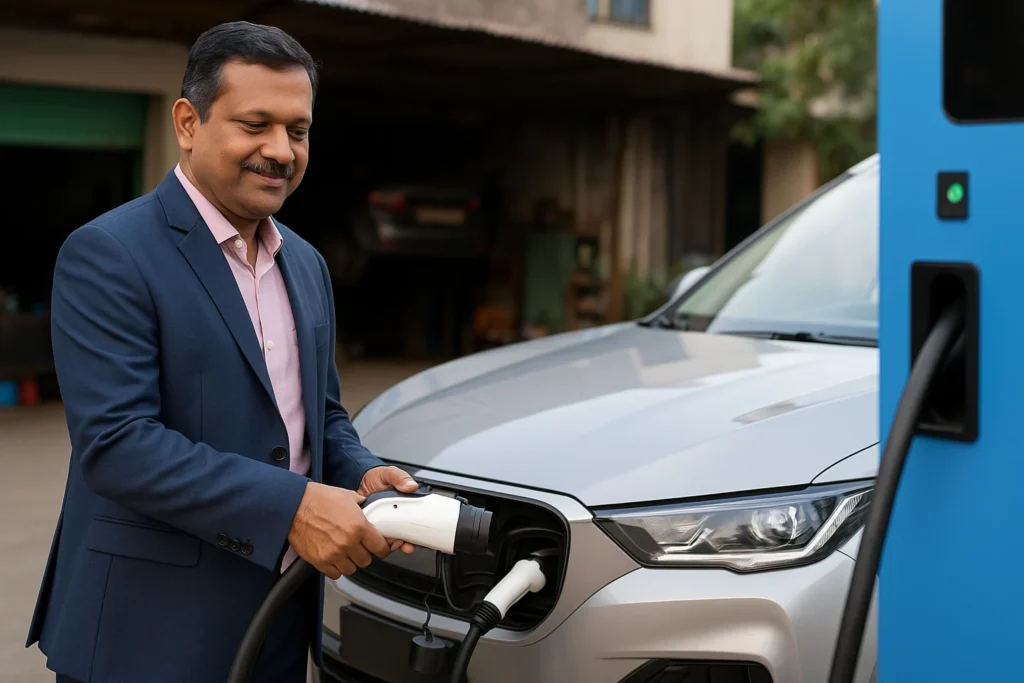
The world is moving from petrol pumps to power plugs — and India’s MSME sector stands right at the centre of this transition.
The government’s ambitious plan to install 1 million public EV charging stations by 2030 is not just a policy dream; it’s a multi-billion-rupee business wave waiting to be tapped.
For decades, MSMEs have powered India’s factories, logistics, and services. Now, they have a chance to power India’s electric future — literally.
This is the story of the EV charging business in India for MSMEs — the next green gold rush.
You may also like to read:Are India’s Electric Vehicle Charging Stations Enough? — Statewise Snapshot & What India Needs Next
The Market Opportunity: EV Charging stations Is the New Petrol Pump
- India is expected to have 1 crore (10 million) EVs on the road by 2030.
- To support that, India needs 1 charging station for every 15 vehicles, according to NITI Aayog.
- As of 2025, fewer than 20,000 public charging points exist — meaning a massive supply gap.
This gap is where entrepreneurs and MSMEs step in.
Setting up EV charging stations can be:
- A standalone business (direct charging model),
- An add-on business (existing shops, hotels, malls, or fuel pumps), or
- A franchise / partnership model with charging network operators like Tata Power EZ Charge, ChargeZone, Statiq, or BPCL.
💡 Key Insight: The EV charging ecosystem is not just about selling electricity — it’s about selling convenience, trust, and access.
You may also like to read: China’s WTO Complaint: Why It Could Be Good News for EV Battery Manufacturers in India
Investment & Profit Potential of ev charging stations
| Type of Charger | Typical Cost (₹) | Ideal For | Earning Potential / Month* |
|---|---|---|---|
| AC Slow Charger (7–22 kW) | ₹1–2 lakh | Apartments, shops, small stations | ₹15,000–₹25,000 |
| DC Fast Charger (25–60 kW) | ₹10–15 lakh | Highways, fleets, urban MSMEs | ₹70,000–₹1.5 lakh |
| Ultra-Fast (120 kW+) | ₹30 lakh+ | Fleet hubs, logistics MSMEs | ₹2–3 lakh+ |
Approximate, based on utilization and tariff margins.
MSMEs can earn through:
- Charging fees per kWh (₹15–₹25 range)
- Franchise revenue sharing (30–40% margins possible)
- Advertising / retail tie-ups (cross-selling at charging hubs)
- Battery swapping and service add-ons (extra revenue)
⚡ A small-town entrepreneur installing 4 slow chargers at ₹6 lakh total could break even within 2–3 years, depending on footfall and partnerships.
Business Models of ev charging stations MSMEs Can Adopt
- Franchise Partnership Model
Join existing CPOs (Charge Point Operators) like Tata Power, Statiq, or Jio-BP.- They provide hardware + backend software.
- You provide land, connectivity, and maintenance.
- Revenue is shared (usually 60–40 or 70–30).
- Independent MSME-Owned Model
Buy chargers directly, get government subsidy under FAME II or PM e-Drive, and run it independently.
You control pricing and partnerships. - Community Charging Hub
MSMEs in smaller towns can combine efforts — one provides land, another invests, another markets.
Great for co-operative or rural clusters. - Charging + Retail Model
Integrate a café, convenience shop, or local service station with the charger.
The real business lies in customer waiting time — monetize those minutes.
Government Support & Subsidies on ev charging stations
The Indian government actively supports the EV charging business through:
- FAME II Scheme — capital subsidy for setting up public charging stations.
- State EV Policies — many states (Maharashtra, Delhi, Gujarat, Tamil Nadu) offer additional subsidies, electricity tariff rebates, and property tax exemptions.
- Priority Sector Lending (PSL) — RBI has included EVs & charging infra under PSL; banks can offer easier loans for MSMEs in this sector.
- GST Reduction — EV chargers attract only 5% GST.
🏆 In short: easier financing, lower taxes, and faster approvals — everything MSMEs have been asking for.
MSMEs: The Backbone of India’s ev charging stations Ecosystem
MSMEs are perfectly positioned to lead this transition because:
- They already dominate India’s auto components, electrical, and fabrication industries.
- They have local networks and community trust.
- They are agile — can adapt faster than large corporates.
From local garage owners adding a small charging unit, to regional entrepreneurs building EV plazas — this is inclusive growth powered by green innovation.
“When India’s small businesses go electric, India’s mobility becomes unstoppable.” — BusinessZindagi
The Road Ahead: From MSMEs to Green Giants
By 2030, the EV charging market in India could be worth $20 billion.
Even if MSMEs capture just 25% of that value, it’s a ₹4-lakh-crore opportunity.
Beyond profit, MSMEs entering EV charging will also:
- Create local jobs (technicians, service staff, electricians)
- Promote clean energy awareness
- Strengthen energy independence in rural and semi-urban India
This is not just a business opportunity — it’s a chance to build the future.
Conclusion
The EV charging business in India for MSMEs isn’t a dream — it’s already happening.
From Delhi to Dindigul, from malls to mandis, small entrepreneurs are electrifying India’s roads one plug at a time.
If you’re an MSME owner looking for your next growth opportunity, this might be the plug that powers your future.
BusinessZindagi takeaway:
“When innovation meets local ambition, every small business can build a cleaner, richer tomorrow.”
🔗 Sources & References
- NITI Aayog – Handbook on EV Charging Infrastructure (2023)
- IEEFA Report – Upgrading India’s Public EV Charging Experience (2024)
- FAME II Scheme – Ministry of Heavy Industries
- Tata Power EZ Charge Franchise Model
- ChargeZone & Statiq Franchise Details | https://www.statiq.in/
- RBI Circular on Priority Sector Lending for EV Infrastructure (2023)