
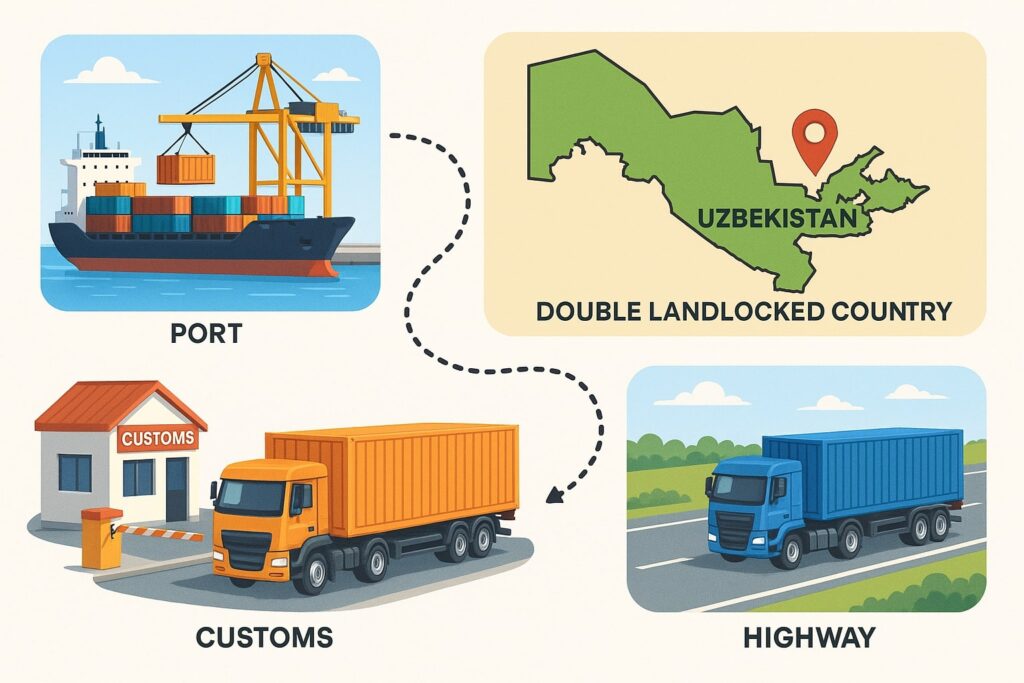
Exporting to landlocked countries is nothing like shipping to a coastal nation. Since these countries don’t have direct access to the sea, they depend on neighboring countries’ ports for global trade. This means extra steps, more documentation, and higher costs.
In this post, I’ll explain the challenges of exporting to landlocked countries, the ports they rely on, and share my personal experience exporting to Uzbekistan—a double landlocked country.
What is a Landlocked Country?
A landlocked country is a country that has no coastline and no direct access to a sea or ocean. Since most global trade happens through sea routes, these countries must depend on neighboring countries for port access.
Currently, there are 44 landlocked countries in the world. Some of the major ones include:
- Nepal – Uses Kolkata Port (India)
- Bhutan – Uses Kolkata Port (India)
- Afghanistan – Uses Karachi Port (Pakistan) and Chabahar Port (Iran)
- Ethiopia – Uses Djibouti Port (Djibouti)
- Bolivia – Uses Port of Arica (Chile) and Port of Ilo (Peru)
- Kazakhstan – Uses Port of Aktau (Caspian Sea) for regional trade and ports in Russia
- Mali – Uses Port of Dakar (Senegal)
- Zambia – Uses Durban Port (South Africa) and Dar es Salaam (Tanzania)
🌍 Landlocked Doesn’t Mean Impossible to Export
A country without a coastline is not automatically a difficult or unattractive export market.
Yes, landlocked countries depend on neighbouring countries, ports, roads and rail networks to move international cargo.
But many landlocked markets have developed strong trade corridors and regional transport connections.
The real question for an exporter is not simply:
“Does this country have a seaport?”
The more important question is:
“Can my product reach the buyer efficiently and profitably?”
A good export opportunity depends on several factors:
✔ Demand for your product
✔ Availability of reliable buyers
✔ Transport connectivity
✔ Transit routes
✔ Total logistics cost
✔ Import regulations
✔ Your final export profitability
Landlocked does not mean impossible. It means logistics planning becomes more important.
What is a Double Landlocked Country?
A double landlocked country is surrounded entirely by other landlocked countries, meaning goods must pass through at least two countries to reach a seaport.
There are only two double landlocked countries in the world:
- Uzbekistan (Central Asia)
- Liechtenstein (Europe)
My Experience Exporting to a Double Landlocked Country – Uzbekistan
Exporting to Uzbekistan was a real learning curve for me. It was my second export consignment overall and my first time exporting to a landlocked country. Honestly, I had no idea how it worked at first.
Thankfully, my importer was very cooperative and explained the steps. I also found a helpful freight forwarder and CHA who guided me through the process.
Here’s what happened:
- I exported black tea to a CIS country (Uzbekistan).
- Since Uzbekistan has no port, my goods were shipped to Bandar Abbas Port (Iran).
- From there, the importer’s agent handled customs clearance and moved the cargo by truck to Uzbekistan.
Challenges I Faced
- Very Long Transit Time
From Kolkata Port to Bandar Abbas took 30–35 days, plus extra delays in customs and transshipment. The full journey took around 45–50 days. - Transshipment Hassles
Multiple border crossings and customs checks caused delays. - Importer Frustration
My importer was sometimes upset with the slow delivery, which I couldn’t fully control. - Higher Costs
Multiple legs of transport mean more expenses compared to direct shipping.
Common Challenges When Exporting to Landlocked Countries
- Longer Delivery Times: Multiple borders and transshipments.
- Complex Documentation: Transit permits for each country en route.
- High Costs: Land freight is expensive, and so is handling at multiple points.
- Dependence on Neighboring Countries: Political or logistical issues can cause unexpected delays.
🚚 How Does Your Cargo Actually Reach a Landlocked Country?
Before accepting an export order, understand the complete journey your cargo will take.
In many cases, the shipment may follow a route like this:
Indian Exporter
↓
Indian Port or Land Border
↓
Transit Country or Foreign Port
↓
Road / Rail / Multimodal Transport
↓
Border Clearance
↓
Landlocked Country
↓
Final Buyer
🚢 Sea + Road
Your cargo travels by sea to a suitable foreign port and then continues by truck into the landlocked destination.
🚆 Sea + Rail
Cargo may travel by sea and then move through rail networks towards the destination country.
🚛 Direct Road Transport
For nearby countries and suitable trade routes, goods may move directly through land borders.
🔄 Multimodal Transport
Some shipments may use a combination of:
Sea + Rail + Road
💡 The Important Lesson
The best route is not always the shortest route on a map.
You need to consider:
✔ Cost
✔ Transit time
✔ Border procedures
✔ Reliability
✔ Cargo handling
✔ Risk of delays
Always understand the complete logistics journey before giving your buyer a final price.
💰 The Hidden Costs Many Exporters Forget
One of the biggest mistakes exporters make is calculating only:
Product Cost + Freight
When exporting to a landlocked country, the actual logistics chain may involve additional costs.
Depending on the route and commercial terms, these may include:
✔ Inland transport
✔ Transit-country charges
✔ Border handling
✔ Port handling
✔ Storage costs
✔ Documentation
✔ Additional cargo handling
✔ Insurance
✔ Delays and unexpected logistics expenses
⚠️ The Biggest Risk
A shipment may look profitable when you calculate the product price.
But after logistics and additional costs, your actual profit may be much lower.
💡 Before Quoting Your Buyer
Ask:
“Have I calculated the complete cost of delivering this product under my agreed terms?”
Never guess your export price.
Calculate your costs carefully before confirming the order.
Tips for Exporting to Landlocked Countries
- Work with Experienced Freight Forwarders & CHAs: They can handle the tricky paperwork.
- Maintain Clear Communication: Set realistic expectations with your importer.
- Learn Transit Rules: Every country on the route has its own regulations.
- Plan for Extra Time: Always allow a buffer. Delays are common.
2026 Update: Exporting to Landlocked Countries Is Becoming Easier
Global trade is becoming more efficient, even for landlocked countries. Governments and customs authorities are increasingly adopting digital customs systems, electronic documentation, and faster border clearance procedures to reduce delays and logistics costs.
For Indian exporters, this means that shipping goods to countries such as Nepal, Bhutan, Kazakhstan, Uzbekistan, and Mongolia is gradually becoming more streamlined through improved transit infrastructure and regional trade cooperation. Although transporting goods to landlocked destinations still involves additional customs formalities and inland transportation, digital trade facilitation measures are helping businesses save both time and money.
Major Landlocked Countries That Import Goods from India
India exports a wide range of products to several landlocked countries through road, rail, sea, and multimodal transport networks.
| Landlocked Country | Common Transit Route | Major Indian Exports |
|---|---|---|
| Nepal | Road & Rail | Tea, medicines, steel, FMCG products, textiles |
| Bhutan | Road | Cement, packaged foods, machinery, electrical goods |
| Kazakhstan | Sea + Rail via Iran and Central Asia | Tea, pharmaceuticals, chemicals, engineering products |
| Uzbekistan | Multimodal Transport | Tea, textiles, machinery, auto components |
| Mongolia | Via China or Russia | Tea, pharmaceuticals, industrial products |
| Afghanistan* | Through approved transit routes where available | Medicines, tea, food products |
Note: Transit routes may change depending on geopolitical conditions and international trade agreements.
🌏 Which Landlocked Markets Should Indian Exporters Watch?
Not every landlocked country will be the right market for your product.
Instead of choosing a country simply because it looks interesting, evaluate the actual business opportunity.
🇳🇵 Nearby Markets
Countries such as Nepal and Bhutan can be important markets for Indian businesses because of geographic proximity and established regional trade connections.
🌏 Central Asian Markets
Countries including:
- Kazakhstan
- Uzbekistan
- Kyrgyzstan
- Tajikistan
may offer opportunities depending on your product, buyer demand and available logistics routes.
🌍 African Landlocked Markets
Several African countries also depend heavily on regional transport corridors.
Potential markets should be evaluated based on:
✔ Product demand
✔ Active importers
✔ Competition
✔ Logistics cost
✔ Import requirements
✔ Payment risk
⚠️ Don’t Choose a Market Just From a Map
A country may look close geographically but still be expensive or difficult to serve.
Another country may be farther away but have better buyers and stronger trade demand.
Research the buyer and market before planning the shipment.
Find Verified Buyers with Volza
Looking for genuine importers in landlocked countries like Kazakhstan, Nepal, Uzbekistan, or Mongolia?
With Volza, you can access real import-export shipment data, identify active buyers, analyze competitors, and discover high-potential export markets to grow your business.
👉 Explore Volza free trail and start finding verified international buyers today
Biggest Challenges While Exporting to Landlocked Countries
Although exporting to landlocked countries offers excellent business opportunities, exporters should be aware of several practical challenges.
✅ Frequently Asked Questions (FAQ)
1. How many landlocked countries are there in the world?
There are 44 landlocked countries globally. They are spread across Africa, Asia, Europe, and South America.
2. Which are the two double landlocked countries in the world?
The two double landlocked countries are:
- Uzbekistan (Central Asia)
- Liechtenstein (Europe)
3. Which ports do landlocked countries use?
Landlocked countries rely on ports in neighboring coastal countries. For example:
- Nepal & Bhutan → Kolkata Port (India)
- Afghanistan → Karachi Port (Pakistan) and Chabahar Port (Iran)
- Ethiopia → Djibouti Port (Djibouti)
- Bolivia → Port of Arica (Chile) and Port of Ilo (Peru)
4. What is the biggest challenge when trading with landlocked countries?
The biggest challenge is long transit times and higher costs because goods must travel across multiple borders and through transshipment hubs.
5. How can I make exporting to landlocked countries easier?
Work with experienced freight forwarders and CHAs, understand the transit process, and maintain clear communication with your importer about timelines and costs.
6.which countries/country is a transit country.
A transit country is a country through which goods pass before reaching their final destination.
For example:
Exporter in India → Indian Port → Transit Country → Rail/Road Transport → Landlocked Country Importer
The transit country does not usually consume the goods. Instead, it provides the transport route needed for cargo to reach the importing country.
7.Which Incoterms are commonly used for landlocked exports?
Commonly used Incoterms include FCA (Free Carrier), CPT (Carriage Paid To), CIP (Carriage and Insurance Paid To), DAP (Delivered at Place), and DPU (Delivered at Place Unloaded), depending on the agreement between the buyer and seller.
📚 Suggested Articles
Continue your export journey with these helpful guides:
- How to Find International Buyers Without Visiting Trade Fairs
- How to find Genuine Buyer for Export in 2026: What Has Changed and What Never Will
- Best Free Import Export Databases
- Export to Russia from India: Complete Guide
- Insurance for msme: Critical Policies Small Businesses Can’t Afford to Ignore
- How to Export Tea from India: A Beginner’s Guide
🔗 Related BusinessZindagi Export Tools & Guides
📊 Export Profit & Cost Calculators
Calculate your export costs and estimated profitability before confirming an international order.
📦 Import Landed Cost Calculator
Understand how freight, duties and additional expenses can affect the final landed cost of imported goods.
🌍 More Import & Export Guides
Explore practical BusinessZindagi guides, tools and resources designed for Indian exporters and importers.
About the Author
About the Author:
Tabrez is the founder of BusinessZindagi.com and an entrepreneur from Assam. He shares practical insights on export-import, MSMEs, startups, government schemes, and business growth based on research and real-world experience.
AI Disclaimer
AI Disclosure:
This article was researched and edited with the assistance of AI and reviewed using reliable sources. Trade regulations may change, so always verify the latest information with official authorities before making business decisions.
Affiliate Disclosure
Affiliate Disclosure:
Some links on this page may be affiliate links. If you purchase through them, we may earn a small commission at no extra cost to you. This helps support BusinessZindagi.com and keeps our content free.
Trusted Sources
Official Sources & References:
- DGFT (India): https://www.dgft.gov.in/
- CBIC (Indian Customs): https://www.cbic.gov.in/
- Ministry of Commerce & Industry: https://commerce.gov.in/
- World Trade Organization (WTO): https://www.wto.org/
- International Chamber of Commerce (Incoterms®): https://iccwbo.org/business-solutions/incoterms-rules/