
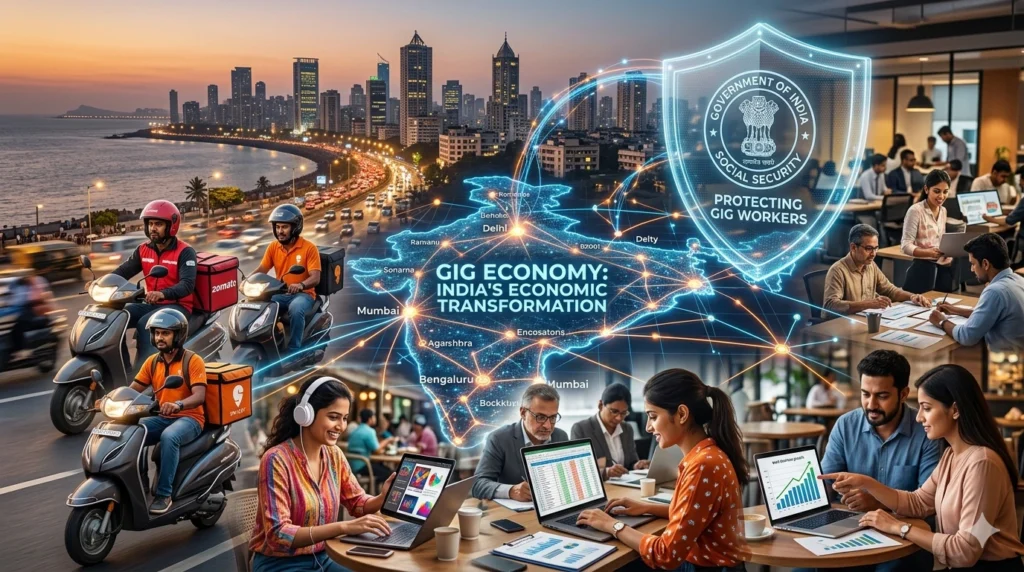
Imagine running a small business where you can hire a digital marketer for a product launch, a freelance accountant during tax season, a graphic designer for branding, and delivery personnel during festive demand spikes—all without adding permanent employees to your payroll.
This flexibility is exactly why millions of Indian businesses are increasingly relying on the gig economy.
However, 2026 could become a turning point for the sector.
The Indian government has started implementing a stronger social security framework for gig workers and platform workers under the Code on Social Security. While the primary objective is to improve worker welfare, the changes could also have significant implications for MSMEs, startups, online sellers, and small businesses that depend on flexible talent.
So, what exactly are the new gig worker social security rules? Will they increase business costs? Could they make it easier to access skilled talent? And what should MSMEs do now?
Let’s understand.
India’s Gig Economy Is Growing Faster Than Ever
A decade ago, gig work was largely associated with cab drivers and delivery partners.
Today, the picture is very different.
India’s gig economy includes:
- Freelance accountants
- Tax consultants
- Content writers
- Digital marketers
- Graphic designers
- Software developers
- Virtual assistants
- Delivery partners
- Ride-hailing drivers
- Customer support professionals
Industry estimates suggest India’s gig workforce could exceed 2 crore workers in the coming years, making it one of the world’s largest gig economies.
For MSMEs, this workforce offers a powerful advantage: access to specialized talent without the cost of maintaining large permanent teams.
related article:Blinkit Zomato December 31 Orders: India’sd 10-Minute Delivery Moment, Labour Reforms & Lessons for Businesses
What Are the New Gig Worker Social Security Rules?
The government is strengthening social security coverage for gig workers and platform workers through provisions under the Code on Social Security, 2020 and related implementation rules.
For the first time, gig workers are being formally recognized within India’s social security framework.
The objective is simple:
Provide workers with a safety net while building a more organized and sustainable gig economy.
Who Is Considered a Gig Worker?
A gig worker is a person who earns income through temporary, project-based, freelance, or platform-driven work instead of a traditional full-time employment arrangement.
Examples include:
- Food delivery riders
- Cab drivers
- Freelance accountants
- Content creators
- SEO consultants
- Digital marketing professionals
- Designers
- IT freelancers
Many professionals working remotely for MSMEs today fall under this broader category.
Key Social Security Benefits Being Introduced
Under the new framework, eligible gig workers may receive access to various welfare schemes.
These may include:
Accident Insurance
Coverage against accidents occurring during work-related activities.
Life and Disability Cover
Financial support for workers and their families in case of disability or death
.Health Benefits
Access to healthcare-related assistance and welfare programs.
Old-Age Protection
Future pension and retirement-related social security measures.
Maternity Benefits
Support for eligible female workers.
Skill Development Programs
Training initiatives designed to improve employability and earnings.
This represents one of the biggest changes in India’s labour ecosystem in recent years.
The Importance of e-Shram Registration
One of the most important aspects of the new framework is worker registration.
Gig workers are expected to register through the e-Shram portal.
Gig workers are expected to register through the e-Shram portal.
Registration generally requires:
- Aadhaar details
- Mobile number
- Occupation information
- Basic personal information
Without registration, workers may not be able to access future benefits under government welfare schemes.
The 90-Day Rule: Why Businesses Should Pay Attention
One of the most discussed provisions involves eligibility criteria.
Under recently notified rules, a worker may need to complete at least 90 days of work with an aggregator within a year to qualify for certain benefits.
In some cases involving multiple aggregators, a worker may need around 120 days of engagement.
For example:
A delivery rider working continuously with a food delivery platform for 90 days may become eligible for certain social security benefits.
This requirement aims to ensure that benefits reach active workers rather than occasional participants.
While the rule primarily affects workers and platforms, it reflects the government’s intention to create a more structured gig ecosystem.
Aggregator Contributions
A major feature of the social security framework is the creation of funding mechanisms.
Large digital platforms and aggregators may be required to contribute towards worker welfare funds.
The contribution may be:
- 1% to 2% of annual turnover, or
- Up to 5% of payments made to gig workers,
whichever amount is lower.
The funds are intended to finance social security and welfare schemes.
Although most MSMEs are not directly classified as aggregators, businesses that rely heavily on platform-based services should monitor future developments closely.
Why MSMEs Should Care About These Rules
Many small business owners assume these regulations concern only companies like food delivery apps and ride-hailing platforms.
That would be a mistake.
The new rules reveal a broader trend: India’s workforce is becoming more formalized.
Businesses hiring:
- Freelancers
- Consultants
- Contract professionals
- Remote workers
- Project-based specialists
should expect greater emphasis on documentation, compliance, transparency, and workforce management in the future.
Could Business Costs Increase?
This is perhaps the biggest question for MSME owners.
The answer is: potentially, yes.
As gig workers receive stronger protections, businesses may experience:
- Higher platform service charges
- Increased contractor rates
- Additional documentation requirements
- Improved compliance expectations
However, increased costs may also be offset by higher workforce stability and professionalism.
The Opportunity Side That MSMEs Should Not Ignore
While much attention is focused on compliance, the opportunities could be even bigger.
Access to Better Talent
Workers receiving social security protections may be more willing to choose gig work as a long-term career.
This could increase the availability of skilled professionals.
Better Worker Retention
Businesses may face fewer disruptions from worker turnover.
Greater Professionalism
A more regulated gig economy often leads to improved service quality and accountability.
Faster Scaling
MSMEs can continue using flexible talent while benefiting from a more organized workforce ecosystem.
Industries Likely to Benefit the Most
Several sectors stand to gain significantly.
E-Commerce
Online sellers frequently rely on:
- Delivery partners
- Product listing specialists
- Customer support freelancers
Digital Marketing
Businesses increasingly hire:
- SEO experts
- Content writers
- Social media managers
on a project basis.
Professional Services
Accounting, taxation, consulting, and legal firms often engage freelance specialists.
Technology Services
Software developers and IT consultants form a rapidly growing segment of the gig economy.
How Artificial Intelligence Is Creating New Gig Opportunities
The rise of AI is creating entirely new categories of gig work.
Examples include:
- AI data annotation
- AI model training
- Content quality review
- Prompt engineering
- Virtual assistance
For MSMEs, this means access to highly specialized expertise without investing in large in-house teams.
Businesses that combine AI tools with skilled gig workers could gain a significant competitive advantage in the coming years.
Practical Compliance Checklist for MSMEs
Even if you are not directly affected today, it is wise to prepare.
Maintain Written Contracts
Clearly define:
- Scope of work
- Deliverables
- Payment terms
- Confidentiality requirements
Keep Digital Payment Records
Maintain transparent records for all freelancer and contractor payments.
Track Regulatory Developments
Monitor updates from labour and employment authorities.
Verify Worker Details
Maintain basic documentation and identification records.
Use Trusted Platforms
Work through established freelance and service platforms whenever possible.
The Bigger Picture: The Future of Work in India
The introduction of social security for gig workers is about much more than labour regulations.
It signals a fundamental shift in how India views work itself.
The future workforce will likely be:
- More flexible
- More digital
- More remote
- More project-based
For MSMEs, this evolution creates enormous opportunities to access talent, reduce fixed costs, and scale faster than ever before.
Businesses that understand and adapt to this transformation early may gain a lasting competitive advantage.
Conclusion
India’s new gig worker social security rules mark an important milestone in the evolution of the country’s labour market.
While the regulations are primarily designed to improve worker welfare, they also carry significant implications for MSMEs and small businesses.
Some companies may face modest increases in workforce-related costs. However, they may also benefit from a more stable, skilled, and professional gig workforce.
Rather than viewing these changes as merely another compliance requirement, forward-looking business owners should see them as part of a broader transformation that is reshaping the future of work in India.
The businesses that prepare today may be the biggest winners tomorrow.
Frequently Asked Questions
What is a gig worker?
A gig worker is an individual who performs temporary, freelance, project-based, or platform-mediated work instead of traditional full-time employment.
What benefits may gig workers receive under the new rules?
Potential benefits include accident insurance, health coverage, life insurance, disability support, maternity benefits, skill development programs, and old-age protection.
What is the 90-day rule for gig workers?
A worker may need to complete at least 90 days of work with an aggregator within a year to become eligible for certain social security benefits.
Will these rules affect small businesses?
Indirectly, yes. Businesses that hire freelancers, consultants, and contract professionals may need to pay greater attention to documentation and compliance in the future.
What is e-Shram registration?
e-Shram is the government’s national database for unorganized, gig, and platform workers that may be used to facilitate access to welfare benefits.
Can MSMEs benefit from the growing gig economy?
Absolutely. Gig workers allow MSMEs to access specialized talent, reduce fixed costs, improve flexibility, and scale operations more efficiently.
Business Zindagi Editorial Team
The Business Zindagi Editorial Team specializes in entrepreneurship, MSMEs, startups, technology, workforce trends, renewable energy, finance, and emerging business opportunities. Our mission is to provide practical, well-researched, and actionable insights that help Indian entrepreneurs make smarter business decisions.
AI Disclaimer
This article was created with editorial assistance from artificial intelligence and reviewed by human editors. Information has been compiled from government publications, labour policy documents, industry reports, and credible news sources available at the time of writing.
Labour laws, social security regulations, and implementation guidelines may change over time. Readers should verify the latest official notifications and consult qualified legal, labour, tax, or compliance professionals before making business decisions based on this information.
This article is intended solely for educational and informational purposes and should not be considered legal, financial, tax, or professional advice.