
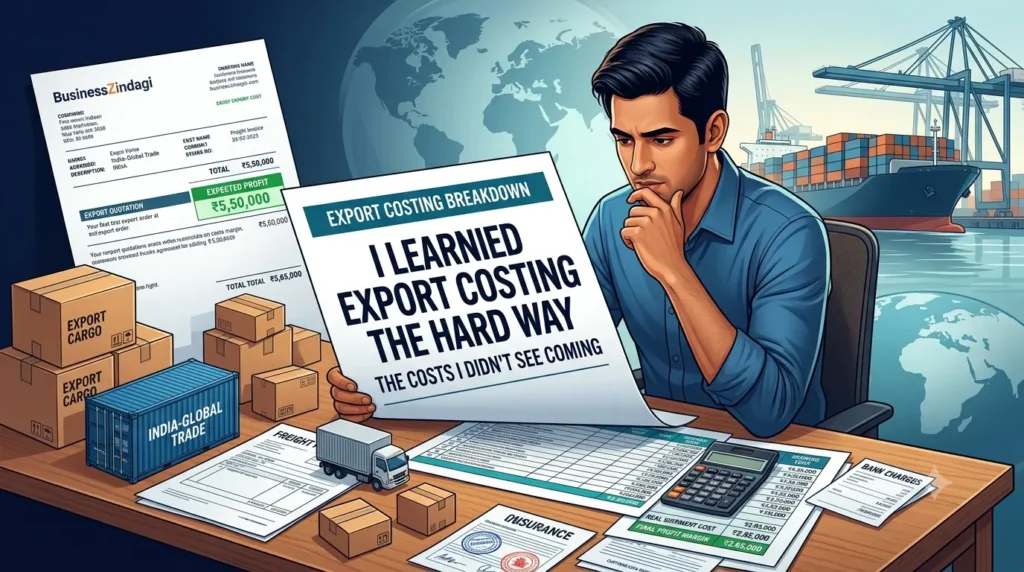
I thought an export order was always highly profitable.I thought I knew how much I could make from an export shipment. I didn’t. Then I started adding the real shipment costs.
When you are a first-time exporter, getting an export order can be exciting.
You look at the product cost, look at the price offered by the overseas buyer, do a quick calculation in your head and think:
“There is a good profit in this shipment.”
I have been there.
But one of the most important lessons I learned while trying to understand exporting was that the difference between an apparently profitable export order and a genuinely profitable shipment can be surprisingly large.
The reason is simple.
An export shipment involves much more than the cost of the product and the price charged to the buyer.
There are packaging costs, transportation, freight, insurance, CHA and customs-related expenses, documentation, banking costs and other charges that can gradually reduce the margin.
That experience is one of the reasons I decided to build the BusinessZindagi Export Profit Calculator & Shipment Cost Tracker
This article shares my personal learning while understanding export costing and building the BusinessZindagi Export Profit Calculator. I am sharing what I learned as a first-time exporter, including mistakes, overlooked costs and lessons that may help other small businesses.
Calculate your complete shipment cost
rather than repeatedly using “export profit calculator”.
Loading Export Profit Guard…
This article is not professional export, tax, legal or financial advice. It is my experience-sharing and an attempt to explain what I have learned while understanding the practical side of exporting.
My First Lesson: An Export Price Is Not Your Profit
One of the easiest mistakes for a new exporter is to think about export profitability like this:
Selling Price − Product Cost = Profit
It looks simple.
But an actual shipment can look more like this:
Export Revenue
↓
Product Cost
↓
Packaging
↓
Inland Transportation
↓
CHA / Customs-Related Charges
↓
Port & Documentation Expenses
↓
Freight
↓
Insurance
↓
Banking & Payment-Related Costs
↓
Other Shipment Expenses
↓
Actual Export Profit
This was one of the biggest lessons for me.
The price quoted on an export invoice is not automatically the money that the exporter will keep.
The Costs I Started Paying More Attention To
As I learned more about exporting, I realised that costing needs to be looked at as a complete shipment rather than as a simple buying-and-selling transaction.
1. Product Cost
This is the obvious starting point.
Whether you manufacture the product yourself or purchase it from another supplier, the cost of obtaining the goods needs to be included in your calculation.
But it is only the beginning.
2. Packaging
Export packaging can be different from ordinary domestic packaging.
Depending on the product and destination, the packaging needs to protect the goods during handling, transportation and international shipment.
That means packaging can become a real part of export costing rather than a minor expense.
3. Transportation
The goods have to move from somewhere to somewhere.
Factory to warehouse.
Warehouse to port.
Port-related movement.
Local transportation charges can add up, especially when the shipment involves multiple stages.
4. Freight
Freight can have a major effect on the profitability of an export order.
A quotation that looks attractive before freight is considered can look very different after the actual transportation cost is added.
This is why I believe exporters should test their numbers before committing to an order rather than simply assuming that the original margin will remain intact.
5. CHA and Customs-Related Expenses
This is another area I realised should not be ignored.
CHA and customs-related charges can form part of the actual cost of completing an export shipment.
That is also why I wanted the BusinessZindagi calculator to provide space for CHA costs rather than leaving exporters to remember them separately.
6. Documentation and Other Shipment Costs
Exporting involves documentation and compliance requirements.
The exact requirements depend on the product, transaction and destination.
DGFT’s guidance for MSME e-commerce exporters, for example, highlights the importance of checking the product’s ITC(HS) classification, export policy and applicable regulatory requirements before exporting.
That reminded me of another important lesson:
Export costing and export compliance cannot really be treated as completely separate subjects.
A mistake in understanding the product requirements can ultimately become a business cost.
7. Banking and Payment-Related Costs
International transactions can also involve banking and payment-related expenses.
And there is another risk that is sometimes forgotten by new exporters:
A profitable order is not necessarily a safe order.
The payment terms, buyer, documentation and method of receiving payment matter.
The RBI’s foreign-exchange framework also deals with the realisation of export proceeds, which shows why exporters need to pay attention not just to shipping the goods but also to completing the financial side of the transaction properly
.
The Moment I Realised I Needed a Calculator
After seeing how many different expenses can enter into an export shipment, I started thinking about something very practical:
Why not put all these costs in one place and calculate the expected result before accepting the order?
That was the idea behind the BusinessZindagi Export Profit Calculator.
I wanted something that was:
- Simple enough for a first-time exporter
- Useful for MSMEs
- Focused on the actual shipment
- Flexible enough to add different expenses
- Useful for comparing different export orders
- Easy to understand without needing complicated spreadsheets
So I started building it.
Try the BusinessZindagi Export Profit Calculator
If you are planning an export shipment, you can try the tool here:
Calculate Your Export Profit & Shipment Cost →
The basic idea is straightforward:
Enter your numbers → calculate the costs → estimate the profit → understand your margin.
It is not intended to replace professional accounting, customs, tax or financial advice.
It is simply a practical tool to help an exporter think through the numbers.
A Simple Example
Imagine an exporter expects an export revenue of:
₹10,00,000
At first glance, the order might appear very attractive.
But suppose the combined product and shipment-related costs come to:
₹7,25,000
The estimated profit would be:
₹10,00,000 − ₹7,25,000 = ₹2,75,000
The estimated profit margin on revenue would therefore be:
₹2,75,000 ÷ ₹10,00,000 × 100 = 27.5%
Now imagine that freight increases, packaging costs are higher than expected, or additional shipment expenses appear.
The final margin can change.
That is why I think scenario planning is just as important as the first calculation.
What I Would Do Differently Today
If I were approaching an export order again as a beginner, I would try to answer these questions before saying that the order is profitable:
1. What is my complete product cost?
Not just the obvious purchase price.
2. What will packaging cost?
Especially if the product requires export-specific packaging.
3. What will transportation cost?
From the point where the goods are ready until they reach the relevant shipping point.
4. What will freight cost?
And what happens if freight changes?
5. Have I included CHA and related expenses?
This is easy to forget when making a quick calculation.
6. What other documentation or shipment costs could arise?
The exact requirements vary by product and destination.
7. What are my banking and payment-related costs?
These should not be treated as completely separate from the commercial calculation.
8. What is my actual profit margin?
A ₹2 lakh profit sounds good until you understand how much capital and turnover were required to generate it.
9. What happens if one major cost increases?
This is the stress test that I think more exporters should perform.
10. Will I actually be paid safely and on time?
Profit on paper means little if payment problems turn the transaction into a headache.
The Export Business Is Bigger Than the Calculator
Building the calculator also made me realise something else.
Exporting isn’t just about calculating profit.
You need to understand the market.
You need to find buyers.
You need to understand the product’s export policy and regulatory requirements.
You need to understand logistics.
You need to understand payment terms.
You need to keep learning about DGFT rules, tariffs, trade agreements, documentation and export incentives.
The Government’s Export Promotion Mission is itself designed to address areas such as trade finance, quality compliance, branding, packaging, logistics and market access for exporters.
For MSMEs, this is particularly important because smaller businesses often have fewer people and fewer resources to manage all these areas.
The Ministry of MSME has also highlighted initiatives supporting first-time exporters, including capacity-building and assistance related to export certifications, insurance premiums and testing/quality certification.
Finding Buyers Is the Next Challenge
Once you know your numbers, another question naturally follows:
Who will buy my product?
Calculating a 20%, 30% or 40% potential margin doesn’t help much if you don’t know where the demand exists.
That is why I see the BusinessZindagi export tools as part of a larger journey:
Understand → Calculate → Research → Find Buyers → Export
If you are looking for ways to research overseas buyers and markets, you can also explore:
Find Foreign Buyers →
And if you want to research global trade data and potential buyers:
Find Global Buyers with Volza →
Affiliate/referral link may apply.
Profit Is Important — But Payment Risk Matters Too
Another lesson I have come to appreciate is that an export order isn’t successful simply because the mathematics looks good.
You also have to think about how and when you will receive the money.
Payment terms such as advance payment, Letter of Credit and open-account transactions can have very different risk profiles.
For anyone starting out, understanding these differences is important.
Understand Export Payment Risks →
The objective isn’t to become an expert overnight.
It is to know enough to ask the right questions before committing your money and goods.
I Know the Calculator Is Not Perfect Yet
I want to be transparent about something.
The BusinessZindagi Export Profit Calculator is an evolving project.
This is not a claim that I have built the perfect export-costing system.
Far from it.
I built the first version around the practical problems I encountered and the things I felt a small exporter should be able to calculate more easily.
But I have an ambition to make it much better.
One Feature I Really Wanted: Remembering the Mistakes I Made Earlier
There is another reason I wanted the BusinessZindagi Export Profit Calculator to become more than just a calculator.
When you are learning something for the first time, you don’t make only one mistake.
You make a mistake, understand it, promise yourself that you won’t repeat it — and then, a few months later, you can forget exactly what happened.
I have experienced this myself.
Sometimes the mistake isn’t that you don’t know something. The problem is that you forget what you learned from an earlier experience.
That made me think:
What if an export tool could help us remember our previous mistakes?
For example, perhaps an earlier shipment had an unexpected freight cost.
Or a documentation expense was higher than expected.
Or a particular charge was simply forgotten when the original costing was prepared.
Or the exchange rate moved against the shipment.
Or the final profit was lower than the original estimate.
Instead of treating every export order as a completely new calculation, I wanted the tool to eventually help an exporter look back and ask:
“What happened last time, and what should I remember before I quote this shipment?”
That is an important part of the direction in which I want to take the calculator.
From Calculator to Learning Tool
My long-term idea is not simply to build a calculator that gives you one number and then you close the page.
I want BusinessZindagi’s export tool to gradually become something that helps an exporter learn from previous shipments.
For example, an advanced version could help remind the user about things such as:
- A freight cost that was underestimated previously
- A CHA or documentation expense that was forgotten
- An unexpected shipment charge
- A payment-related cost
- An exchange-rate difference
- A margin that was lower than expected
- A mistake in the original quotation
- A cost that repeatedly gets overlooked
The purpose would not be to tell an exporter what decision to make.
The purpose would be much simpler:
Help you remember what you have already learned.
Why I Think This Matters for First-Time Exporters
Experienced exporters often develop their own checklists, spreadsheets, notebooks and systems.
A first-time exporter may not have any of these.
You are learning while doing.
That can be stressful.
You don’t want every shipment to become another lesson learned the expensive way.
If a tool can help you remember an earlier mistake before you make the same mistake again, I believe that can be genuinely useful.
My philosophy is simple:
Don’t just calculate the profit. Learn from the shipment.
That is one of the ideas I want to carry forward as I continue developing the BusinessZindagi Export Profit Calculator.
My Endeavour: A More Advanced Version Over Time
As I continue learning about exporting and understanding what exporters actually need, my endeavour is to bring more advanced versions of the calculator over time.
That could include more sophisticated costing scenarios, additional export expenses, better shipment comparisons, more detailed profitability analysis and other practical features.
I don’t want to add features simply to make the tool complicated.
My goal is the opposite:
Make a powerful export-costing tool that remains understandable to a small business owner.
The calculator will therefore continue to evolve.
And I would genuinely like to learn from exporters using it.
If there is a cost, feature or practical problem that you think should be included, that feedback can help shape future versions.
What I Wish Someone Had Told Me Before My First Export
If I could go back to the beginning, I would tell myself:
Don’t confuse revenue with profit.
Don’t calculate the shipment from only the product price.
Don’t ignore freight.
Don’t forget CHA and other shipment expenses.
Don’t underestimate documentation and compliance.
Don’t ignore payment risk.
Don’t assume the first calculation is the final calculation.
And perhaps most importantly:
Don’t be afraid of not knowing everything when you are starting.
Exporting has a learning curve.
You learn from documents.
You learn from conversations.
You learn from mistakes.
You learn from other exporters.
And sometimes you learn by building a tool because you couldn’t find something simple enough for your own needs.
That is how this calculator came about.
Find Buyers After You Calculate Your Costs
Know your target margin. Then research where your product is being imported and who the potential buyers are.
🔎 Explore Global Buyers with Volza →
Affiliate/referral link. BusinessZindagi may earn a commission at no extra cost to yo
My Journey Is Still Continuing
I am still learning.
BusinessZindagi is my attempt to turn that learning into something useful for other entrepreneurs, MSMEs and small businesses.
The Export Profit Calculator is one small part of that journey.
It started with a simple question:
“Is this export order actually profitable after I count everything?”
I hope the answer becomes easier for another first-time exporter to find.
Because an export order should not only look profitable on paper.
The numbers should make sense after the shipment costs are counted.
And that is the lesson that led me to build this calculator.
Calculate Your Export Profit
Before you quote your next international order, take a few minutes to work through the numbers.
Free Export Profit Calculator & Shipment Cost Tracker
About the Author
Tabrez Khan is the creator of BusinessZindagi, a platform focused on practical business information, MSMEs, entrepreneurship, exports and useful tools for small businesses.
Rather than presenting himself as a lifelong export expert, Tabrez uses BusinessZindagi to share his learning, practical experiences and the questions he encounters while understanding business and exporting.
The Export Profit Calculator was developed from this practical learning journey, with the aim of making export costing easier for first-time exporters and MSMEs.
Author’s Note
This article is an experience-sharing piece, based on my own learning and understanding of export costing.
I am not presenting myself as a customs broker, Chartered Accountant, lawyer, export consultant or financial adviser.
Export rules, taxes, customs requirements, foreign-exchange regulations, tariffs and government schemes can change. Always verify the current requirements with the relevant government authority, authorised professional or other qualified adviser before making a business decision.
Editorial & AI Disclaimer
Editorial Disclaimer: BusinessZindagi aims to provide practical and useful business information, but readers should independently verify important regulatory, financial, tax, customs and export-related information before acting on it.
AI Disclaimer: AI tools may be used during research, editing, formatting or content development on BusinessZindagi. However, AI-generated information is reviewed and edited before publication. AI assistance does not replace human judgement, official government sources or professional advice.
Affiliate Disclosure
Some BusinessZindagi articles and tools may contain affiliate or referral links. If you click such a link and subsequently purchase a product or service, BusinessZindagi may receive a commission or referral benefit at no additional cost to you.
Affiliate relationships do not determine our editorial conclusions or recommendations. Where applicable, affiliate relationships are disclosed clearly to readers.
Authentic Sources & References
For export rules and regulatory requirements, always verify the latest information from official sources:
- DGFT — Foreign Trade & Export Rules Official DGFT
- RBI — Export & Foreign Exchange Rules RBI Export Guidelines
- Ministry of Commerce — Export Policy & Initiatives Ministry of Commerce
- Ministry of MSME — MSME Support & Schemes Ministry of MSME
Government rules, export procedures, foreign-exchange requirements and applicable charges can change. Readers should verify the latest requirements before making an export or financial decision.
More Export Guides
- Find Foreign Buyers →
- Export Payment Risks →
- DGFT LIFT Scheme →
- DGFT EODC Guide →
- India–UK CETA Guide →
- Export Profit Calculator →