
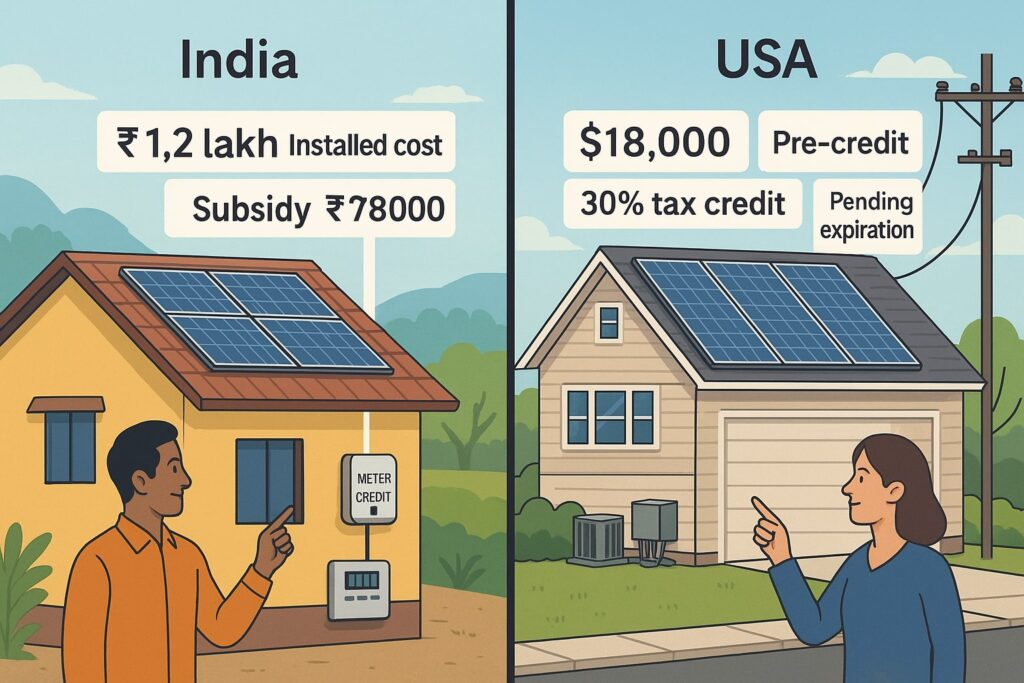
India’s clean-energy revolution is in full swing — and at the center of this momentum lies one powerful opportunity for entrepreneurs to start solar business in india
As electricity tariffs rise and industries continue shifting toward sustainable energy, solar panel systems have emerged as a high-demand, low-entry-barrier, future-proof business. And nowhere is this opportunity more exciting than in Assam and the Northeast, where government policy, sunlight availability, and rising consumption are creating a perfect market for new MSMEs.
If you’re an entrepreneur in the Northeast, this could be the best time to step into the solar panel business.
“India’s solar industry is also creating new opportunities for MSMEs, from rooftop installation and EPC services to maintenance, equipment distribution and battery storage. With MNRE continuing to update ALMM and solar-related requirements in 2026, businesses should understand both the technology and the latest compliance rules.”
Solar Business in India 2026: Latest MNRE & ALMM Updates
India’s solar market is moving beyond simply installing solar panels. For MSMEs and entrepreneurs, the growing solar ecosystem is creating opportunities in installation, EPC services, maintenance, distribution, rooftop solar, electrical services and energy storage.
At the same time, solar businesses need to keep up with changing MNRE rules and equipment eligibility requirements.
Latest MNRE Solar Updates in 2026
One of the most important developments is the continuing update of the Approved List of Models and Manufacturers (ALMM).
MNRE maintains:
- ALMM List-I for solar PV modules
- ALMM List-II for solar PV cells
MNRE’s official ALMM page currently lists an updated List-I dated 3 August 2026 and the 8th revision of List-II for solar PV cells dated 22 July 2026.
For applicable government, government-assisted, government-scheme, open-access and net-metering projects, the eligibility of solar modules under ALMM is an important compliance consideration.
What Does This Mean for a Solar Business in india?
If you are buying or supplying solar equipment, don’t select products only because they are cheaper.
Before purchasing panels for a project, check:
Manufacturer → Model → ALMM status → Project eligibility → Documentation
Always verify the latest information on the MNRE website because ALMM lists and related requirements can be updated.
MNRE has also issued a notice concerning ALMM List-II, stating that there is no blanket extension, while providing a limited window up to 31 December 2026 for commissioning certain net-metering and open-access renewable-energy projects.
Solar Business in india Opportunities for MSMEs
You don’t need to manufacture solar panels to enter India’s solar industry.
Some practical opportunities include:
1. Rooftop Solar Installation
Small businesses can provide site surveys, installation, electrical work, commissioning and maintenance for residential and commercial rooftop systems.
2. Solar EPC Services
An MSME can offer complete project services covering:
Site Survey → Design → Procurement → Installation → Testing → Commissioning
3. Solar Maintenance & AMC
Solar systems need ongoing maintenance. Businesses can offer panel cleaning, inverter checks, electrical inspections, fault detection and annual maintenance contracts.
This can create recurring revenue instead of depending only on new installations.
4. Solar Equipment Distribution
Entrepreneurs can specialise in supplying:
- Solar modules
- Inverters
- Mounting structures
- Solar cables
- Connectors
- Protection equipment
- Batteries and storage equipment
But reliable sourcing and after-sales service can be more valuable than competing only on price.
5. Solar + Battery Storage
Energy storage is another emerging opportunity as solar installations increasingly need solutions for backup power, energy management and better utilisation of renewable electricity.
Solar business in india:What About PM Surya Ghar?
The PM Surya Ghar: Muft Bijli Yojana is primarily a residential rooftop solar programme. It should not be confused with a general government subsidy for starting a solar company.
However, government-supported rooftop solar demand can create opportunities for eligible vendors, installers and service providers.
So the better business question is not:
“How can I get a solar subsidy to start my business?”
It is:
“Which customers and services are being created by India’s growing solar market?”
Should an MSME Start a Solar Business in india 2026?
It can be an attractive sector, but starting small may be wiser than immediately investing heavily in inventory or manufacturing.
A practical route could be:
Installation → Maintenance → EPC → Equipment Distribution → Storage/Specialised Services
Start with one customer segment—such as homes, shops, hotels, warehouses or small factories—and build expertise before expanding.
BusinessZindagi Tip
Don’t ask only:
“How much profit is there in selling solar panels?”
Ask:
“Which problem in the solar industry can my small business solve better than others?”
That could lead to a much stronger business model.
Official reference: MNRE — Approved List of Models and Manufacturers (ALMM)
Note: Solar rules, ALMM lists and project eligibility requirements can change. Always verify the latest MNRE notification and applicable DISCOM/state requirements before making a business or investment decision.
Why Solar business in india is Becoming a Huge Business Opportunity in India
Solar energy is no longer a niche — it’s becoming mainstream. India is targeting 500 GW of renewable energy capacity by 2030, and rooftop solar is a major part of this mission.
Here’s why the market is exploding:
1️⃣ Rooftop Solar Demand Is Rising Everywhere
Homes, shops, factories, schools, and hospitals are rapidly switching to solar panel systems to reduce electricity bills. Even small residential systems now offer stable savings and long-term returns.
2️⃣ Government Policies Are Pushing Solar Aggressively
From net-metering to production-linked incentives (PLI), India is encouraging both manufacturing and installation of solar systems.
3️⃣ Electricity Costs Are Increasing Every Year
For many commercial consumers, power tariffs range between ₹8–₹13 per unit. Solar helps drastically cut these expenses.
4️⃣ Solar Technology Has Become Cheaper & More Reliable
Higher efficiency panels, smarter inverters, and 20–25 year warranties make solar financially attractive.
This combination makes solar panel systems one of the fastest-growing MSME sectors in India.
Why Northeast India (Especially Assam) has huge scope for Solar Businesses
Assam is undergoing a major transition in its energy landscape. The Assam Solar Power Generation Promotion Policy 2025 aims to dramatically increase solar adoption across the state.
Here’s why MSMEs in Assam have a unique advantage:
1️⃣ State Policy Supports Rooftop Solar in a Big Way
Assam’s 2025 solar policy encourages:
- Rooftop solar installations
- Net-metering & net-billing
- Virtual/groupl solar for apartments
- Decentralized solar for rural areas
This makes it easier for customers to install solar systems — and easier for MSMEs to sell them.
2️⃣ APDCL Electricity Tariffs Make Solar More Attractive
With retail tariffs rising across several slabs, commercial and residential customers are actively seeking solar panel systems to reduce monthly bills.
For MSMEs, this means a ready market with high demand.
3️⃣ Low Competition but Fast-Growing Market
Compared to other states like Gujarat or Karnataka, the Northeast has:
- fewer solar installers
- fewer EPC companies
- fewer distributors
This means lower competition and bigger opportunity for new, quality-focused businesses.
In Guwahati and surrounding regions, customers often struggle to find reliable solar installers — creating a significant demand gap.
4️⃣ Ideal for Rural Entrepreneurship
Solar panel systems are perfect for entrepreneurs in towns like:
- North Guwahati
- Nalbari
- Mangaldoi
- Tezpur
- Jorhat
- Dibrugarh
- Silchar
Rural rooftops, farms, small workshops, and micro-industries are all potential customers.
Business Models MSMEs Can Start in Solar Panel Systems (Low Investment to High Growth)
✔️ 1. Solar Installation/EPC Business (Best for New Entrepreneurs)
Low investment, high demand.
Focus areas: rooftops for homes, shops, schools, small factories.
✔️ 2. Solar Distribution & Retail
Become an authorized seller of panels, inverters, or batteries.
✔️ 3. Solar AMC & Maintenance
Offer cleaning, repair, servicing — recurring revenue.
✔️ 4. Solar System Assembly (Moderate Investment)
Assemble rooftop solar kits locally.
✔️ 5. RESCO/OPEX Model (Advanced)
Install solar for customers at zero upfront cost and charge monthly.
Profitability of Solar Panel Systems Business (Realistic Estimates)
1️⃣ Residential Systems (2–5 kW)
- System cost: ₹40,000–₹80,000 per kW
- Your margin: 10–15%
- Earning per installation: ₹15,000–₹40,000
2️⃣ Commercial Systems (20–100 kW)
- System cost: ₹35,000–₹60,000 per kW
- Your margin: 8–12%
- Earning per project: ₹80,000 to ₹7 lakhs+
3️⃣ Annual Maintenance Contracts (AMC)
- Charge ₹2,000–₹6,000 per kW yearly
- Recurring income with high margins
4️⃣ Sustainability
Solar business is highly sustainable because:
- Every system needs maintenance
- Tariff rates keep rising
- Government regulations continue supporting solar growth
This ensures repeat business, referrals, and long-term growth.
Challenges To Consider (and How to Overcome Them)
⚠️ High competition in metro markets
Solution: Focus on under-served towns and rural areas of the Northeast.
⚠️ Customer trust issues
Solution: Provide warranties, after-sales service & quick installations.
⚠️ Fluctuating import prices for solar panels/inverters
Solution: Keep multiple suppliers—domestic and international.
You can build a highly profitable and future-proof MSME in the solar panel systems business.
This is the right time.
This is the right industry.
And Northeast India is the right market.
☀️ More Solar & Green Energy Guides
- Solar Panel Subsidy for MSMEs — Subsidies, incentives & financing options.
- Solar Financing Schemes for MSMEs — Loans and financing for business solar projects.
- Top MSME Startup Ideas — Solar installation and green-business opportunities.
- Carbon Credits for MSMEs — How green initiatives can create new opportunities.
- Lithium-Ion Battery Charger Guide — Batteries, storage and related technology.
Authentic Clickable Links & References
🔗 MNRE – Ministry of New and Renewable Energy
https://mnre.gov.in
🔗 Assam Solar Power Policy (APDCL/AEDA)
https://www.apdcl.org
🔗 National Rooftop Solar Portal
https://solarrooftop.gov.in
🔗 Government of India – Solar PLI Scheme Updates
https://pib.gov.in
About the Author
At businesszindagi.com we is dedicated to empowering Indian entrepreneurs, MSMEs, and first-generation business owners through practical, research-driven business insights. Our mission is simple — to help you start smarter, grow faster, and build a business that lasts.